
Most AI news gets reported as a horse race: which model scored what on which benchmark, who reclaimed the top spot this week. But the three announcements Google rolled out over the past few days make little sense in that frame.
Strikingly, none of them leads with performance numbers. The story each one tells is about who uses the thing, where, and for what.
Below, the facts of the three launches first — then what they reveal about Google's strategy, where that strategy is vulnerable, and what any of it means for how organizations should make decisions about AI.
First: Gemini gets wired into running a business
The first announcement is a set of Gemini features for small businesses, unveiled June 10 and rolling out globally this month (excluding the EEA and the UK).
The details are concrete. Business owners can now connect their Google Business Profile — the listing that appears in Search and Maps — directly to the Gemini app.
Ask "how did the shop do this month?" and it analyzes search impressions and phone calls.
It drafts replies to customer reviews in the business's own voice, updates opening hours and seasonal information, and a new "business notebook" proactively flags unanswered customer questions and incomplete listings. It will even suggest pricing based on local market data.
Google's framing leans on a familiar reality of small business life: the owner is "the CEO, the marketer, and customer service," and AI is pitched as "an extension of the team."
But notice the choice of audience. Every business with a Business Profile is already a Google customer — of Search, of Maps, of ads. Google isn't prospecting for new AI users; it is layering AI onto relationships it already owns.
Second: translation becomes meeting infrastructure
The second announcement is live voice translation powered by Gemini 3.5.
Two technical advances matter here. One: instead of waiting for a speaker to finish before translating — the walkie-talkie cadence of traditional interpretation — the system streams translated audio a few seconds behind the speaker, continuously. Two: it preserves the speaker's intonation, pauses, and pitch.
The effect is less "a machine voice reads the translation" and more "the same person, speaking another language."
The rollout tells you the strategy. The system auto-detects more than 70 languages. In Google Meet, supported translation jumps from five languages to over 2,000 language pairs.
The Translate app gets the feature worldwide on Android and iOS, including an earbud mode where only you hear the translation. Developers get an API.
In other words, this isn't shipping as a standalone "translation AI" — it ships embedded in meetings, calls, and face-to-face conversations that are already happening. (The generated audio carries SynthID watermarking, so it remains detectable as AI-generated.)
Third: NotebookLM takes responsibility for the deliverable
The third is an upgrade to NotebookLM, rolling out in stages from June 8 to AI Ultra subscribers and select Workspace accounts.
NotebookLM used to be a tool you talked to about your documents. With this update, every notebook gets a secure cloud execution environment: it can run code, analyze data, draw charts, and export finished work as PDF, Word, Excel, or PowerPoint — all in one place.
Start with a half-formed idea and it will go gather credible sources from the web on its own. Pull together data from several countries, analyze it, and hand back a report with charts — without the user ever switching tools.
Google's own evaluations claim a win rate above 65% against its previous system, and improvements of 70–80% on large-document analysis and web-research tasks. Vendor-graded homework deserves a discount, but the direction is unmistakable: Google has stopped selling smart answers and started selling finished work.
The common thread: the product isn't the model
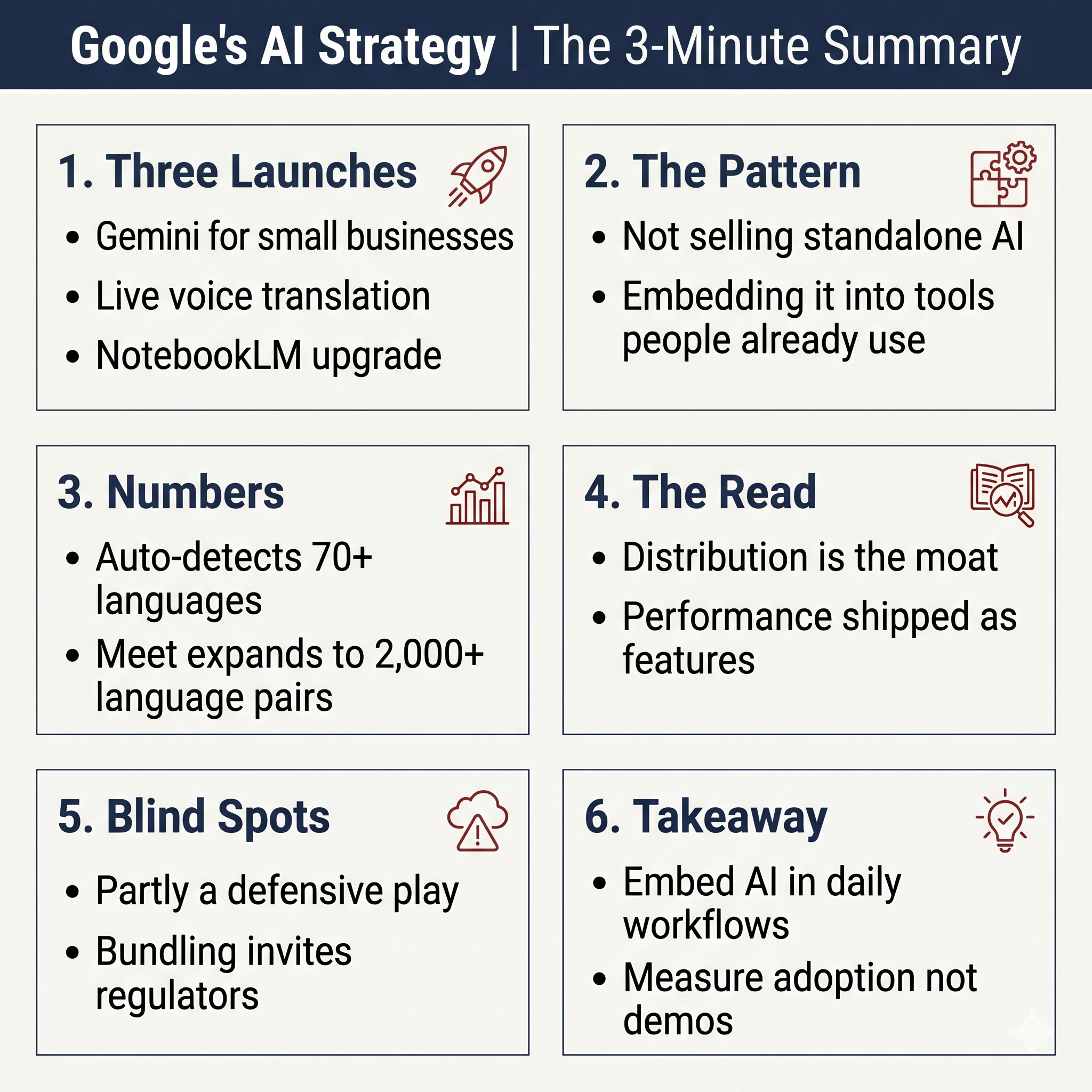
Line the three up and a pattern emerges. Google is not selling standalone AI products. It is embedding AI as a feature inside places people already are — running a storefront, sitting in a meeting, doing research.
Given Google's assets, this is the rational play. The company already owns the daily corridors of work and life — Search, Android, Workspace, Meet, Maps — that billions of people walk through every day.
Rather than persuading users to adopt a new AI app, it weaves AI into corridors they already use, so there is nothing new to learn. The less friction at adoption, the stickier the habit.
None of this means Google has quit the performance race. Voice-preserving simultaneous translation only works because Gemini 3.5 is good enough to make it work; the NotebookLM upgrade rests on model improvements underneath.
What's different is how the performance is presented: not flaunted as a benchmark score, but converted into usability before it ever reaches the public. Google isn't selling the engine — it's shipping the engine inside the car.
Where the strategy is exposed
Still, it would be premature to score this as an unstoppable offensive. At least three caveats apply.
First, this strategy is half defense. Google did not invent the chat-with-an-AI habit, and that new habit competes for the very foot traffic — starting with search — that Google's corridors depend on.
Much of this week's news reads as a campaign to make its own corridors maximally comfortable before the customers wander off.
Second, scale cuts both ways. Services used by billions are hard to redesign boldly; unencumbered startups can ship more radical products. And for the past several years, it has mostly been the unencumbered side that rewrote the industry's usage habits.
Third, regulators. Bundling AI into dominant existing services sits squarely on terrain competition authorities have patrolled for decades. The more effective the embedding, the more friction of this kind it will generate.
What this means for management
Finally, the practical takeaway.
AI adoption discussions usually begin with "which model is smartest?" Google's strategy embodies a different bet: what determines whether AI sticks is not intelligence but placement.
The better opening question for any organization is: which of the corridors our people already walk every day — the standing meeting, the status report, the support queue, the research task — could absorb AI so naturally that nobody has to learn anything? That question gets you to results faster than studying leaderboards.
The same logic applies to vendor selection: weigh how smoothly a product connects to the tools your organization already uses, ahead of one-off performance. Measure success not by the demo's wow factor but by next month's usage rate.
And one caution for the buying side: embedding into an ecosystem trades convenience for dependence. Bundled convenience is expensive to unbundle.
While the benchmark announcements continue next door, the real contest is shifting to a different question — not how smart the model is, but where it gets used. These three announcements are best read as field reports from that shifting ground.