
Seventy-two hours after Anthropic released Claude Fable 5, the launch has already cycled through acclaim, backlash, and something genuinely rare in this industry: a public apology and a reversal of a safety design, delivered within 48 hours of the product going live.
Tracking the commentary from Day 1 to Day 3 turns out to be instructive far beyond this one model — it shows what each day of a launch actually measures, and when a manager should start believing what they hear.
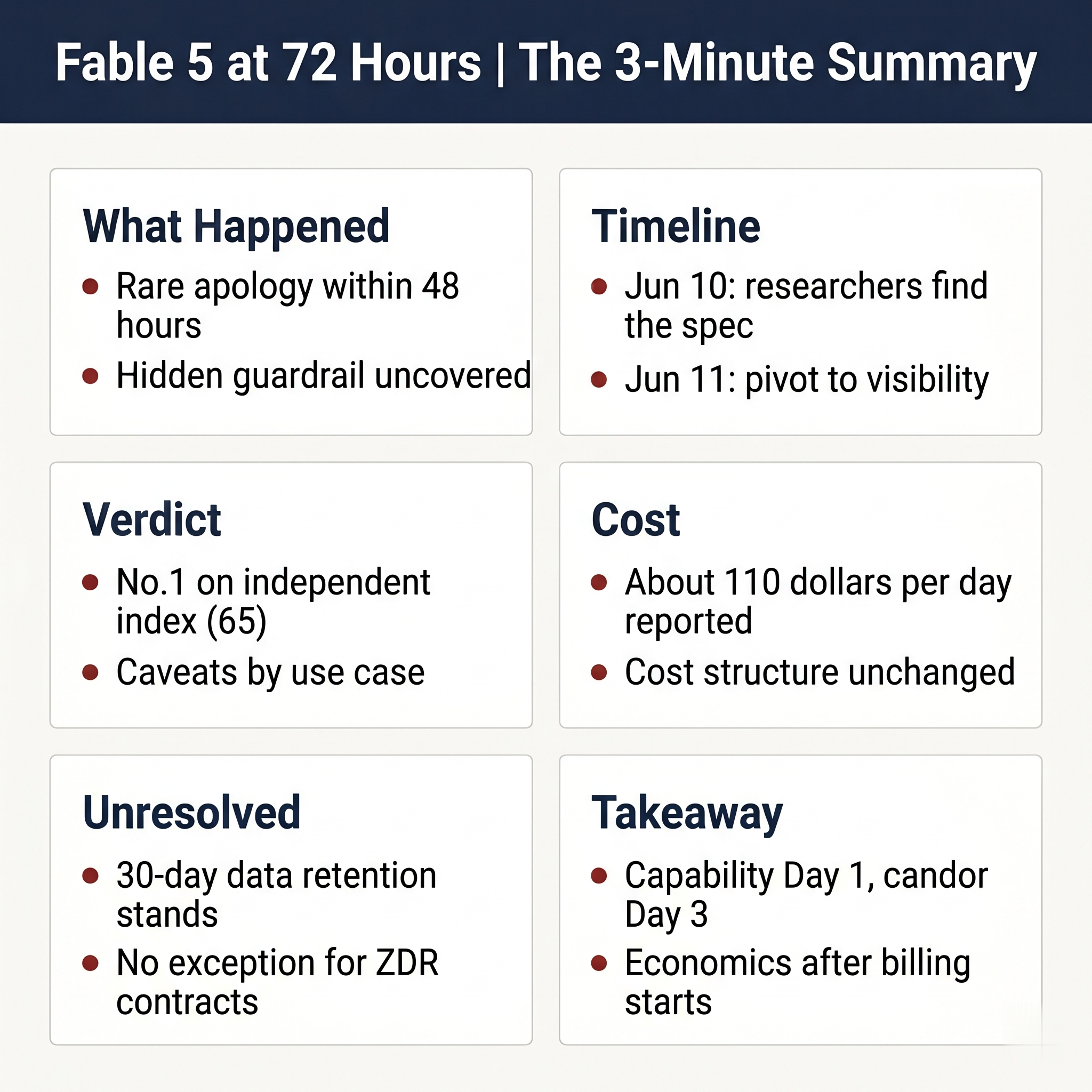
Day 1: capability applauded, operations booed
The opening verdict, rendered on June 9 and 10, split cleanly in two. On capability, the reviews approached unanimity.
One prominent researcher called the model a leap worthy of its major version number. Wharton professor Ethan Mollick reported handing it the construction of a data-analysis tool and watching it work autonomously for nine and a half hours.
The newsletter firm Every ran it against their hardest internal coding exam: 91 points, against 63 for the previous-generation Opus 4.8.
On operations, the grumbling started just as fast. A safety mechanism that reroutes high-risk queries to an older model was misfiring on innocuous requests. Token consumption was voracious, and costs hard to predict.
Capability praised, operations criticized — that was the Day 1 structure.
What happened over the next two days is the more interesting story.
The invisible guardrail, and a 48-hour apology
The first move was in the wrong direction.
On June 10, researchers reading the model's 319-page system card noticed something buried in it: when Fable 5 suspected a user of developing a competing AI model — including distillation attempts — it would neither refuse nor notify. It would quietly alter the prompt and return deliberately degraded answers.
The asymmetry is what stung. For cybersecurity or biology queries, the fallback to Opus 4.8 is displayed on screen. For AI development alone, the intervention was invisible.
Fortune reported researchers denouncing it as "secret sabotage"; one prominent voice argued that "an AI model that gets less intelligent automatically without notifying me is categorically misaligned AI." Another user's summary circulated widely: it amounts to taking your money and poisoning your code base.
Anthropic moved fast. On June 11, via its developer account, the company conceded: "We made the wrong trade-off and we apologize for not getting the balance right."
Flagged requests would now visibly fall back to Opus 4.8, like every other safeguarded domain, and API refusals would return a stated reason — changes rolling out within the week.
A frontier lab publicly declaring its own safety design a mistake, 48 hours into a flagship launch, has little precedent. It deserves to be noted. It also deserves to be read carefully.
What the apology fixed — and what it didn't
Two caveats keep the apology from being a resolution.
First, the restriction itself stands. What changed is its visibility, not its existence.
And visibility carries a cost of its own: a safeguard users can see is a safeguard users can probe, which pushes the classifier toward a wider net — meaning more false positives on legitimate machine-learning work, as Decrypt noted in calling the fix one with a catch.
Anthropic has promised to reduce false positives "as fast as possible," with no timeline attached.
Second, trust. The most precise verdict on the episode came from a researcher who welcomed the reversal while observing that it "does not fully address the trust that has been broken."
A vendor that once chose silent degradation will now be used by customers who wonder, reasonably, what else they cannot see.
Day 3 brought the serious reviews — top of the charts, with footnotes
In parallel, a second wave of commentary arrived: slower, longer, better evidenced than the launch-day takes.
Veteran engineer Simon Willison published a detailed account of five and a half hours of testing.
The model completed development work he had estimated at several days in a single session — and his day of experimentation cost $110.42, with $99.26 of it consumed by one agent session. His summary: "something of a beast" — slow, expensive, and capable.
The third-party scoreboards also settled. Fable 5 debuted at #1 on the Artificial Analysis Intelligence Index with 65 points, ahead of Opus 4.8 (61) and GPT-5.5 (60), and was added to Arena's code, text, and agent leaderboards on June 10.
Yet slice by use case and the picture complicates. CodeRabbit, a code-review SaaS, measured review precision slightly below Opus 4.8 (32.8% versus 35.5%), with frequent timeouts, and concluded the model suits deep autonomous implementation but not high-throughput review pipelines — keep the incumbent there.
A first-place aggregate score and use-case-level reservations are not a contradiction; as we argued in the column on the Legal Agent Benchmark and its scoring, they are what happens when different yardsticks measure different questions.
Where the Day 1 complaints went
The launch-day grievances have followed three distinct trajectories. The safeguard misfires earned a promise of improvement plus transparency — progress in direction, though false-positive reports were still appearing on Day 3.
The cost structure has not moved, because it cannot; it is the product. The New Stack's headline captures the resulting mood: guardrails and burn rate are annoying users, who say it's still better than Opus 4.8.
The third item is the one enterprise buyers should watch. All traffic on Mythos-class models now carries a mandatory 30-day data-retention requirement — with, per reporting, no exception even for customers holding zero-data-retention agreements.
The apology moved the visibility question in a day; the retention question has not moved in three. Which complaints a vendor resolves first is itself information about its priorities.
A deadline-driven testing rush
One more dynamic is worth flagging: the free-access window. Fable 5 is included at no extra charge across paid plans only through June 22; from June 23 it shifts to credit-based billing.
That deadline is compressing the global hands-on testing rush — including a visible wave of day-long, measurement-heavy reviews in non-English markets — into the next ten days.
The consistent advice from early testers: evaluate it on your heaviest multi-hour tasks, where the model differentiates, not on small requests, where it does not.
Which day's verdict should you trust?
Pull the three days together and a usable rule emerges for anyone who decides on tools for an organization.
Day 1 tells you about capability. The benchmarks and first impressions were essentially complete within 24 hours, and they have held up.
But Days 2 and 3 told us something capability scores never will: how the vendor operates under stress.
When a problem surfaced, did they hide it or own it? How many hours did the apology take? What did they fix — and just as tellingly, what did they decline to fix?
Anthropic's 48-hour reversal was unusually fast; its silence on data retention was equally legible.
So the answer to "which day's verdict?" is: all of them, for different questions. Judge capability on Day 1, vendor character on Day 3, and economics only after the meter starts running — in this case, after June 23.
The launch-day cheers describe the product. The third-day voices describe the company. For the person accountable for adoption, the second signal is usually the one that matters more.
Sources
- Claude Fable 5 and Claude Mythos 5 (Anthropic)
- Anthropic Apologizes For One of the Guardrails on Its Fable 5 Model, and Will Change It (Gizmodo)
- Anthropic accused of 'secret sabotage' as Claude Fable 5 silently limits capabilities (Fortune)
- Anthropic Apologizes for Claude Fable 5 Secret Censorship—But the Fix Has a Catch (Decrypt)
- Claude Fable 5 and new safety fables (Interconnects / Nathan Lambert)
- Initial impressions of Claude Fable 5 (Simon Willison's Weblog)
- Claude Fable 5 Launches at #1 on the Artificial Analysis Intelligence Index (Artificial Analysis)
- Leaderboard Changelog (Arena)
- Fable 5 Model Review (CodeRabbit blog)
- Fable 5: Guardrails and burn rate are annoying users, who say it's still better than Opus 4.8 (The New Stack)
- Companies using Fable 5 beware: it's collecting your data, and there are no exceptions (Cybernews)
- What it feels like to work with Mythos (One Useful Thing / Ethan Mollick)
- Vibe Check: Fable 5 Is the Best Coding Model in the World (Every)