A tool that now finishes the job
On June 9, 2026, Anthropic released a new top-tier model, "Claude Mythos 5," and its sibling, "Fable 5." (This column uses the publicly documented Fable 5 as its reference point.)
A new tier, the "Mythos class," now sits above the name "Opus." The fact looks modest, but it captures where the year arrived. A year ago, each lab's flagship sat at the top of the conventional pile — "Opus," "o3," "2.5 Pro."
Today, a rung above that top rung is permanently installed.
The destination, in a sentence: writing, researching, summarizing, writing and fixing code, building tables, reading through long documents — the kinds of desk work that once took a person hours, the latest generation now carries all the way to the end. This is not a bold forecast. It is already happening, in your own hands.
A caveat is in order. This is not the arrival of AGI. Specialized judgment, scholarly originality, artistic leaps — the territory only humans can enter remains wide. If anything, as AI takes over the "everyday cognitive labor," the outline of what is left to humans has grown sharper.
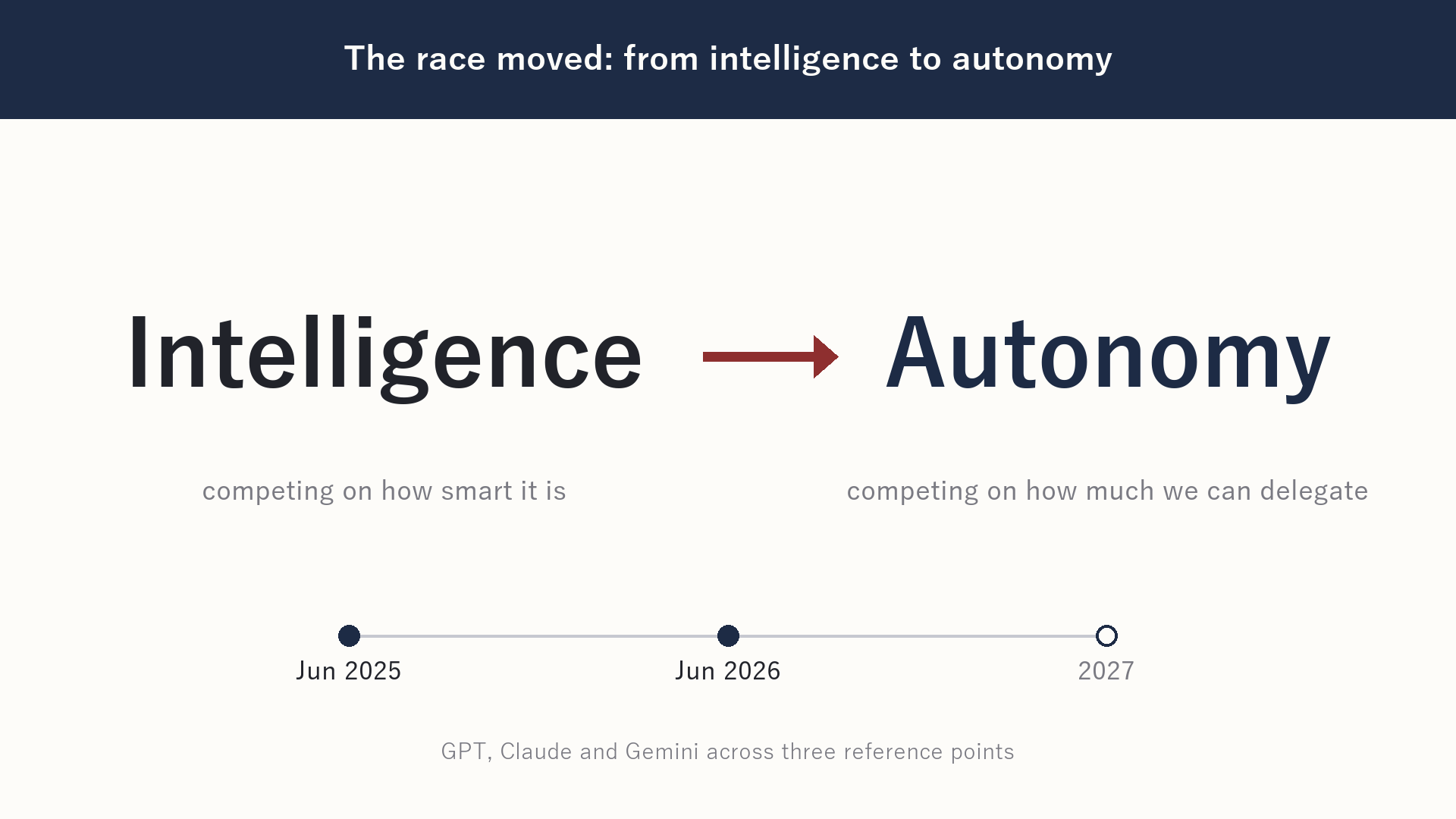
So this column measures three lineages — GPT, Claude, Gemini — at three fixed points.
End of June 2025 — the map exactly one year ago.
June 14, 2026 — this very moment.
June 2027 — how far we will have gone a year from now.
A note on the figures. The 2026 benchmark numbers in this piece were, in many cases, difficult to retrieve from the labs' official pages and were cross-checked against secondary sources. Each number carries its measurement conditions (with or without reasoning, parallel compute, tool use) and is attributed to its source.
June 2025: smart, but not yet able to finish on its own
Spread out the map of a year ago. The reference date is June 30, 2025. The three top models stood like this.
OpenAI placed the reasoning-tuned o3-pro (shipped June 10, 2025) at the summit, with GPT-4.1 carrying the general-purpose load. Anthropic had Claude Opus 4 (May 22, 2025). Google had Gemini 2.5 Pro (generally available June 17, 2025).
All were the leading edge of their day. And yet — to today's eye — they were "smart, but not yet able to finish on their own."
The ceiling on coding was around 72%
The indicator that best captured that "not-yet-finishing" was SWE-bench Verified, which hands the model real GitHub issues. You give it an actual software bug, have it write a patch, and check whether the tests pass. The ceiling then looked like this.
SWE-bench Verified: a set of bug-fix tasks from real GitHub repositories (a human-verified subset of about 500 problems). The AI writes a patch and is scored on whether the tests pass. A measure of practical coding ability.
| Model | Score | Condition |
|---|---|---|
| Claude Opus 4 | 72.5% | standard (79.4% high-cmp) |
| OpenAI o3 | 69.1% | no-scaffold |
| Gemini 2.5 Pro | 63.8% | Google's figure |
| GPT-4.1 | 54.6% | non-reasoning model |
| (ref.) GPT-4o | 33.2% | prior generation |
Anthropic pitched Opus 4 as "the world's best coding model," and it did sit at the top of SWE-bench. But even that champion scored 72.5% under standard conditions. It solved roughly seven of ten problems and dropped three.
What does that mean? That you could not yet hand production code to it without human supervision. A 30% miss rate becomes an incident when there is no human reviewing. So the AI of that era was a "smart consultant," not a "colleague you could hand the work to and walk away."
Reasoning and math looked dazzling — but only "depending on tools and thinking"
In math (AIME 2025) and graduate-level science (GPQA Diamond), OpenAI's o-series and Gemini 2.5 Pro ran out front. On AIME 2025, o4-mini scored 92.7% (no tools), o3 88.9%, Gemini 2.5 Pro 86.7%. On GPQA Diamond, Gemini 2.5 Pro 84.0%, o3 83.3%.
AIME 2025: the American Invitational Mathematics Examination (2025 edition), a hard U.S. high-school contest whose integer-answer problems test advanced mathematical reasoning.
GPQA Diamond: Graduate-level Google-Proof Q&A. Graduate-to-expert-level questions in biology, physics and chemistry; Diamond is the hardest subset. Designed so that search cannot solve it, it measures specialist knowledge and reasoning.
What is easy to miss is the swing in Claude Opus 4's numbers. On AIME 2025 it scored 33.9% without thinking and 75.5% with extended thinking switched on. The same model, more than doubling depending on whether it was given time to think. On GPQA Diamond it moved from 74.9% to 79.6%.
Already, then, the question "how smart is the AI" could not be separated from "under what conditions did you run it." Listing the numbers without the conditions had stopped being honest.
In fact, the researcher Nathan Lambert took issue with how Claude 4's benchmarks were presented (the way the high-compute figures were displayed). Numbers move a great deal with "conditions" — and both writers and readers were beginning to be held to that awareness.
On human preference (LMArena Elo), Gemini 2.5 Pro stood alone at the top. On its March 2025 debut it jumped in with what was called the largest-ever leap of about 40 Elo, and it held the seat through June 2025.
LMArena Elo: humans compare two models' answers blind and vote for the winner, ranked on a chess-style Elo rating. It measures the answers humans find "good" (preference).
On long context, GPT-4.1 and Gemini offered one million tokens (eight times GPT-4o's 128K), while Claude offered 200K. On cost, OpenAI cut o3's price by 80% on June 10, 2025, signaling that "smart models are getting cheap," and Gemini 2.5 Pro's "roughly one-eighth the price of o3" drew its own headlines.
The agents had "all arrived — but were still previews"
And here is the most important point. Around this time, the "autonomous agents" that would later take the lead were just finishing their entrance. OpenAI's Operator (January 2025), Deep Research (February 3, 2025), Codex (expanded to ChatGPT Plus in June 2025). Anthropic's Claude Code (research preview in February 2025).
But every one of them was still a preview. The shift from "AI you talk to" to "AI that acts on its own" had only just begun. The starting gun had fired; no one was yet running in earnest.
So the AI of late June 2025 can be summed up like this. Thinking, it was smart enough. But the power to finish on its own, and the trust to hand work over safely, were both still short. The destination one year later is the story of filling exactly those two gaps — "the power to finish" and "the trust to hand off."
The year just past: from "AI that thinks" to "AI that finishes"
So what changed? If you draw one thick line through the year, it runs from "AI that thinks" to "AI that finishes." The race for intelligence continued, but the main battlefield moved from "how smart" to "how completely it gets to the end."
Coding — from 72.5% to the 95% class. Past the human bar
Coding rose the most dramatically. Place SWE-bench Verified a year ago next to today, and the size of the leap is obvious.
| Lab | 2025-06 (ceiling) | Now (2026-06) |
|---|---|---|
| Anthropic | 72.5% (Opus 4) | ~95% class (Fable 5) |
| OpenAI | 69.1% (o3) | 82.6% (GPT-5.5) |
| 63.8% (2.5 Pro) | 80.6% (Gemini 3.1 Pro) |
What is decisive here is that one "wall" was cleared. On SWE-bench Verified, 80% is the line Anthropic's internal engineering evaluations have treated as "the level of a human candidate." The first to break it was Claude Opus 4.5 (80.9%) on November 24, 2025.
And the speed after that is the astonishing part. Less than a year after clearing 80%, the field reached the 90s. Opus 4.7 (April 2026, 87.6%), Opus 4.8 (May 2026, 88.6%), and on June 9, 2026, Fable 5 at roughly the 95% class on aggregator figures.
Consider what "80% to 95%" means. In the 72.5% era, human review was mandatory because one in three was dropped. At the 95% class, only one in twenty is dropped.
This is a qualitatively different world. Work you handed over "on the assumption you would check all of it" can now be handed over "on the assumption you check it occasionally." The cost of supervision falls by an order of magnitude.
AI changed from "smart consultant" to "an operating unit you can actually hand the work to" — and the turning point sits right inside those numbers.
The shift shows up in the economics, too. As of May 2026, Anthropic reported that over 80% of the code merged into its own codebase was written by Claude — "over 90% counting scripts and experimental code."
Shipped code per engineer was roughly eight times the 2024 figure — though the company honestly corrected, in an internal study, that "true productivity gains are overstated; the median is about four times." That double number — "eight times, but four times in felt experience" — is a fine example of describing progress without inflating it.
Agents going autonomous — from running alongside to standing in
Alongside the rising numbers — arguably more fundamental than them — was agents going autonomous. The tools that were "previews" a year ago now run for hours, even 24 hours, on their own under human supervision.
OpenAI's Codex tells this story most eloquently. The November 2025 GPT-5.1-Codex-Max handled project-scale work spanning multiple context windows, and an internal case completed a 24-hour continuous task was reported. SWE-bench Verified 77.9% (extra-high reasoning).
Into 2026 came a desktop app (Win/Mac, over a million users before launch) and Codex Security, which finds and fixes vulnerabilities (around 800 critical and over 10,000 high-severity issues detected across major projects). Weekly active users passed two million. A complement became the operating backbone of development.
Anthropic's Claude Code advanced autonomy from a different angle: subagents (child sessions with context independent of the parent, launched in parallel); deterministic "hooks" that execute 100% of the time (solving the problem that advisory instructions only land "about 80% of the time" by enforcing them); Auto Mode (March 2026), which raises autonomy a notch; and Goal Mode (GA in May 2026), which sustains hours-long sessions.
Longitudinal data shows the "auto-approve rate" — leaving execution to the agent without human sign-off — rising with usage (about 20% under 50 uses, over 40% at 750). Claude Code is no longer a CLI helper; it has reached the level of "an operating system for autonomous software engineers."
Google's Antigravity arrived on November 18, 2025, with "agent-first" on its banner: a Manager View to oversee multiple agents across a fleet; a design where agents touch browsers and terminals directly to plan, execute and verify on their own; and, rather than raw tool calls, verifiable Artifacts — task lists, implementation plans, screenshots, browser recordings.
At I/O in May 2026 it expanded to 2.0 across desktop, CLI, SDK and a managed service, turning from an IDE into a development platform.
The shared shift is plain. The tool changed from "a companion that helps you write code" to "a stand-in that plans, executes and verifies the work itself." That is what "AI that finishes" actually is.
Reasoning benchmarks saturate — the "yardstick of intelligence" reaches the end of its life
Ironically, something else happened too. The reasoning benchmarks that once "proved the frontier" now sit pinned against the ceiling, across the board.
AIME 2025 (contest math) reached 100% — a perfect score (no tools) with OpenAI's GPT-5.2 (December 2025). An indicator that was "o3 at 88.9%" a year ago hit full marks and gave out all the signal it had.
GPQA Diamond (graduate science) clustered the three labs in the low 90s — Anthropic 93.6%, OpenAI 92.4%, Google 94.3%. Abstract reasoning's ARC-AGI-2 reached the 90s band, too.
This is welcome progress and a deep implication at once. The instruments that measure "how smart" are finishing their job. A test where everyone scores full marks can no longer tell anyone apart.
So the world of evaluation has begun shifting its weight from static Q&A to "how much of a long, autonomous task can it complete." Terminal-Bench, which has models actually compile and stand up servers inside a terminal (under 65% even for frontier models), and METR's "time horizon," discussed below, lead the way. The saturation of intelligence forced a change in the axis of measurement itself.
Context — from 200K to one and two million tokens
Finally, a quiet change that is doing real work: the length of context a model can handle. A window of 200K to one million tokens a year ago has widened to one to two million. Claude went from 200K to one million; Gemini advertises two million.
This matters because long context is a precondition for "AI that finishes." A whole codebase, a stack of long contracts, hours of conversation history — without holding them all in view at once, you cannot run a long task to the end on your own.
Expanding context was not a spec race for its own sake. It enlarged the vessel an agent needs to "hold a big job all the way through."
To sum up the year: intelligence (reasoning benchmarks) saturated; the battlefield moved to coding and autonomous agents; tools went from running alongside to standing in; and the vessel grew longer. The "power to finish" that was missing a year ago has largely been filled. What remains is "the trust to hand off." That becomes the theme of the next year.
Toward June 2027: progress that gets "harder to see in the numbers"
So, the year ahead. What does the map of June 2027 look like? From here we leave fact and enter forecast. For that reason we name who said what, set optimism beside skepticism, and only then give the editorial desk's read.
What the labs are saying — executives who have begun to say "AGI"
The labs' executives are now making pointed statements.
OpenAI published the most concrete roadmap. On October 28, 2025, Sam Altman set internal targets of "an automated AI research intern by September 2026" and "a true automated AI researcher by March 2028." Chief scientist Jakub Pachocki says current models can already handle "tasks with a roughly five-hour time horizon."
At the same time Altman says, "Users are not asking for more IQ. They want speed, experience, integration," showing a pivot from pure intelligence toward experience and memory.
Anthropic's Dario Amodei is bolder. "Powerful AI is one to two years out, perhaps sooner" — perhaps even 2026. He describes AI "smarter than a Nobel laureate across most relevant fields" as "a country of geniuses in a data center."
On coding: "In late 2025 Claude's code was worse than a human's; now it is roughly on par. I expect it to clearly surpass humans within the year" (May 2026). And his longest-range claim: "The recursive self-improvement loop, where the current generation of AI autonomously builds the next, has already begun."
Google DeepMind's Demis Hassabis pulled his AGI window forward, from the earlier "2030–2035" to "2029 or 2030." "We are standing at the foot of the singularity." "AGI will bring about ten times the impact of the Industrial Revolution, ten times as fast." The main reason he gives for the shortening is, of all things, the rapid progress of agents.
Three labs saying in unison that "the next major paradigm is agents" — the agreement is worth heeding.
But executives' statements are also advertisements for their own products. They cannot be taken at face value. So it is worth looking at a cooler, measured yardstick.
The METR time horizon — the most trustworthy yardstick
The most-cited measured indicator in the forecasting world is the "time horizon" measured by the non-profit research body METR. It measures "the length of task an AI can complete at a 50% success rate." Intuitively: "how long you can leave it to the AI and walk away."
By METR's latest measurement (published January 29, 2026), this task length is growing at a pace that doubles roughly every four months (the doubling time since 2024 is 88.6 days). By model: Claude Opus 4.5 at a 50% horizon of 320 minutes, GPT-5 at 214, o3 at 121. The year-ago Opus 4 was 101 minutes — clear growth here, too.
Extrapolating this measured trend — in a forecast AI Digest calls "a new Moore's Law for AI agents" — the model runs a "one business day (8 hours)" task on its own in 2027, "one business week (40 hours)" in 2028, and "one business month" in 2029.
So by about June of next year, "hand off a full day's work and receive the result in the evening" starts to feel real.
Caution is still due. METR itself notes that "the confidence interval is still very wide" and "the trend is sensitive to task composition." The measurement is fact; the extrapolation is forecast. There is no guarantee the doubling pace continues.
Tectonic shift in architecture — what rose up "outside" the LLM
To speak of "the year ahead," looking only at LLM improvement misses half the picture. Outside the LLM, a separate line of foundations has begun to rise. Three movements are worth noting.
First, the World Model. This is an AI that does not "predict text" but "simulates reality."
Google DeepMind advanced from Genie 3 (August 2025, generating a real-time, navigable world) to Project Genie (January 2026), and at I/O 2026 Sundar Pichai declared that "with world models, AI moves from text prediction to simulating reality" (Gemini Omni). Fei-Fei Li's World Labs has already shipped a commercial product, "Marble" (November 2025), that generates persistent 3D environments.
These are not concepts; the real things are out. The world model has risen.
Second, the LTM (Large Tabular Model). Where an LLM handles words, an LTM is a foundation model that handles "tables (structured data)." It claims to understand not "the next word" but "the relationships between data points," doing demand, price and churn forecasting deterministically and auditably.
In February 2026, Fundamental raised $255 million to launch "NEXUS," signing seven-figure-dollar deals with the Fortune 100. Mastercard is training its own LTM on billions of transactions.
Corporate decision-making — a domain where LLMs have struggled with hallucination — is being targeted by a separate line of models. This, too, has risen.
Third, continual learning. This is "the next main keep," but it remains homework.
Richard Sutton (2024 Turing Award), the father of reinforcement learning, calls LLMs "a sophisticated dead end" and argues that the next leap is not static training but "agents that keep learning from experience" (the Era of Experience). Yet he himself admits that "continual learning that keeps learning without catastrophic forgetting has not yet been achieved."
Where the world model and the LTM "have risen," continual learning remains "the next main keep" — and that temperature gap is the topography of early 2026.
Don't forget the skeptics — "2027 may be slower than we think"
Presenting both sides is this column's habit. For every bullish forecast there is an equally weighty skeptic.
Daniel Kokotajlo, who wrote the aggressive "AI 2027" scenario, himself conceded in early 2026 that "things are running somewhat slower than the AI 2027 scenario," putting his AGI median at "around 2030."
The research community is harsher still. In an AAAI survey, 76% of AI researchers answered that "scaling up current models alone is unlikely to reach AGI." Epoch AI notes that "compute scaling will slow as data-center build lead times stretch to four or five years."
The economist Daron Acemoglu (2024 Nobel laureate in economics) estimates AI's lift to U.S. GDP over the next decade at a far more modest "about 1.1%, roughly 0.05% in annual productivity."
And there are shadows on the ground of agent adoption. Gartner predicts "40% of enterprise apps will feature task-specific AI agents by 2026," while also predicting that "over 40% of agentic AI projects are at risk of cancellation by 2027."
Adoption expands fast, but dropouts are many in adoption, ROI and governance. Overheating and disillusionment advance together.
The editorial desk's read — from "smart" to "can you hand it off"
On all of this, the editorial desk offers its read. Three points.
First, next year's progress gets "harder to see in the numbers." Reasoning benchmarks have saturated, and the room for new numerical gains has thinned. What grows instead is "the range you can hand off" — a hard-to-quantify quality.
The kind of clean, steep curve the year produced as SWE-bench ran from 72% to 95% will likely not be seen next year. But that is not because progress stopped. The site of progress moved from benchmark numbers to "how many hours you can hand off in practice." METR's time horizon is precisely that new yardstick.
Second, the next axis of competition is not "smart" but "can you trust it enough to hand off." The top models are already smart enough. They take full marks in math and sit pinned in the low 90s in graduate science.
The difference is made from here on — in how well a model grounds in fact and makes its output verifiable. Antigravity designed to emit "verifiable Artifacts" rather than raw tool calls; the LTM selling "auditable predictions"; Claude Code enforcing organizational rules with deterministic hooks — all are expressions of a contest over not "smart" but "the grounding and verification that let you hand off."
The second gap named at the top of this piece — "the trust to hand off," missing a year ago — now becomes the front-and-center subject.
Third, overheating and disillusionment advance together. Agent adoption expands fast, and the market swells (McKinsey estimates $2.6–4.4 trillion a year in value creation). But at the same time, as Gartner warns, no small number of underprepared projects will founder.
Next year is a year in which "AI is amazing" headlines and "an AI project failed" headlines run side by side. Both are true.
The wise organization reads this two-sidedness coolly — neither swept up by the overheating nor cowed by the disillusionment — and steadily widens, in its own setting, the "range it can hand off."
What kind of work does the human do now?
When a tool finishes the job this thoroughly, how does human work change? At the end, this question deserves a straight answer. Because this is not a story about technology; it is a story about us.
Work moves to the "making" side
The first change is that the human role moves from "doing the work" to "making the thing that does the work."
If AI writes code, researches and summarizes, what remains for the human is the work of designing "how to build that AI and how to run it." It is no accident that Anthropic's Claude Code became a tool for "assembling agents" with hooks and subagents, and Google's Antigravity became a platform for "designing custom subagent workflows."
The knowledge worker of the future builds agents that work in their stead, and prepares the high-quality data foundation to feed them — moving, in effect, from "the person who works" to "the person who designs how the work gets done."
The rise of the LTM is telling here. For an LTM to deliver value, the quality of a company's "tabular data" is what gets tested. The better the AI becomes, the more the quality of the data you feed it — and the human judgment that designs it — decides the outcome.
The more capable the tool, the scarcer the design skill of the person using it — and we will be the ones to take on that paradox.
Value gathers around "judgment, taste and responsibility"
Second, human value concentrates in three abilities that cannot be fully delegated to AI: judgment, taste and responsibility.
Judgment — what to build, which option to take. AI can lay out the options and show the grounds. But deciding "we go with this" among conflicting values can only be done by a subject who bears responsibility.
Taste — which outcome is "good." The sense of beauty, fitness and dignity that lies beyond "the code runs" and "the prose is correct" cannot be measured by a full-marks benchmark.
Responsibility — bearing the result. AI cannot be held responsible. Carrying the weight of a decision is always the human's.
In the language of economics, this is a migration of scarcity. The cheaper and more abundant AI becomes, the higher the relative scarcity of the judgment, taste and responsibility that cannot be delegated to it.
Once, "processing fast and accurately" was the value. Now that this has become a commodity, value shifts to "being able to decide what ought to be done." This is not a threat. It is a process by which human work is distilled toward its more human core — so the editorial desk believes.
What you may let go of, and what you must not
Here is a line to draw. You may let go of labor. But you must not let go of "thinking and deciding," nor of "meaning."
Tedious work, repetitive processing, mechanical fact-finding — letting these go to AI is liberation, not loss. As we handed calculation to the calculator, we can let go of much labor with a clear conscience.
But two things must stay in hand.
One is "thinking and deciding." Why do this, which path to take. The moment you hand this wholesale to AI, you let go of the controls of your own life.
The other is "meaning" — will, relationships, and the "why." What you want to do, for whom, and what it means. AI can stand in for the "how," but the "why" is territory the human should keep holding.
In closing — what is it you want to see through?
A year ago, AI was a tool that was "smart, but could not finish on its own." Now it is a tool that "carries the job to the end." And next year, it will likely become a tool you "can hand a full day's work to."
But here, let us stop and think. That a tool now "finishes" means that the work of deciding "what to finish" remains, at last, the human's exclusive province.
However smart and however autonomous AI becomes, the one who answers "what do I want to accomplish" is you.
Precisely because this is an age in which tools "finish," the question is worth asking again.
——What is it you want to see through?
For those who hold an answer, the year's progress becomes the finest tailwind there is.
Selected references
The map a year ago (2025-06-30) - Introducing OpenAI o3 and o4-mini (OpenAI) / GPT-4.1 (OpenAI) - Introducing Claude 4 (Anthropic) / Claude Opus 4 (MindStudio) - Gemini 2.5 Pro (DataCamp) / Gemini 2.5 Pro Model Card - o3 price cut report (VentureBeat) / o3 truthfulness (Transluce)
The year of progress - OpenAI: GPT-5 (Wikipedia) / GPT-5.5 (Wikipedia) / GPT-5 benchmarks (Vellum) / GPT-5.1-Codex-Max 24-hour task (VentureBeat) / Codex (Wikipedia) / ChatGPT agent (OpenAI) - Anthropic: Claude Opus 4.5 (DataCamp) / Claude Opus 4.7 (Anthropic) / Claude Opus 4.8 (Vellum) / Claude Fable 5 / Mythos 5 (Anthropic) / SWE-bench Verified leaderboard (llm-stats) / Claude Code and Autonomous Software Engineering (catalaize) - Google: Gemini 3 (blog.google) / Gemini 3 benchmarks (Vellum) / Gemini 3.1 Pro benchmarks (smartchunks) / Introducing Google Antigravity / Antigravity 2.0 at I/O 2026 (TechCrunch) - Code share & productivity: Anthropic Economic Index (2026-01) / Claude writes over 90% of its code (the-decoder)
The forecast for the year ahead - OpenAI roadmap: Automated AI researcher by 2028 (TechCrunch) / OpenAI's 2026 vision (The Neuron) - Anthropic: The Adolescence of Technology (Amodei) / Recursive self-improvement (Anthropic) - Google DeepMind: Hassabis AGI forecast (Axios) / Sundar Pichai I/O 2026 (blog.google) - METR time horizon: METR Time Horizon 1.1 / Moore's Law for AI agents (AI Digest) - Skeptics & economics: AI 2027 is slower than expected (OfficeChai) / 76% of researchers skeptical of scaling (eWeek) / Acemoglu vs Goldman (AEI) / Gartner: 40% cancellation risk / 40% adoption - Architecture: Fundamental $255M / LTM (AWS) / Citi Ventures: LTMs / Genie 3 (DeepMind) / World Labs Marble (TechCrunch) / Richard Sutton: LLMs are a dead end (Dwarkesh)
Note: the 2026 benchmark figures in this piece were cross-checked against secondary sources (Vellum / llm-stats / VentureBeat / TechCrunch, etc.) because of retrieval constraints on the labs' official pages. As values move with measurement conditions (with or without reasoning, parallel compute, tool use), assertions are avoided and figures are attributed to their sources. Gemini 3.5 Pro was announced in May 2026 and, as of early June, had not shipped (no independent verification).