The draft appears in an instant. The trouble starts after that.
You copy the text out of the chat window, paste it into another app, check the facts, fix the tone, and type yet another instruction back into the chat. Before you know it, as much time has passed as when you wrote the whole thing from scratch.
This particular brand of disappointment is something we hear again and again in the field.
- The proposal draft takes seconds, yet verifying the names and numbers eats the same time it always did.
- Three plausible options arrive at once, and the work of judging which one is correct has actually grown.
- You copy the AI's text into a document, type the corrections back in, and the round-trips across windows never stop.
- Each department uses it differently, with everyone rewriting near-identical prompts from scratch.
None of this is a story about AI not being smart enough. It is smart, and yet somehow the work as a whole never speeds up.
That gap usually gets explained away with "your prompts are weak" or "you haven't rethought your workflow." But the real reason hides one layer below where those explanations can reach.
The very shape of how we use AI is not built for an explosion in productivity.
The Task Is Fast. The Work Is Not
Start with the fact that AI is not ineffective. Slice off a single piece of the work, and the effect is plain to see.
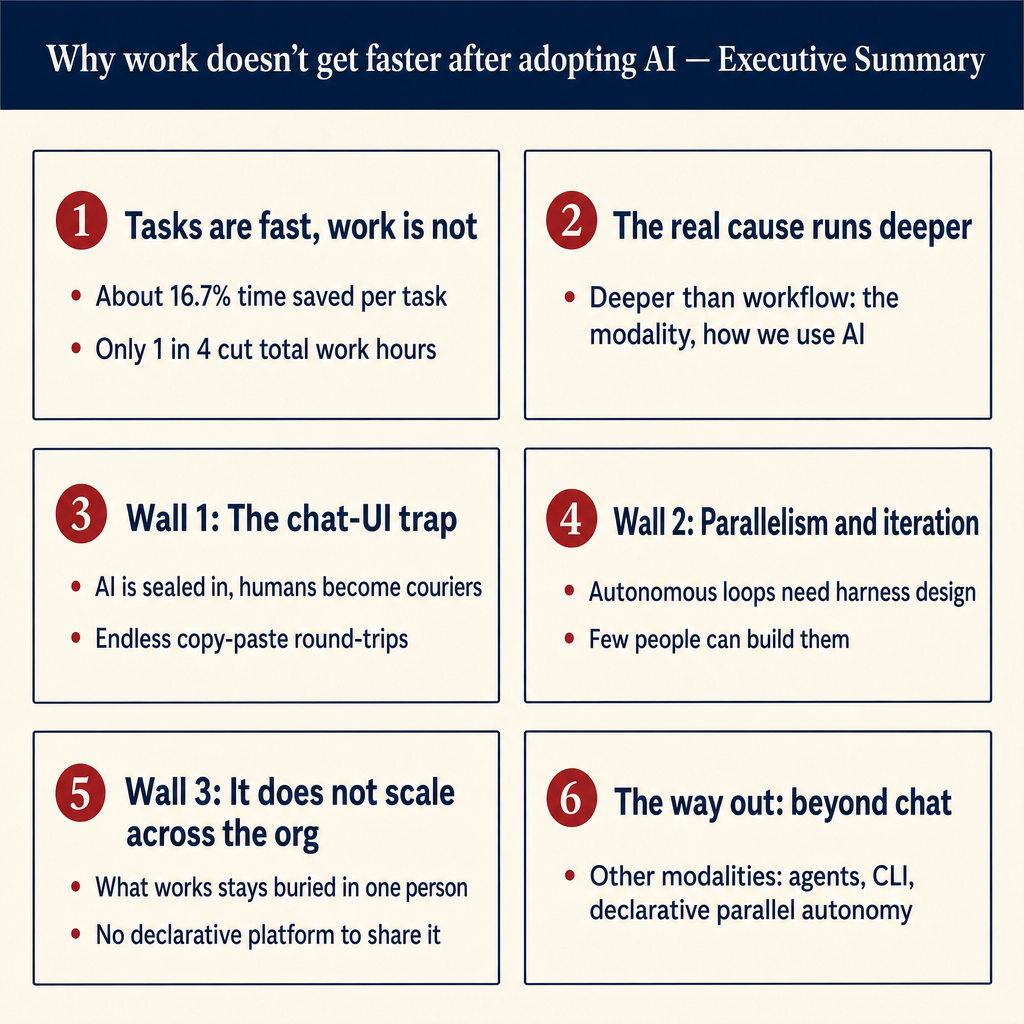
A large domestic survey found that generative AI cut the time spent on individual tasks by roughly 16.7% on average. Overseas studies have repeatedly confirmed task-level gains in the range of 14 to 55%.
That heavy half-hour of staring at a blank page, wringing out the first sentence, simply vanishes. The feeling of "this got faster" is real, and the measurements back it up.
Yet the moment you lift your gaze to the level of the organization or the month, the number evaporates. In that same domestic survey, only one in four users said they had actually reduced their total working hours.
A rigorous overseas study points the same way. In an experiment with experienced software developers, the group using AI was 19% slower than the group that did not.
What is striking is how the developers themselves felt. Beforehand they predicted a 24% speedup, and afterward they believed they had been 20% faster. The time spent writing code did fall, but the time spent crafting instructions, reading outputs, doubting the quality, and waiting for responses more than canceled it out.
Research tracking organizations at scale lands in the same place. An MIT study found that a full 95% of corporate generative-AI pilots produced no measurable return. The cause was not the models; it was how the organizations went about adopting them.
The task got faster. The work did not. These are not the same thing, and the "faster" we feel day to day is almost always the former.
Note: a task here means a single unit of work such as drafting an email, summarizing a document, or generating a snippet of code. "Work," by contrast, means the whole chain around that task, including the checking, coordinating, and approval that come before and after it.
The Usual Answer: "Reorganize the Bottleneck"
There is a familiar answer to this gap. The real chokepoint, it says, is not the "writing" step that AI touched but the step where someone approves the text, or the step where you coordinate with other departments.
This is a fair point.
The speed of a process is set by its tightest chokepoint. Make the draft ten times faster, and if your manager only reviews once a week, the days-to-submission do not shrink by a millimeter.
If anything, the more drafts you mass-produce, the longer the review queue grows. So the prescription "reorganize the workflow itself" does carry real truth.
But the answer stops there. It is easy to say "reorganize the flow"; it says nothing about why so few organizations actually manage to.
And the reason they cannot is the heart of the matter.
The inability to reorganize is not laziness or ignorance on the organization's part. The current shape of how we use AI — the technical term is modality — is what makes reorganizing the flow technically hard.
The reason breaks into three parts.
Note: modality here means the form in which you use AI — the difference between conversing in a chat window, issuing commands, and running things automatically and continuously. It is the "vessel" the AI lives in.
Reason One: The "Courier" Hell of the Chat UI
The first reason is that, almost without exception, the doorway through which we touch AI is a chat window.
The chat UI was a fine invention as a first encounter with AI. Speak to it and an answer comes back. Anyone can use it.
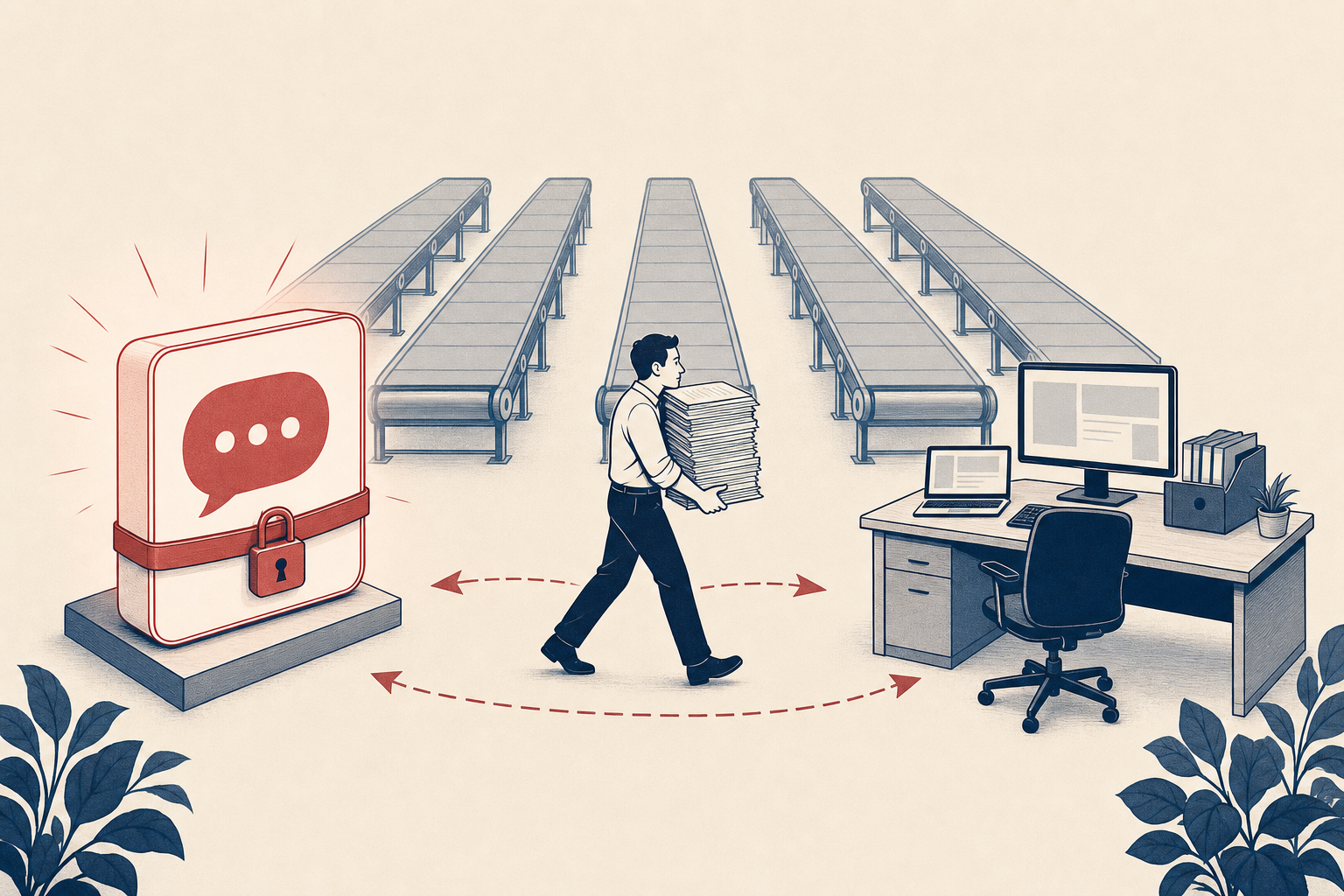
But this chat window carries a decisive limitation. The AI is sealed inside the platform.
It can return text in the chat window, but it cannot save that text as a file, open a spreadsheet and pour numbers into it, or run a program inside your company's systems.
As a result, the human becomes the courier.
You copy the answer the AI produced, paste it into another app, then cut the result and carry it back to the chat. The more you use it, the more these manual round-trips pile up.
Between the AI and the real work lies a no-man's-land where a human hauls the cargo by hand.
Here is the first wall against reorganizing the workflow.
You may want to speed up the approval or coordination steps, but the AI cannot reach them. Unable to touch the real work outside the chat window, it can only move when a human's manual labor primes the pump.
Doing anything beyond speeding up the draft is, structurally, off the table.
Reason Two: The Explosion Needs Parallelism and Iteration — but the Design Is Too Engineer-Bound
The second reason is that the usage which truly detonates productivity can, for now, only be assembled by a small set of engineers.
A chat exchange that returns one answer per instruction merely replaces human handwork one piece at a time. Convenient, certainly, but an order of magnitude away from an explosion in productivity.
The real leap comes from parallelism and iteration.
Run ten matters at once, loop a single task automatically dozens of times, inspect the outputs yourself, and choose the next move — only when you can assemble that kind of autonomous loop does productivity shift from linear improvement to exponential jump.
The catch is that assembling this autonomous loop demands a distinctly engineering-bound design. You give the AI a role, a procedure, and criteria for judgment; you connect it to real-world tools; you define how it behaves when things fail. The framework for this design is, technically, called a harness.
Build a good harness and the AI can push work forward without waiting for the human's every fine instruction. But the people with the literacy to design one do not yet exist in most organizations.
Here is the second wall. You may want to reorganize the flow, but the organization has no one able to carry out the reorganization. The design that runs work through parallelism and iteration remains the tacit knowledge of a handful of engineers and has not yet reached the ordinary worker's hands.
Note: a harness is a system built so an AI agent can act autonomously, given a role, a procedure, the tools it may use, and criteria for judgment. The name borrows from the harness of a draft horse — a framework that "straps" the AI's power onto the work. An autonomous loop is how an AI inspects its own output, chooses the next step, and runs the work continuously without instruction at every turn.
Reason Three: The Method That Works Cannot Be Reused Across the Organization
The third reason is that even when someone finds a usage that works, there is no foundation for sharing it across the organization.
Suppose someone inside the company devises a way to make some task dramatically faster with AI. In today's environment, that "method that works" tends to stay buried in their personal chat history.
The colleague at the next desk, never hearing of it, reinvents the same trick from scratch. The next department over reinvents it again, through yet another person.
Across the whole organization, this is a magnificent duplication of effort.
By rights, a method that works should be defined once as a "part," kept in a form anyone can call up and use. Declare the desired outcome and the procedure, and someone who knows nothing of its internals can reproduce the same quality — with a declarative platform for building agents, an individual's discovery is promoted into an organizational standard.
But that foundation is not yet widely in place. So in the field, each person keeps reinventing tricks in front of the chat window.
The way a company splits into people who are faster with AI and people who are slower with it usually traces back to here. The workflow reorganization ends as one person's feat and never becomes the organization's asset.
Note: declarative means that instead of writing out every step of "how to do it," you declare "what you want to achieve" — the desired outcome — so the result can be reproduced. It is the foundation for sharing a working method as a reusable part across the organization.
The "Lap Behind" Has Its Roots Here Too
These three walls show up plainly in the differences between countries. Japanese firms are no laggards in adoption rates for generative AI. Even so, the share reporting effects "beyond expectations" was the lowest among six major countries at 9%, far behind the United States at 38% and the United Kingdom at 32%.
Writing that gap off as "Japanese IT literacy is low" is almost certainly a mistake. Adoption rates are roughly even. The difference lies in whether AI was "added" to existing work while sealed in the chat window, or whether the shape of its use was "reorganized" by stepping outside the chat altogether.
Install the world's fastest printing press, and if you still have people carry each printed sheet by hand, inspect it, and collect the boss's seal before passing it on, the pace of publishing is capped by the speed of the courier and the stamp. The tool changed; the shape of its use did not. The line between organizations that see results and those that do not runs not along technical skill or capital, but along whether they stepped into that "shape."
So Where Do We Break Out To? Into Another Modality
Pull it together and the prescription is clear.
The move is not "write better prompts." That only shaves a little off the courier's round-trips inside the chat window; it never reaches the real constraint.
The move is to break out of the chat-UI doorway itself and shift into another modality.
Reach the AI's hand outside the chat. For the human to stop being a copy-paste courier, the AI needs to touch real tools directly. It reads and writes files, operates systems, and checks the results itself. Rather than completing everything inside the chat window, the starting point is letting the AI's hand reach into the work itself.
Build with parallelism and iteration as the premise. Move from replacing handwork one question at a time to a design that runs multiple tasks at once and loops them automatically. Here is precisely the key that turns linear improvement into an exponential leap. People who can build a harness are scarce for now — and because they are scarce, cultivating that literacy in-house becomes the greatest investment of all.
Declare and share what works. Take the trick buried in a personal chat history and redefine it, declaratively, as a part anyone can call up. Only then does efficiency get promoted from one person's craft to the organization's standard. It is exactly the same act as the work history of standardizing strong sales methods and seasoned routines.
All three live outside the chat window. Agents, the command line, declarative parallel autonomous loops — the names vary, but the shared direction is to free the AI from the chat window and strap it back onto the real work.
Note: the command line (CLI) is a way of operating software through text commands. By handing the AI direct hold of the tools without going through on-screen buttons, it is considered well suited to automation and continuous execution.
The Tool Got Faster. What Should Get Faster Is the "Shape" of Its Use
This view runs straight on from a flow we examined before: "AI agents equip themselves with APIs and MCP, and chat becomes the universal doorway to every piece of software." What we sketched then was a future in which AI swallows the screen as a middle layer and becomes a universal entrance. This piece is the fork itself — whether we let that entrance end as "merely a convenient chat," or grow it into "another modality that truly speeds up the work."
The real reason work does not speed up is neither the skill of your prompts nor a failure to rethink your workflow. It is that the use of AI is still confined to a single shape: the chat window. The courier's round-trips, the absence of people who can build, the missing foundation for sharing — these three hold back the workflow reorganization in the field.
So the next question to ask is not "which prompt works." It is "in what shape do we strap AI onto the work?" Only when we answer that does the speed of the task turn into the speed of the work.
The tool got faster. What should get faster is the shape of how we ourselves slot that tool into the work.
Note: MCP (Model Context Protocol) is a shared standard that lets an AI connect to external tools and data through a common interface.
References
- Survey on Generative AI and How We Work (Persol Research Institute)
- Measuring the Impact of Early-2025 AI on Experienced Open-Source Developer Productivity (METR)
- The GenAI Divide: State of AI in Business 2025 (MIT Project NANDA)
- Generative AI Survey 2026 Spring: Six-Country Comparison (PwC Japan)
- Still Waters, Rapid Currents: Early Labor Market Transformation under Generative AI (NBER Working Paper w33777, Humlum & Vestergaard)
- Developers Felt "Faster" with AI Coding Tools. Measured, They Were 19% Slower (Zenn)