If you have ever gone looking for a securities report yourself, you probably remember wrestling with EDINET's search. Type in a company name and you still can't reach the filing you want; narrow by period or document type and it refuses to behave. Japan's Financial Services Agency runs this disclosure system, and for all its wealth of data, its search has long left users frustrated.
Now a response to that frustration is coming from the AI side. EDINET DB — an independent service that cleans up and re-serves EDINET's disclosure data — has published a guide for wiring its data straight into an AI through a standard called MCP. "Filter for undervalued, high-ROE stocks," "pull a company's revenue trend across the last five years": the work you once assembled by fighting a search screen now comes back to you just by asking, a shift from an age when humans searched EDINET to one where we let the AI do the searching.
It looks like a small feature addition, yet it touches the very map of the software industry. Once an AI can strike a database directly, our relationship with our tools changes at the root. And the AI that should only grow smarter the more you connect begins to dull once you connect too much — and it is inside that paradox that the contest of the years ahead is hidden.
MCP (Model Context Protocol) = a shared standard for connecting an AI agent to external data and tools; proposed by Anthropic in November 2024, it became the de facto standard after OpenAI, Google, and Microsoft adopted it.
API (Application Programming Interface) = the window through which software exchanges functions and data with other software.
CLI (Command Line Interface) = a way of operating software through text commands.
The End of the Era of Learning the "Screen"
For a long time, we learned a separate set of operations for every piece of software. This screen for the accounting package, that screen for customer management, yet another for searching financial data. Each had its own ritual for logging in, its own placement of buttons, its own private vocabulary. To master software was, in part, to grow fluent in the geography of its screens.
But once an AI agent equips itself with APIs and MCP, that premise collapses.
The human no longer needs to care about the screen of each individual piece of software. Say to the AI, "Tell me how this company's profit margin has moved over the last five fiscal years," and the AI connects to the right database behind the scenes, calls the functions it needs, and returns the result. The screen — that intermediate layer — recedes behind the conversation.
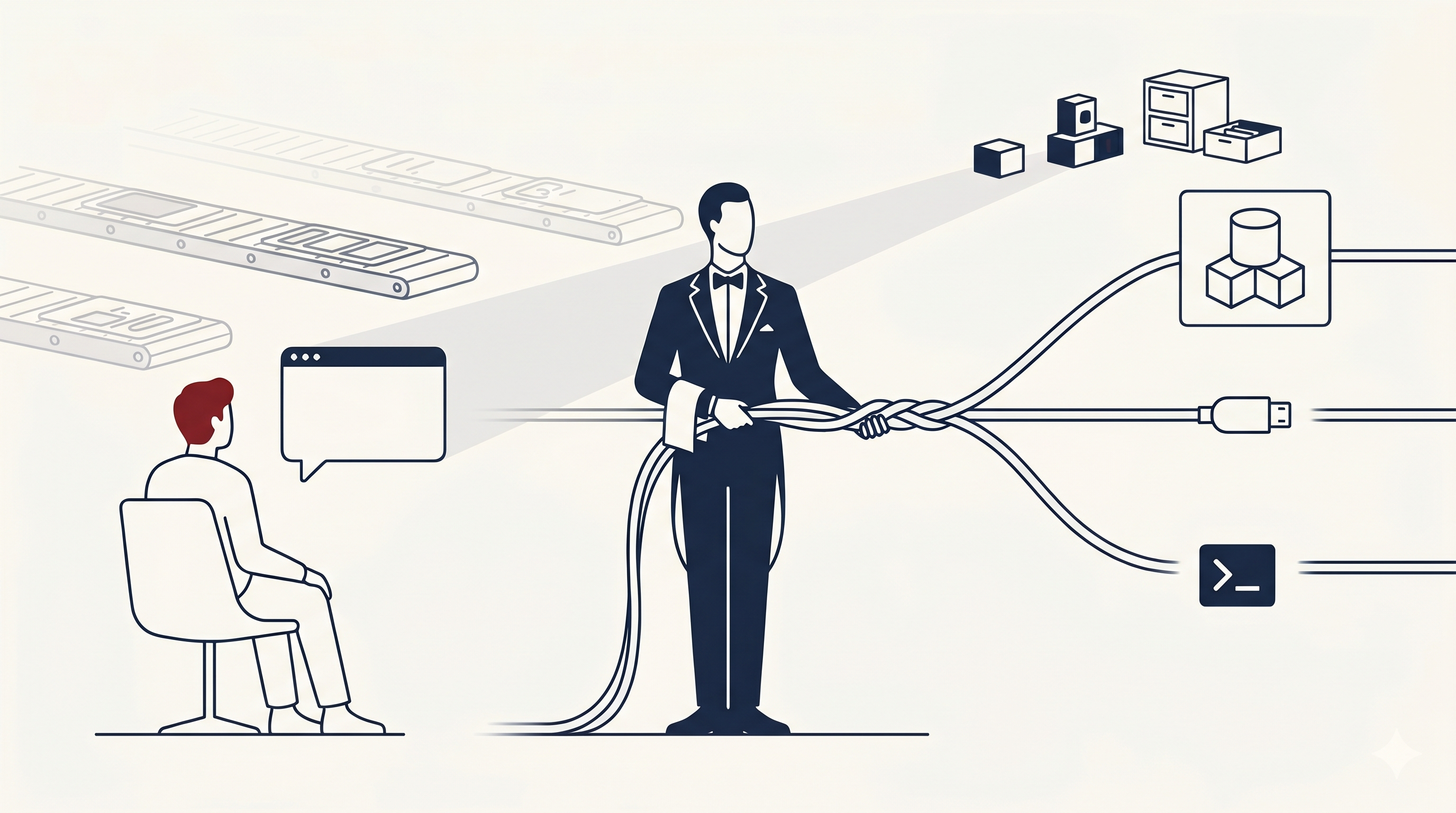
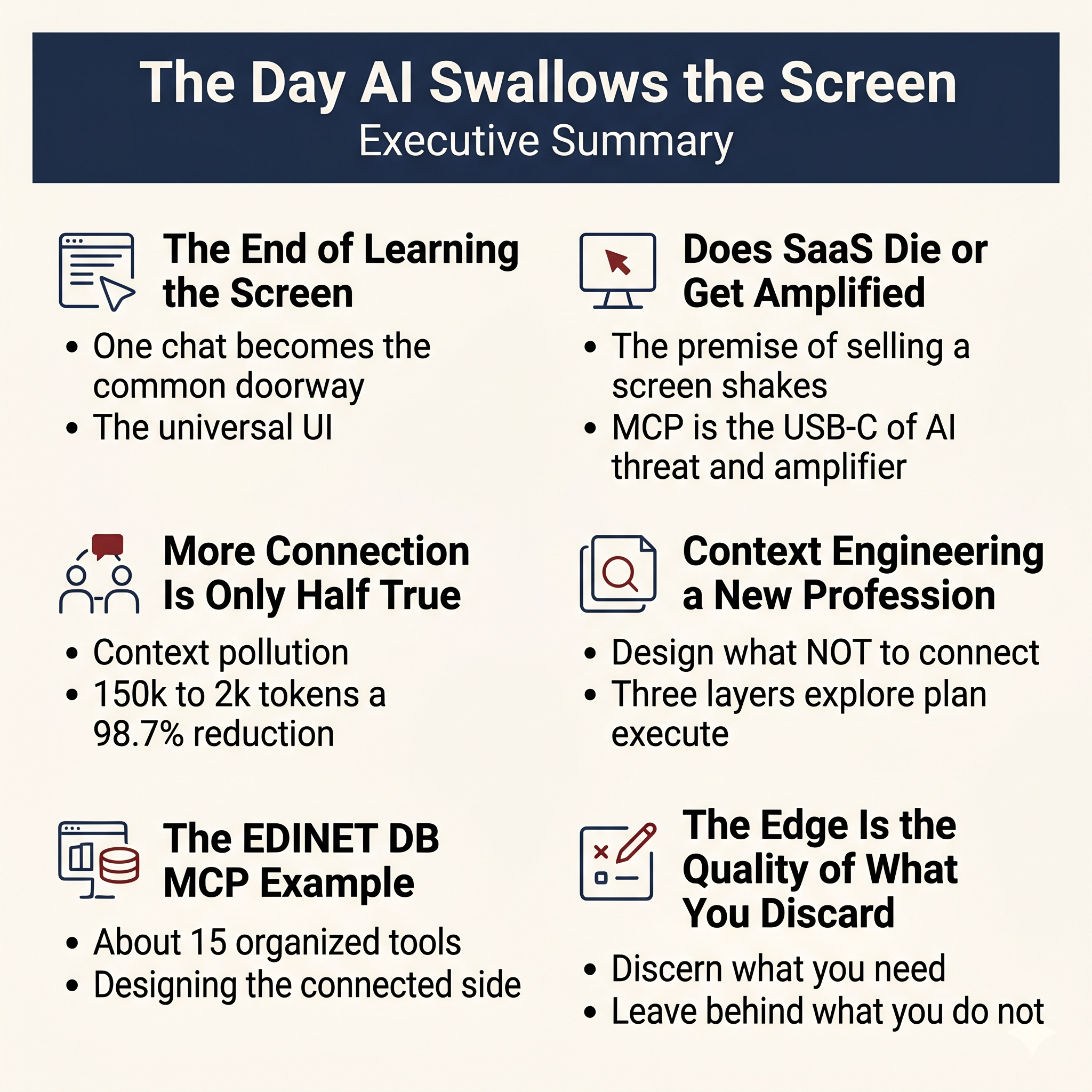
If we capture this change in one phrase, it is the universal UI. A single chat screen becomes the common doorway to every piece of software. From the user's side, the only operation left to learn is one kind: asking in words.
The financial database's MCP support, mentioned at the outset, is one concrete instance of this current. A query against disclosure data that once meant logging into a dedicated site and assembling search conditions on screen now dissolves into a conversation with the AI. The data itself originates as disclosure information from Japan's EDINET; an independent service bundles and tidies it, then offers it in a form the AI can handle — playing the role of the doorway.
EDINET = the electronic disclosure system operated by Japan's Financial Services Agency for securities reports and similar filings by listed companies; the database discussed here is an independent third-party service that processes and provides EDINET disclosure data, not an official service of the FSA or EDINET.
Push this trajectory to its end and one image emerges. In the world of smartphones, people once spoke of the "super app" — a single app inside which payments, chat, ride-hailing, and shopping all fit. The AI agent looks like that idea carried one step further.
In other words: the AI agent becomes, in effect, the OS.
From an era in which individual apps were the arena, to an era in which the AI that calls the apps becomes the arena. What we face shifts from a collection of apps to a single "butler" that bundles them all. This reversal of the picture is the starting point of this piece.
OS (Operating System) = the foundational software that bundles and runs hardware and applications; Windows, and iOS/Android on smartphones, are representative examples.
Does SaaS Die, or Get Amplified?
When the doorway moves to AI, the first thing to shake is the commercial premise of "selling a screen." This is the theme debated in the industry under the name "the death of SaaS."
Let me lay out the argument fairly. The phrase "the death of SaaS" is often taken in exaggerated form. It does not mean that cloud software disappears. What shakes is the central place of the old model — selling software as a "product with a screen" and charging by the number of users.
Why does it shake? Because once an AI agent takes a goal, then bundles and runs the necessary systems on its own, the scenes that require no individual screen or manual hand-off multiply. Ask it to "build next term's sales forecast and share it with the executives," and the AI assembles the steps across multiple systems. At that moment, the easy-to-use screen each piece of software prides itself on loses its turn on stage. The source of value moves from the quality of the screen to the quality of the functions and data running behind it.
Here, before tilting into easy pessimism, we need to look at the opposing force as well. MCP is, at the same time it is a threat to SaaS, an amplifier.
MCP is often called the "USB-C of AI." Until now, connecting an AI to each piece of software meant building a dedicated connection for every combination. MCP, as a shared standard, collapses that labor into a single implementation. Make your own software MCP-ready, and you join the ranks of the called — invokable by AI agents the world over. You can offer your functions into usage scenes that never reached you back when the screen was the doorway.
In fact, a view that positions MCP as a "translation layer" is spreading. Rather than letting the AI touch your internal systems directly, you receive its requests at a managed window and dispatch data provision and operations in a standardized form. This way, you can accept the current toward a conversational doorway while never letting go of control over your core systems.
Here a lesson that runs to the essence of business comes into view.
When a tectonic shift in technology occurs, a given asset is threatened, and that same asset, in a different context, turns into a weapon. What separates the two is whether you can correctly identify where the source of your value lies. A business competing on the beauty of its screen alone gets shaved away; a business with value intrinsic to its functions and data keeps getting called even after the doorway moves to AI. If anything, being called by more AIs, it stands to grasp demand it never reached before.
There is one more fact we cannot overlook. A surprising share of the world's software UI/UX is, in truth, hard for an AI to handle. Screens designed on the premise of human eyes and hands are redundant for an AI agent to operate mechanically, and full of elements that invite hesitation. Turn that around, and it means a whole new field is about to open: designing UI/UX on the premise that an AI agent will use it. We are entering an era in which the screen a human looks at and the window an AI strikes must be designed from separate philosophies.
"The More You Connect, the Smarter" — A Half-Truth
The flow so far seems to arrive at a single optimism. An AI agent, the more endpoints it connects, becomes capable of richer analysis and output — and yes, this direction is essentially correct.
If, on top of financial data, the AI can connect to internal sales figures, industry news, and even past meeting minutes, the resolution of its answers rises. That API, MCP, and CLI — this "equipment" — will remain the mainstream of software integration going forward is all but certain. The opening financial database's MCP support is one drop in this larger current.
But this intuition that "more connection is better" is only half right. The remaining half holds the core of this piece.
Connect too many endpoints, and the AI's accuracy actually falls.
The reason lies in how AI works. An AI agent first reads the list of tools available to it into its head — its context — as material for judgment. Yet tool descriptions are surprisingly bulky. One analysis reports that a single tool with twenty-eight fields runs to roughly 1,600 tokens, and connecting thirty-seven tools exceeds 6,000 tokens. The more information it must read in, the thinner the AI's attention, and the duller its judgment.
Token = the smallest unit by which an AI processes text, corresponding roughly to a word or a fragment of one; there is an upper limit on how much an AI can handle at once (its context).
The problem is not volume alone. When dozens of tools with similar functions line up, the AI hesitates over which to call, and begins to invent tool names that do not exist or mix up the arguments of one tool with another. This phenomenon is called "context pollution," or "context confusion": irrelevant, duplicated, sometimes contradictory information piles up in its head and clouds its reasoning. In environments connecting over 100 tools, this kind of mix-up is reported to rise markedly.
The numbers tell the gravity of the problem. According to a technical article from Anthropic, the conventional approach of letting the AI read tool definitions and intermediate results verbatim required 150,000 tokens for a certain task; redesigned to read in only the definitions it needs, when it needs them, the same task took 2,000 tokens. A reduction of fully 98.7%. For the very same task, the load and cost change by an order of magnitude depending on how you design what gets read, and how.
The conclusion that follows is plain. The naive praise of "the more you connect, the better" is dangerous. Value rises not when you let the AI read everything you have connected, indiscriminately, but when you offer only what is needed at that moment, neatly arranged.
Context Engineering as a New Profession
In a world where the power to connect has become ordinary, the focus of competition moves from "what to connect" to "what not to connect." This is the field called context engineering.
The way it is solved in practice is already taking shape. There is a case, for instance, in which a payment platform's 30-plus APIs and 200-plus endpoints were reorganized so the AI sees only three layers — explore, plan, execute. Without losing depth, it narrows the options the AI faces at once. This "design of narrowing down" is becoming the linchpin that divides success from failure in putting AI to use.
Stop and think, and this picture resonates with an old piece of business wisdom.
Excellent management, it is often said, is not doing everything you can but deciding what not to do. Information is the same. When the material you can gather approaches the infinite, value moves from the volume collected to the quality of the judgment of what to discard. Precisely because this is an age when you can connect anything to AI, the people and organizations that can design what to show and what not to show will pull ahead.
It may be easiest to picture hiring a single expert. The better the advisor, the less they pile documents on the desk. They keep at hand only the few pages that bear on the matter right now, and leave the rest in the drawer. What an AI agent is asked to do is exactly this design of the drawer: keep the connected endpoints waiting inside the drawer, and pull them out only at the moment they are needed. The three-layer structure above is nothing other than the technical expression of this idea.
Let me return to the opening financial database's MCP support through this lens.
What this service offers is a set of roughly 15 organized tools. Basic company information, financial time series, rankings, filtering by criteria. Rather than dumping miscellaneous windows out indiscriminately, the roles are carved up by purpose. This is the manifestation of an idea: that the connected side should arrange things in advance so the AI agent can handle them easily. Not only the design of the connecting side, but the design of the connected side too, governs the quality of context. When the two mesh, the hard primary source of financial disclosure finally rides smoothly on the AI's reasoning.
Primary source = information at its origin, before the processing of reporting or commentary; in financial disclosure, the originals a company itself files — securities reports and the like — are the primary source.
In Place of a Conclusion — The Manners of the Age of Equipment
Let me tie the argument so far into a single line.
By equipping itself with APIs, MCP, and CLIs, the AI agent frees the human from the screens of software, and we are coming into possession of a universal doorway called chat. Beyond it, a world comes into view in which the AI agent behaves like an OS. In this current, the premise of software that sold only a screen shakes, yet services with value intrinsic to their functions and data instead gain power by being called by AI.
And what remains at the very end is the trap of over-connecting. When the power to connect becomes everyone's, what makes the difference is not the volume you connect but the quality of the design of what you discard.
The manners we ought to acquire may not be especially novel. Bathing in information does not make you smarter. Discern what you need, and leave behind what you do not. Precisely now, holding the powerful equipment that is AI, this classic moderation speaks louder than ever. What is asked of us, having gained a universal doorway, is not the width of the doorway but the judgment of what we let pass through it.
References
- Introducing the Model Context Protocol (Anthropic)
- Code execution with MCP: building more efficient AI agents (Anthropic)
- Model Context Protocol (Wikipedia)
- EDINET DB: MCP Financial Data Integration Guide (EDINET DB / Cabocia)
- Will Agentic AI Disrupt SaaS? (Bain & Company)
- The death of the SaaS interface as AI agents move work into messaging apps (Tech Edition)
- Avoid context rot and improve tool accuracy for AI agents using MCP (WRITER)
- Tool Masking: The Layer MCP Forgot (Towards Data Science)
- Help or Hurdle? Rethinking Model Context Protocol-Augmented Large Language Models (arXiv)