"Once upon a time" is the wrong way to begin, because this is all far too much the present.
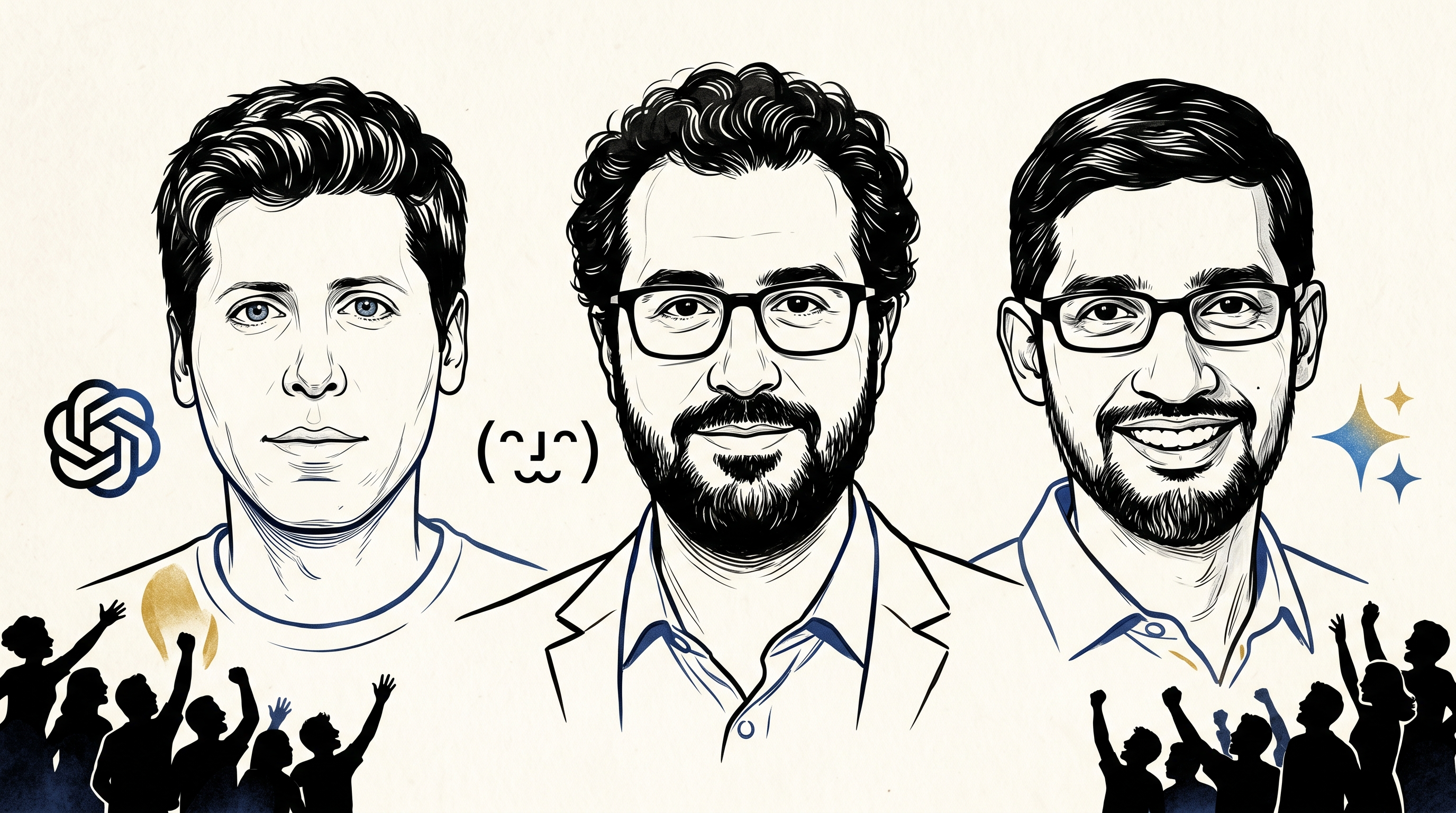
And yet, when you stand back and look at what is unfolding in the world of frontier AI, it really does start to look like three rivals competing for supremacy. Three giants, each with their strengths and weaknesses, and each holding motives they will not say aloud, are reaching to release their next models. The U.S. government halts one model. Probabilities fly through the prediction markets. And all of us lie awake over the rumor of a new model we have not even held.
So as not to be too dazzled by the flash of new models, let us look through this summer's events one at a time, telling things apart as we go — is this an official preview, a news report, or merely the going odds on a prediction market?
The Hegemon OpenAI, and the Small-Step Move Called ".6"
First up is the hegemon running at the head of this race: OpenAI.
It presses on the market with momentum and sheer mass, and most users gather under its banner. Now a rumor is spreading that OpenAI will soon release a new model. Its name, they say, is GPT-5.6.
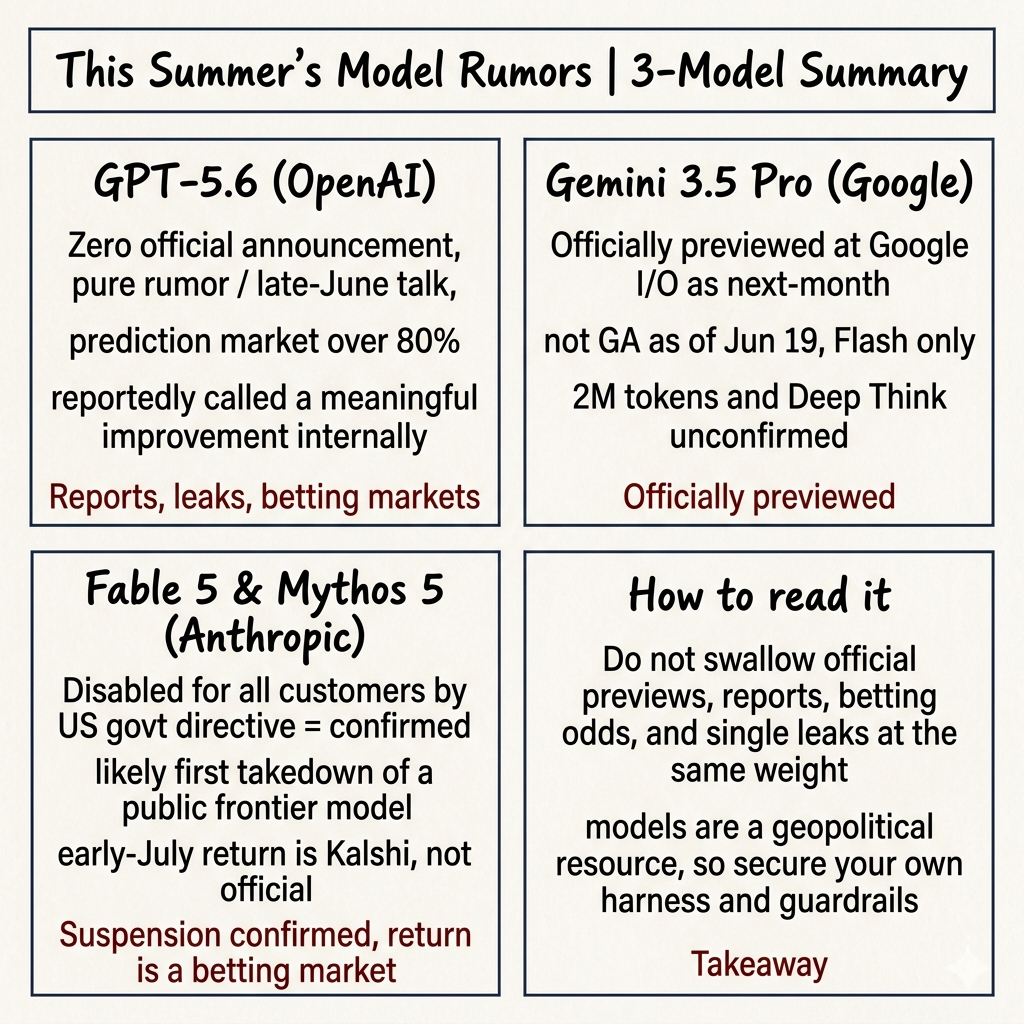
This is not an official preview but rumor, pure and simple. OpenAI has never once spoken this name in public. The newest model the company has released is still GPT-5.5. Everything that follows is no more than a "map of rumors," stitched together from a single leak, scattered reports, and the odds on a prediction market.
That said, the rumor has real thickness to it.
Several tech outlets write that "a late-June release is near." In the report that lit the fuse, chief scientist Jakub Pachocki is said to have called this next model, internally, a "meaningful improvement."
Here is one thing worth noting: the step after "5.5" is not "6" but "5.6."
Rather than raising the major number in one leap, it advances the decimal by a single notch. That usually means not a world-changing leap but a steady, incremental improvement. And the development core calls that modest ".6" a "meaningful" one. In the pairing of a humble number and a confident word, you can glimpse OpenAI's stance.
Rumors about the contents circulate too: that it will handle a context on the order of 1.5 million tokens at once, that this is the internal code-name, that traces were found in the logs of the developer tools.
But here we should tread carefully. Most of these trace back to a single leak, or to roundup pieces that copied it out. Separate corroboration by the major outlets is still missing. A single leak is fascinating. But it is a little early to speak of it as a settled specification.
And the timing of the release should not be missed.
OpenAI, it is said, has a major milestone ahead — an IPO, a public listing. On the eve of it, the company sends steady improvements into the world in rapid succession. The interval from GPT-5.4 to GPT-5.5 was roughly six to seven weeks. At the same pace, late June is exactly the next turn. Ahead of the listing, the very act of showing the market that "the advance has not stopped" may be a second message, apart from the model's specifications.
OpenAI's strength is speed and scale: moving earlier and larger than anyone. Its weakness is the price of that — the relentless drain of capital.
On the prediction market, the odds of a release by month's end read better than eight in ten. An exciting number.
Yet the point is worth pressing. This is not "a release schedule." It is the going price, formed by participants betting that "it will probably ship" — a current value, if you will. Eighty percent is the feel of public sentiment, not a timetable OpenAI issued. With OpenAI, what is worth noting is less the rumor of performance than the temperature of the strategy that the ".6" and the listing create together.
The Old Lord Google, Who Gave an Official Preview but Has Not Yet Delivered
The second is a player in a somewhat different position: the old lord Google, now awake on the strength of its own resources.
The model in its hand is named Gemini 3.5 Pro. Where OpenAI was "rumor with zero official basis," Google is different. Google itself has acknowledged the model's existence in public.
At the developer conference Google I/O, on May 19, Google unveiled the 3.5 family and stated plainly that the higher model, Pro, would be "made generally available next month." This is no rumor. It is an official preview from Google itself. The hardness of its source is decisively different from OpenAI's rumor.
Still, an official preview and a model actually reaching your hand are two different things.
As of this June 19, the higher model Pro is still not broadly available. What you can take up is only the lighter Gemini 3.5 Flash (and that one has already been available since May 19). "Available next month" is a plan, not a fixed date, and nearly a month on, Pro has yet to ship. Even an official preview often slips backward. This, too, is common in this kind of competition.
The rumored contents include a two-million-token context and a take-your-time, deliberate reasoning mode called "Deep Think."
What I want to note here is Google's ordering: the lighter Flash sent out first, with the higher Pro following behind.
Hand out the light, fast one widely first to broaden the footing, then bring in the heavy, clever main act later, at just the right moment. It looks like a strategy of letting many people touch AI first to firm up the ground, then reaching for the top with the main act. And the rumored contents lean heavily toward an agentic direction — not merely returning words, but planning the steps and "moving its hands" on its own. What Google is aiming for is less a clever conversation partner than a worker that acts on its own.
A caveat, just in case. Neither the two million tokens nor Deep Think has been officially confirmed in number as of now. DeepMind, Google's subsidiary, still says only "coming soon." The preview is real; the contents are still at the reporting stage. With Google, it is best to keep those two layers apart.
The Standard-Bearer Anthropic, Whose Frontier Models Were Halted by Government Order
The third is a player in a different position again: the standard-bearer Anthropic, which raises the question of "what is good for humanity" as its banner.
Anthropic has a distinctive approach. Constitutional AI — a training method that gives the model itself a set of principles to follow. It sharpens the model's power and, at the same time, tries to discipline how that power is used. Among the three giants, it has a somewhat unusual stance.
This summer, Anthropic was swept into an unexpected incident. Its two frontier models — Fable 5 and Mythos 5 — were, one day, suddenly halted by order of the U.S. government.
Start with the firm facts. On June 12, Anthropic announced in an official statement that it had no choice but to abruptly disable both for all customers.
This is no rumor. There is Anthropic's own statement, and major outlets including CNBC, CNN, and TIME reported it in unison — a confirmed event.
This is the moment to look squarely at how strange it is.
Not a degradation in performance, not a generational retirement. A current, frontier model, already widely used, was suddenly halted one day by a force apart from the provider's own will. According to the reporting, the source of that force is a U.S. government export-control order. It is reported to be, in all likelihood, the first time a government has effectively had a publicly released frontier model taken away (and even the reporting attaches a careful caveat to that "first").
What this means reaches far beyond the story of a single model.
Until now, we have treated AI like water from a tap — turn it, and out it comes, an everyday tool. But this episode laid bare that a government can hold the master valve behind that tap. A model is no longer merely a convenient tool; it has become, like rice and iron and oil, a strategic resource exposed to the tides of geopolitics.
So what are the prospects of it becoming usable again? Here, too, the line between the confirmed and the rumored runs sharp and clear.
On the prediction market, the odds read "a just-under-60% chance of return by early July." Yet what Anthropic says in public is only "as soon as possible." A senior executive in charge of international affairs said, at a press conference in Seoul, that he is "confident the models will be usable again in the coming days" — but he named no firm date.
In other words, the date of "early July" is not the company's own plan but a number produced by the prediction market. To read it as "scheduled to return in early July" is to swap the source by one notch. A market probability is a forecast, not a timetable the company issued.
The true reason it was halted is still in the fog, as well.
The view that it was because a jailbreak — a breach of the safety mechanism — had been made public; the view that export control is the real thread; the view that it was political retaliation. The three are tangled, and the matter is still contested. Anthropic itself counters that it was "a narrow vulnerability that does not justify pulling the model." No one can say for certain yet.
Even so, the question this incident puts to us is clear: is there any guarantee that the model underpinning your work can be used tomorrow, just as it is today?
Us — The Prediction Markets Buzz, and We Get Pulled Around by a Single Leak
Here, let us take our eyes off the three giants for a moment and turn to those who watch them.
That is, all of us watching this competition.
Each time a rumor of a new model goes by, we get stirred up. A colleague mutters, "GPT-5.6 drops next week, apparently," and with that one line, your hands stop. You chase the spec rumors, stare at the prediction market's numbers, quietly do the math on when it might reach your hand — and before you know it, you have melted the better part of an hour into a model you have not even held.
Probabilities fly through the prediction markets. "Released by month's end." "Restored by early July." Participants wager on future events, and from that buying and selling a "market-implied probability" is calculated. Let a single leak arrive, and the whole community buzzes at once.
※A prediction market = a market where participants bet money on the probability that a future event will occur, and the "market-implied probability" is computed from that trading. The probability is an aggregate of participants' expectations, not an official schedule from the company in question.
This buzz is nothing to deny.
To let your heart race at a new model is deeply human. It is no more shameful than a cook whose eyes light up at the edge of a new knife.
Only, if I add one habit to how we take it in, it is this: do not swallow an official preview, the reports of several outlets, the prediction market's odds, and a single leak at the same weight. Google's official preview is hard, OpenAI's release date is soft, and Anthropic's timing of return is no more than a feel from the prediction market. Take each in with the difference in texture intact, and the rumors stay a source of excitement rather than something that pulls us around.
Motives — What Lies Behind the Call to "Let Us All Stop"
Now, this summer carries a second thread alongside the rumors of new models: the three giants' motives.
Earlier we watched a government halt a model. Yet that same June, a strange move running the opposite way is unfolding. The companies who were supposed to be on the receiving end of being stopped have begun, of their own accord, to say, "discipline us."
Begin with the facts at face value.
Anthropic, in a document titled "When AI builds itself," published on June 4 to 5, issued a warning. Recursive self-improvement (RSI) — an AI designing and training its own successor models — may arrive sooner than most camps are prepared for, and "could raise the risk that humanity loses control" (the company itself attaches a caveat: this is "not inevitable").
On that basis, Anthropic offered a prescription modeled on the arms control of the Cold War era. Not binding regulation, but a verifiable mechanism for international coordination — and "if competitors agree to the same terms," it would willingly slow its own development, or call a temporary pause. OpenAI, too, in early June, called for setting up an international oversight body, and echoed this view. The stated reason, in both cases, is "for the safety of humanity."
That is the fact of who said what. Now — why say it?
A reading that takes this move at a temperature other than the safety argument is now gaining ground.
David Sacks, the Trump administration's AI advisor, publicly denounced Anthropic by name as "a sophisticated 'regulatory capture' strategy based on stoking fear." The criticism has two cores.
One: that the banner of safety, in competition, works as a barrier to entry — a wall that locks out latecomers. The other: that Anthropic's pause proposal is conditional on "if competitors agree." Conditional means it is not a pause that hurts the company alone. If all stop at once, that is also a breather from the war of attrition.
Here, the reading goes, you can sense a different temperature flowing beneath the safety argument. The endless race over compute and capital for inference and training. If that race could be slowed in lockstep, everyone gets a breath from the war of attrition — a financial and strategic motive that shows through.
That said, to narrate this as a settled conspiracy goes too far. Both sides stand here, side by side.
There is a rebuttal that sees Anthropic's stance as a genuine conviction rooted in effective altruism. And OpenAI's "echo" was, in fact, partial. While nodding to the diagnosis that RSI is dangerous, it stopped short of calling for a binding pause, holding up "protecting innovation" instead. The diagnosis may align, but the prescription does not.
And OpenAI's own Sam Altman said at the G7 that "rules should be led by governments, not companies — do not entrust the responsibility to labs like mine." A voice calling to be disciplined does not necessarily translate straight into the front-runner's gain.
The face-value safety argument and the strategic motive. This is not a matter of one of them being a lie. The honest answer is that both can hold at the same time.
What matters for us, I think, is less to pronounce which is true than to notice something one step earlier. Even an upstanding-sounding call like "let us all stop" carries an entirely different temperature depending on who voices it, and on what conditions. Exactly as with the rumors of new models, here too we do best to take in not the words themselves but the difference in their texture.
The Summer Three Giants Compete — How Should We Spend It?
The strategy showing through OpenAI's ".6," the intent visible in Google's ordering, the geopolitics that Anthropic's halted models thrust upon us, and the motives of each company. Every part is interesting to watch. Every one is worth a racing heart.
The three giants compete while wearing each other down — caught in an endless race over compute and capital, an excess of competition. The hegemon OpenAI runs ahead on speed and scale; the old lord Google hones its main act on sheer underlying strength; the standard-bearer Anthropic raises an ideal and preaches a pause. Who will reach the top, no one can yet say.
So how should we who watch this competition spend the summer?
A model's value is not decided by performance alone. As Anthropic's case showed, geopolitics can halt it by a government's hand, and the companies' motives can reshape it from above. If so, tethering your entire work to one particular model is dangerous. Build the role, the procedure, and the safety frame on your own side, and keep the model itself as a swappable part. Whichever giant reaches the top, the one who holds their own footing on their own side is not pulled around.
※Building the role, procedure, and safety frame on your own side = keeping, on your own side and independent of any particular model, both the structure that gives an AI a role, procedure, available tools, and judgment criteria so it can act autonomously (technically, a "harness"), and the structure that sets the allowable range for outputs and actions and halts deviations (a "guardrail"). Even if one model is halted, you can swap to another and keep walking.
Those who have firmed up their footing simply swap quietly and move forward each time a new model ships. Even if one is halted, they reconnect to another and keep walking. Let the prediction markets buzz, let official previews go up, let leaks run — their footing does not waver.
So there are two things we should hold. The human thrill of letting your heart race at this summer's events. And the quiet posture of securing the footing beneath it with your own hands. Enjoy the rumors of new models as you would the weather; build the foundation of your work yourself. Light of heart, but sure of foot — let us walk lightly through this summer in which three giants compete.
What moves next? Perhaps OpenAI shipping its ".6," or Google opening Pro, or the halted models returning. Whichever it is, let us pick up the rest of the story at the next rumor.
References
- ChatGPT 5.6 release date rumors point to June but OpenAI has not confirmed it (Webiano)
- GPT-5.6: OpenAI Chief Scientist Calls It a Meaningful Leap as June Launch Nears (Tech Times)
- OpenAI GPT-5.6 meaningful improvement (Android Authority)
- When will GPT-5.6 be released? (Polymarket)
- GPT-5.5 model page (OpenAI)
- Gemini 3.5 (Google Blog)
- Gemini API changelog (Google AI for Developers)
- Google Gemini 3.5 Pro Nears June Launch With 2 Million Token Context And Deep Think Reasoning (Tech Times)
- Anthropic on Fable and Mythos access (Anthropic)
- Anthropic disables access to Fable 5 and Mythos 5 to comply with government directive (CNBC)
- The US government's Anthropic models ban was never about an AI jailbreak (TechCrunch)
- Kalshi traders think Anthropic will restore access to AI model quickly (CNBC)
- Anthropic confident of re-enabling Mythos, Fable 5 access in coming days (Korea JoongAng Daily)
- When AI builds itself: recursive self-improvement (Anthropic)
- Anthropic urges a coordinated, verifiable pause for frontier AI (The Next Web)
- Anthropic wants to pause AI development over recursive self-improvement (Fortune)
- Public policy agenda (OpenAI)
- OpenAI joins Anthropic in call for international AI watchdog (Gizmodo)
- David Sacks' warning about Anthropic (Newcomer)
- AI chiefs on regulation and collaboration at the G7 summit (Fortune)