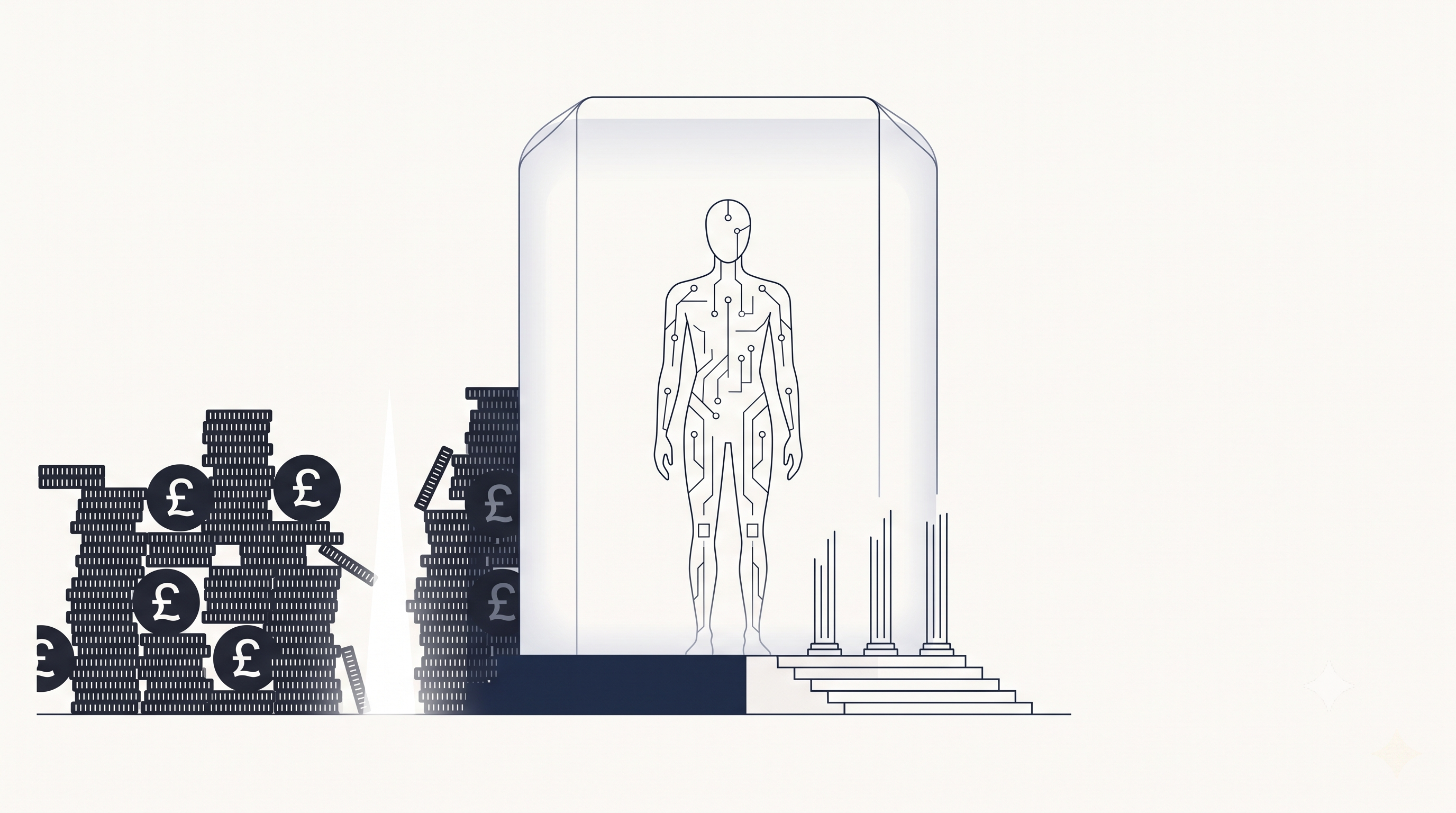
You delivered the work and sent the invoice. The deadline passed, and no reply came. The amount is a few thousand pounds.
Hire a lawyer, and the retainer alone approaches the sum in dispute. Even if you win, the fees are not refunded, and little is left in your hand. So you run the numbers, sigh, and quietly treat the claim as if it never existed — a calculation many small businesses make at least once.
In the UK, someone overturned that calculation. A letter of demand for £2, recovery for around £400. And the documents were not drafted by a human.
The headline read, "An AI won in court." Peel that headline back one layer at a time, however, and a completely different shape appears.
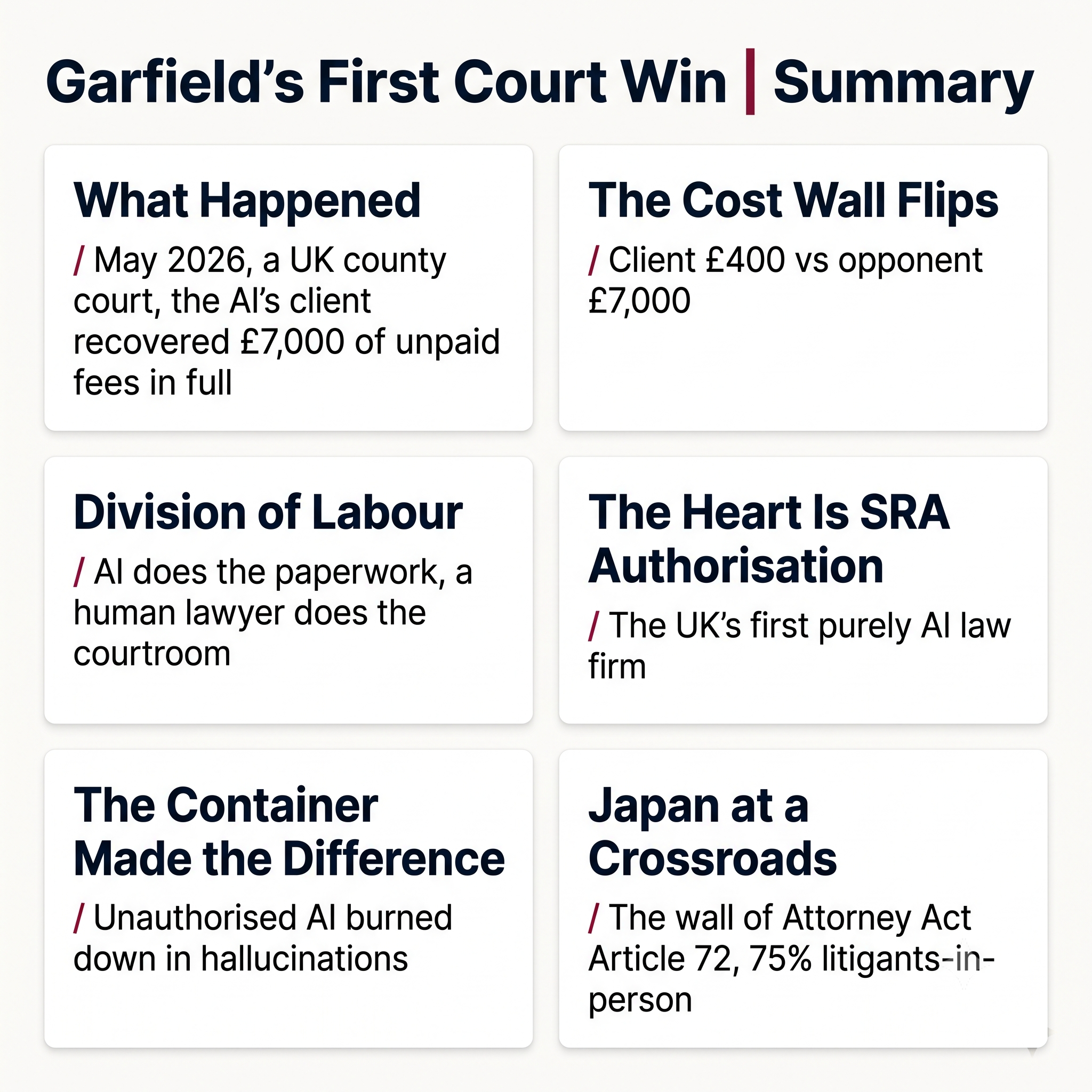
The essence is not that an AI replaced a lawyer. A regulated AI broke the procedural cost of a small claim — £400 against £7,000. The cost barrier that had blocked access to justice quietly fell.
What Actually Happened
On 14 May 2026, at Wandsworth County Court in south-west London, a hearing of roughly three hours ended with Tamires Camal Taquidir, a freelance HR consultant, recovering £7,000 in unpaid fees in full. The counterclaim brought by the opposing party — a hospitality business — was dismissed.
Representing the claimant was the AI law firm Garfield AI. What the client paid Garfield came to about £400. The opposing party, by contrast, had instructed both a solicitor and a barrister.
But the roles must not be confused here. What the AI handled spanned the entire pre-trial paper trail: the pre-action correspondence, the issuing and procedural preparation, the particulars of claim, the response to the counterclaim, the directions questionnaire, document disclosure, four witness statements, and the assembly of the trial bundle.
The advocacy in court was not done by the AI. Dominic Li, a junior barrister at One Essex Court, was instructed shortly before the hearing and appeared in court.
In short, the AI prepared the documents, and a human stood in the courtroom. That division of labour is the true shape of this case.
Stripping Away the Headline's Hype
The headline "An AI beat a lawyer" carries several exaggerations woven into it. Three of them are worth stripping away.
- The one who won was the human barrister who appeared in court; the AI merely prepared the documents that supported the advocacy.
- The judgment was not finalised that day — the judge reserved the decision, and the conclusion was carried over to a later date.
- "World first" is Garfield's own claim; the trade press hedges it as "what may be the first," so it is best received as marketing language.
Ironically, the people pushing back hardest against the hype are the parties themselves. Garfield's founders have said this is "not about gimmicks or replacing lawyers," and stated plainly that "AI did not replace the judge, the barrister or the legal system."
Even with the exaggerations stripped away, the case loses none of its value. If anything, it is precisely once the hype is removed that the genuinely structural event remains.
The Heart of It Is the SRA Authorisation
The core of this story lies not in the courtroom result but a year earlier.
On 6 May 2025, the Solicitors Regulation Authority (SRA) authorised Garfield.Law Ltd as the UK's first purely AI-based law firm. SRA Chief Executive Paul Philip called it "a landmark moment for legal services in this country."
The authorisation is landmark not because it let AI run free. The opposite is true: it precisely engineered a container in which AI could be used.
That container has several safeguards built in. A named solicitor bears ultimate responsibility for all outputs; minimum professional indemnity insurance is required; and the system is not autonomous, taking a step only where the client has approved it.
Most telling of all is that the system is designed so that it "will not be able to propose relevant case law." Selecting case law is the high-risk domain where hallucination is most fatal — and precisely there, the AI is kept from touching anything.
The SRA takes a technology-neutral stance, specifying no particular technology and regulating on an outcomes basis. The question is not what you use, but who bears responsibility and where the line is drawn. That is the philosophy of the container.
The founders' profiles reinforce this design thinking. CEO Philip Young is a former Baker McKenzie litigator; CTO Daniel Long is a quantum physicist.
In a little over a year, Garfield has taken on more than 600 cases and recovered around £500,000. The claims it handles range from £30 to £10,000 — exactly the tier for which conventional legal fees never made economic sense.
The Same Month, Unauthorised AI Was Going Up in Flames
Why is the regulatory container decisive? You only have to look at what AI does without one.
The emblematic case is Mata v. Avianca in the United States. Lawyers leaned on ChatGPT to draft a brief, cited six fictitious precedents, and were sanctioned $5,000 by the court. It showed the world the danger of an AI producing "plausible lies" without verification.
The same kind of failure has not stopped since. In the UK, the major firm Pinsent Masons submitted a non-existent insolvency rule, "12.37(5)," twice, and ended up self-reporting to the SRA.
The US blue-chip firm Sullivan & Cromwell also apologised to a judge in April 2026 over fabricated citations. In the UK cases of Ayinde and Al-Haroun ([2025] EWHC 1383 (Admin)), as many as 45 fictitious precedents were submitted, drawing a stern warning from the court.
AI hallucination is no longer a rare accident. There is, however, a reason these must not be lumped together too easily.
These were all failures where a human neglected to verify. The AI was made to generate case law, and that output was carried into court unchecked.
Garfield's design, by contrast, differs in its very structure. The AI is kept from touching case law at all, and a named solicitor bears responsibility for every output. The presence or absence of safeguards is reversed from the very starting point.
That an authorised AI firm won cleanly in the same period that unauthorised, unguarded big firms were going up in flames over hallucinations is no coincidence. What separated failure from success was not the cleverness of the AI, but the design of the container.
The Cost Structure Collapses
Small claims have long carried a brutal economics: the legal fees cost more than the claim itself. That wall has led many businesses to let go of legitimate claims and quietly swallow the loss. It is the very scene from the opening — running the numbers and sighing.
What Garfield broke is that economics. If it moves for £400, a £7,000 claim becomes worth pursuing. Once the structure in which fees devour the recovery is reversed, claims long given up for lost turn back into recoverable assets.
Behind this lies the unbundling of legal work. The routine, procedural drafting goes to the layer that can be automated; advocacy, judgment, ethics, and ultimate responsibility remain in the layer that stays with humans. What was a single block — "the lawyer's job" — splits into two layers.
The billing model shifts along with that split. The IBA's analysis points to a tension in the move from hourly billing to per-document pricing, noting that 47% of lawyers said how they bill would change. It is a world where the price is set not by "how many hours you worked" but by "what you delivered."
What is striking is that this change is advancing from two directions at once.
On one side is a movement "from the top." Kirkland & Ellis is investing $500M in an AI platform over three to four years, and Freshfields has partnered with Anthropic. This is large firms using AI to lift efficiency and high-end work.
On the other side is Garfield's movement "from the bottom." It opens access to justice for a tier that could never reach a lawyer before.
The same AI, but pointed in opposite directions: efficiency, and access. This polarisation is exactly what maps the present state of legal tech.
Where Does Japan Stand at the Crossroads?
So, is a Garfield possible in Japan? The answer, for now, is close to "no."
The wall is Article 72 of the Attorney Act. It prohibits anyone who is not a lawyer or a legal professional corporation from engaging, for profit and as a business, in the appraisal, representation, or other legal services concerning general legal matters (with a proviso excluding cases otherwise provided for by other laws).
Its purpose, as set out in the Supreme Court judgment of 14 July 1971, is to protect the public from the harms of legal services performed by unqualified persons. The idea is to keep for-profit legal work out of places where there is neither qualification nor responsibility.
Around this wall, the administrative stance has begun to move. In August 2023, the Ministry of Justice published "On the Relationship Between the Provision of AI-Based Contract-Related Business Support Services and Article 72 of the Attorney Act."
Its content was an interpretation: in addition to the three requirements — for-profit purpose, the existence of a dispute, and qualification as legal services — illegality may be precluded where a lawyer's scrutiny is involved. It offered a certain path for AI-based contract review.
Yet that very interpretation is now being questioned. On 9 January 2026, the Ministry of Justice itself presented to a working group of the Council for Promotion of Regulatory Reform the view that "the guideline is, on the contrary, producing a chilling effect" and that "a re-organisation is needed." The side that built the wall has begun to speak of redrawing it.
That said, whether the re-organisation of Article 72 will be legislation, a new guideline, or a public consultation — which stage it is at — is not yet settled. "It has started to move; it stands at a crossroads" is the accurate description of where things are.
Japan's one institutional analogy is the certified judicial scrivener (nintei shihō shoshi). Under Article 3 of the Judicial Scriveners Act, they are granted rights of litigation representation limited to summary courts and claims of ¥1.4 million or less (the 2002 amendment).
It is a system that opened expert access to small disputes, but its agent is, after all, a human — not an AI firm. Japan opened the container to a neighbouring profession of "people," not to a "machine" called AI.
This contrast vividly captures the two countries' positions. The UK opened the regulatory container to AI. Japan has opened it, in a limited way, not to AI but to a neighbouring human profession.
And Japan has an access gap that cannot be overlooked. About 75% of summary-court cases are litigant-in-person proceedings, with no representative.
In front of the cost wall, many people stand in court without expert help. The very wall Garfield set out to break in the UK exists, thick, in Japan too.
Regulation Was Not a Shackle but a Container
The lesson to draw from this case runs counter to intuition.
Regulation is often spoken of as a shackle on innovation. Garfield's story, however, showed the reverse.
It was precisely because of the container of SRA authorisation that an AI could stand in court while remaining compatible with consumer protection. In the same month that unauthorised, unverified AI lost trust to hallucinations, an authorised AI won cleanly — regulation was not what binds AI, but the device that makes AI worthy of trust.
Brought down to the practice of management and legal work, the very framing of the question changes. "To delegate to AI or not" is no longer the essential question. What should be asked is: "Whom do you entrust, and inside what container of discipline?"
When you deploy AI, who bears ultimate responsibility for the output? Where do you draw the line on what it may not touch? Where do you build in verification?
To deploy without designing these carries, structurally, the same danger as bringing an AI without guardrails into a courtroom. Garfield's strength lay not in technology but in the design of the container.
Japan now stands at the crossroads of how to open that container. The UK opened it to AI; Japan has so far opened it only to humans.
For the business owner who has sighed in front of the cost wall, what breaks that wall is not the clever AI itself. What breaks it is the container of discipline that makes AI safe to use.
For whom, and how far, that container is opened — that design will quietly decide the shape of access to justice from here on.
References
- Garfield AI wins its first court trial (Garfield AI press release)
- AI law firm wins court case in UK first (Legal Cheek)
- Artificial intelligence-based law firm wins in court (Computer Weekly)
- AI-powered law firm claims first county court victory (Law Society Gazette)
- First AI-based law firm authorised by the SRA (SRA)
- SRA risk analysis on artificial intelligence (SRA)
- Pinsent Masons refers itself to SRA over AI failures (Law Society Gazette)
- Sullivan & Cromwell apologizes to judge for AI hallucinations (Bloomberg Law)
- Lessons from Mata v. Avianca (ACC)
- Ayinde v Haringey & Al-Haroun v QNB [2025] EWHC 1383 (Admin) (judiciary.uk)
- Kirkland & Ellis investing $500 million in AI platform (Bloomberg Law)
- AI-native law firms and the restructuring of legal service delivery (IBA)
- AI-based contract support services and Article 72 of the Attorney Act (Ministry of Justice, Japan)
- Article 72 of the Attorney Act and AI legal-tech services (Regulatory Reform Council WG, 2026-01-09)
- On summary-court litigation representation (certified judicial scriveners) (Ministry of Justice, Japan)