
One morning, the core system you spent six months optimizing for a single AI vendor stops working — not because of any fault of your own, but because of a single line in a regulation. In June 2026, export controls landed on Anthropic's Fable 5 and Mythos 5, and certain countries and companies lost access overnight. Sakana AI's new service, Fugu, is designed around exactly that "worst morning."
A system built on a bet on one vendor's API, suddenly unusable for reasons that have nothing to do with you. Any procurement lead who lived through the early cloud era — and the fear of being locked into a single vendor — knows this dread in their bones.
That is why what Fugu sells first, before any peak-performance figure, is relief from that fear itself.
And the technology behind that pitch rests on two papers, out of which emerges a structure where Fugu's true novelty is not a "new model" but a "business built as the middle layer that bundles models."
What Fugu Is — A Conductor, Not a Router
To the user, Fugu is just one OpenAI-compatible endpoint. If your system was already calling OpenAI's API, you can swap the destination to Fugu and it runs — a genuine drop-in replacement. Yet what happens behind that single endpoint is unlike anything that came before.
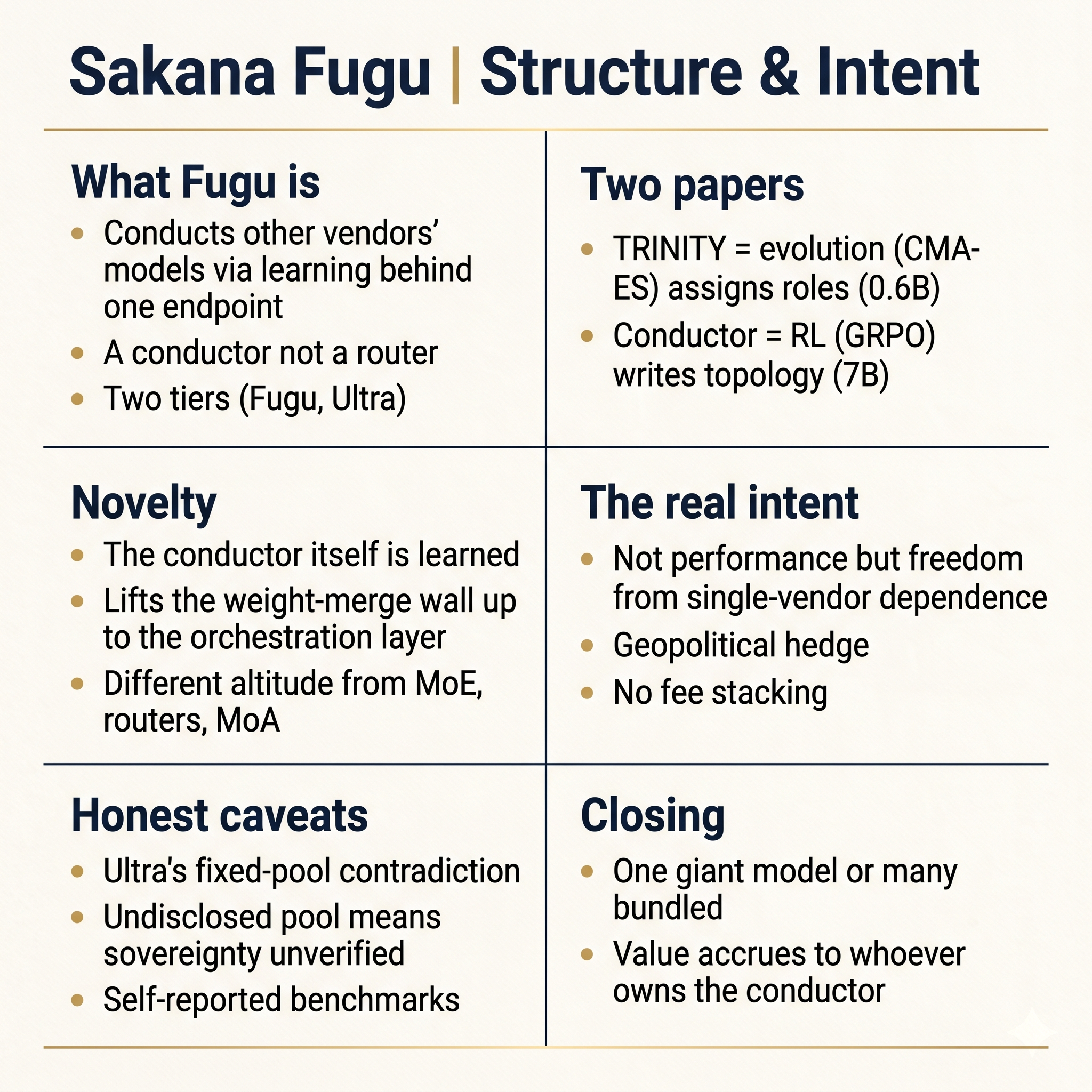
In Sakana's own words, Fugu "is itself a language model trained to call various LLMs in an agent pool, including instances of itself recursively." In other words, depending on the task it receives, Fugu dynamically assembles a team of multiple LLMs — including other vendors' frontier models — assigns each of them a role, and makes them collaborate. It plays nothing itself; it devotes itself to staffing and directing the performers. That is Fugu as a conductor.
This is the point most likely to be misunderstood.
Fugu is not a router that picks one model to throw the query at. It is an orchestrator that runs several models at once and decides who thinks, who builds, and who verifies.
That conductor comes in two tiers.
- Fugu (default): a standard tier balancing latency and quality. Specific providers or models can be opted out of the pool.
- Fugu Ultra: a higher tier that uses a deeper pool, aimed at hard tasks.
This two-tier design itself carries both the novelty and the contradiction we are about to read. The standard tier keeps the freedom to switch; the upper tier fixes its pool to chase quality — an implication that turns into structure later in the piece.
Who Is Sakana AI
Who, then, is the Sakana AI that built Fugu? The name "Sakana" is Japanese for fish.
Simple individuals form a school and, as a whole, behave intelligently — a collective intelligence modeled on a school of fish, an AI inspired by nature and evolution. That is this company's identity. Rather than concentrating capability into one giant model, it aims to win with a collective of small models that each have their own strength.
The bet the company has placed consistently runs straight into the thinking behind Fugu we will reach shortly.
Carrying that bet is a small, elite lab that competes with brains. Sakana AI was founded in Tokyo in July 2023 by former Google researchers.
Its CTO, Llion Jones, is one of the co-authors of "Attention Is All You Need," the 2017 paper that proposed the Transformer and became the foundation of modern AI, and its CEO, David Ha, led Google Brain's Japan team and served as Head of Research at Stability AI. A third co-founder, from a diplomatic and business background, supports the business side as the former CEO of Mercari Europe.
The headcount was roughly 20 as of 2024 — a deliberately small Tokyo lab that competes on intellect rather than scale.
What put this lineup on the map was a method called "evolutionary model merging." With no gradient-based training at all, using only a search modeled on biological evolution, it blends the weights and layers of multiple models to auto-generate a stronger hybrid. The result was published in Nature Machine Intelligence, and in one case, crossing a Japanese model with an English math model produced a system that outperformed every Japanese LLM under 70B.
This "merge to create" method, however, comes with a constraint that matters later. Because it touches the weights directly, it works only on open models that publish those weights; closed frontier models that expose only an API, like GPT or Claude, simply cannot be merged. This wall takes on real weight in the section on novelty below.
In positioning, Sakana is a fast-growing "homegrown, sovereign AI lab." It champions AI optimized for the Japanese language, Japanese culture, and Japanese regulation, with finance and government in its sights.
Its fundraising tells the same story of momentum.
Through seed and Series B rounds, it is reported to rank among Japan's most valuable private companies — its unicorns — though the valuation varies by source. A November 2025 report put the raise at around $135M at a roughly $2.65B valuation, while Sakana's own page (updated April 2026) states about $200M at a roughly $2.7B valuation. Rather than treat either as the definitive figure, the sound reading is to take it as a fact within a range.
It does not take on the multibillion-dollar scale of America's giant labs head-on, by sheer volume. It challenges them with cleverness — and that consistent stance is this company's signature.
The Core Claim — What "Orchestration via Learning" Actually Means
Fugu's true novelty is not its benchmark numbers. It is that the way of conducting — how multiple models are bundled and used — is not hand-designed by humans but discovered through machine learning.
This core is stated explicitly in the two ICLR 2026 papers Sakana builds on: TRINITY and Conductor. The conductor rises from two different schools, and we begin with one of them.
TRINITY — An "LLM Coordinator" Optimized by Evolution
TRINITY casts itself as "an evolved LLM coordinator." In truth, it is a tiny arbiter.
Per the paper, it is merely a small language model of roughly 0.6B parameters, with a small head of about 10,000 parameters on top. A conductor, the first implication runs, need not be large.
What stands out is how it is trained. TRINITY is optimized not by reinforcement learning, not by imitation, and not by weight merging, but by an evolutionary method (separable CMA-ES) — a search algorithm modeled on biological evolution that finds good ways to conduct across generations.
※CMA-ES = Covariance Matrix Adaptation Evolution Strategy. A gradient-free optimization method that tries many candidates and keeps the strongest. Here it searches the parameters of "how to conduct."
Each turn, the coordinator assigns one model in the pool one of three roles — Thinker, Worker, or Verifier — and stops at the first ACCEPT from verification. The paper reports 86.2% on the coding benchmark LiveCodeBench.
A tiny conductor that marshals models to this level looks, so far, like a striking result.
Yet the same paper also draws a clear boundary.
What it can orchestrate is only calls to black-box LLMs; it cannot run tools or execute code itself. It can conduct, but it does not hold the instruments that do the hands-on work — a deliberate limit in the design.
Conductor — Orchestrating Agents in Natural Language
Conductor attacks the same problem from a different angle. Its base is the public model Qwen2.5-7B, trained with reinforcement learning (GRPO), and choosing RL over evolution is the contrast with TRINITY.
For each input, the trained Conductor emits a structured output of three things.
- Which Workers to call
- A natural-language sub-instruction for what each step should do
- A communication topology — who sees whose output
By randomizing the pool during training, it aims to generalize beyond any fixed lineup. Conductor can also nominate itself as a Worker, which gives rise to recursive topologies and test-time scaling. The paper claims state-of-the-art results on LiveCodeBench and GPQA, and it was accepted as an ICLR 2026 poster.
An ablation the paper itself reports, however, cannot be overlooked. A 3B Conductor converged on "nearly the same selection distribution" as the 7B version, yet performed worse.
The implication is heavy: much of the win may be attributable not to the choice of "which model to combine and how," but to the larger model's "skill at writing prompts." Not just the art of conducting, but the conductor's richness of vocabulary, is doing work. To judge novelty soberly, this caveat cannot be dropped.
Reading the Novelty as Structure — How It Differs in "Altitude" from MoE, Routers, and MoA
Combining multiple models is not, in itself, Fugu's invention. That is precisely why Fugu's novelty is best read as a difference in "altitude" from look-alike methods.
First, MoE (Mixture-of-Experts). This keeps several expert sub-networks inside one model and switches which expert handles each token. It lives within a single model — a different layer from Fugu, which bundles other vendors' models.
Next, routers (the RouteLLM family). These are classifiers that pick one model for one query. They "choose" but do not "compose." Fugu does not pick one; it assembles several to collaborate.
Then, MoA (Mixture-of-Agents). This bundles multiple agents, but the shape of their collaboration — the topology — is fixed by human design. Fugu sets out to learn that shape itself.
Last, ensembles and cascades. Classic methods that vote across model outputs, or try cheaper models first. They follow fixed rules and carry no learned policy that changes how it conducts per input.
The core of Fugu's novelty, then, is this.
The conductor is itself a learned model that recursively assembles a "swappable pool" of other vendors' black-box frontier models, and its conducting policy — roles, topology, prompts, stopping conditions — is discovered through learning: by evolution in TRINITY, by reinforcement learning in Conductor.
Sakana's Intellectual Consistency — If You Can't Merge Weights, Learn to Conduct
That Fugu is no one-off idea becomes clear once you trace Sakana's lineage. As we saw earlier, Sakana's starting point was merging weights evolutionarily.
But this "merge the weights" approach hits a wall it cannot avoid: merging requires visibility into each model's internals (parameters), and frontier models served as closed APIs stay out of reach.
Here lies Fugu's most authentic story of novelty.
If the weights cannot be merged, Sakana lifted the same evolutionary tool (CMA-ES) up one layer. Rather than mixing model internals, it elevated the work to optimizing how the models are used — the conducting — through evolution and learning.
A middle layer invented by researchers who hit the wall of the closed API, in order to route around it: this consistency is the heart of Fugu, and an intellectual moat that rivals find hard to copy.
Reading the Intent — The Real Pitch Is Not Performance, but "Freedom from Single-Vendor Dependence"
Translate the technical argument into the language of business, and the core of the value Fugu is selling comes into view. It is not a benchmark ranking but "freedom from single-vendor dependence" — a geopolitical hedge.
Sakana states the aim frankly. If export controls land on models such as Anthropic's Fable or Mythos, then "access can shift or disappear overnight." With a swappable pool, Fugu can route around a sanctioned provider and re-point the baton to another model. That is the central appeal.
What matters here is how the value shifts. The one who captures it is not the farmer who grows the best ingredients, but the chef who sources the best ingredients from everywhere and plates them into a single dish — and the chef's seat is exactly the position Fugu is after. The bet is not on who builds the strongest model, but on the middle layer that sources the world's models and composes them into one dish.
The Intent Encoded in Pricing — No Fee Stacking
This aim runs consistently through the pricing as well. Bundle and run multiple agents, and naively the charges would pile up with every model called.
Here Sakana is explicit: there is "no fee stacking." Concretely, even when several agents run at once, only the single rate of the top model applies, and the orchestration overhead is billed at the standard rate.
Subscriptions come in three monthly tiers — Standard at $20, Pro at $100, Max at $200 — all including both layers. Fugu Ultra's usage pricing is, per million tokens, $5 input, $30 output, and $0.50 cache as the baseline. If the fear of "bundling" is that the bill snowballs, the design pre-empts that fear.
What Being Homegrown Means — Orchestration as Sovereignty
A second intent is the strategic meaning of being a domestic, homegrown system. Training a frontier model from scratch is hard, in both capital and compute.
But hold the conducting layer that "wields the world's models" domestically, and even if one country's model becomes unusable under regulation, you can switch to another option. This is an attempt to secure technological sovereignty not through "the strongest move" but through "the strongest conducting."
That sovereignty story comes with a practical limit at this stage. Fugu is not offered in the EU/EEA at launch.
It is positioned as still working through GDPR compliance, so European users cannot simply pick it up yet. The picture of "we can bundle a model from anywhere," and the reality that the regions of availability are themselves bounded, are best held apart.
Whoever holds the middle layer gains bargaining power over both the upstream (model providers) and the downstream (users). Fugu's business moat lies not in giant weights themselves, but in the learned conducting policy and a pricing design that encourages switching.
Who Should Care
The people who should watch this most closely are these.
- Procurement: worth evaluating the middle layer as an option for avoiding lock-in to a single vendor.
- Architects: an OpenAI-compatible drop-in replacement materially changes migration-cost estimates.
- Compliance: a new question arises around mapping which models fall under which jurisdiction, and guaranteeing the ability to route around them.
- FinOps: the presence or absence of fee stacking is a key variable in forecasting the cost of agent operations.
The Honest Caveats — Weaknesses That Structure Reveals
The pitch above sounds attractive. For a trustworthy judgment, however, the structural weaknesses deserve the same resolution. The caveats worth reading out are these.
First, the contradiction in the upper tier. Fugu Ultra, which chases the highest quality, fixes its pool.
Freedom to switch was supposed to be the core of Fugu's pitch, yet in the very moment of maximizing quality, that freedom is surrendered. The story of "freedom from single-vendor dependence" and the fixed pool of the upper tier are structurally in tension.
Second, unverifiability. The claim that Fugu Ultra stands shoulder to shoulder with Anthropic's Fable5 or Mythos Preview is Sakana's own assertion, and cannot be independently verified — those models are private, and the comparison columns do not even exist in the benchmark tables.
This must be received not as fact, but as Sakana's claim.
Third, the unverified sovereignty story. Which specific models sit in Fugu's pool is not disclosed, so the claims of "no single-vendor dependence" and "secured sovereignty" cannot be independently checked.
If it quietly depends on a particular country's frontier model internally, the sovereignty story thins. This is not something to debunk flatly, but an open structural question worth flagging.
Fourth, the self-reported benchmarks. As of June 23, 2026, the benchmarks Fugu touts have not been reproduced by third parties.
Beware, too, of conflating paper figures with product figures: TRINITY's 86.2% and Conductor's numbers are paper values for specific versions, measured on indicators different from the LiveCodeBench figures on the product page. On top of that, the Conductor ablation noted above — that "much of the win may be attributable to skill at prompting" — both sharpens the resolution of the novelty and acts as a sober brake on excessive expectation.
And fifth, as the flip side of all this, the most ironic caveat. Fugu is sold as a mechanism for avoiding lock-in to a single vendor.
Yet entrust your organization's systems to that conducting layer, and a new lock-in — dependence on Fugu itself — can take shape. The middle layer meant to free you from vendors quietly becomes a new single linchpin; that swap is a danger worth keeping in view as structure.
The cost advantage, too, is conditional. Orchestration increases actual token consumption, so on hard tasks it can cost more than a single call. Savings depend on the mix of traffic; they are conditional, not guaranteed.
In Closing — The Fork: "One Giant Model, or Many Bundled Together?"
What Fugu poses is a fork in the road for the architecture of the agent era. On one side runs the path of concentrating capability into a single giant model; on the other runs the path of cleverly bundling and wielding many models.
With Fugu, Sakana made a clear choice to bet on the latter. Rather than training a new giant model, it trained a "conductor" to bundle and direct the world's models — a consistent bet that, in an age where weights cannot be merged, lifts the tool of evolution up one layer. The school of fish in the company's name — small individuals gathering to behave intelligently — is, here, repeated once more in its largest form.
From here we can draw one lesson that touches the essence of business.
Holding the strongest single move and being able to assemble the strongest lineup are two different abilities.
Think of managing people and organizations, and this is an old truth. More than holding the single most brilliant individual, the value of a "conductor" who can assemble the optimal team for the task at hand — and judge who should think, who should execute, and who should verify — does not change in the world of AI either.
And the final question Fugu's structure presses on us is this.
In an age of swappable models, perhaps the value that truly remains belongs not to whoever holds the strongest model, but to whoever owns the conductor. Not weights, not parameters, but "who holds the orchestration layer" becomes the main battlefield of the coming years. As long as that answer remains wrapped in self-reporting and non-disclosure, what we should do for now is not to chase the glamorous benchmarks, but to keep reading the structure and the intent coolly.
References
- Fugu (Sakana AI product page, benchmarks, pricing)
- Fugu release (Sakana AI, on the export-control context)
- TRINITY: An Evolved LLM Coordinator (arXiv)
- Learning to Orchestrate Agents in Natural Language with the Conductor (arXiv)
- Conductor (OpenReview, ICLR 2026)
- Evolutionary Optimization of Model Merging Recipes (arXiv, Nature Machine Intelligence)
- Mixture-of-Agents Enhances Large Language Model Capabilities (arXiv)
- RouteLLM: Learning to Route LLMs with Preference Data (arXiv)
- Sakana AI Company Info (Sakana AI)
- Evolutionary Optimization of Model Merging Recipes (Nature Machine Intelligence)
- Evolutionary Model Merge, Explained (Sakana AI)
- Sakana AI Raises $135M Series B at a $2.65B Valuation (TechCrunch)
- Sakana AI Takes Crown as Japan's Most Valuable Unicorn (Nikkei Asia)