There are still many people who remember that answer from 2018. A minister responsible for national cybersecurity strategy was asked in the Diet whether he used a computer himself, and replied that "when you use one, you apparently put it in a hole, but I don't really understand the details." Describing a USB memory stick as something you "put in a hole" became a moment reported even overseas, remembered as emblematic of the digital instincts of those at the very center of Japanese politics.
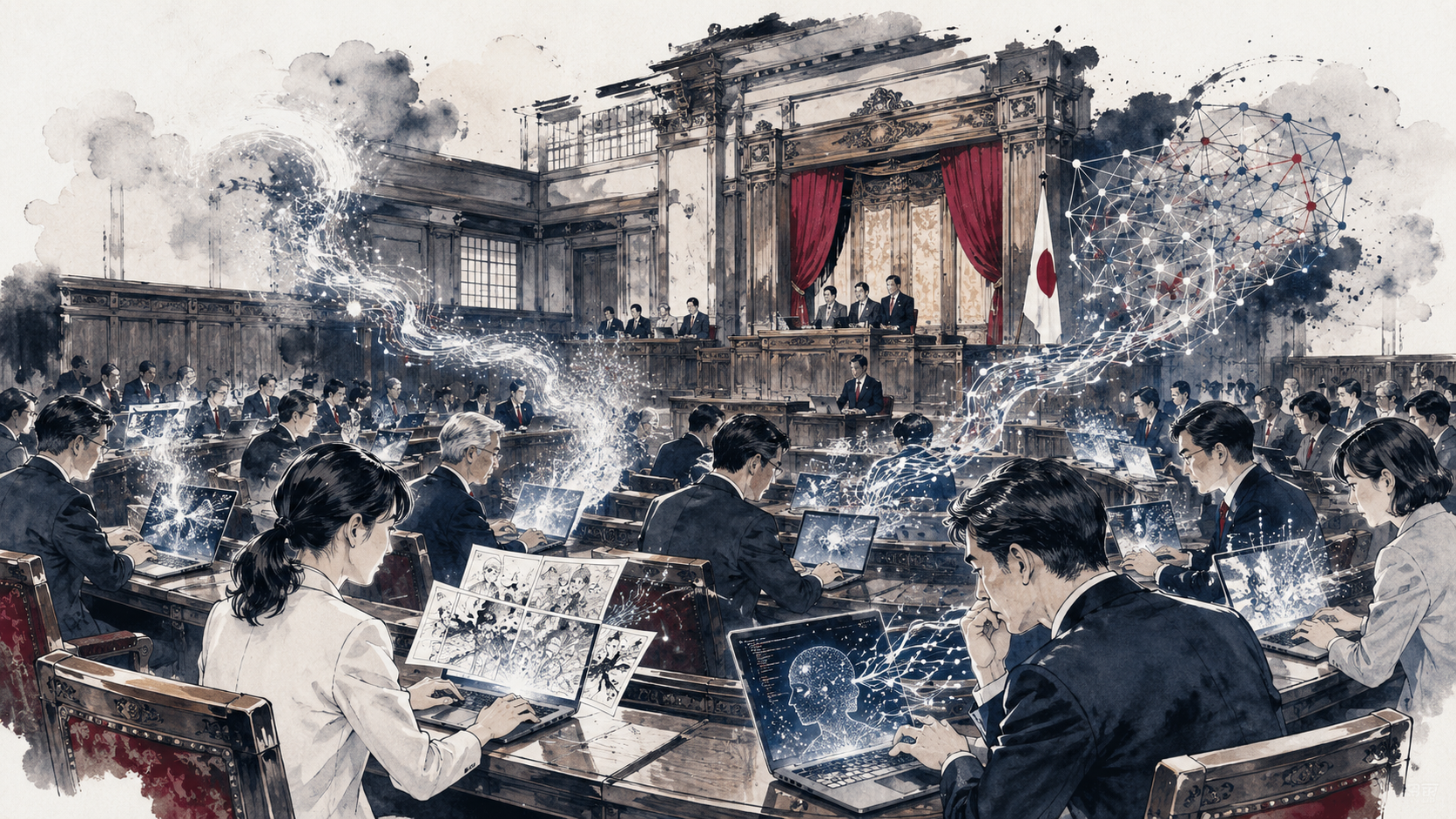
Eight years later, in a room inside the same Diet building, the exact opposite scene unfolded. Sitting lawmakers from both ruling and opposition parties faced their own laptops, ran AI with their own hands, and turned their own past Diet questions into works styled like a boys' manga.
What this contrast reveals is neither a debate about technology nor about generations. The true bottleneck that decides whether AI takes root in an organization is not the quality of the tools that frontline staff use. It is the single question of whether the people who make the decisions have ever touched the technology with their own hands.
Eight Years From "You Put It in a Hole" to Lawmakers Making Manga With AI
What made the answer by Yoshitaka Sakurada, then the minister for cybersecurity, a problem was not the absence of knowledge itself. The problem was that, while holding a position that shaped the nation's cyber policy, he had no experience of his own with the very thing he was governing. The metaphor of putting something "in a hole" captured, as vividly as anything could, that the technology had been carried into the decision-making chamber while remaining someone else's concern.
When decision-makers hold no firsthand experience of a technology, policy and strategy pile up on hearsay. Judgments built from secondhand phrases such as "apparently" and "they say" lack texture at the crucial point, no matter how thick the supporting documents are.
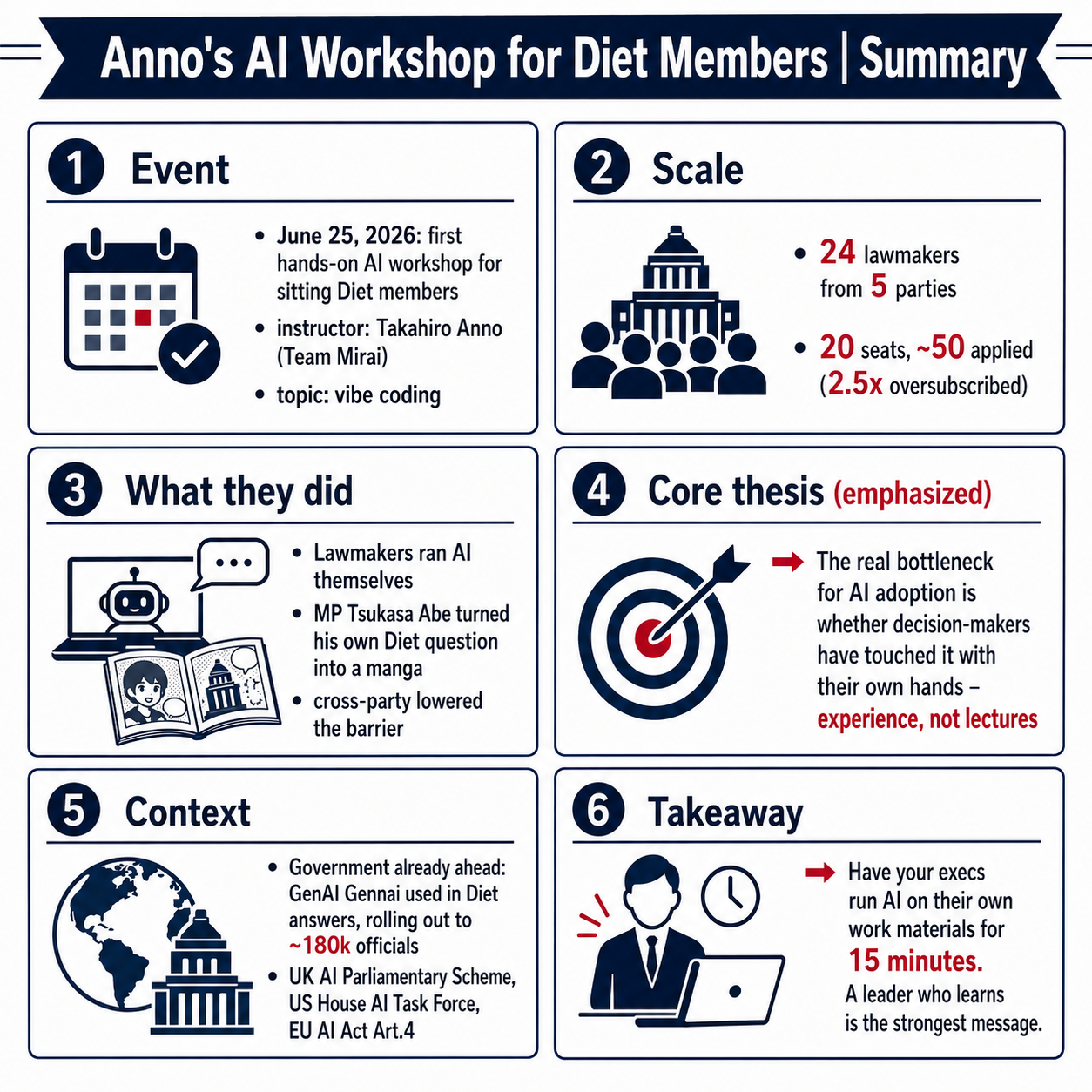
On June 25, 2026, that structure reached a turning point. On that day, inside the Diet, the first-ever AI workshop aimed at sitting members of the Diet was held. The instructor was Takahiro Anno, an AI engineer who is also a science fiction novelist.
This was not a training session where someone narrates an overview using slides. It was a hands-on format in which the lawmakers themselves had AI write code on the spot and built finished works. One participating lawmaker instructed the AI to "turn a Lower House member's Diet questions into a boys' manga," and completed a work based on their own questioning right there.
A technology described eight years earlier as something you "apparently put in a hole" has now become a tool that produces works from a lawmaker's own fingertips. This gap is precisely what gives the workshop its meaning.
What changed was not only the progress of the technology. The decision-makers stepped from being people who "watch" the technology to people who "touch" it. The fact that this shift happened in none other than the Diet is worth paying attention to.
A Capacity of 20, Around 50 Applicants — The Thirst for a "Place to Touch" Showed in the Numbers
A total of 24 Diet members from five parties took part in the workshop: the Liberal Democratic Party, the Japan Innovation Party, the Democratic Party for the People, the Centrist Reform Coalition, and Sanseito. Lawmakers of different parties and different standing faced the same tool in the same room.
What deserves the most attention is the number of applicants. Against a capacity of 20, around 50 people raised their hands — fully 2.5 times the capacity.
This number shows that a thirst to "try touching AI myself" existed among lawmakers far more strongly than anyone had imagined.
Anno, who organized the workshop, said he "would like to consider holding it for those who could not come today," signaling his appetite for a second session and beyond. The intent there is not a one-off event but a continuing place of learning to be nurtured over time.
What must not be overlooked here is the format of the workshop. Until now, whenever AI was discussed in the political arena, the focus was almost always on regulation or on overviews. How to regulate AI, how to contain risks, how it affects society — all important debates, yet none of them presume any experience of actually running AI oneself.
What was new about this workshop was that it overturned that premise. The theme was "vibe coding," the practice of having AI write code.
The lawmakers did not passively listen to explanations. They issued instructions to the AI with their own hands, received the output, and layered on further instructions. Through this back-and-forth, they confirmed the AI's capabilities firsthand.
Anno's words sum up the aim of the workshop plainly.
Knowing that AI can do this much is important when thinking about a wide range of policies.
There is a decisive gap between hearing, as knowledge, that "AI has these features," and running it with your own hands and feeling that "it can go this far." The former remains hearsay; the latter stays in the body as experience. What Anno aimed for was exactly this shift from hearsay to experience.
The fact that applicants reached 2.5 times the capacity is evidence that many lawmakers had been waiting for that shift. Something that was not satisfied by adding more training materials or stacking up more outside lectures had converged on the single act of "touching it yourself."
Why "Doing It By Hand" Works — Voices of Participating Lawmakers
Why does doing it by hand work so well? The voices of the lawmakers who took part point to some of the answers.
Tsukasa Abe, a Lower House member of the Japan Innovation Party, instructed the AI to "turn Lower House member Tsukasa Abe's Diet questions into a boys' manga," and built a work based on his own questioning. He then assessed it this way: "Leaving the things that are hard to make yourself to AI and steadily streamlining them — in that sense, it's genuinely useful as a new tool."
This remark has a texture that listening to an overview alone could never produce. It is not the abstract understanding that "it helps with efficiency," but the concrete understanding, drawn close to his own work, that "I can hand off the things that are hard to make myself."
Don't Stop at the Overview — Why Using the Material of Your Own Work Matters
What Abe used as his material was not generic sample data, but his own Diet questions. Here lies one of the reasons hands-on learning works.
A demo using someone else's material, however elaborate, ends up as a "well-made affair of someone else's." But when the output of your own work changes shape before your eyes, AI suddenly becomes a tool continuous with your own duties. The conviction that "this is usable in my own work" is born only in the moment your own material moves.
As long as it stays classroom-style, the vague sense that "AI is hard to understand" and "it's somehow frightening" lingers forever. Yet the experience of watching your own questioning data turn into manga before your eyes overwrites that sense in an instant.
Something incomprehensible becomes something you can handle. This qualitative shift does not happen no matter how many slides you flip through.
A Cross-Party Setting — Designing an Environment Where "Colleagues Are Touching It Too, Right Beside You"
Another point not to be missed is that this workshop was held across party lines.
Eriko Omori, a Lower House member of the Centrist Reform Coalition, assessed the cross-party format this way: "The hurdle felt lower, in a way. Because it was done across party lines, I could do it while talking with people from various parties, so it was a really good opportunity."
The sense of "the hurdle felt lower" spoken of here is not about the difficulty of the technology. It is about psychological barriers.
When touching a new technology for the first time, people fear failure. Those with standing, in particular, want to avoid being seen as "the only one who doesn't get it."
But when the colleague beside you, from another party, is fumbling with it in just the same way, that fear eases greatly. In a place where everyone is a beginner, the hurdle to admitting what you don't understand drops.
Designing an environment where members face the same tool across party lines was no accident, but a deliberate device to remove psychological barriers. Rather than pushing learning onto individual effort, the design of the setting makes it easier to step forward. This way of thinking is wisdom that extends beyond the world of politics to AI adoption in any organization.
It should be noted that this cross-party movement did not begin out of nowhere. Ahead of this workshop, on October 15, 2025, a cross-party Diet digitalization study group was launched, co-chaired by Anno and Masaaki Taira, the minister for digital affairs. Six parties — the LDP, Team Mirai, the Constitutional Democratic Party, Komeito, the Innovation Party, and the Democratic Party for the People — joined as officers, and the ground for confronting digital technology and AI across party lines was already being prepared.
The Message of Leaders Putting Themselves on the Learning Side
Let us step back one more notch to view what it means for lawmakers to touch AI.
In Japan today, AI is being placed at the core of institutions across both legislation and administration. The AI Promotion Act was enacted on May 28, 2025, and came into full force on September 1 of the same year. Under this law, which avoids excessive regulation, sets no penalties, and prioritizes promotion, an AI Strategy Headquarters has been established.
Furthermore, on December 23 of the same year, the Basic Plan for Artificial Intelligence — under the banner of "Japan's revival through trustworthy AI" — was approved by the Cabinet. AI is no longer a technical issue for one department; it has become a pillar of national strategy.
In a phase like this, it cannot be acceptable for the lawmakers who draft and deliberate policy to know AI only through hearsay. Whether designing regulation or steering promotion, the precision changes greatly depending on whether one has experience of moving the subject with one's own hands.
Administration Runs Ahead and Legislation Chases — A Lagging Decision Layer Constrains the Quality of Institutional Design
What is interesting is that the administrative side has already moved ahead.
On May 27, 2026, at a plenary session of the House of Councillors, Digital Minister Matsumoto used, for the first time in a plenary session, a draft answer prepared with "Gennai," a generative AI work-support system developed by the Digital Agency. The government is further advancing a plan to put in place, through this Gennai, a framework by which roughly 180,000 officials across all ministries will be able to use generative AI in fiscal 2026.
While the administration is working to embed generative AI into its operations as an organization, the legislative side has only just taken its first step in the form of a workshop. This structure of "administration running and legislation chasing" carries a lesson.
When the decision layer has not caught up with the technology, the quality of institutional design is constrained by that lag. As long as the people who decide how to regulate AI, how to promote it, and how to implement it in society do not know the subject as experience, the debate cannot help but stay within the realm of hearsay. This workshop can be read as a sign of the legislature's awareness that it must make up for that lag.
Other Countries Are Institutionalizing "Lawmaker Training" — Whether Japan's Workshop Ends as a One-Off Is the Dividing Line
Widening the view abroad, raising the literacy of the decision layer is already becoming an international trend. Major countries alike are seeking to guarantee the literacy of lawmakers and users not as a matter of individual mindset, but as institutions.
- The UK Parliament launched its first AI training for all members, the "AI Parliamentary Scheme," in 2025, and also set up a committee on AI. A mechanism for lawmakers to learn about AI is built in as an institution.
- In the United States, the House's bipartisan AI Task Force released its final report on December 17, 2024, emphasizing the importance of AI literacy education among its 66 key findings and 85 recommendations.
- In the EU, Article 4 of the AI Act took effect on February 2, 2025, expressly imposing on providers and users of AI systems the obligation to ensure "sufficient AI literacy."
What these share is a posture of embedding opportunities to learn by doing not as incidental events but as permanent mechanisms. That is the direction the world is moving.
Seen against this international context, one dividing line comes into view for Japan's workshop. Will it end as a one-off event, or will it grow into a mechanism for continuing training? Anno's appetite for a second session and beyond points to the latter, but whether it takes hold as an institution depends on the efforts ahead.
That said, it is hasty to think hands-on learning is a cure-all. There are also voices critical of lawmakers touching AI at all.
In situations that handle sensitive data tied to national governance, unless the design of which data to handle and how to handle it safely is in place first, the experience of doing it by hand carries its own danger. Acknowledging the value of touching it, it is essential to develop, in parallel, the framework of safe handling that must underpin it.
Creating places for hands-on experience, and setting the manners of handling. Only when both wheels are present can the literacy of the decision layer grow soundly.
Where Is the Bottleneck in Your Organization
The Diet scene we have followed so far can be laid directly over AI adoption in companies and organizations.
When an organization's use of AI fails to advance, we tend to lay the cause on the tools. If only there were an easier tool, if only we introduced a more capable product. Or: if only we thickened the training materials, if only we called in an outside lecturer.
But what that workshop, which drew 2.5 times its capacity, shows is a different answer.
The true bottleneck for AI adoption in an organization is neither the quality of the tools nor the thickness of the training materials. It comes down to a single point: whether the executives and decision-makers have ever, even once, run AI with their own hands and felt that "it can go this far."
Literacy is not acquired through classroom study. No matter how refined an overview slide you gaze at, AI remains "something you feel like you understand."
Yet the moment you throw in the material of your own work and the output comes back, AI turns into "a tool I can handle." Between a decision-maker who has gone through this shift and one who has not, the quality of the judgments they make afterward differs entirely.
Moreover, the very act of leaders putting themselves on the learning side becomes a powerful message to the organization.
Consider it. Sitting Diet members, of different parties and different standing, welcomed a single engineer as instructor and bowed their heads to be taught. When this scene happens in a workplace, how will the front line take it?
The sight of executives humbly learning before a new technology speaks more eloquently than any directive that "this organization means business." Conversely, if the top says "leave it to the front line" while never touching it themselves, that attitude too is conveyed to members more honestly than any directive.
That is exactly why the next move, starting tomorrow, is clear. Before adding one more overview slide to the next management meeting, have your executives bring the material of their own work and create a setting where they actually run AI — even just for 15 minutes.
Polish does not matter. Passing once through the experience of watching the material of your own work change shape before your eyes is the shortest path to releasing the bottleneck that has been constraining your whole organization's use of AI.
Eight years ago, technology was placed in the decision-making chamber as hearsay — something you "apparently put in a hole." Now, in that same place, the people who make decisions have begun to touch the technology with their own fingertips.
Whether this shift ends as an event of the political world alone, or becomes common sense for every organization — the dividing line rests on whether leaders can muster the courage to put themselves on the "touching" side.
References
- Team Mirai's Anno Leads AI Workshop, Teaching "Vibe Coding" for Policymaking (Nikkei)
- Diet Members Experience AI Use, With Team Mirai's Anno as Instructor (Jiji Press)
- Team Mirai's First AI Workshop for Diet Members Draws 2.5x Its Capacity (KSB Setonaikai Broadcasting)
- Team Mirai's Anno and Digital Minister Hold Cross-Party Study Group on Diet Digitalization (Nikkei)
- Takahiro Anno (Wikipedia)
- AI Act in Full Force — Toward the Next Phase (Cabinet Office)
- Basic Plan for Artificial Intelligence — "Japan's Revival" Through "Trustworthy AI," Cabinet Decision of Dec 23, 2025 (Cabinet Office)
- Digital Minister Matsumoto Uses Generative AI for a Diet Answer, a First in Plenary Session (Nikkei)
- Government AI "GENAI" (Digital Agency)
- The "Real Problem" Hidden in the Cybersecurity Minister's Remark
- The AI Parliamentary Scheme (Demos)
- House Bipartisan Task Force on Artificial Intelligence Delivers Report (House Committee on Science, Space & Technology)
- Article 4: AI literacy (EU Artificial Intelligence Act)