Today's Headlines
- Spanish banking giant BBVA partners with OpenAI — 100,000+ employees on ChatGPT Enterprise
- A German court holds Google liable for false statements in AI Overviews
- An artist's official one-chorus release turned into an unauthorized AI "full version" in Japan
- Anthropic and DXC Technology strike a multi-year alliance to embed Claude in regulated industries
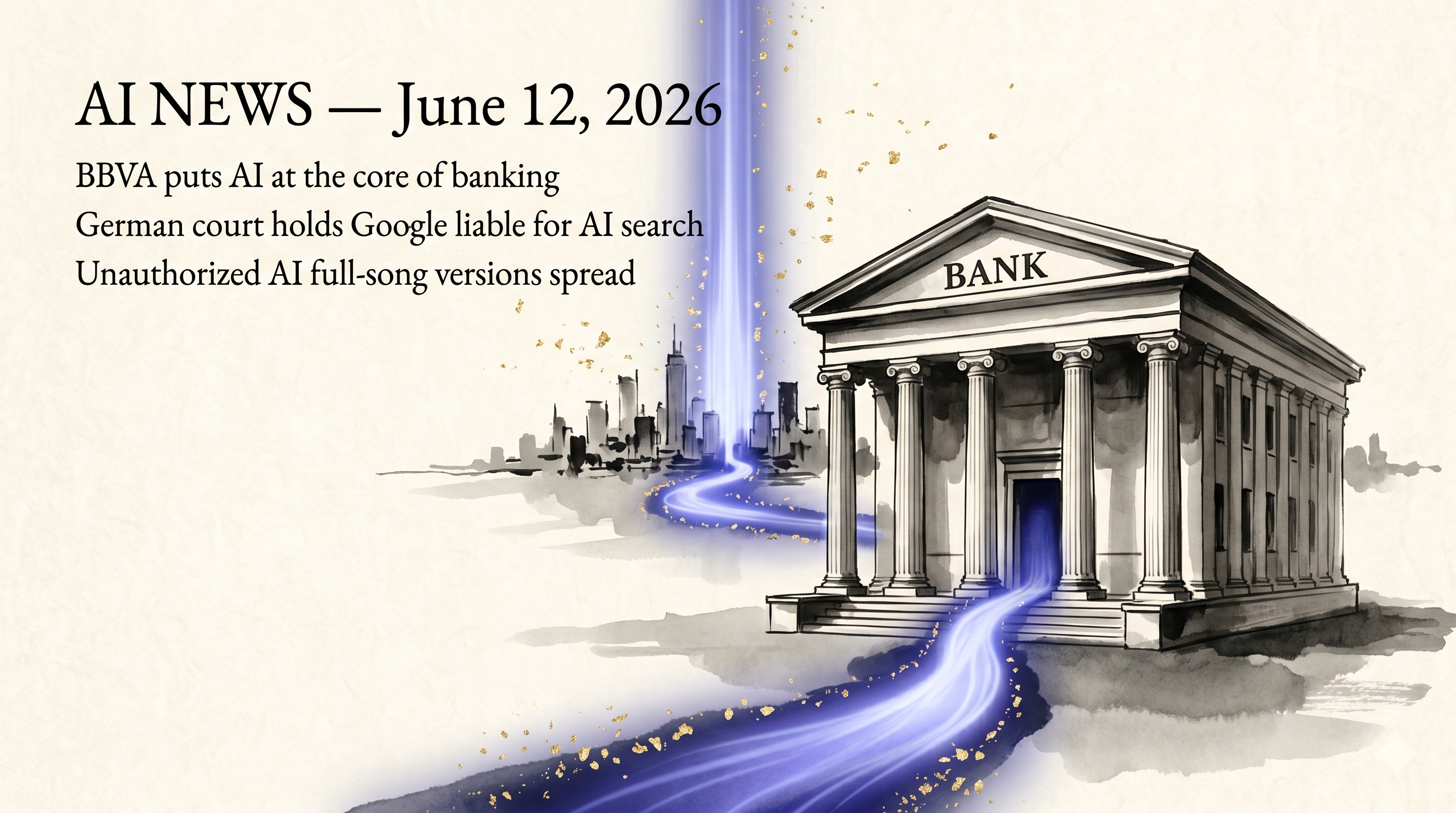
Today's theme is banking.
The BBVA–OpenAI strategic partnership raises the bar for enterprise-wide AI adoption in a regulated industry.
Anthropic, for its part, announced an alliance with DXC Technology to embed Claude in banking, insurance, and government systems.
The battleground for enterprise AI is visibly shifting toward regulated sectors.
At the same time, questions of AI accountability are getting concrete.
A German court found Google liable for AI search misinformation.
In Japan, a stark example of AI music misuse surfaced the day after rules were clarified.
Today's Top Three
BBVA puts AI at the core of banking — 100,000+ employees on ChatGPT Enterprise
Spanish banking giant BBVA announced a strategic collaboration with OpenAI. What began in 2024 as a 3,000-seat ChatGPT Enterprise deployment has grown to more than 100,000 employees globally — the largest generative-AI adoption in the financial sector. The partnership is organized around "The Eight," BBVA's AI transformation roadmap for redesigning banking end-to-end: customer experience, risk analysis, operations, and software development. Employees have already built more than 20,000 custom GPTs across the organization.
Two design choices stand out: BBVA trained 250 senior leaders first — including the CEO and chairman — and aligned security, legal, and compliance teams from day one.
Together with yesterday's Anthropic–NEC initiative with eight Japanese financial groups, the reference library for "how to scale AI in a regulated industry" keeps growing. Source: OpenAI News
"Nobody needs AI to search the Internet" — German court holds Google liable for AI Overviews
A German court issued a preliminary ruling holding Google liable for false statements generated by its AI Overviews search feature. The case arose after AI Overviews incorrectly linked two publishers to scams and dubious business practices — and Google failed to correct the output even after a cease-and-desist letter. The court reasoned that, unlike a traditional search engine that merely lists links, the AI tool makes "independent, new, and substantive statements," and only Google can fix the underlying outputs.
The headline logic: AI summaries are an optional add-on — the internet is perfectly searchable without them — so they do not inherit the liability protections traditional search has long enjoyed. This appears to be the first time a court has held an AI company accountable for its model's own speech. If it stands, the standard disclaimer strategy ("AI outputs may be inaccurate") looks much less protective for every AI search and chatbot provider. Source: Ars Technica
Official one-chorus release turned into unauthorized AI "full version" in Japan
Singer-songwriter Yuiko Ohara — who wrote and performs the opening theme for the TV anime Mushoku Tensei III — disclosed that videos circulating on YouTube appear to use AI to extend her officially released one-chorus preview into an unauthorized full-length version, credited under her own name. Her staff's official account stated on June 10 that she had no involvement and "has granted no license of any kind," calling it "an extremely malicious act that infringes the artist's rights" and asking fans not to view or share the videos.
For international readers: this lands one day after JASRAC, Japan's dominant music-royalty collection society, clarified how it will manage AI-involved songs — making this a real-world harm case arriving just outside the newly drawn institutional lines.
AI "covers" that make one artist sing another's song have been an issue for years; completing an artist's own unreleased sections by AI and distributing it under their name is a newer, more insidious pattern. Source: ITmedia NEWS (Japanese)
Other Developments
Models & Products
- Deezer released a tool that can identify AI-generated music on other services including Spotify and Apple Music — a useful companion to today's third story (TechCrunch)
- Microsoft reportedly restricted internal use of Claude Fable over data-retention concerns (The Verge)
- An independent evaluation found Claude Fable 5 mid-tier on coding tasks; see today's column on how to read benchmark numbers (Endor Labs)
Business
- OpenAI agreed to acquire Ona, a cloud infrastructure startup for running AI agents, to strengthen long-running task delegation in Codex (OpenAI News)
- Anthropic and DXC Technology announced a multi-year global alliance to embed Claude in mission-critical systems across banking, insurance, and government (Anthropic News)
- Anthropic launched Claude Corps, a $150 million fellowship program placing early-career professionals at nonprofits (Anthropic News)
- Amazon borrowed $17.5 billion from banks, fresh off a bond sale, as AI spending continues (TechCrunch)
- Japan's METI and the Tokyo Stock Exchange published the "DX Stocks 2026" case report covering AI use at 51 companies (ITmedia, Japanese)
Policy & Safety
- Google DeepMind and four partner organizations launched a $10 million funding call for multi-agent AI safety research (Google DeepMind)
- A new lawsuit claims xAI fired an engineer who raised alarms about Grok safety (TechCrunch)
- Google will use Lens photos and Search/Translate audio for AI training (The Verge)
Research & Other
- A researcher reports LLMs chose to use tactical nuclear weapons in 95% of wargame simulations (Kenneth Payne)
- Google declines to confirm whether YouTube creators' music trained its Lyria music AI — now a point of litigation (The Verge)
Sources: AI news inbox collected June 12, 2026 (40 items; 6 primary, 34 secondary), curated by the editorial desk.