Today's Headlines
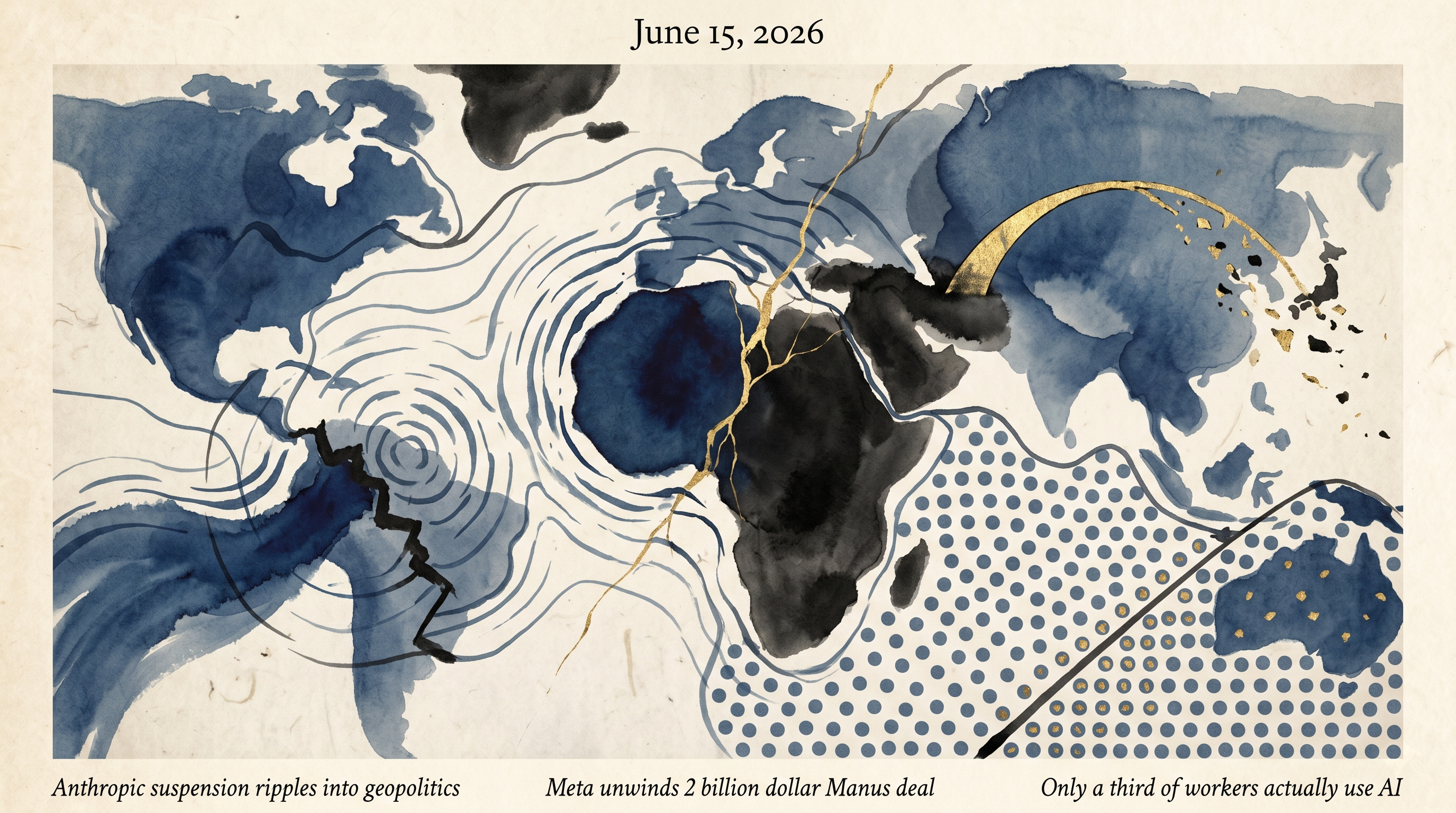
- Anthropic suspension fallout — India revisits sovereign AI, and a report raises the possibility China accessed Mythos
- Meta moves to unwind its $2B Manus acquisition under a Beijing order
- "Everyone uses AI for everything" is a myth — only about a third of working-age people actively use it
The Monday after a weekend is less about fresh announcements than about how recent events spread. The model suspension we covered over the weekend is no longer a purely domestic US matter.
It is now feeding into India's debate over sovereign AI and into security questions involving China. Separately, US-China tech friction has surfaced inside a private acquisition. And new data invites a look at how much AI is actually used day to day.
Today's Three Stories
Anthropic Suspension Ripples Into Geopolitics, India Rethinks Sovereign AI
The weekend's export-control directive has reignited India's debate over sovereign AI, TechCrunch reports.
The directive that led Anthropic to suspend access to its newest Fable 5 and Mythos 5 models was covered in our June 13 special edition and June 14 briefing. What is new today is the reporting on how the fallout reaches Indian startups and policymakers.
According to TechCrunch, Indian investors and policy figures are openly questioning their reliance on US-built AI. Venture investor Aakrit Vaish said the move "materially changes the way all of us should be thinking about sovereign AI in India." Zoho's Sridhar Vembu argued for embracing smaller Indian and Chinese open-source models, and investor Mohandas Pai called on the government to create an annual fund of about 500 billion rupees for AI and deep tech, the report says.
These are individual views rather than official government policy. The article also cites a policy expert's view that the measure could provoke a significant nationalist backlash in India.
On the origin of the suspension, separate reporting points to concerns over a jailbreak — a bypass of safety controls. The Verge reports that China may in some way have accessed Anthropic's newest Mythos model, with the White House involved in the response. Both remain reported possibilities; neither China's involvement nor any access has been confirmed.
Sources: As Anthropic suspends access to new models, India debates its AI future (TechCrunch) / China may have accessed Mythos (The Verge)
Meta Moves to Unwind Its $2B Manus Acquisition Under a Beijing Order
Meta is moving to unwind its roughly $2 billion acquisition of the Chinese-founded AI startup Manus, TechCrunch reports.
According to the report, Chinese regulators about two months ago ordered the deal reversed, citing national security concerns alongside potential violations of technology export controls and foreign investment rules. In response, Meta is completing an operational separation — cutting Manus off from its internal systems and halting data sharing between the two companies.
Manus co-founders have held preliminary discussions about raising roughly $1 billion from outside investors to reclaim the business from Meta, the report says. A path involving a Chinese joint-venture structure and an eventual Hong Kong listing has also been floated.
The case shows US-China tech friction surfacing as a regulator's direct intervention in a private M&A deal. For companies weighing partnerships with Chinese AI firms, it marks where the regulatory risk sits.
Source: Meta reportedly moves to unwind $2B Manus deal after Beijing's demand (TechCrunch)
"Everyone Uses AI for Everything" Is a Myth — Active Use Sits at About a Third
Only about a third of the working-age population actively uses AI, according to an analysis published by DuckDuckGo founder Gabriel Weinberg.
Weinberg triangulates several studies into three tiers of the US working-age population: roughly a third who use AI actively, a third who use it occasionally, and a third who rarely or never do. Microsoft's data puts active users — those engaging with AI for 90-plus minutes a month — at about 30 percent, leaving roughly 70 percent below that bar. A Datos study found only 21 percent of desktop devices visit AI tools ten or more times a month, while 62 percent visit none.
The leading reasons people give for avoiding AI are fear that it will replace jobs (42 percent), violate privacy (35 percent), and spread misinformation (33 percent).
AI also trails other technologies on net sentiment. In the survey Weinberg cites, AI's net positive impact on society sits at plus 8 percent — close to social media at plus 7 percent, and far below cell phones (plus 68 percent) or the internet (plus 67 percent). The data suggests the tech industry's narrative overstates how far adoption has actually spread.
Source: Not everyone is using AI for everything (gabrielweinberg.com)
Other Developments
Business
- SpaceX completed what is described as the largest IPO ever, and both OpenAI and Anthropic have reportedly filed confidentially to go public — a sign of accelerating AI-driven realignment in capital markets (TechCrunch)
Models and Products
- MONO BRAIN released a free Claude Code plugin, Mamorak Secret, that monitors the agent's inputs and outputs to block leaks of credentials such as API keys (ASCII.jp)
- Mercedes-Benz said its new S-Class will ship with ChatGPT and Google Gemini as standard — an instance of a premium car carrying multiple AI assistants at once (ASCII.jp)
Policy
- Nex-AGI alleges that Rio de Janeiro's homegrown LLM, "Rio-3.5-Open-397B," is in fact an undisclosed merge of its own model with Qwen3.5, raising questions about claims of locally built public-sector AI (GitHub)
Other
- The IEEE VLSI Symposium 2026 opened in Honolulu, with AI-driven memory, advanced packaging, and AI-assisted circuit design as central themes (PC Watch)
Source: Selected by the editors from the AI news inbox (collected June 15, 2026 — 10 items, 0 primary, 10 secondary).