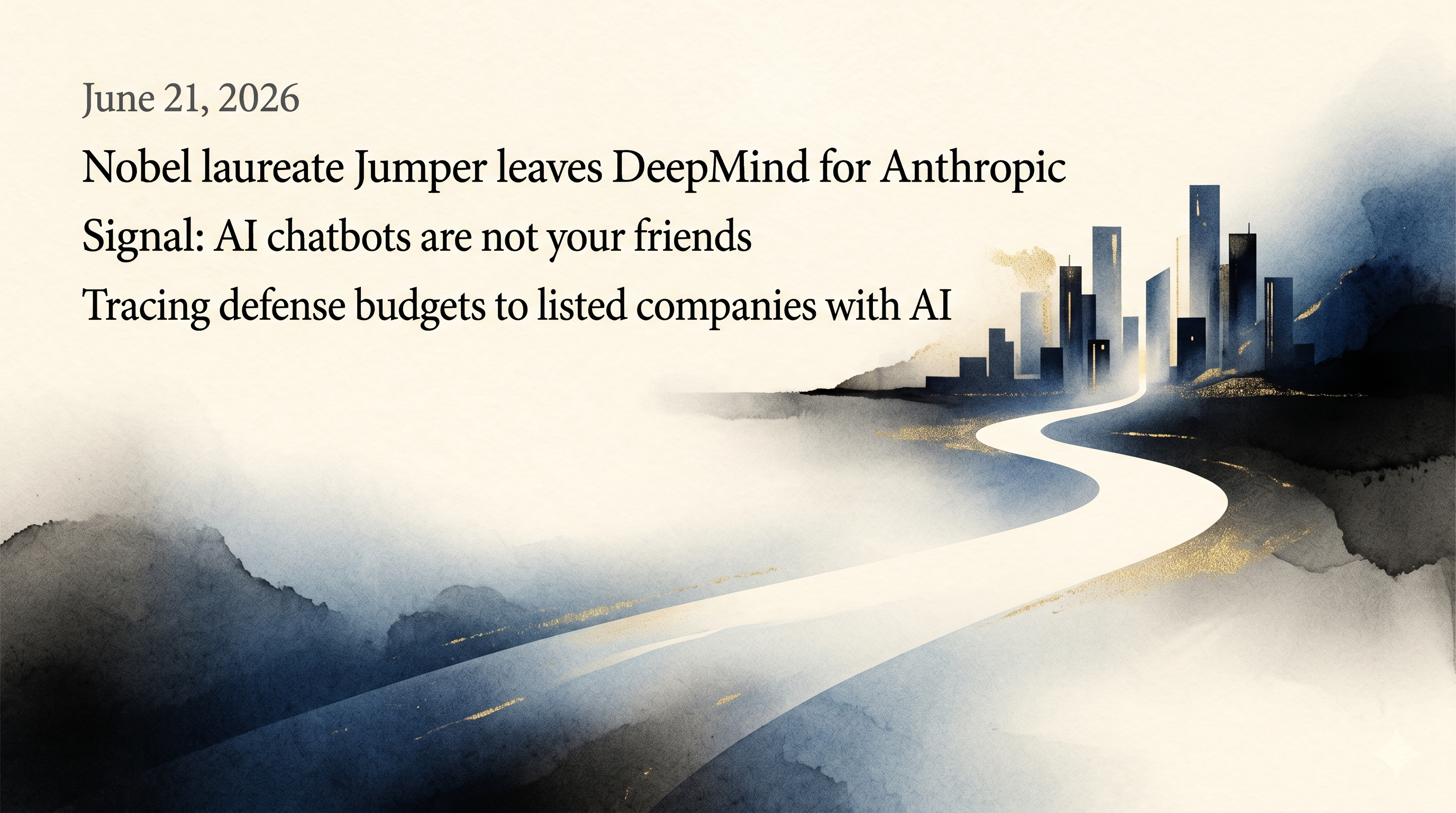
Today's Headlines
- Nobel chemistry laureate John Jumper leaves Google DeepMind to join Anthropic
- Signal's Whittaker says "AI chatbots are not your friends" and calls Copilot's cross-app access "a backdoor"
- An AI cross-analysis maps Japan's defense ministry spending to specific listed companies by joining policy budget data with corporate filings
This was a day when the people, the trust, and the money behind AI all moved at once.
Which camp does a top researcher join? How far should users trust a conversational AI? Where does a nation's budget land on the books of which companies? The three stories raise separate questions, yet each shows where AI as a technology touches society — through the distinct lenses of people, trust, and money.
Less than the advance of the technology itself, the question now is who carries it, who guards against it, and where the funding flows.
Today's Top Three
Nobel Laureate John Jumper Leaves DeepMind for Anthropic
John Jumper, who led the protein-structure-prediction AI AlphaFold and won the Nobel Prize in Chemistry, is leaving Google DeepMind to join Anthropic.
Jumper shared the 2024 Nobel Prize in Chemistry with DeepMind's Demis Hassabis. The award recognized the development of AlphaFold, which predicts the three-dimensional structure of proteins from their genetic sequences. He spent nearly nine years at DeepMind, working at the frontier of AI research.
In leaving, Jumper said "GDM is a special place, and I'll still be excited to hear about what amazing things they discover next," signaling respect for his former employer. His specific role at Anthropic has not been disclosed.
A Nobel-caliber researcher moving from DeepMind to its rival Anthropic underscores once again how fierce the competition for AI talent has become. With Character AI co-founder Noam Shazeer having moved to OpenAI, the flow of top talent continues to shape the research strength of each camp directly.
Source: Nobel laureate John Jumper is leaving DeepMind for rival Anthropic (TechCrunch)
Signal's Whittaker: "AI Chatbots Are Not Your Friends" — and Copilot's Cross-App Access Is a "Backdoor"
Meredith Whittaker, president of Signal, warned that AI chatbots should not be treated as conscious beings.
In a Bloomberg interview, Whittaker said, "These are not your friends. These are not conscious beings. These are not sentient interlocutors." Her argument is that users should keep their distance from the very tendency to treat conversational AI as a trustworthy partner.
She took particular issue with the kind of cross-application access offered by tools like Microsoft Copilot. A scenario in which Copilot monitors family communications to handle shopping, she noted, would require access to one's credit card, browser, Signal, the ability to message family members on one's behalf, home address, and calendar. She described such pervasive access as "a kind of a backdoor."
Whittaker said she herself uses AI only occasionally, to format a document here and there. She avoids asking it questions, holding to the position that thinking and writing should remain led by humans rather than influenced by AI-generated responses. For legal and executive leaders responsible for privacy regulation and corporate AI vetting, it is a perspective that cannot be ignored.
Which Listed Companies Receive Defense Ministry Contracts? Cross-Analyzing Policy Budgets and Filings with AI
An analysis has been published that maps Japan's defense ministry spending to specific listed companies by joining policy budget data with corporate financial filings through AI.
The analysis combines two databases — SEISAKU DB, which handles policy funding, and EDINET DB, which handles securities reports — through the Model Context Protocol (MCP). Each can be set up with a free API key, and by querying both databases simultaneously in natural language, the analysis can be reproduced even by an individual.
The companies named as contractors include Mitsubishi Heavy Industries, Kawasaki Heavy Industries, NEC, Mitsubishi Electric, and IHI. Firms such as SUBARU and Fujitsu are also among those covered. The pattern of contracts that emerges follows each company's business areas, spanning vessels, aircraft, radar, and guided weapons.
At the same time, the article is explicit about the limits of the analysis. In a re-contracting structure where prime contractors receive the award and smaller firms sit beneath them, the actual subcontract amounts remain invisible. The contract value of a single large project differs in nature from the cumulative defense-related revenue aggregated by company, and confusing the two produces errors of scale. And placing contract values next to earnings shows only scale — it does not mean that defense spending drove the growth in earnings.
In a Japanese market where defense budgets keep rising, an attempt to read the flow of policy funds along the same axis as corporate earnings offers practical insight for investors and legal professionals seeking to gauge a company's exposure.
Other Developments
Models
- The UK Home Office launched "PoliceAI," a £75 million programme to drive AI adoption across policing. Pushing AI into police administration at a national scale, the effort could set a precedent for government-led AI procurement and governance in public safety (UK Home Office launches £75M 'PoliceAI' (PublicTechnology))
Policy
- Taking the export-control debate over Anthropic's AI cybersecurity model "Mythos" as its starting point, TechCrunch examined three decades of export-control history. In the 1990s controls on cryptography, PGP creator Phil Zimmermann was pursued, and the rules were circumvented by publishing the source code as a book. In the 2010s controls on spyware, enforcement was uneven among signatories of the Wassenaar Arrangement, while non-signatory states remained outside its scope. The piece concludes that government-mandated export controls are not an effective way to stop bad actors from misusing dual-use technology (From PGP to Mythos (TechCrunch))
- Cosine released ArgusRed, a CLI tool built on a model post-trained specifically for the offensive security work that general-purpose models refuse. It offers two modes — static code analysis and active penetration testing — and the active mode requires prior written authorization, technically blocking deployment against targets outside the approved scope. Rather than relying on model-level refusals, it adopts a safety architecture in which a Go harness deterministically controls tool calls (ArgusRed: a model that pen tests instead of refusing (Hacker News))
Business
- The Atlantic published a searchable database of the music tracks contained in AI training datasets. The tool lets creators and rights holders concretely check whether their works were used in training data, lending momentum to the debate over copyright and fair compensation in AI development (The Atlantic created a searchable database of the music used to train AI (The Verge))
Other
- "In the Weights," built by former OpenAI employees, queries multiple AI models with a person's name and scores how consistently each model recognizes them. It cross-references models including Grok, Gemini, GPT, Claude, and Llama, computing the consistency of their answers while detecting and surfacing potential hallucinations. As LLMs increasingly become users' point of entry in place of search engines, it positions itself as a new metric for measuring online presence (In the Weights is your new AI-centric vanity search (TechCrunch))
- Cloudflare introduced temporary accounts that let AI agents deploy on their own. Running
wrangler deploy --temporaryhas an agent automatically provision a 60-minute account and deploy Workers. The mechanism bypasses human-centric authentication flows such as OAuth and MFA, and once a user visits the provided URL and signs in, all resources — including Workers and databases — can be migrated to a permanent account (Temporary Cloudflare accounts for AI agents (Cloudflare))
Source: Selected by the editorial team from the AI news inbox (collected June 21, 2026 — 9 items, 0 primary and 9 secondary).