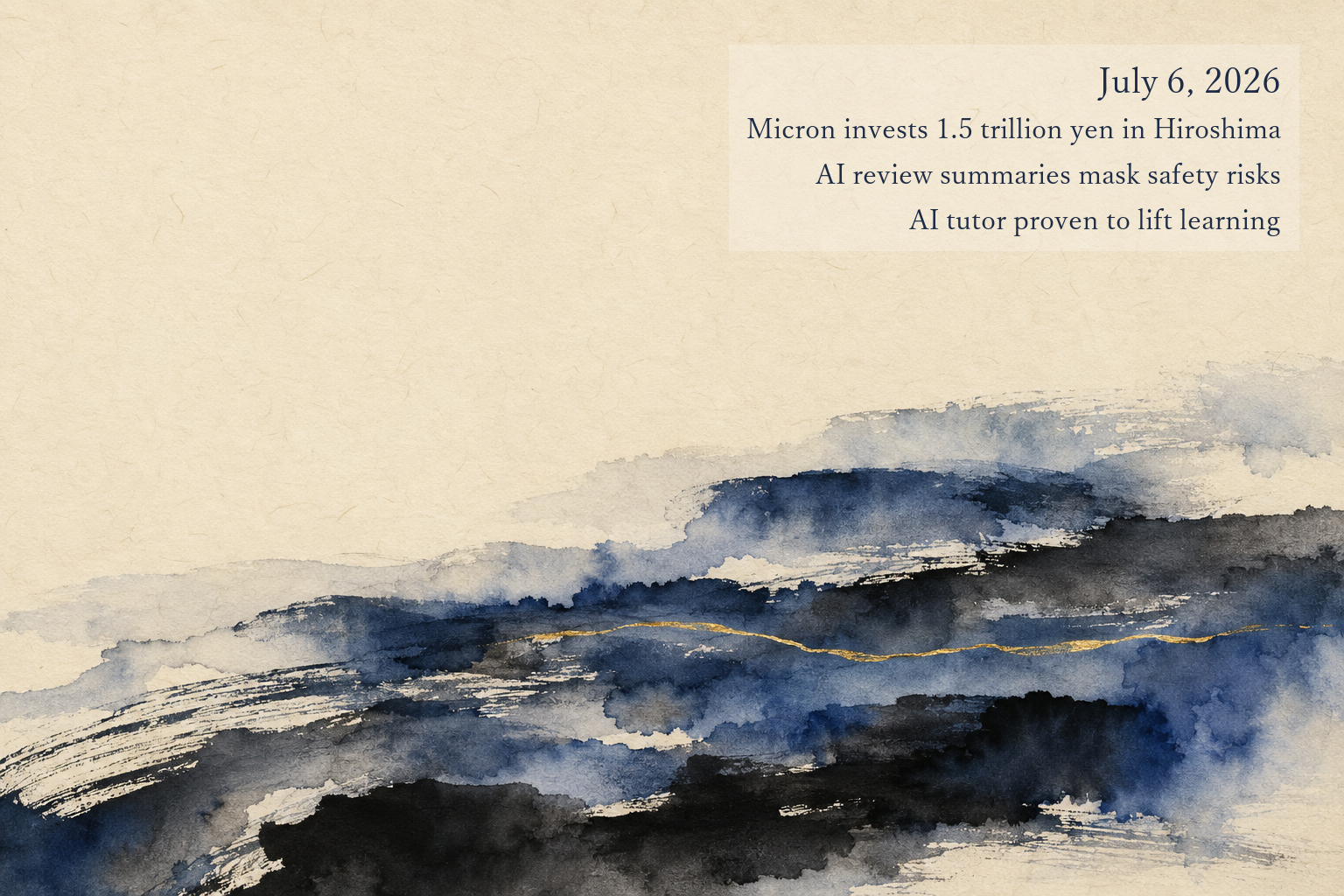
Today's Headlines
- Micron breaks ground on a new building at its Hiroshima plant, committing 1.5 trillion yen to expand memory output for AI and data centers
- A consumer watchdog finds Tripadvisor's AI-generated summaries described hotels with food-poisoning outbreaks and deaths as having "perfect" cleanliness
- Dartmouth's AI tutor "Phosphor" delivers a measured learning effect of 0.71–1.30 SD in an introductory statistics course
What stood out today was that both the benefits and the harms of AI surfaced with concrete numbers attached.
On one side, a memory maker is committing more than a trillion yen in capital spending on the expectation that AI demand will hold. On the other, an AI summary already in production is being blamed for potentially steering travelers toward dangerous hotels. Between them, a case that embedded AI in teaching and actually measured the outcome offered firm evidence on the benefit side.
Today's Top Three
Micron Commits 1.5 Trillion Yen to Expand AI Memory in Hiroshima
Micron held a groundbreaking ceremony for a new building at its Hiroshima plant to meet surging demand for AI and data-center memory.
The total investment comes to roughly 1.5 trillion yen, of which up to 536 billion yen is expected to be subsidized by the Japanese government. The roughly 28,000-square-meter facility will house production lines for advanced DRAM, including HBM, DDR5 and LPDDR. Mass production is targeted for mid-2028.
The bet rests on a view that demand for the memory underpinning AI training and inference will hold for some time. High-bandwidth memory (HBM) in particular, which moves large volumes of data at high speed, is a core component for AI systems, and securing capacity for it is now advancing on Japanese soil.
Tripadvisor's AI Summaries Called Dangerous Hotels "Perfect" on Cleanliness
A Which? investigation found that Tripadvisor's AI-generated hotel summaries described properties with serious safety problems in glowing terms.
The summaries sit at the very top of each hotel page, yet they failed to surface serious safety risks. Critics warn that a traveler reading only the summary could end up booking a dangerous property.
At the Riu Palace Santa Maria in Cape Verde, the AI summary called cleanliness "perfect." In reality, the property had 102 reports of food poisoning, seven deaths since 2023, and legal action involving more than 400 people underway.
At the Garza Blanca in Cancún, Mexico, the summary described the stay as "truly perfect" despite food-poisoning reports from multiple guests.
At the Kaia Coracesium in Turkey, a report of sexual harassment was downplayed in the summary as little more than a "service issue."
Tripadvisor says its summaries reflect both positive and negative reviews and are not meant to replace reading individual reviews.
Dartmouth's AI Tutor "Phosphor" Proves Its Worth in a Statistics Course
Dartmouth College piloted Phosphor, a learning platform that grades constructed-response questions with Claude Sonnet 4.6, across three sections of an introductory statistics course with 151 students.
Final-exam performance rose by an effect size of 0.71 SD (adjusted for prior performance) to 1.30 SD (unadjusted). Even though the tool was entirely optional and ungraded, 90.2% of students used it, far exceeding the 10–15% reading-compliance rate typical of the course.
The format itself was what produced the effect. In units with constructed-response (CRQ) quizzes, the number of completed tasks correlated with performance. In units with multiple-choice (MCQ) questions only, that correlation disappeared.
Cumulative checkpoints mattered a great deal as well. Students who passed all three cumulative quizzes scored 7.1 points higher on the final (effect size d=0.66), the single strongest predictor.
One feature saw little use. The RAG-based chat assistant drew just 72 total queries, with students saying a general-purpose LLM was faster and more capable.
Other Developments
Business
- Amazon will stop accepting new customers for its crowdsourcing marketplace, Mechanical Turk, effective July 30, 2026. Existing customers can keep using the service, but no new features are planned. A 2023 analysis had estimated that 33–46% of workers were using LLMs to complete tasks, eroding trust in the reliability of human-performed work. - Amazon will stop accepting new customers for Mechanical Turk (TechCrunch AI)
Product
- Google released a Workspace ad titled "Group project, but make it 1776," depicting Thomas Jefferson and Benjamin Franklin drafting the Declaration of Independence with help from Google Workspace and Gemini, drawing a divided response online. Audiences on YouTube and Instagram reacted largely positively, while historians on Bluesky criticized it as unconvincing for applying AI to a scene where human judgment, such as political consensus-building, is the whole point. - Infuriating Google commercial imagines the founding fathers embracing AI (The Verge AI)
- Microsoft's Surface Laptop 13 special edition, with an 8-core Snapdragon X Plus, 16GB of memory and 1TB of storage, is selling on Amazon for 142,362 yen, 13% off its 162,800 yen reference price. Putting a Copilot+ PC with a 45 TOPS NPU at around 140,000 yen lowers the entry point for AI-ready laptops. - Surface Laptop special edition with Snapdragon X Plus and 1TB storage drops to about 140,000 yen (ASCII.jp)
Research
- A study drawing on interviews with 18 UK-based domestic workers built a sociotechnical threat model for the surveillance and data-management risks created by AI-powered smart home devices, and was accepted at USEC 2026. It finds that employer-controlled homes amplify surveillance through AI analytics and cross-household data flows, while worker-owned devices raise their own issues stemming from unclear administrative responsibilities and ambiguous data-retention policies. - A sociotechnical threat model for AI-driven smart home devices (Hacker News)
Source: Selected by the editorial team from the AI news inbox (collected July 6, 2026; 7 items, 0 primary and 7 secondary).