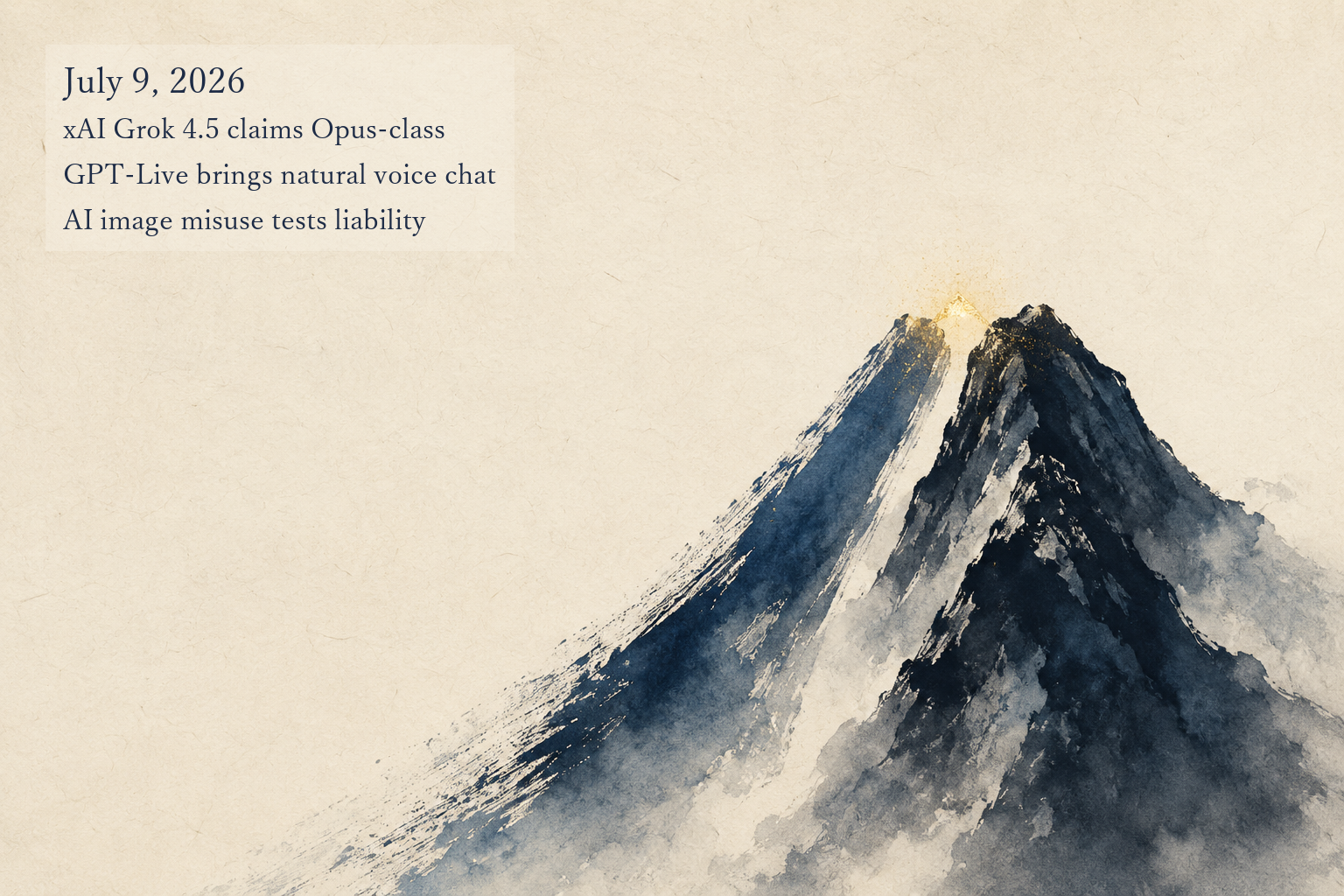
Today's Headlines
- xAI released its new Grok 4.5 model, with Elon Musk calling it "Opus-class" at less than half a rival's price
- OpenAI unveiled GPT-Live, a full-duplex voice model that can listen and speak at the same time for more natural conversation
- A class action over child sexual abuse material (CSAM) generated with Grok added new plaintiffs, putting generative-AI platforms' reporting duties and liability at issue
What stood out today was that the conversation split in two directions.
On one side is a performance race built on faster, cheaper models. On the other is a reckoning with how that performance is measured — the reliability of benchmarks — and a legal question about what a generative-AI platform owes, and how far, when its tools are misused. The speed of building and the responsibility for how something gets used showed up side by side on the same day.
Today's Top Three
xAI Releases Grok 4.5 — Musk Calls It "Opus-Class"
xAI released a new model, Grok 4.5, which Elon Musk described as "Opus-class."
Musk called Grok 4.5 "an Opus-class model, but faster, more token-efficient and lower cost," saying it performs roughly on par with Anthropic's Opus 4.7 while running faster. It is priced at 2 dollars per million input tokens and 6 dollars per million output tokens, well below Opus 4.7's 5 and 25 dollars. The model targets coding and agentic work and was trained alongside the coding editor Cursor.
xAI's own published benchmarks, however, do not fully bear out the "Opus-class" framing. Across the four evaluations xAI showed — DeepSWE 1.0, DeepSWE 1.1, Terminal-Bench 2.1 and SWE-Bench Pro — Anthropic's Fable led every one, and Grok 4.5 beat Anthropic's higher-end Opus 4.8 on only two of them (DeepSWE 1.0 and Terminal-Bench 2.1). Opus 4.8 came out ahead on the other two, DeepSWE 1.1 and SWE-Bench Pro. "Opus-class," in other words, is Musk's claim; on the published numbers the wins and losses fall differently depending on the rival and the benchmark.
The substance behind the low-cost pitch is token efficiency. By xAI's own figures, Grok 4.5 resolves a SWE-Bench Pro task in about 15,954 output tokens on average, roughly 4.2 times fewer than Opus 4.8 (about 67,020), and is served at 80 tokens per second.
These figures are worth reading with care: each company measured them in its own harness. Unless the source and the method are aligned, the rankings should not be taken at face value.
- SpaceXAI releases Grok 4.5, which Elon describes as an 'Opus-class model' (TechCrunch AI)
- Introducing Grok 4.5 (SpaceXAI)
OpenAI Unveils GPT-Live — a Full-Duplex Voice Model That Listens While It Talks
OpenAI released GPT-Live, a new voice model built on a full-duplex architecture that can listen and speak at the same time.
GPT-Live processes what it hears while generating its reply in parallel. It can offer listening cues like "mhmm," or simply stay quiet while you gather your thoughts. Earlier ChatGPT voice chained speech recognition, a language model and text-to-speech in sequence, or used turn-taking that judged the end of a turn by silence. GPT-Live is meant to remove the latency and the unnatural interruptions that those approaches produced.
When a question needs web search or deeper reasoning, GPT-Live hands the work to a frontier model behind the scenes and returns the result to the conversation once it is ready. At launch it uses GPT-5.5 in the background, and OpenAI says it will keep swapping in newer models over time.
The rollout brings two versions, GPT-Live-1 and GPT-Live-1 mini, to ChatGPT users worldwide starting today. Per TechCrunch and The Verge, free users get the mini model by default, while paid tiers gain the larger GPT-Live-1. API access is expected soon.
By OpenAI's count, more than 150 million people talk to ChatGPT each week through features like Voice and Dictation — the experience this release aims to lift.
- Introducing GPT-Live (OpenAI)
- OpenAI releases new voice models for more natural live conversations (TechCrunch AI)
- ChatGPT's upgraded voice mode is better at shutting up (The Verge AI)
A Grok CSAM Lawsuit Adds Plaintiffs — Platform Reporting Duties at Issue
A class action over child sexual abuse material (CSAM) generated with xAI's Grok added new plaintiffs on July 7.
According to the amended complaint, a stepfather used Grok to generate more than 7,000 unlawful images and videos from a single photo taken when his stepdaughter was 11, and distributed them online. That count is the approximate figure confirmed in a forensic review of seized devices. The stepfather died by suicide after his arrest.
The central issue in the suit is the allegation that xAI failed to cooperate with law enforcement. In the US, providers are required to report CSAM to the National Center for Missing & Exploited Children (NCMEC) when it is detected. The complaint alleges that xAI's report included only the original photo and omitted the generated images and the IP address — information essential to identifying the perpetrator — so that the investigation was obstructed for weeks.
The plaintiffs' lawyers argue this is not an isolated case. They cite a finding by NCMEC in early 2026 that roughly 90 percent of xAI's CyberTipline reports "were not actionable by law enforcement because xAI declined to include user information."
The suit challenges platform responsibility from two angles: liability for offering a dangerous image-manipulation capability in the first place, and responsibility for how far it met its duty to report misuse. How existing reporting obligations and product-liability frameworks apply to content produced by generative AI is what this case will test.
More to Note
Models
- Google reportedly overhauled the scoring of its Android Bench AI coding benchmark, switching to a standardized Harbor framework. In the new rankings, Anthropic's Claude Fable 5 topped the board at 84.5, ahead of GPT-5.5 at 80.2 and Claude Sonnet 5 at 76.2, while Google's own Gemini 3.1 Pro Preview trailed at 73.7 — its model behind rivals on its own benchmark. - Google updates Android Bench with new LLMs, but Gemini still lags behind (Ars Technica AI)
- Cognition released SWE-1.7, a coding-focused model trained with reinforcement learning on top of Kimi K2.7. It edged out GPT-5.5 on SWE-Bench Multilingual (77.8% to 76.8%), while falling just short of GPT-5.5 and Opus 4.8 on Terminal-Bench 2.1 and FrontierCode 1.1. It is served at 1,000 tokens per second via Cerebras. - SWE-1.7 Reach Near GPT 5.5 and Opus Intelligence (Cognition)
- Microsoft open-sourced Flint, a visualization intermediate language for AI agents. Using more than 70 semantic field types such as Rank, Price, and Country, it auto-derives scales and axes and renders to Vega-Lite, ECharts, or Chart.js. An accompanying MCP server lets agents create and validate charts directly from chat or coding tools. - Microsoft releases Flint, a visualization language for AI agents (Hacker News)
- Anthropic expanded its "Claude for Open Source" program, which gives eligible open-source developers six months of free access to its top Claude Max 20x tier. Newly eligible groups include maintainers of projects with 100+ dependent packages or 200,000+ monthly downloads, and developers who merged 100+ pull requests in the past year. - Anthropic expands free Claude Max 20x access for open-source developers (ITmedia AI+)
Research
- OpenAI audited the SWE-Bench Pro coding benchmark and found that of its 731 public tasks, an automated pipeline flagged 200 (27.4%) as broken while a five-reviewer human campaign flagged 249 (34.1%), citing overly strict tests and underspecified prompts. Because flawed evals can misrepresent model safety and capability, OpenAI retracted its earlier recommendation to adopt SWE-Bench Pro. Notably, on the same day, xAI presented some of Grok 4.5's results on SWE-Bench Pro. - Separating signal from noise in coding evaluations (OpenAI)
- Engineer Dan Luu published an essay warning that agentic coding tools and LLM benchmarks show high run-to-run variance, making single-run comparisons unreliable. He notes that even results from 50 runs can flip depending on how the benchmark is built — a caution for companies leaning on benchmark scores alone to guide AI adoption. - Notes on agentic coding, LLM benchmarks, and variance (Hacker News)
Products
- Google Photos added Video Remix, a Gemini-powered AI editing tool that can relight footage, swap backgrounds, or apply artistic styles like watercolor and oil painting in seconds. It began rolling out July 8 to Google AI Plus, Pro, and Ultra subscribers across 14 countries, including the US and Japan. - Google Photos adds a new AI 'Video Remix' tool (TechCrunch AI)
- Google spotlighted a family-run San Francisco coffee shop that uses Gemini across its operations. The owner, with no coding background, built a daily sales-forecast tool in about an hour using plain-language instructions and shared screenshots, and cut the time to create design assets like menus by 95%. - 3 ways this coffee shop is growing with Gemini (Google Blog)
Policy
- OpenAI published its National Security Principles, formalizing how it approaches government and national-security partnerships. Through its Daybreak cyber-defense program, it has established Trusted Access for Cyber partnerships with Australia, Canada, Japan, South Korea, France, Germany, Poland, the Netherlands and EU body ENISA. It also reaffirmed contractual restrictions with US defense authorities against mass domestic surveillance, directing autonomous weapons, and high-stakes automated decisions. - Our approach to government and national security partnerships (OpenAI)
- Meta answered privacy questions about its AI glasses in a Q&A, saying the camera auto-disables if the white capture-indicator LED is physically blocked or tampered with. TechCrunch countered that the company is simultaneously expanding AI data collection — using public Instagram photos for image generation and accessing unshared camera-roll photos — undercutting its privacy-friendly messaging. - Meta wants its AI glasses to seem less creepy. Its AI strategy says otherwise. (TechCrunch AI)
- A fabricated image depicting a US senator ailing in a hospital bed spread on Reddit and X, but fact-checking site Snopes confirmed it was AI-generated using Google's SynthID watermarking. SynthID is embedded in images from Gemini and, since May 2026, OpenAI, but it cannot detect output from non-participating tools — exposing a gap in deepfake defenses. - Google's deepfake detector system used to debunk McConnell hoax pic (TechCrunch AI)
Business
- Meta broke ground on its first data center in Canada, in Sturgeon County, Alberta — the company's 33rd global site. The AI-optimized facility represents more than 13 billion Canadian dollars of investment with 1GW of capacity, expected to support about 3,000 construction jobs at peak and more than 300 permanent roles, running on 100% clean energy, with roughly 60 million Canadian dollars going to local infrastructure. - Breaking Ground on Meta's First Data Center in Canada (Meta Newsroom)
- General Intuition, a startup spun out of a game-streaming platform, reached a 2.3 billion dollar valuation on a 320 million dollar raise. It trains "world models" on massive gameplay data to give AI a sense of space and time that text-centric large language models lack. The company claims it got a quadruped robot walking using just eight minutes of real-world data. - Your gaming data could be the secret to AGI, according to this Bezos-backed startup (TechCrunch AI)
- Prime Intellect, an enterprise AI-agent platform, raised a 130 million dollar Series A at a 1 billion dollar valuation, led by Radical Ventures with participation from Nvidia Ventures and Intel Capital. Its full-stack platform combines compute, reinforcement-learning frameworks, and evaluation tools to help enterprises build their own agents. Its annual recurring revenue has already reached 100 million dollars. - Prime Intellect raises $130M Series A to help enterprises build their own AI agents (TechCrunch AI)
- Several AI startups are reaching revenue milestones in ever-shorter intervals. Anthropic's annualized run-rate revenue hit 47 billion dollars in May 2026, up sharply from 30 billion a month earlier, while talent-matching startup Mercor reached a 2 billion dollar annualized rate in June, up from 1.5 billion in May — showing AI companies compounding faster than traditional SaaS peers. - These AI startups are growing revenue at faster and faster rates (TechCrunch AI)
Other
- OpenAI Academy, partnering with the Walton Family Foundation, is hosting AI Skills Jam workshops for K-12 educators across US cities, bringing together more than 1,600 teachers and administrators. Research from the two organizations and Gallup found that teachers who use AI tools weekly save an average of 5.9 hours per week, underscoring the program's push for practical AI adoption in schools. - Helping K-12 educators build practical AI skills (OpenAI)
Source: Selected by the editorial team from the AI news inbox (collected July 9, 2026 — 30 items, 7 primary and 23 secondary).