Today's Headlines
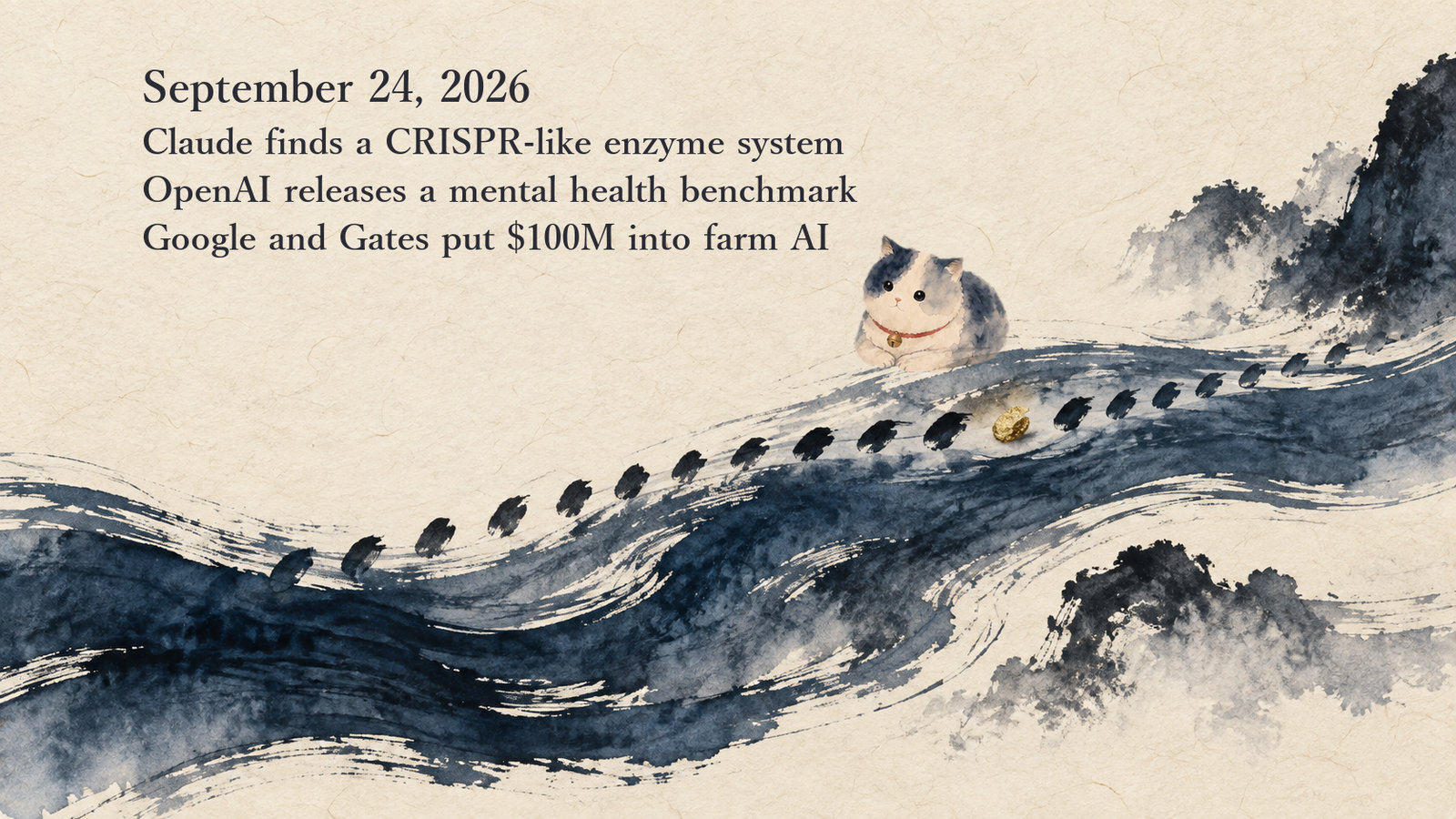
- Anthropic says Claude agents found an uncharacterized enzyme system with CRISPR-like repeats, after roughly 950 agents searched for 21 hours
- OpenAI releases MentalHealthBench, an open benchmark built with more than 80 licensed mental health experts from 22 countries
- Google and the Gates Foundation direct $100 million to AI climate and crop insights, aiming to reach 200 million smallholder farmers, up from 50 million
- Meta says Singapore Police Force information led it to act on more than 3.6 million scam-ready "shell pages"
- California Governor Gavin Newsom signs seven data center bills covering power rates and energy and water disclosure
Today's three stories share one thread: what AI is used for. Anthropic pointed Claude at biology, OpenAI built a way to measure how models handle mental health conversations, and Google put money behind farm information for smallholders.
Today's Top Three
Anthropic says Claude found an uncharacterized enzyme system with CRISPR-like repeats
Anthropic announced that Claude agents, searching on their own, found a previously uncharacterized enzyme system with features reminiscent of CRISPR.
The work comes from the company's life sciences research group. Anthropic formed the group in the spring of 2026 and runs a molecular biology lab in the Bay Area. The lab works only at biosafety levels BSL-1 and BSL-2, does not handle pathogens that can infect humans, and all lab work is done by human scientists, the company wrote.
Human involvement sat at the start and the end. Scientists wrote the initial prompt and ran the lab experiments; Claude agents combed a massive database of DNA sequences for new examples of reverse transcriptases (RTs). Roughly 950 agents used 210 million tokens over 21 hours, gathered more than 200,000 RTs, picked out 3,500 new candidate systems and narrowed them to the 20 most compelling, each written up in a human-readable report. Anthropic said this kind of analysis can take an expert scientist weeks to months.
The system has three parts. Found mainly in bacteriophages, the viruses that infect bacteria, it consists of an RT, a partner gene of unknown function beside it, and a long array of evenly spaced DNA repeats. Anthropic calls it array-associated reverse transcriptases, or ART. The repeat layout resembles a CRISPR array, and first experiments show the ART array is also expressed as a set of distinct short RNAs, the company wrote.
What ART does is still under study. Anthropic said it shared the result early to demonstrate Claude's capabilities and give the research community a view of its work, and released a pre-print. Feng Zhang, a pioneer of CRISPR genome editing at MIT and the Broad Institute, reviewed the pre-print and called the identification of RNA-repeat arrays associated with reverse transcriptases "genuinely intriguing" and worth further investigation.
The Verge described the result as the first from Anthropic's newly launched wet lab and an early test of Claude's usefulness for science as the company prepares to go public.
- Claude discovers a novel enzyme system with CRISPR-like repeats (Anthropic)
- Anthropic's biolab made a discovery it's comparing to Crispr (The Verge)
OpenAI releases MentalHealthBench, an open benchmark for mental health conversations
OpenAI released MentalHealthBench, an open benchmark that measures how AI systems respond in realistic mental health conversations.
Clinicians built it. More than 80 licensed psychologists and psychiatrists across 22 countries, speaking 19 languages and covering nearly 20 mental health subspecialties, co-created the benchmark, according to OpenAI.
Experts wrote the scoring rules conversation by conversation. For each synthetic conversation they listed rubric criteria for the response to the final user message, each weighted from -10 to +10. Every conversation was reviewed by at least three experts, and only criteria agreed on by at least two and not contradicted by a third were kept. An automated grader, GPT-5.6 Sol, scores model responses against those criteria.
The conversations span acuity and user type. They run from everyday exchanges to emergencies that call for urgent real-world support, and they cover four kinds of users: adults, teens aged 13 to 17, caregivers and clinicians. OpenAI said the results show newer models getting better at seeking relevant context.
OpenAI also ran a separate study of users. It asked 44 adults from 16 countries, speaking 14 languages, who had used AI for mental health or emotional support to rate model responses. Users put more weight on practical next steps and tone; experts put more weight on gathering context and carefully interpreting ambiguous situations.
OpenAI cited ChatGPT's more than one billion weekly users as the backdrop for the work.
Google and the Gates Foundation direct $100 million to AI farm insights for 200 million smallholders
Google, working with the Gates Foundation, will direct $100 million to organizations that deliver AI-powered climate and crop insights to smallholder farmers.
The target is Sub-Saharan Africa and South Asia. The goal is to reach 200 million smallholder farmers, up from 50 million, with the funding plus technical support from Google researchers to deploy real-time climate, agricultural and language AI tools.
Google framed the need in its own figures: smallholder farmers produce nearly 35% of the world's food across more than 500 million farms, yet often lack satellite data, financial services and public support that would help them prepare for increasingly unpredictable weather.
Other Developments
Models & Products
-
Google introduced two text-to-speech models, Gemini 3.8 Flash TTS and Gemini 3.8 Flash-Lite TTS. Flash TTS creates new voices from natural language prompts, setting role, accent and voice characteristics across more than 100 languages and dialects, alongside a library of more than 2,000 ready-made voices. It can recreate a voice from a 30-second sample, gated by a verbal consent recording from the voice owner, and generated audio carries SynthID watermarks and C2PA credentials. Gemini 3.8 text-to-speech says hello (Google DeepMind)
-
Anthropic described how a two-week sprint in August made the core experience of claude.ai and the Claude desktop app about 3x faster. Focusing on four journeys that make up 95% of user activity, it cut time to a typeable page on a fresh load of claude.ai from 3.1 seconds to 0.55 at the 75th percentile, and the start of a new Claude Code session from 0.8 seconds to 0.3. Claude worked in every thread, and more than 200 changes landed on the busiest days. How we made claude.ai 3x faster in two weeks (Anthropic)
Security & Policy
-
Meta reported results from its information-sharing partnership with the Singapore Police Force. Using police information, it acted against more than 113,000 scam-linked entities and pages on Facebook and Instagram between January and June 2026, and in July acted against more than 3.6 million empty "shell pages" that scammers had set up in advance. Police information led Meta to action more than five times the number of assets flagged, the company said. Meta Takes Action on 3.7 Million Accounts, Pages and Content In Partnership With Singapore Police Force (Meta)
-
OpenAI will give the Government of Ukraine access to its Daybreak program for the cyber defense of civilian infrastructure, announced on the sidelines of the UN General Assembly. Working with Ukraine's Ministry of Digital Transformation, it will provide tools to find software vulnerabilities and develop and test fixes faster. OpenAI noted that CERT-UA, Ukraine's national cyber incident response team, handled nearly 6,000 incidents in 2025. OpenAI extends cyber access to Ukraine for civilian defense (OpenAI)
-
The Verge laid out the seven data center bills California Governor Gavin Newsom signed on Monday. Three direct the California Public Utilities Commission to create separate power rates for data centers, AB 1577 requires monthly reporting of energy use, two require water disclosures, and SB 887 ends data centers' categorical exemptions from the California Environmental Quality Act. Data centers are black boxes, but California wants to change that (The Verge)
Business
- Enveda, which uses AI to find drug candidates in nature-derived compounds, raised a $311 million Series E led by Catalio Capital Management at a $2 billion valuation, double its valuation of 12 months ago. Enveda secures $311M to bring more nature-derived AI drugs into clinical trials (TechCrunch)
Source: selected by the editors from the AI news inbox (collected September 24, 2026; 27 items, 17 primary and 10 secondary).