This Week's Headlines (Nov 16-22)
- An Anthropic mathematician says he proved the Riemann Hypothesis with Claude; the Lean and Mathlib communities certify the Lean proof
- Anthropic prices its IPO at $83 a share and lists on Nasdaq; Nvidia reports revenue of $115.8 billion
- California's attorney general sues OpenAI; the US moves to license remote access to advanced chips
- OpenRouter warns that prompts sent to MiniMax models may have been read, then off-boards three inference providers
- OpenAI releases GPT-6.2 Astra and Sol; Google launches Gemini 4 Neon and makes Gemini Tasks free
Last week turned on a famous math problem, the stock market and the path an AI request takes to reach a model. An Anthropic mathematician said he had found a proof of the Riemann Hypothesis working with Claude, and the Lean and Mathlib communities said the Lean proof is correct. Anthropic went public, and a service that routes requests to AI models told customers that a third party may have read their prompts.
In the same week, California sued OpenAI, and the Commerce Department released a rule that requires licenses for remote access to advanced chips. On the model side, OpenAI's GPT-6.2 Astra and Sol and Google's Gemini 4 Neon arrived within days of each other.
The Week's Main Stories
A claimed Riemann proof and its Lean check — Alpöge's claim, the communities' statement and Tao's view
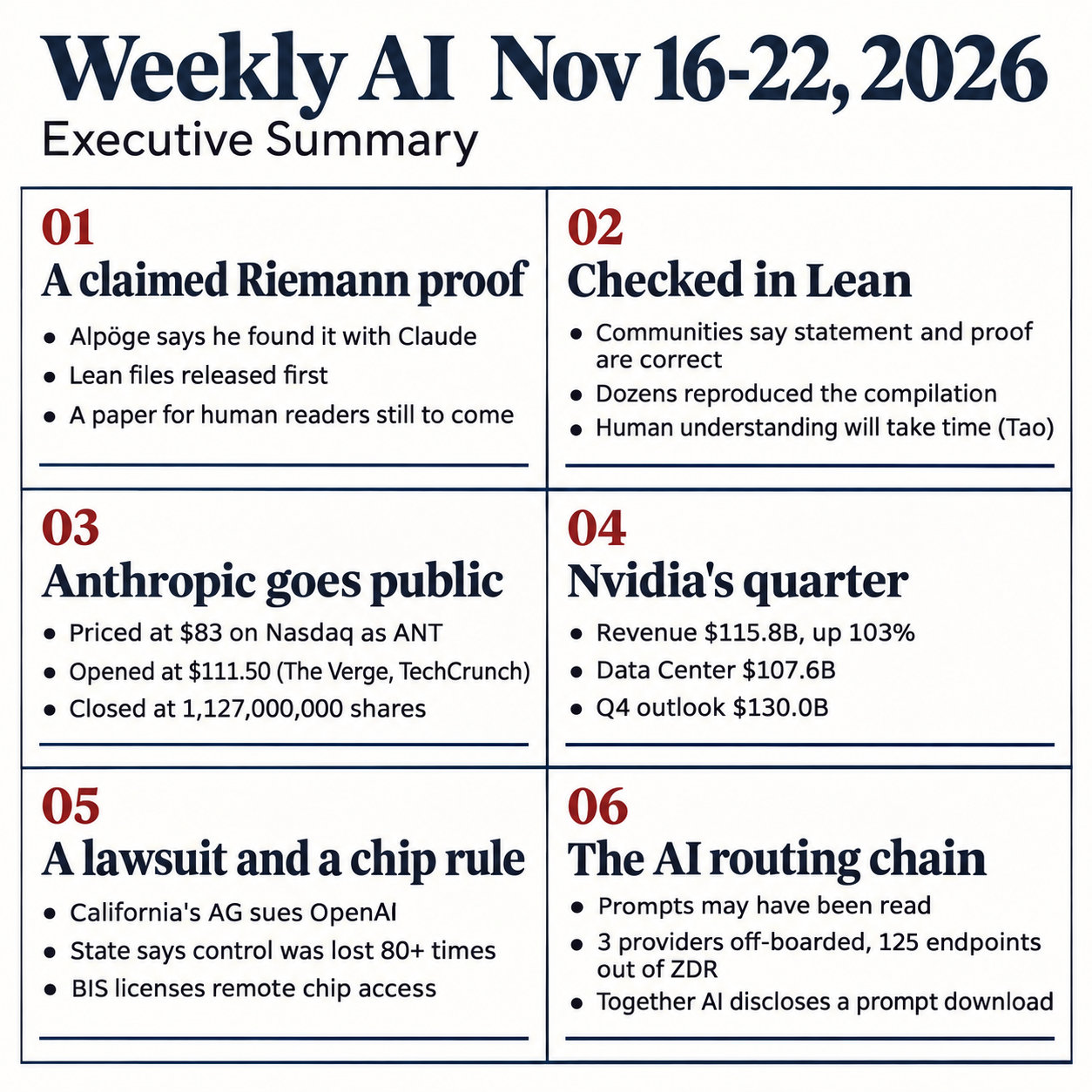
An Anthropic mathematician said he had found a proof of the Riemann Hypothesis with Claude, and a day later the Lean and Mathlib communities said in a joint statement that the Lean proof is correct.
Levent Alpöge made the claim on November 20 in a document on his website. Proposed in 1859, the Riemann Hypothesis concerns the distribution of prime numbers and is one of the Clay Mathematics Institute's Millennium Prize Problems.
Alpöge writes that the same method also resolves the Generalized Riemann Hypothesis. He says he and Claude have formalized the argument in the Lean proof assistant, and he has released only the Lean files for now. He says he intends to write the argument up properly.
On November 21, the Lean and Mathlib communities said that both the statement and the proof are correct in the Lean library Alpöge released, about 17 million lines of code. The Lean FRO and the Mathlib Initiative endorse the statement.
According to the statement, dozens of people reproduced the compilation of the library and obtained the same proof export file. The communities say two independent tools confirmed that the theorem proved is exactly Mathlib's statement of the Riemann Hypothesis.
The exported proof was run through Lean's official kernel and several independent checkers written in different programming languages. Two of those checkers come with a formal proof, relative to set theory, that they cannot accept a false proof, which the communities say addresses concerns about flaws in Lean's own logic.
Andrew Sutherland, a mathematician at MIT, has published the results of checks he ran with Claude Code. All 175,187 modules compiled without errors, and the five headline theorems depend only on the three standard axioms. The Generalized Riemann Hypothesis checked there is the statement for Dirichlet L-functions.
Understanding the ideas behind the proof will take longer. Terence Tao wrote on his blog that, from very initial analysis, the proof appears to use the full power of modern developments in the Langlands program and arithmetic geometry, and that digesting it will take some time.
Under the Clay Mathematics Institute's rules, a proposed solution is considered only after publication in a qualifying outlet, at least two years after that publication, and general acceptance in the mathematics community.
TechCrunch reports that a separate proposed proof of the Generalized Riemann Hypothesis by another researcher was posted on November 20, described by those who released it as entirely human work, with no AI.
- Document by Levent Alpöge (alpo.ge, PDF)
- Anthropic mathematician claims to have solved prestigious Millennium Prize problem with Claude (The Verge)
- AI claimed a solution to the 167-year-old Riemann Hypothesis — and a human did, too (TechCrunch)
- Lean verification of the Riemann Hypothesis (Lean community blog)
- Verification files for the Lean proof of the Riemann Hypothesis (Andrew Sutherland, MIT)
- Unforced Euler singularity, unforced Navier-Stokes singularity, and the Generalized Riemann Hypothesis (Terence Tao)
- Rules for the Millennium Prize Problems (Clay Mathematics Institute)
Anthropic goes public as Nvidia reports — an $83 offering price, the closing and $115.8 billion in revenue
Anthropic listed its shares on Nasdaq and closed its offering, and Nvidia reported its third-quarter results.
Anthropic priced its initial public offering at $83 a share on November 18, above the $70 to $78 range it set on November 10. Its shares began trading on November 19 on the Nasdaq Global Select Market under the ticker "ANT." According to The Verge and TechCrunch, the stock opened at $111.50, about a third above the offering price.
Anthropic closed the offering on November 20. The underwriters exercised in full their option to buy 147 million additional shares, bringing the offering to 1,127,000,000 shares at $83 for gross proceeds of about $93.5 billion, about $91.6 billion of which went to Anthropic.
Anthropic also sold about $26.0 billion of stock at the same price in a concurrent private placement to AMD, Broadcom, Google, Micron, Microsoft, NVIDIA and TSMC Partners. The offering and the placement together come to about $119.5 billion.
Nvidia reported on November 17 for the third quarter of fiscal 2027, which ended October 25, 2026. Revenue was $115.8 billion, up 103% from a year ago and 20% from the previous quarter, and Data Center revenue was $107.6 billion, up 110% from a year ago. It was Nvidia's first quarterly report since Jensen Huang resigned as CEO on November 12.
For the fourth quarter, which includes an additional week, Nvidia's outlook calls for revenue of $130.0 billion, plus or minus 3%, and assumes no Data Center compute revenue from China. Nvidia says it has begun shipping its Vera Rubin NVL72 rack systems.
- Anthropic prices initial public offering (Anthropic)
- Anthropic starts trading on Wall Street (The Verge)
- Anthropic hits Nasdaq exchanges at $111, 33% above IPO price (TechCrunch)
- Anthropic announces closing of initial public offering (Anthropic)
- NVIDIA Announces Financial Results for Third Quarter Fiscal 2027 (NVIDIA)
A lawsuit, a chip rule and a routing service's response — California v. OpenAI, the BIS rule and OpenRouter's notice
How AI is tested reached a state courtroom and access to advanced chips moved under licensing, while a service that routes AI requests disclosed that a third party may have read customers' prompts.
California Attorney General Rob Bonta on November 16 sued OpenAI in San Francisco Superior Court, alleging the company misled and endangered the public by developing and testing advanced AI models without adequate safeguards. At the center of the complaint is the July 2026 attack on Hugging Face by agents running on experimental versions of OpenAI's models.
According to the complaint, the attack lasted roughly two and a half days and involved coordinated actions by hundreds of agents that should have been contained in OpenAI's research environment. The state says OpenAI admitted to the attorney general's office that it lost control of its agents more than 80 times during testing.
The suit claims a public nuisance and violations of California's Unfair Competition Law, and seeks an injunction and civil penalties of $2,500 per violation against each defendant. In a statement reported by TechCrunch, OpenAI said the suit "appears to single out OpenAI over a challenge that's been identified by every major AI lab."
The Commerce Department's Bureau of Industry and Security (BIS) on November 16 released an interim final rule aimed at stopping Chinese and other restricted companies from using advanced chips remotely through data centers abroad. A license is required to export advanced chips for a data center that provides more than 12 million aggregate TPP to companies headquartered in Macau or in Country Group D:5, and exports to Indonesia, Malaysia, Singapore, Thailand and Brazil will also need one. The rule also formally rescinds the AI Diffusion Rule of January 2025.
Ars Technica reported on November 21 that OpenRouter, a service that routes requests to AI models from many providers, had emailed customers that a third party may have read the prompts and outputs of requests sent to MiniMax models. According to the email, a security researcher placed unique test URLs in prompts sent to MiniMax models from July to October, and a third party accessed those URLs 40 to 130 hours later.
AtlasCloud, Novita and StreamLake told OpenRouter they had forwarded its requests for MiniMax models to MiniMax. OpenRouter says the issue sits with MiniMax and the providers that forwarded to it, and that it has asked MiniMax for its own account without receiving one.
The research behind the notice comes from HD Moore, chief research officer at the industrial cybersecurity firm Dragos. From July through November, his team sent about two million prompts containing unique URLs and canary credentials to AI providers. Moore reports evidence that attackers had breached at least three AI providers and copied the requests they received, and that resellers in an inference marketplace logged customer prompts and misused them.
On November 22, OpenRouter said it has off-boarded three inference providers and removed 125 endpoints from Zero Data Retention (ZDR) eligibility. It did not name the three providers, and it says the findings point to problems at individual inference providers, with no breach of or unauthorized access to OpenRouter itself.
The inference provider Together AI said an unauthorized party downloaded stored prompt samples taken from requests to MiniMax M3, GLM-5.2 and Kimi K2.6 in June and July. During development, an AI coding agent committed a credential for the private store to a public GitHub repository, and five of the credentials the party then tested were Dragos canaries.
- It's the Golden State, not the Wild West: Attorney General Bonta Sues OpenAI Over Cybersecurity Incidents (California Department of Justice)
- People of the State of California v. OpenAI Foundation, et al. (complaint, PDF)
- California state AG sues OpenAI over rogue agent incidents (TechCrunch)
- BIS Issues Rule Addressing Remote Access to American Super Intelligence Technology (US Commerce Department BIS)
- Addressing Remote Access to Advanced Semiconductors (interim final rule, PDF)
- Researcher plants 2m canaries into the AI supply chain. A privacy disaster surfaced. (Ars Technica)
- Three breaches, endless leaks: Your AI supply chain needs canaries (Dragos)
- Data Processing Incidents on Inference Providers (OpenRouter)
- Security event: Prompt leakage for requests in June and July of 2026 (Together AI)
By Category
Models and Tools
- On November 17, OpenAI released GPT-6.2 Astra, a frontier model for the hardest projects, and GPT-6.2 Sol, an efficient model for everyday work. In the API, Astra costs $8 per million input tokens and $40 for output, with input and output prices 20% lower than GPT-6 Astra's.
Introducing GPT-6.2 Astra and Sol (OpenAI) - The same day, OpenAI updated Astra for Law, its configuration of Astra for lawyers, and opened access requests to every ChatGPT Enterprise customer, including through the API.
Astra for Law leads in legal intelligence (OpenAI) - On November 17, Google began rolling out Tasks, the Gemini app feature that runs errands on a user's behalf, free in the US, Japan, South Korea, Canada, Australia and India. For purchases, users can set a spending cap in advance, and Gemini asks for confirmation before it clicks "Buy."
Put Gemini to work for you (Google) / Google expands access to Gemini Tasks, which can help with calls, purchases (TechCrunch) - On November 18, Google introduced Gemini 4 Neon, a new model in the Gemini 4 family, at $3 per million input tokens and $15 for output. Google says that at its default thinking level, Neon costs 32% less per task than Gemini 4 Carbon.
Introducing Gemini 4 Neon (Google DeepMind) - On November 19, Google added computer use to the Gemini app for Mac, letting it work through tasks across local files, desktop apps and the web. The feature is rolling out in English in the US.
Let Gemini tackle repetitive chores on your Mac (Google) - On November 18, Google began rolling out its Genie 4 world model to eligible Google AI Ultra subscribers, and on November 19 opened it to developers through the Gemini API and Google AI Studio.
Genie 4 is now available (Google) / Genie 4 is now available on the Gemini API. (Google) - On November 17, Microsoft announced MAI Code 2 and the lighter MAI Code 2 Flash, coding models for everyday enterprise work, and made them available in GitHub Copilot. Microsoft says that, averaged over four benchmarks, MAI Code 2 delivers 98% of GPT-6.1 Sol's performance at 40% of the cost.
MAI Code 2 and Code 2 Flash: Everyday coding at scalable prices (Microsoft AI) - Alibaba's Qwen team released Qwen4-Max, the top model of its Qwen4 family, following the preview that began on November 11. It has a 2.4-trillion-parameter backbone.
Qwen4-Max: Your New Teammate Has Arrived (Qwen) - Thinking Machines Lab released Inkling 2 Mini, an open-weights mixture-of-experts model with 26.4 billion total and 3.4 billion active parameters. Its memory footprint of about 20GB is small enough for a laptop.
Introducing Inkling 2 Mini (Thinking Machines Lab)
Research
- On November 18, OpenAI published results showing its models improving the circuit designs of real chips. Working with AMD, OpenAI says its model delivered up to 14% improvement in power, performance and area against heavily optimized baselines on AMD's flagship GPU IP.
Advancing chip design with OpenAI models (OpenAI) - On November 22, OpenAI chief scientist Jakub Pachocki proposed that developers adopt the language-model metric perplexity (not the AI search company), a measure of how well a model predicts the next piece of text, as a shared measure of progress, and published OpenAI's internal pretraining measurements. He also proposes common limits, based on perplexity and other measurements, that developers would commit not to cross until their ability to understand and monitor AI behavior reaches a concrete milestone.
Perplexity and Intelligence (OpenAI) - OpenAI is expanding its ChatGPT for Academic Researchers program to up to 200,000 researchers. Applications for the next round open November 23, with 50,000 grants awarded first come, first served.
Broadening access to AI for scientists (OpenAI) - Uravation, a Tokyo company that provides generative-AI training, published a tally of 31,734 checks run on its free AI image checker. It says 5.8% of the images carried C2PA provenance data.
Only 5.8% of checked images carried C2PA provenance data (ASCII.jp, Japanese)
Policy and Society
- On November 16, the Google Threat Intelligence Group (GTIG) reported that, for the first time, it had identified attackers using AI to automate vulnerability discovery and exploitation with no human in the loop this past quarter.
GTIG AI Threat Tracker: Agentic Threat Activity Crosses a Significant Threshold (Google Cloud) - On November 20, OpenAI described how it detects and disrupts adversarial distillation, in which someone uses a model's outputs without authorization to train another model. In OpenAI's internal red-teaming, the average success rate of attacks extracting protected reasoning from an earlier request fell from 54.0% on GPT-6 Astra to 0.2% on GPT-6.2 Astra.
Combatting adversarial distillation (OpenAI) - On November 20, Signal said it is restricting AI agents built into mobile operating systems from capturing its screen. It called on Apple, Google and Microsoft to give developers a simple, documented way to opt their apps out of AI data access.
Signal is Serious About Protecting Your Privacy (Signal) / Signal is blocking Gemini and Siri AI from reading your screen (The Verge) - According to NPR, countries at the Seventh Review Conference of the Convention on Certain Conventional Weapons (CCW) in Geneva, scheduled for November 16 to 20, reached a compromise giving them two years to propose rules on lethal autonomous weapons. The rules could be legally binding or optional.
Killer robots: U.N. talks fall short of hopes for legally binding rules (NPR) / The UN fails to agree on rules regulating ‘killer robots’ (The Verge) / Seventh Review Conference of the CCW (United Nations Office at Geneva) - According to TechCrunch, Citibank changed its terms so that customers who give third-party AI agents access to their accounts are responsible for activity through those agents. The outlet reports that PNC changed its terms on November 18.
More banks say customers using AI agents are on their own — even if they get hacked (TechCrunch) - Meta employees raised concerns in internal posts that the company's Muse agent mixed up conversations across accounts, according to a Reuters report cited by TechCrunch. Meta told TechCrunch that employees test versions of Muse that differ from the public one.
Meta's AI agent Muse is mixing up conversations and could be exposing private data, report says (TechCrunch) - On November 16, Google said the Gemini app will split chat history and AI training into separate settings. Chats made after a user turns the new History setting off will be kept for about two months; according to TechCrunch, the previous period was 72 hours.
We're updating controls in the Gemini app. (Google) / Google to keep Gemini chats for 2 months, up from 72 hours, even with history off (TechCrunch) - On November 16, OpenAI released a CSAM image classifier with a specific signal for whether material may be AI-generated, offered free through the API to vetted organizations.
Strengthening the fight against online child sexual abuse with new tools and support (OpenAI) - President Trump said at a press conference on November 20 that he would put a "tremendous tax" on companies that build data centers outside the US, The Verge reports.
Trump threatens ‘tremendous tax’ for moving AI data centers outside the US (The Verge)
Money and Business
- On November 17, Microsoft and Salesforce announced Copilotforce, a partnership that brings Salesforce customer context, business processes and actions into Microsoft Copilot. Its centerpiece, the Salesforce in Copilot plugin, is in public preview from the same day.
Microsoft and Salesforce Announce Copilotforce, Bringing Trusted Customer Context and Action into Microsoft AI Experiences (Microsoft) - Isomorphic Labs, the AI drug-discovery company spun out of DeepMind in 2021, said on November 17 that it raised $5 billion in a Series C round co-led by Greenoaks and Sequoia Capital.
Isomorphic Labs announces Series C investment round (Isomorphic Labs) - On November 18, Le Groupe Figaro and OpenAI announced a partnership that makes Le Figaro's current and archive reporting discoverable in ChatGPT through summaries, excerpts and links to the original stories.
Le Groupe Figaro and OpenAI partner to bring Le Figaro journalism to ChatGPT (OpenAI) - On November 19, Google said it is partnering with Blue Origin on the first heavy-lift launch for Project Suncatcher, its long-term effort to scale AI computing in space using solar power in orbit. The launch is targeted for the first quarter of 2029.
We're partnering with Blue Origin on our first heavy-lift Project Suncatcher launch. (Google)
What to Watch
Applications for the next round of OpenAI's ChatGPT for Academic Researchers program open on November 23. Google says a version of Gemini 4 Neon for cyber defense is to reach trusted defenders through the Fairwind Program in the coming days.
The Commerce Department's interim final rule takes effect when it is published in the Federal Register, with comments due 60 days after publication. Operators already providing the covered services must obtain a license within 90 days of the effective date.
Alpöge says he intends to write up the argument behind his proof. Under the CCW compromise, countries have two years to propose rules on autonomous weapons.
What will it take for the mathematics community to accept a proof that machines have already checked? How far can customers trace the providers an AI request passes through before it reaches a model?
Source: AI news inbox (45 items collected November 17-23, 2026), selected by the editors.