Today's Headlines
- Nvidia's board reinstates Jensen Huang as president, CEO and board director
- Oregon and Virginia attorneys general sue SpaceX over Grok's sexualized images
- Google DeepMind uses AI agents and formal verification to cut the cost of quantum algorithms
- Amazon agrees to acquire Decart's optimization technology and founding team
Nvidia's decision to bring back Jensen Huang, who resigned earlier this month, leads the day. Two state lawsuits over generative-AI safeguards and a quantum computing result follow.
Today's Top Three
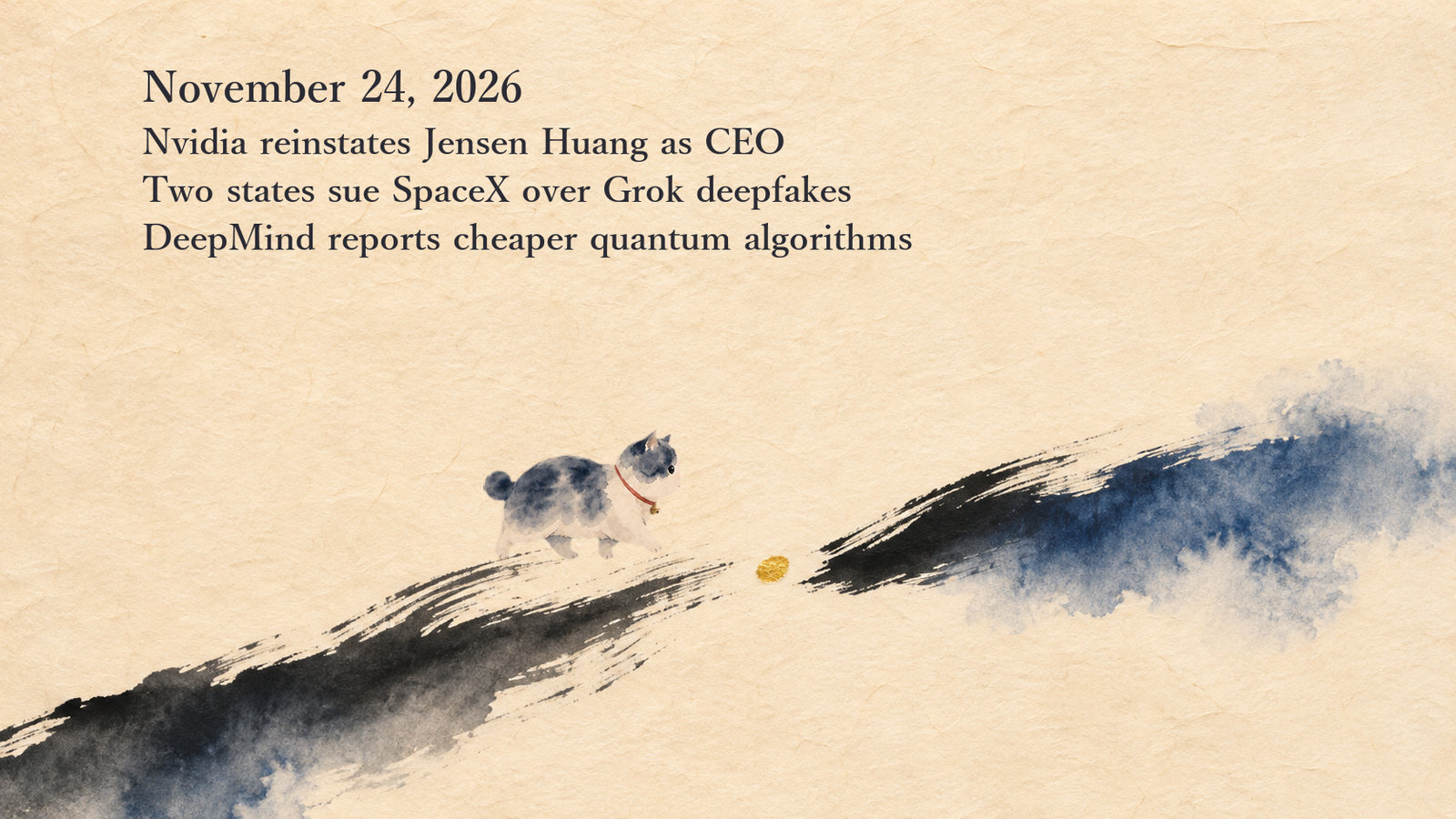
Nvidia reinstates Jensen Huang as president, CEO and board director
Nvidia announced on November 23 that Jensen Huang has been reinstated as president and chief executive officer and as a member of the board, effective immediately.
According to the announcement, the board voted unanimously after a series of discussions and meetings with Huang, and said it was satisfied with his candor and ability to lead the company. The board said it received input from senior levels of the U.S. government and, based on that input, is confident that his reinstatement poses no national security risk.
Harvey Jones remains board chair. Colette Kress, who served as interim CEO, continues as chief financial officer.
The committee of independent directors investigating reports that Huang was the target of a foreign intelligence effort will proceed to a conclusion, the board said, and Huang supports the investigation and will cooperate with it. The board has also formed a committee to oversee export control and national security risks, and Nvidia is starting a search for a new chief compliance officer.
Oregon and Virginia attorneys general sue SpaceX over Grok's sexualized images
Oregon Attorney General Dan Rayfield and Virginia Attorney General Jay Jones announced on November 23 that they had filed separate lawsuits against SpaceX, X Corp. and related companies under their states' consumer protection laws over the Grok AI tool.
The complaints allege that the companies failed to stop Grok from generating sexualized images of people, including children, without their consent, while promoting the safety of X and Grok. They also allege that the companies stripped out industry-standard safeguards and marketed a "spicy mode" built to produce nudity. xAI, which made Grok, has merged with SpaceX and is now called SpaceX Super Intelligence.
Virginia's announcement cites an estimate by the group CCDH that between December 29, 2025, and January 8, 2026, Grok created and posted about three million sexualized images on X, including about 23,000 that appeared to depict children.
Virginia filed in the Circuit Court for the City of Richmond and Oregon in Multnomah County Circuit Court. Both states seek injunctions, disgorgement and civil penalties; Virginia asks for up to $2,500 per willful violation. According to The Verge, X's safety team said those who misused Grok Imagine deliberately violated its terms and worked to circumvent its safeguards, and that it acted promptly to tighten its protections.
- Attorneys General Jones and Rayfield file suit against SpaceX (Office of the Attorney General of Virginia)
- Complaint, State of Oregon v. SpaceX Super Intelligence Corp. et al. (Oregon Department of Justice, PDF)
- Oregon and Virginia sue SpaceX over Grok's porn deepfakes (The Verge)
Google DeepMind uses AI agents and formal verification to cut the cost of quantum algorithms
Google DeepMind reported in a new paper on November 23 that teams of Gemini 4 agents improved well-known quantum algorithms and found more efficient quantum circuits.
Because large quantum circuits cannot be tested on today's computers, the agent teams proved each result in Lean, a formal theorem prover. Separate teams searched for improvements to each problem, only ideas verified in Lean entered a shared notebook, and every four hours agents from each team met at a virtual conference to compare ideas.
For a calculation in inertial confinement fusion, the agents cut the required computing cost by 11.8 times and lowered the memory needed from 5,650 to 4,338 error-corrected qubits, DeepMind says. For Cytochrome P450, an enzyme that breaks down most human medicines, they found a 2.5-times improvement and reduced memory from 481 to 333 qubits. DeepMind also reports a 290-times speedup for arcsin, a common building block of quantum algorithms.
DeepMind says running these algorithms in scientific simulations would still demand more resources than the first error-corrected quantum computers are likely to provide. It has released its Lean library, problem specifications and verified solutions on GitHub. The work was a collaboration with Google Quantum AI.
Other developments
Business
- Amazon said on November 23 that it has agreed to buy the technology behind the Decart Optimization Stack and bring Decart's three co-founders and its team of AI researchers and engineers to Amazon, to further its custom chips such as Trainium and optimize AI inference; the deal is subject to closing conditions including regulatory clearance. TechCrunch, citing Bloomberg, reports the price as $7.5 billion.
Amazon to acquire Decart's AI optimization technology (Amazon) / Amazon snaps up Decart's AI optimization tech for $7.5B (TechCrunch)
Products
- Anthropic launched Claude Ship in beta on November 23, taking pull requests through review, fixes and an approval decision. It pairs the existing Code Review with two new agents: PR Steward, which works on failing CI checks, merge conflicts and review feedback, and Claude Approvals, which can approve routine changes under a policy the team writes. It is available on Claude Team and Enterprise plans for GitHub repositories.
Introducing Claude Ship (Claude) - Google began rolling out the option to connect Google Wallet to Personal Intelligence in AI Mode in Search on November 23, with Google Drive and the Gemini app to follow in the coming weeks. Google says AI Mode can only read Wallet account information and cannot move or manage money.
A more tailored Google Search that's uniquely yours (Google)
Source: selected by the editors from the AI news inbox (collected November 24, 2026; 6 items, 6 primary and 0 secondary).