Wanting someone to look at a bug, an employee pasted internal code and meeting minutes straight into a generative AI. There was no ill intent. The deadline simply happened to be today.
Can you blame that employee?
You can. But blaming them will not stop the problem. This is not a question of individual discipline — it is a question of organizational strategy.
The phenomenon of employees drifting toward convenient AI tools without waiting for the organization's permission — so-called shadow AI — is now breaking out across many companies at once. And the bulk of it is born not as rebellion, but as the flip side of diligence.
Shadow AI = generative AI tools and services that employees use for work without their company's formal approval or oversight; the "shadow" use the IT department cannot see.
In Front of a Deadline, Policy Always Loses
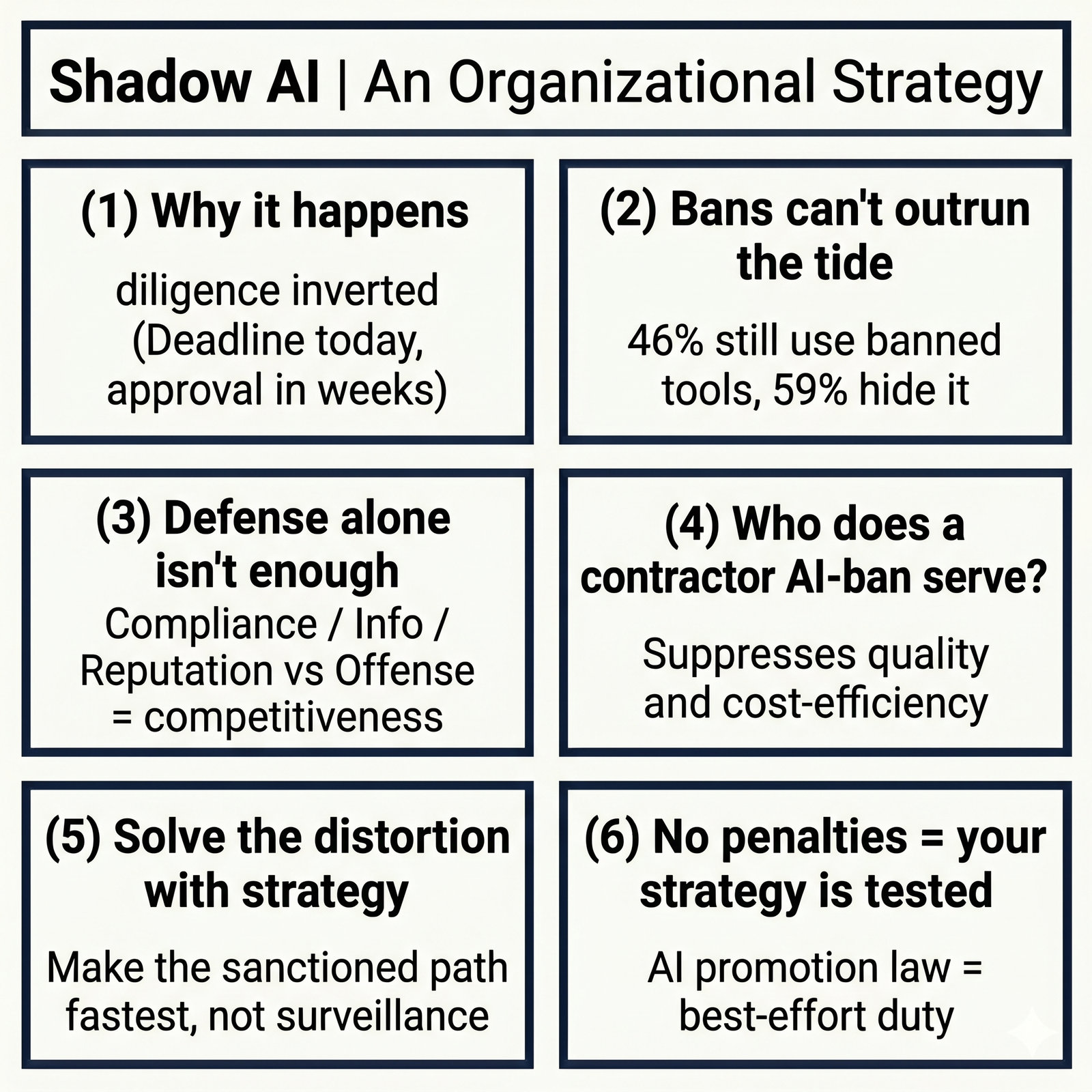
Why does it happen? The answer is almost anticlimactically simple. Because people want to get their work done.
A survey published by PagerDuty in 2026 found that 66% of office workers at companies with over 500 million dollars in revenue said they had used AI tools for work even while believing it was not permitted under company policy. The same survey notes that over a third have entered customer data into a public AI model.
This is not a story about a few bad actors. It is becoming the standard behavior of the workplace.
What is driving this is an asymmetry of speed. File a formal request for a new tool, and it is not unusual for approval to take weeks, passing through internal sign-off and an information-security review. Signing up for the same tool, meanwhile, takes minutes.
When the deadline is today, which path the field chooses is not a question of discipline but a question of arithmetic.
The employees are not defying the organization. The official route the organization built has simply failed to keep pace with the field's timeline. That is exactly why blaming individuals will not stop it — discipline one person, and someone at the next desk is facing the very same deadline.
A Ban Cannot Outrun the Tsunami
Here is where many Japanese companies reflexively reach for one move: the blanket ban across the organization. In a culture of following precedent and avoiding demerits, the judgment to first stop anything you do not understand looks, at a glance, like sound organizational defense.
But a ban does not erase use. It only drives it underground.
In fact, one survey found that 46% of employees would keep using AI tools even if their employer explicitly banned them. Another international survey found that 59% hide their AI use from their bosses.
In other words, the single move of banning erases not the use itself, but the visibility of the use. Use that cannot be seen is use that cannot be controlled — and a ban manufactures, by its own hand, the very state of affairs governance most wants to avoid.
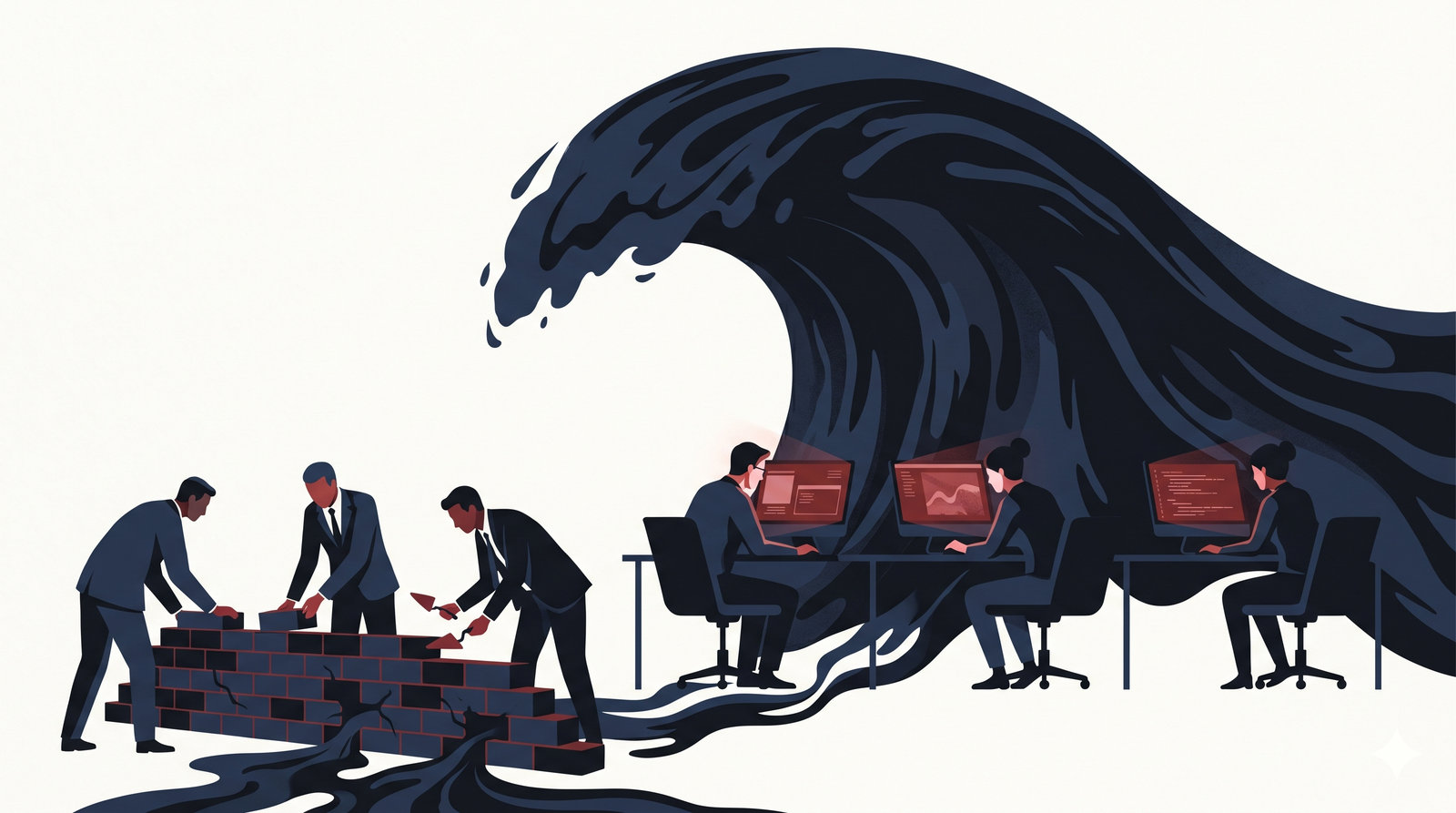
The advance of technology resembles a tsunami. Raise the seawall and the water level does not drop. Into the building called "the ban," where everyone thought they had taken shelter, unseen water seeps steadily in. This is the reality on which many organizations now stand, in the transitional period of AI adoption.
The emblematic case is Samsung Electronics in 2023. Within a span of just twenty days, engineers in the semiconductor division leaked information multiple times by pasting source code for equipment diagnostics and the minutes of internal meetings into a generative AI. In response, the company imposed a full ban on the use of generative AI on company devices.
But what the incident demonstrated was not the efficacy of the ban. It was the fact that the field's use had already outrun the company's controls.
Ingestion into training data = the risk that entered information passes to the external AI service and is absorbed into future training; enterprise contracts and training opt-out settings govern this exposure.
Defense Alone Is No Longer Enough
So what is being protected? What must be protected is clear: legal compliance, information management, and reputational risk. These three are the pillars of "defense" when we talk about shadow AI, and none of them is dispensable.
If confidential or personal information flows into a public model, it ties directly to breaches of confidentiality duties and problems under personal-data protection law. If it is a client's information, it touches contractual confidentiality obligations as well. Once leaked, information that develops into news coverage or litigation can inflict reputational damage that is hard to undo.
There is no shortage of reasons to fortify the defense.
But defense alone is no longer enough.
Here lies the difficulty of the transitional period. Try to make the defense perfect, and the safest choice converges on "let no one use anything." Meanwhile, competitors are trying to turn the same technology into a source of competitive advantage.
An organization that plays nothing but defense may avoid information incidents, yet it will quietly fall behind in productivity and in the speed of its decisions. Avoiding incidents and winning the competition are two different things.
So the question is no longer either-or. Defense (legal compliance, information management, reputational risk) and offense (turning technological advance into a source of organizational competitiveness): balancing both has become an ordinary requirement of the age. Shadow AI is the first touchstone that forces this balance upon an organization.
A Ban on the Contractor's AI — For Whose Benefit?
This scale weighing offense against defense does not close within a single company. At the site of outsourcing, it takes on a more troublesome form.
A client imposes on a contractor, by contract, a blanket ban: no use of AI in the work. From the standpoint of confidentiality, the reasoning is understandable. The client wants to prevent the entrusted information from flowing into a public model in the contractor's hands. That concern is legitimate.
But here too, it is worth pausing once. Is that blanket ban truly serving the client?
Consider it. If the contractor uses AI appropriately, the quality of the deliverable rises, the deadline shortens, and the cost-performance improves. Those benefits are, in the end, what the client itself was meant to receive. A blanket ban seals off this entire benefit.
The contractor is forced into the old methods — slower and more expensive — and the cost of that inefficiency is ultimately passed back into the contract fee. What was meant to protect confidentiality can end up purchasing one's own disadvantage.
The real issue is not "use it or not," but "how to let it be used safely." Limit use to enterprise editions, make opting out of training mandatory, draw a clear line around what entrusted information may be entered. Rewriting a prohibition clause into design clauses of this kind is, I believe, a more sophisticated form of contracting practice — one that satisfies both confidentiality and cost-performance at once.
Writing "prohibited" is easy. But being easy and serving the client's interest are not the same thing.
A Transitional Distortion Is Solved by Strategy, Not Symptomatic Treatment
Tie the argument so far into a single line, and the true nature of shadow AI comes into view. This is not a lack of discipline; it is a distortion that arises inevitably in the transitional period of adopting and putting AI to use. Being a distortion, it cannot be solved by symptomatic treatment such as bans and surveillance — it is something to be redesigned as part of a mid-to-long-term business strategy.
Let me invert the framing once. Many organizations think about "how to monitor and clamp down." Instead, think about "how to make the official route the fastest." Since the true motive for using AI in silence is the difference in speed, the moment the official route becomes faster than the back channel, people lose the reason to hide their use.
In concrete terms, the moves are easier to organize as three overlapping layers.
First, deliver an approved, fast alternative tool to the field before anyone else. Preparing the receptacle as quickly as possible is the starting point. By standardizing enterprise editions and making opt-out from training the default, you turn the safe option from "something endured" into "the first thing naturally reached for."
Second, make it visible. Surface who is using what and how, not for the sake of punishment but for the sake of understanding. To erase the motive for silent use, you need the trust that reporting it will not draw a reprimand — and the culture of hiding is often created by the attitude of those who manage.
Third, combine the three layers of governance, technology, and education. Rules (governance) alone, tool controls (technology) alone, or training (education) alone all fall short. Only when these three mesh does the balance of offense and defense hold up as a design. Do not clamp down by surveillance; make the official route the fastest. With the same budget, point it elsewhere and the result reverses.
Because There Are No Penalties, What Is Tested Is Your Own Strategy
Let me touch on Japan's institutional context here. It may come as a surprise, but Japan today has no law that directly regulates shadow AI.
The Act on the Promotion of Research, Development, and Utilization of AI-Related Technologies — enacted in 2025 and fully in force in 2026, commonly called the AI Promotion Act — is, as its name suggests, a principle-based law whose main aim is promotion. What it imposes on businesses is centered on duties of effort, and there is no penalty for violation.
The "AI Business Operator Guidelines" of the Ministry of Internal Affairs and Communications and the Ministry of Economy, Trade and Industry have likewise been designed, consistently through their latest version of March 2026, as soft law without legal binding force. They are, at bottom, a framework encouraging voluntary efforts.
Duty of effort = an obligation in which the law goes no further than "must endeavor," with no penalty or compulsion for breach; how far it is observed is left largely to each company's judgment.
Soft law = norms that lack the coercive force of statute yet function in practice as guidelines or industry standards; lacking legal force, they leave a wide area to each company's own initiative.
This is not a loophole. If anything, it is a heavy assignment. To be free of fine-grained external constraints means that the quality of control and utilization comes back, directly, as each company's own responsibility for strategy and design.
Precisely because there are no penalties, the question of what to do and how far ceases to be a "make-work" task that can be dumped on the compliance department. The will of management itself is what is tested.
How you conduct yourself in the territory the law does not protect — that is exactly where the difference in each organization's strategy shows up, in sharp relief.
In Closing — How to Marshal a Field That Moves Faster Than the Company
Let me close by raising the vantage point one notch.
As long as you see shadow AI as a "discipline problem," your moves tilt toward bans and surveillance, and it becomes a war of attrition with the field. But the moment you reread it as a sign that "the field is moving faster than the company," the shape of the question changes: what should be stopped is not the use, but the invisibility.
Only the organizations that solve the transitional distortion by strategy, not symptomatic treatment, will grasp competitiveness and control at the same time. Fortify the defense while training the legs for offense — the organizations that happen to pull off both, I think, will be the ones that set the next standard.
And this is not a story confined to generative AI. The spreadsheet, cloud storage, the workplace chat tool — each, when it appeared, was seized first by the field, with the managers chasing after.
Facing a new and convenient tool, how to marshal the field's speed and the organization's control — here is the essential question of business that management has repeated again and again. Shadow AI is merely its latest edition.
What deserves blame is not the employee chased by a deadline. What is tested is whether the organization can lay down a fast, official road to that field — that is the question of strategy.
References
- Shadow AI Is Happening Within Your Organization (PagerDuty)
- Bosses blinded by confidence about shadow AI use by workers (The Register)
- Why your most AI-savvy employees are driving shadow AI (CIO)
- Nearly Half of Employees Are Using Banned AI Tools at Work (Newsweek)
- 59% of employees hide AI use from their bosses (Cybernews)
- Samsung Bans ChatGPT, Other Generative AI Use by Staff After Leak (Bloomberg)
- Japan's 2025 AI Act: A Plain Explanation of the Law Promoting AI R&D and Use (Keiyaku Watch)
- AI Business Operator Guidelines (Version 1.2) (Ministry of Economy, Trade and Industry / Ministry of Internal Affairs and Communications)