Today's Headlines
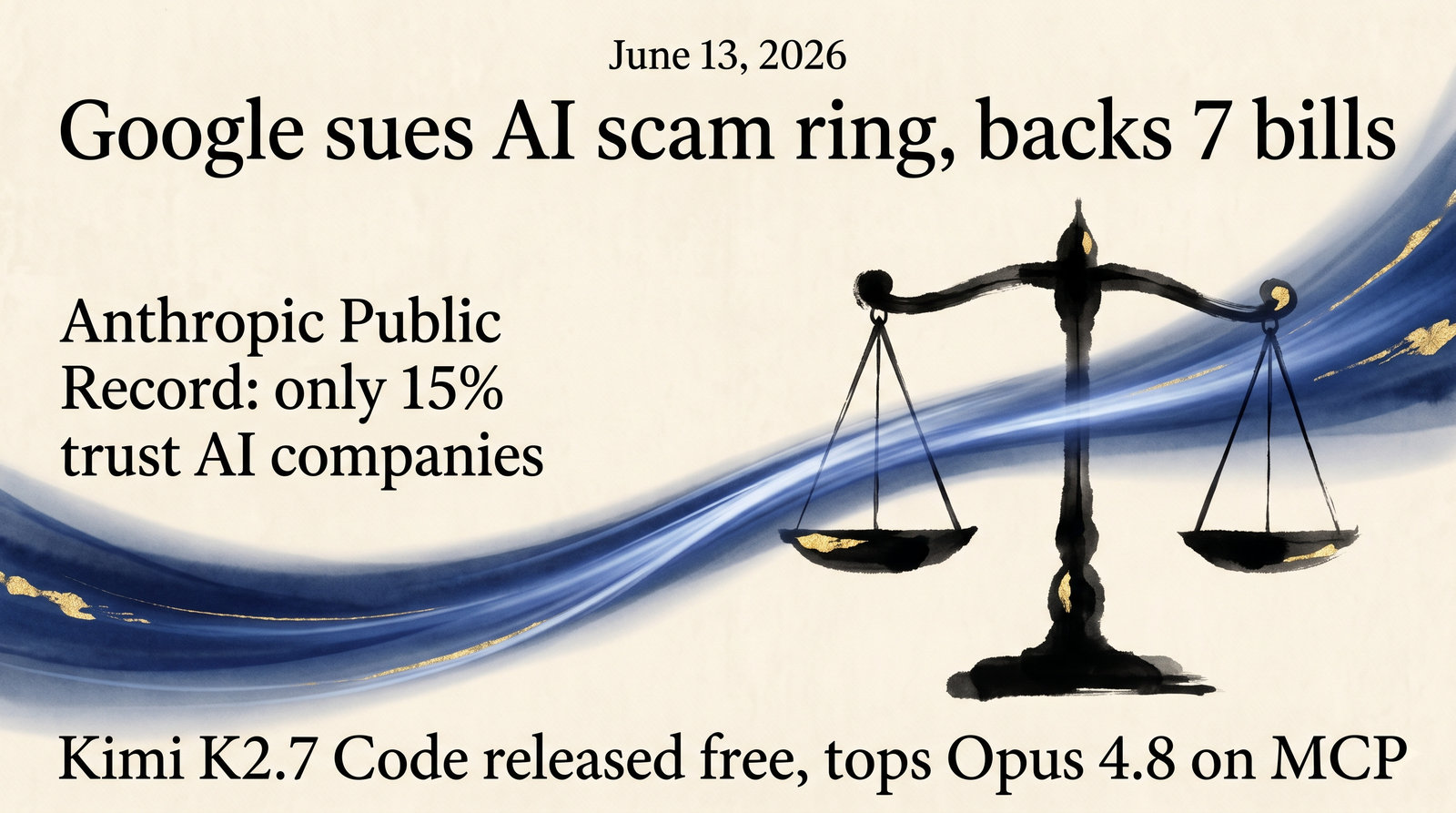
- Google unveils a three-pronged fight against AI scams — a civil lawsuit against a China-based crime ring, support for seven bipartisan bills, and 10 billion-plus malicious messages blocked monthly
- Anthropic's first large-scale "Public Record" survey finds only 15% of Americans trust AI companies
- Moonshot AI open-sources Kimi K2.7 Code, a 1-trillion-parameter model that beats Claude Opus 4.8 on an MCP benchmark
- SpaceX raises $75 billion in history's largest IPO — shares close up 19%, putting its closing-price valuation near $2.1 trillion
- Ukraine reportedly conducted a one-time combat test of fully autonomous lethal drones
Today's theme is trust.
Google hauled an AI-powered scam operation into court, pairing litigation with legislative advocacy and technical defenses.
On the same day, Anthropic published a 52,000-person survey showing just how little trust AI companies have earned with the public.
The performance race did not pause either: China's Moonshot AI released a free coding model that tops Claude's flagship on a key agentic benchmark.
Today's Top Three
Google strikes back at AI scams with lawsuits, legislation, and technology
Google announced a comprehensive campaign against AI-enabled scams.
The first prong is a civil lawsuit against "Outsider Enterprise," a China-based cybercrime network that distributed phishing kits and allegedly deployed more than 1 million fraudulent domains to scam hundreds of thousands of victims; the complaint cites trademark and copyright infringement alongside racketeering (RICO) and wire fraud.
The second prong is support for seven bipartisan bills targeting scams, including AI-generated ones.
On the technical front, Google's AI-powered messaging defenses now intercept more than 10 billion malicious messages a month. The company also works with AT&T, T-Mobile, and Verizon to block fraudulent texts before they reach consumers.
According to follow-up reporting, the operation used AI — including Google's own Gemini — to mass-produce fake websites, and sold itself as a subscription "scam-as-a-service" starting at $88 a week, with estimated losses of about $1.9 billion since July 2023.
The case stands out as a precedent for an AI provider taking the abusers of its own models to court, with implications for how acceptable-use policies get enforced.
Source: How we're combatting AI scams with security, legislation and more (Google) / TechCrunch / Ars Technica
Only 15% trust AI companies — Anthropic publishes a 52,000-person survey
Anthropic released results from its first "Public Record," a large-scale opinion survey of roughly 52,000 Americans conducted with pollster YouGov.
Just 15% of respondents said they trust AI companies to make decisions about how AI is developed and used — the lowest score of any institution tested.
Concern about job displacement reached 64%, the most common fear in every state. Support for government regulation of AI stands at 71%, holding across party lines: 79% among Democrats, 68% among Republicans, and 69% among independents. On the hopeful side, curing diseases such as cancer and Alzheimer's topped expectations at 48%.
What makes the release notable is that an AI company commissioned and published the evidence of its own industry's trust deficit. As AI adoption accelerates in regulated industries, public trust is not keeping pace — a signal that investment in governance and accountability needs to move as fast as deployment itself.
Source: Results from the first Anthropic Public Record (Anthropic)
Moonshot AI open-sources Kimi K2.7 Code, topping Opus 4.8 on an MCP benchmark
China's Moonshot AI has released Kimi K2.7 Code, a coding-focused LLM, free of charge under a Modified MIT license.
The mixture-of-experts model has 1 trillion total parameters with 32 billion active, and the weights are available on Hugging Face with support for local inference tools such as vLLM and SGLang.
On MCP Mark Verified, a benchmark measuring how well models work with Model Context Protocol integrations, it scored 81.1% — ahead of Claude Opus 4.8 at 76.4%, though still behind the leader GPT-5.5 at 92.9%. API pricing is set at $0.95 per million input tokens and $4 per million output tokens.
A single benchmark never settles a model comparison — a point our recent column explored in depth — but a free model built for long-running agentic tasks across multiple MCP servers meaningfully widens the menu for enterprise coding-agent decisions.
Source: Kimi K2.7 Code release coverage (PC Watch) (Japanese)
Other Developments
Models & Products
- OpenAI launched new OpenAI Academy courses on applying AI at work (OpenAI News)
- Jeff Bezos' AI startup Prometheus reportedly aims to build an "artificial general engineer" — an AI that autonomously handles the full software engineering lifecycle (The Verge / Ars Technica)
- Apple made clear that Siri will not be designed as an AI companion or "AI girlfriend" (The Verge)
- KUROKO AI, an autonomous marketing agent for stores and hotels in Japan, was approved for the country's 2026 Digital/AI Adoption Subsidy, cutting adoption costs by up to half for small businesses (ASCII.jp, Japanese)
Business
- SpaceX went public on Nasdaq, raising a record $75 billion; shares closed the first day up 19% at $160.95 — the roughly $1.75 trillion valuation at the $135 IPO price works out to about $2.1 trillion at the closing price — and filings reportedly disclosed that Anthropic and Google pay on the order of $1 billion a month for compute (TechCrunch)
- The IPO made Elon Musk the world's first trillionaire (The Verge)
- France's Mistral is in early talks to raise €3 billion at a roughly €20 billion valuation, per Bloomberg — nearly double its September 2025 mark (TechCrunch)
- TCS and Anthropic announced a partnership to deploy Claude to 50,000 TCS employees across 56 countries and build solutions for regulated industries including financial services, healthcare, and the public sector — following yesterday's DXC alliance (Anthropic News)
- Local opposition blocked or delayed more than 75 data center projects worth an estimated $130 billion in the first quarter of 2026, per Data Center Watch (10a Labs) (Ars Technica)
Policy & Safety
- Ukraine's military reportedly conducted a one-time combat test of fully autonomous drones that identified and engaged targets without human oversight — a development that goes straight to the international debate over lethal autonomous weapons (Ars Technica)
- Meta will provide free Ray-Ban Meta AI glasses to more than 130,000 legally blind veterans in the United States (Meta Newsroom)
- Data generated by Pokémon Go players reportedly contributed, without their knowledge, to technology now applied in military drones (Ars Technica)
Research & Other
- An analysis argues AI data centers' water use is a small fraction of total consumption compared with agriculture and industry (Ars Technica)
- World of ClaudeCraft, an open-source browser MMORPG "vibe-coded" with Claude, went live (World of ClaudeCraft)
- A translator's essay on being told to "just upload it to ChatGPT" — and what AI enthusiasm overlooks about professional expertise — is drawing attention (correresmidestino.com)
Sources: AI news inbox collected June 13, 2026 (30 items; 6 primary, 24 secondary), curated by the editorial desk.