Today's Headlines
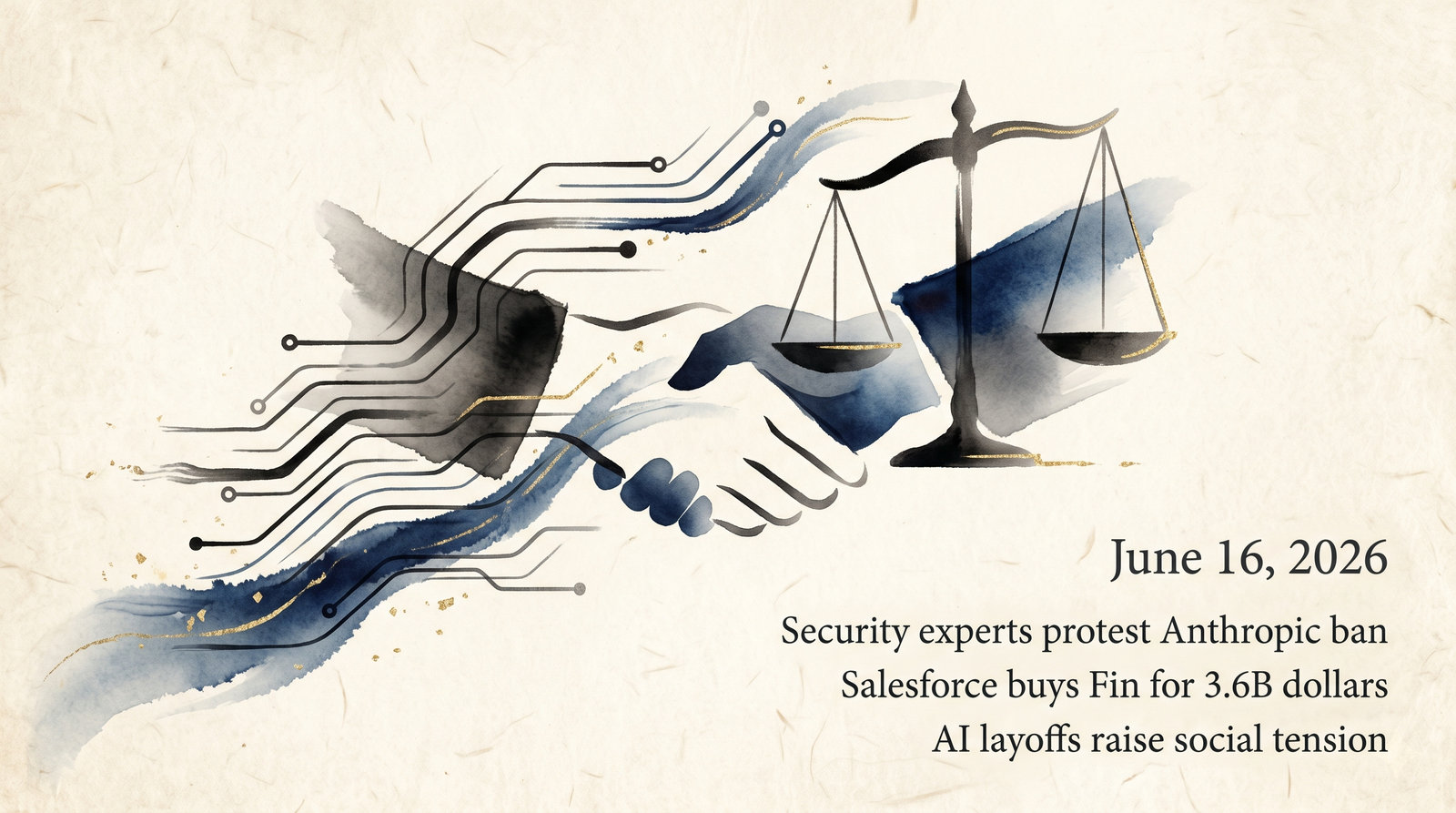
- Anthropic suspension fallout — 76 cybersecurity experts protest that the ban "takes the best tools away from defenders"
- Salesforce acquires AI customer-service platform Fin for $3.6 billion
- AI-attributed mass layoffs become a "powder keg" as the contrast with concentrated wealth fuels social tension
This is a day in which last weekend's events keep spreading, now drawing open dissent.
The US government's suspension of Anthropic's newest models has so far rippled into sovereign-AI debates and security concerns. Today, a direct rebuttal of the measure itself came to the surface.
On the corporate side, the largest CRM vendor moved to bring AI agent capabilities in-house through a major acquisition. Meanwhile, mounting AI-attributed job cuts and their contrast with concentrated wealth are raising the social temperature.
Today's Three Stories
Anthropic Suspension Fallout — 76 Security Experts File a Public Protest
Seventy-six cybersecurity experts signed an open letter calling for the Anthropic model suspension to be reversed.
The directive that placed Anthropic's "Fable" and "Mythos" under export controls on national-security grounds, prompting a worldwide suspension, has been covered since our June 13 special edition. The spillover into national sovereign-AI debates was covered in our June 15 briefing. What is new today is that defensive practitioners are pushing back directly against the measure.
According to TechCrunch, the signatories include Alex Stamos, former chief security officer at Facebook; Casey Ellis, founder of Bugcrowd; and Katie Moussouris, founder of Luta Security. Their letter argues that taking the most capable models away from defenders obstructs the work of finding vulnerabilities and hardening software. Pulling the best capabilities away from defenders without good reason, while adversaries advance rapidly, is dangerous — that is the core of their case.
Moussouris took issue with the unpublished paper by Amazon researchers cited as the basis for the restriction, saying it merely asked Fable to fix code containing deliberately planted vulnerabilities and did not constitute an actual security bypass. She called that "the most valuable thing an AI model can do for defensive security."
The experts also question whether the measure is effective at all. Per TechCrunch, Mythos initially had about 50 organizations with access, expanding to roughly 150 organizations across 15 countries. Yet comparably capable competitors — GPT-5.5, Claude Opus 4.8, and Claude Sonnet — remain publicly available, and Chinese models such as Kimi 2.7 reportedly lack Fable's guardrails. The argument is that a measure aimed at a narrow set of models may end up weakening real-world defenses instead.
Salesforce Acquires AI Customer-Service Platform Fin for $3.6 Billion
Salesforce announced it will acquire Fin, an AI customer-service platform, for $3.6 billion.
Fin — built by the company formerly known as Intercom — is an AI agent that resolves customer inquiries across live chat, WhatsApp, SMS, phone, and Slack. Salesforce plans to apply that technology and team to strengthen Agentforce, its platform for building enterprise AI agents. The deal is expected to close in the fourth quarter of Salesforce's fiscal 2027, in early 2027.
CEO Marc Benioff said Fin brings "proven agent technology, a deep commitment to customer success, and an incredible AI team." Fin co-founder and CEO Eoghan McCabe will remain CEO and accelerate development of the company's proprietary Apex model and an internal agent called Operator.
For the largest CRM vendor, absorbing AI agent capability through acquisition signals that competition in customer service is shifting into a more serious phase.
Source: Salesforce acquires AI customer service platform Fin for $3.6B (TechCrunch)
AI-Attributed Mass Layoffs Are Becoming a "Powder Keg"
TechCrunch warns that mass layoffs attributed to AI are raising social tension.
Nearly 40,000 tech workers lost their jobs in May 2026 alone — the highest in two years, according to the report. Meta announced 8,000 cuts, about 10% of its workforce, while the payments company Block cut nearly half of its staff. Per the outplacement firm Challenger, AI has ranked as the leading stated reason for layoffs for three consecutive months across industries.
At the same time, IPOs and rising valuations at AI companies have made some insiders extraordinarily wealthy. Chipmaker Cerebras Systems saw its shares surge on debut, turning founders into billionaires. The article argues that the contrast between those losing jobs and those building fortunes is producing anger reminiscent of the period after the 2008 financial crisis.
TechCrunch also notes that AI is partly serving as a convenient justification for cuts rooted in pandemic-era overhiring. The more visible the concentration of wealth becomes, the report suggests, the stronger the backlash is likely to grow.
Source: The AI layoff wave is becoming a powder keg (TechCrunch)
Other Developments
Models
- Meta rolled out a suite of new AI features on Facebook, including an "AI Mode" that turns search into answers, image editing that virtually changes clothing or hairstyles, and collage suggestions from the camera roll (Meta Newsroom)
- Moonshot AI added a "HighSpeed" inference mode to Kimi K2.7 Code, its open-weight coding LLM, reaching up to 260 tokens per second on short contexts (PC Watch)
- IBM's AI development assistant "Bob" reportedly cut a Java application update cycle from about a month to three days in one consulting firm's measured case, covering the full software lifecycle beyond code generation (ITmedia)
Products
- TechCrunch flags reliability concerns with Meta's AI Mode, which draws on public user posts from Groups and Reels and may surface outdated or misleading content rather than authoritative sources (TechCrunch)
Research
- Researchers at KU Leuven analyzed 1.4 million passes with AI and found that deliberately kicking the ball out near the goal paradoxically increases scoring opportunities (ASCII.jp)
- Sakana AI launched "Sakana Marlin," a business-research service built on its proprietary AB-MCTS technology, generating 80-page reports from roughly eight hours of autonomous investigation, priced from about ¥200,000 per month (ITmedia)
Policy
- Japan's Society for Artificial Intelligence marked its 40th anniversary with four proposals for AI's social implementation, framed around the principle that "AI augments rather than replaces human intelligence" and addressing education, defense, and legal frameworks including copyright (ITmedia)
- Major tech companies are intensifying last-minute lobbying over AI regulation and the Kids Online Safety Act (KOSA) as Congress weighs its approach, The Verge reports (The Verge)
Business
- Nvidia is pursuing its first bond deal since 2021, aiming to raise more than $25 billion as it races to meet surging AI chip demand — a notable shift in its financing strategy (Ars Technica)
- Sarvam, a full-stack AI company for Indian languages, raised $234 million in a Series B led by HCLTech, reaching a $1 billion-plus valuation as India's newest AI unicorn (TechCrunch)
- OpenAI formally launched a Partner Network for businesses and developers, aimed at delivering its technology to customers through an ecosystem of solution providers (OpenAI News)
Other
- Loft Orbital's YAM-9 satellite, running Google DeepMind's Gemma 3 model, autonomously identified areas of interest in orbit without ground-analyst intervention — reportedly the first use of a vision-language model in space (TechCrunch)
- newmo, an autonomous-taxi operator, opened "JOTO Base" in Osaka's Joto Ward as a data-collection and testing hub, targeting commercial service in 2028 (ASCII.jp)
Source: Selected by the editors from the AI news inbox (collected June 16, 2026 — 30 items, 2 primary and 28 secondary).