Today's Headlines
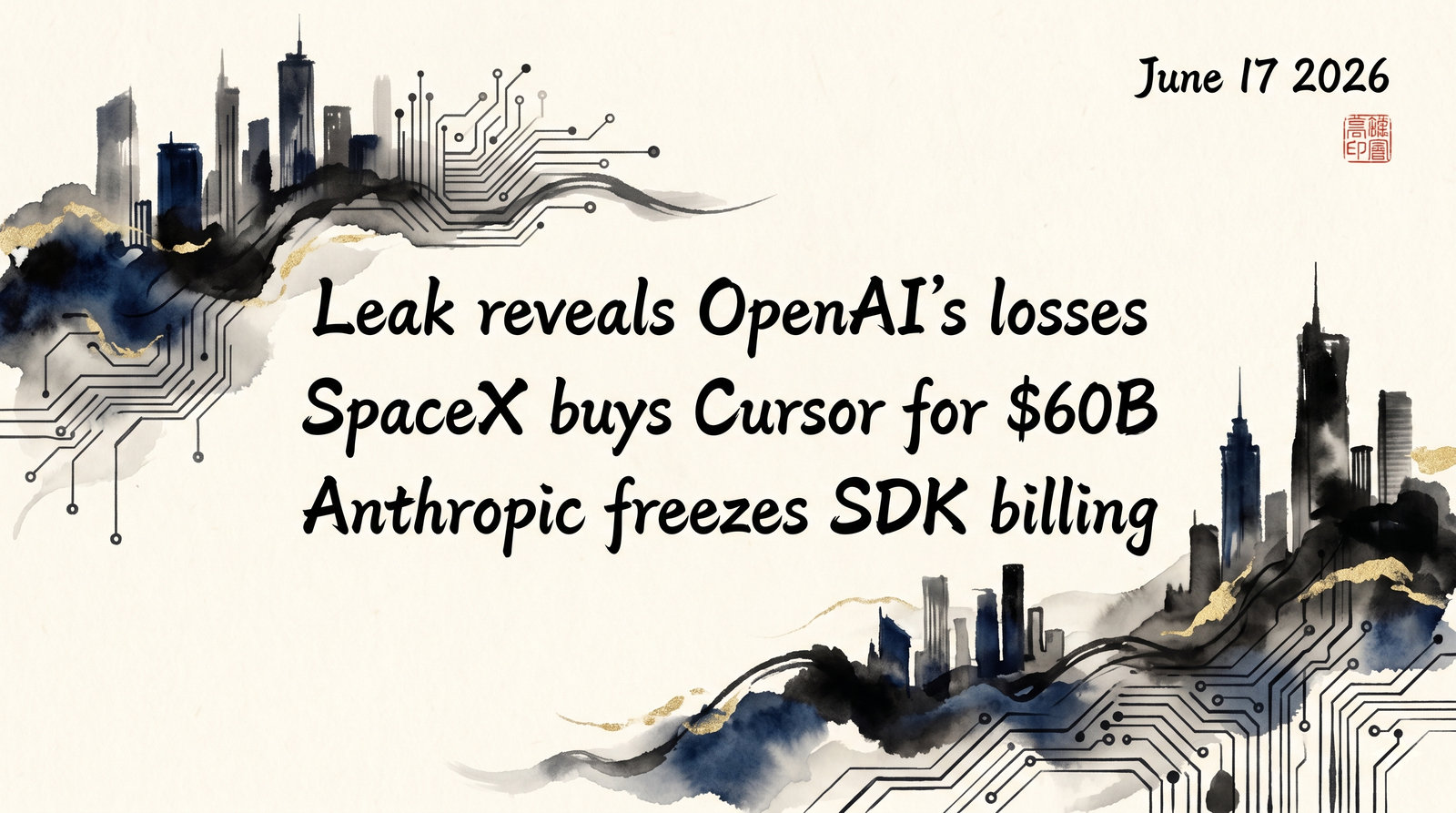
- Leaked financials reveal OpenAI's 2025 — a $38.5 billion net loss, with a $20.9 billion operating loss
- SpaceX to acquire AI coding tool Cursor in a $60 billion all-stock deal
- Anthropic freezes its Claude Agent SDK billing change on the day it was to take effect
This is a day when the numbers and money flows of the AI majors became unusually concrete.
OpenAI's audited financials leaked, exposing both the scale of the company and the structure of its losses. On the well-funded side, SpaceX is moving to absorb a major coding-tool maker at a steep price. And on the question of everyday billing, Anthropic withdrew a planned change at the last moment — the competitive pressure showing up differently for those on offense and those on defense.
Today's Three Stories
Leaked Financials Reveal OpenAI's Reality — a $38.5 Billion Net Loss in 2025
Audited financial documents for OpenAI's 2025 fiscal year have leaked, showing a net loss of $38.5 billion.
According to the reporting, revenue reached $13.07 billion — more than triple the prior year's $3.7 billion. The headline $38.5 billion loss, however, was largely inflated by non-cash charges tied to the company's conversion from a nonprofit to a for-profit structure.
Those non-cash charges totaled $41.55 billion. Stripping them out, the underlying operating loss was $20.92 billion. The single largest cost driver was payments to Microsoft, which came to $17.2 billion.
The outlook is also demanding. The net loss for 2026 is projected at $14 billion, with profitability not expected until 2029. The documents were obtained by Ed Zitron and independently verified by the Financial Times, and as a leak amid IPO preparations, they are likely to intensify investor scrutiny.
Source: Leaked financial docs show OpenAI is losing billions of dollars a year (Ars Technica)
SpaceX to Acquire AI Coding Tool Cursor for $60 Billion
SpaceX has agreed to acquire Anysphere, the maker of the AI coding tool Cursor, in a $60 billion all-stock deal.
According to the reporting, the transaction is structured as a merger of SpaceX's subsidiary X67 Inc. with Cursor, expected to close during the third quarter of 2026. The deal was announced just after SpaceX's Nasdaq listing and a major capital raise.
Cursor's business is already substantial: its annualized recurring revenue surpassed $4 billion as of early June. It was also reportedly in talks to raise capital at a roughly $50 billion valuation before the acquisition.
With the deal, SpaceX — combined with xAI, which it merged with in February 2026 — positions itself to compete head-on with Anthropic and OpenAI in the AI coding market. Separate reporting puts the break-up fee at $10 billion, a measure of the deal's scale.
Source: SpaceX will acquire coding tool Cursor to compete with Anthropic, OpenAI (Ars Technica)
Anthropic Freezes Its Claude Agent SDK Billing Change on Day It Was to Take Effect
Anthropic has frozen a Claude Agent SDK billing change that had been scheduled for June 15, 2026, on the very day it was to take effect.
The original change would have separated usage of the Agent SDK, claude -p, and third-party apps from standard subscription limits, moving anything beyond the monthly cap to API usage-based pricing. On the day it was supposed to take effect, Anthropic notified users that, for now, nothing would change.
Several factors reportedly converged behind the reversal. First, with OpenAI said to be weighing a sharp cut to API prices, a shift to usage-based pricing risked putting Anthropic at a competitive disadvantage.
Second, with an IPO filing already in motion, an unpopular billing change that drove customers away could weigh on the company's valuation. Third, with access to Claude already restricted in places under US export controls, additional billing limits risked being counterproductive. Compounded by developer backlash, Anthropic has not publicly cited any single reason.
Source: Anthropic "pauses" token-based billing for its Claude Agent SDK (Ars Technica)
Other Developments
Models
- Google announced its June Pixel update, including Gemini Omni-powered AI video creation and editing, music generation that turns text or photos into original tracks, and conversational photo editing via "Edit with Ask Photos." The video and music features require a Google AI subscription and are limited to users 18 and older (Google Blog)
- Microsoft unveiled the next-generation Surface Pro and Laptop powered by Snapdragon X2 with an 80 TOPS NPU, sharply boosting on-device AI and exceeding Copilot+ PC requirements. Per PC Watch, GPU performance is up roughly 50% over the previous generation (ASCII.jp)
- The Dutch research organization TNO is developing GPT-NL, a sovereign large language model designed to keep data governance and linguistic control within the Netherlands — part of a broader European push to reduce dependence on US big tech (TNO)
Products
- İmeceMobil, an agriculture app running on Microsoft Azure, serves 150,000 monthly active users among Turkish farmers, combining satellite crop diagnostics with hyperlocal weather alerts to cut costs and time. One farmer reported a three-to-four-hour task reduced to 45 minutes (Microsoft)
Research
- OpenAI published a method for simulating real-world deployment conditions before a model ships, predicting behavior by building an automated grader trained to approximate human expert judgments — framed as part of its evaluation-driven development work (OpenAI)
- Subquadratic released a technical report for SubQ 1.1 Small, a model using its proprietary sparse-attention technique that handles up to 12 million tokens of context with high accuracy at roughly 64x less compute than dense attention, targeting long-context enterprise work in finance, legal, and software engineering (Subquadratic)
Policy
- The US Department of Justice argued that shutting down xAI's 57 unpermitted natural-gas turbines at its Memphis-area data centers would harm national, economic, and energy security, opposing a halt to operations. A lawsuit brought by the NAACP and others centers on the legality of xAI's claim that trailer-mounted turbines qualify as mobile equipment exempt from air-pollution rules (TechCrunch)
- Google officially launched Android 17, expanding Gemini's OS-level integration alongside new multitasking tools. System-level AI assistance grows broader, in a move that repositions Android more firmly as a platform (TechCrunch)
Business
- Google DeepMind partnered with the UK government to build a prototype that uses AI to support housing planning applications. Targeting a 50% reduction in decision times as the UK aims to build 1.5 million homes by 2029, it is being trialed in Barnet, Camden, and Dorset ahead of a planned nationwide rollout in 2027 (Google DeepMind)
- Plaud, which makes AI meeting-notetaker hardware, announced it has shipped more than 2 million devices and surpassed $100 million in software ARR. With roughly half of device buyers upgrading to paid plans, the company exemplifies a hardware-led path to SaaS (TechCrunch)
- Probably, a startup that prevents AI hallucinations by validating outputs against data, raised a $9 million seed round led by Andreessen Horowitz. It pairs deterministic validators with LLMs and is eyeing precision-sensitive fields such as accounting and medicine (TechCrunch)
- Robinhood announced cuts of about 290 employees, roughly 10% of its workforce, yet the CEO made no mention of AI in either the announcement or the SEC filing. In contrast to Amazon, Block, and Coinbase, which cited efficiency gains, TechCrunch notes that AI as a stated reason is losing credibility (TechCrunch)
Other
- A US consumer survey found that 60% of respondents view the use of the word "AI" in brand messaging negatively — a result suggesting that marketing built around AI can backfire (TechCrunch)
- ITmedia explained how Tesla, Waymo, and NVIDIA each take a different approach to "Physical AI," the convergence of generative AI and autonomous driving — Tesla with its own end-to-end model, Waymo with a design built around HD maps, and NVIDIA by providing a cross-industry platform (ITmedia)
- Toshiba advanced its quantum-inspired optimization technology for embedded systems, achieving both faster processing and greater operational stability, in a step toward practical edge deployment in manufacturing and logistics (ITmedia)
Source: Selected by the editors from the AI news inbox (collected June 17, 2026 — 30 items, 5 primary and 25 secondary).