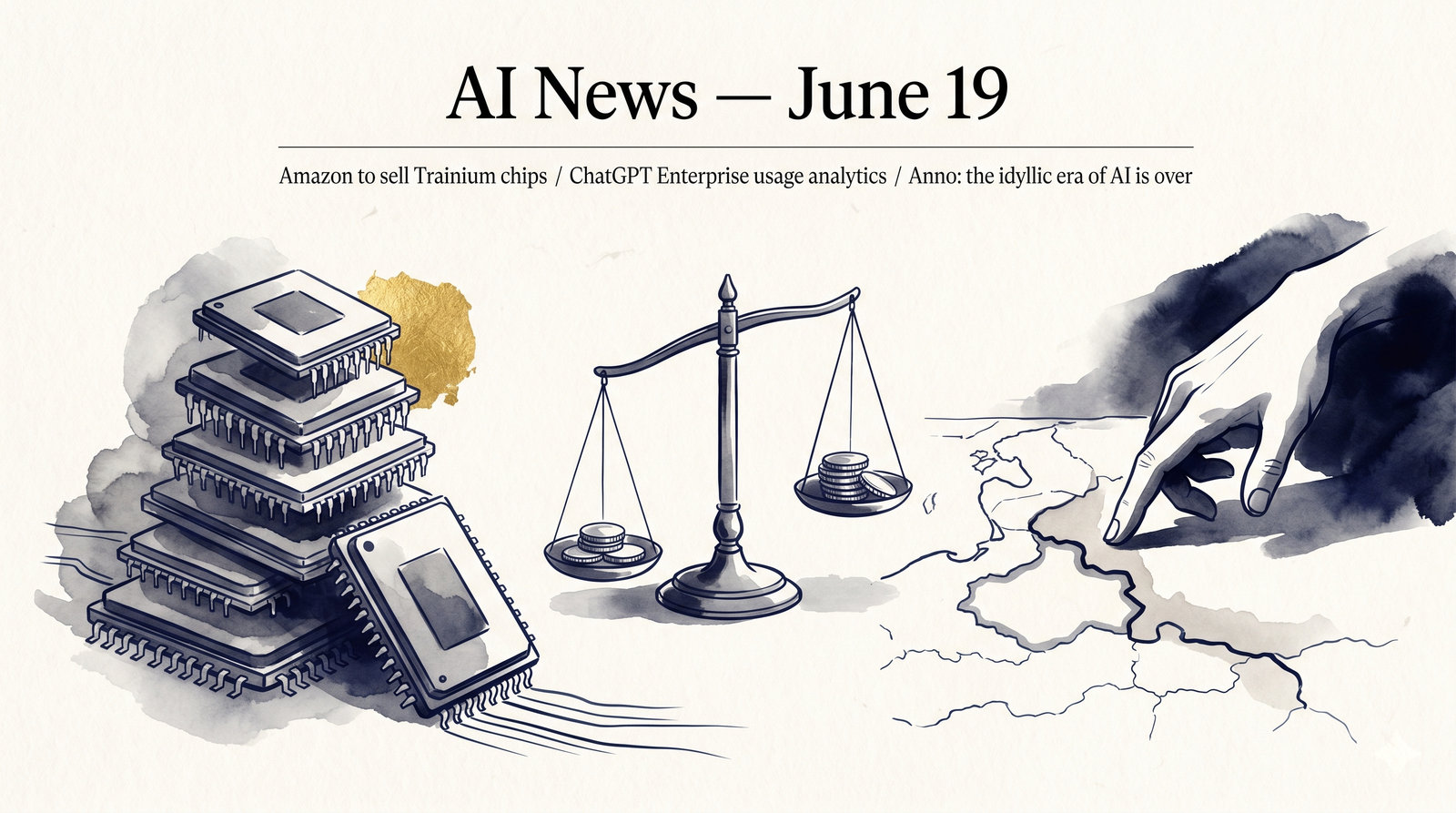
Today's Headlines
- Amazon opens early talks to sell its Trainium AI chips externally, stepping into Nvidia's territory
- OpenAI adds usage analytics and spend controls to ChatGPT Enterprise, aimed at IT and finance governance
- Team Mirai's Takahiro Anno says "the pastoral era of AI development is over," framing the Mythos suspension as a Japanese policy issue
This was a day when companies reached for the foundation that AI runs on.
Three threads — the source of the chips, the management of usage costs, and the right to access models — each moved on a separate front. The action shifted one step down from the contest over performance, toward the footing underneath it.
That shift reached the political arena in Japan as well. The recognition that access to frontier models can become a matter of diplomacy and national strategy began to be spoken in the language of domestic policy.
Today's Three Stories
Amazon Moves to Sell Trainium AI Chips Externally — A Direct Challenge to Nvidia
AWS has opened early-stage talks to sell its in-house Trainium AI chips to outside data centers and companies.
Until now, AWS has run Trainium only inside its own cloud. These talks signal a shift in business model — toward selling the silicon itself to third parties, rather than charging for token processing as before.
The scale has come into focus. In an April letter to shareholders, CEO Andy Jassy said the chip business, if run as a standalone operation, would carry an annual run rate of roughly $50 billion. That falls far short of Nvidia's $326 billion run rate, but it sits at a level comparable to Intel's annual revenue.
A manufacturing constraint stands in the way. To expand external sales, AWS would need to sharply increase capacity at its foundry partner, TSMC. TSMC prioritizes Nvidia, its largest customer, which makes this the supply bottleneck. Volume production of the next-generation Trainium4 is said to be more than a year out, so for now the supply available is what holds the leverage.
Source: Amazon hopes to challenge Nvidia more directly by selling its AI chips (TechCrunch)
ChatGPT Enterprise Gains Usage Analytics and Spend Controls
OpenAI has added new usage analytics and spend controls to ChatGPT Enterprise.
When a company deploys AI at scale, it becomes hard to see who is using how much, and where the costs are landing. The additions provide the visibility and governance to manage that — a layer that tracks usage paired with a layer that constrains spend.
The aim sits with two groups: the IT teams that own deployment, and the finance teams that watch return on investment. At the scale-out stage, there is a persistent worry that spend balloons while the real pattern of usage stays opaque. Building usage visibility and spend control into a single product appears to answer that concern.
Source: New usage analytics and updated spend controls for enterprises (OpenAI News)
Takahiro Anno: "The Pastoral Era of AI Development Is Over" — Casting the Mythos Suspension as a Japanese Policy Issue
Takahiro Anno, head of the Japanese political party Team Mirai, said at a June 18 press conference that "the pastoral era of AI development is over."
Behind the remark is the suspension of Anthropic's Mythos 5 and Fable 5 by U.S. government order. The two models became available on June 10 and were halted from June 13. The episode laid bare a reality — that access to frontier models can be cut off on grounds entirely separate from technical merit.
Anno drew the event into the context of Japanese policy. He argued that the country must pursue both domestic AI development and the diplomacy needed to secure access to foreign models, all while staying aware of these risks. His position treats access to frontier AI as a matter of diplomacy and national strategy.
He also addressed Chinese open models. There is no guarantee, he cautioned, that Chinese firms will keep publishing open models indefinitely, and the assumptions underlying access could erode. What stands out here is that he voiced — in domestic terms — the picture of model access becoming a strategic resource between states.
For readers outside Japan, Team Mirai is a technology-focused political party, and Anno is a software engineer and entrepreneur turned politician. The Mythos suspension itself was covered in the editors' June 13 special report and June 18 roundup; this is a follow-up on the reaction from Japan's political arena.
Other Developments
Models
- Google introduced a beta of Ask Ad Manager, a Gemini-powered conversational AI agent inside Google Ad Manager. Publishers can now handle reporting and troubleshooting through chat, cutting the manual work of stitching together multiple reports. Developer extensions via a REST API and an MCP server are planned to roll out over the course of the year (Google Blog).
- Adobe expanded Firefly's agentic capabilities into a public beta across five apps — Premiere, Photoshop, Illustrator, InDesign, and Frame.io. Natural-language instructions can now drive batch processing and brand management; in Photoshop, for example, that means batch background removal, and in InDesign, automatic layout updates that follow brand guidelines (PC Watch).
Products
- A Match Group survey of 1,000 singles aged 18 to 39 found that 47% view the use of AI in dating negatively. Forty percent said they would not date someone who uses an AI companion app, a figure that rises to 51% among women aged 18 to 24. Yet 64% see value in practical help such as profile writing — a clear split between assistance and intervention in relationships (TechCrunch).
Policy
- OpenAI recruited prominent talent ahead of its IPO: Noam Shazeer, a co-author of "Attention Is All You Need" and former co-lead of Google DeepMind's Gemini, and Dean Ball, who shaped the AI Action Plan under the Trump administration. Ball joins on July 6 to head a new team called Strategic Futures, covering catastrophic risk, labor-market impact, and government relations (TechCrunch).
- The Federal Energy Regulatory Commission ordered six major U.S. grid operators to fast-track interconnection requests from AI data centers. The operators must report available capacity within 30 days and review rates within 60 days. The move responds to data-center electricity demand projected to nearly triple by 2035, with connection backlogs becoming a drag on infrastructure expansion (TechCrunch).
Business
- Baseten, which provides AI model inference infrastructure, is reportedly raising $1.5 billion at a valuation of up to $13 billion. Its January 2026 Series E valued the company at $5 billion, making this a sharp rise in under six months. Investor appetite is concentrating on a business that routes requests to the best-fit model to optimize the cost and speed of inference (TechCrunch).
- General Intuition, which builds world models for embodied AI using gaming video, is in talks to raise $300 million at a valuation of about $2 billion. Backers include Jeff Bezos, Eric Schmidt, Khosla Ventures, and General Catalyst. The company stands out for a strategy of training agents rather than selling its own foundation models (TechCrunch).
- Snap spun off its AI video model team into an independent company called Dotmo, citing the high cost of generative AI development in-house. Snap retains a technology license and an equity stake. This is its second spinoff of 2026, following the Specs smart-glasses unit (TechCrunch).
Other
- Hakuhodo DY ONE, a wholly owned subsidiary of Japan's Hakuhodo DY Group, became the first domestic launch partner for OpenAI's ChatGPT advertising pilot. Ads are shown in a separate frame that does not influence the AI's answers, and users' conversation history is not shared with advertisers. As information gathering shifts from keyword search toward AI conversation, the move stakes out an early position in the market that could succeed search advertising (ASCII.jp, in Japanese).
- Google helped open Dataland at The Grand LA in Los Angeles, billed as the world's first museum dedicated to AI-generated art. Built on Google Cloud, Gemini, and a proprietary Large Nature Model, the roughly 25,000-square-foot space transforms environmental data into real-time immersive experiences across image, sound, and scent. It is the fruit of a decade of collaboration with AI artist Refik Anadol (Google Blog).
Source: Selected by the editors from the AI news inbox (collected June 19, 2026 — 30 items, 5 primary and 25 secondary).