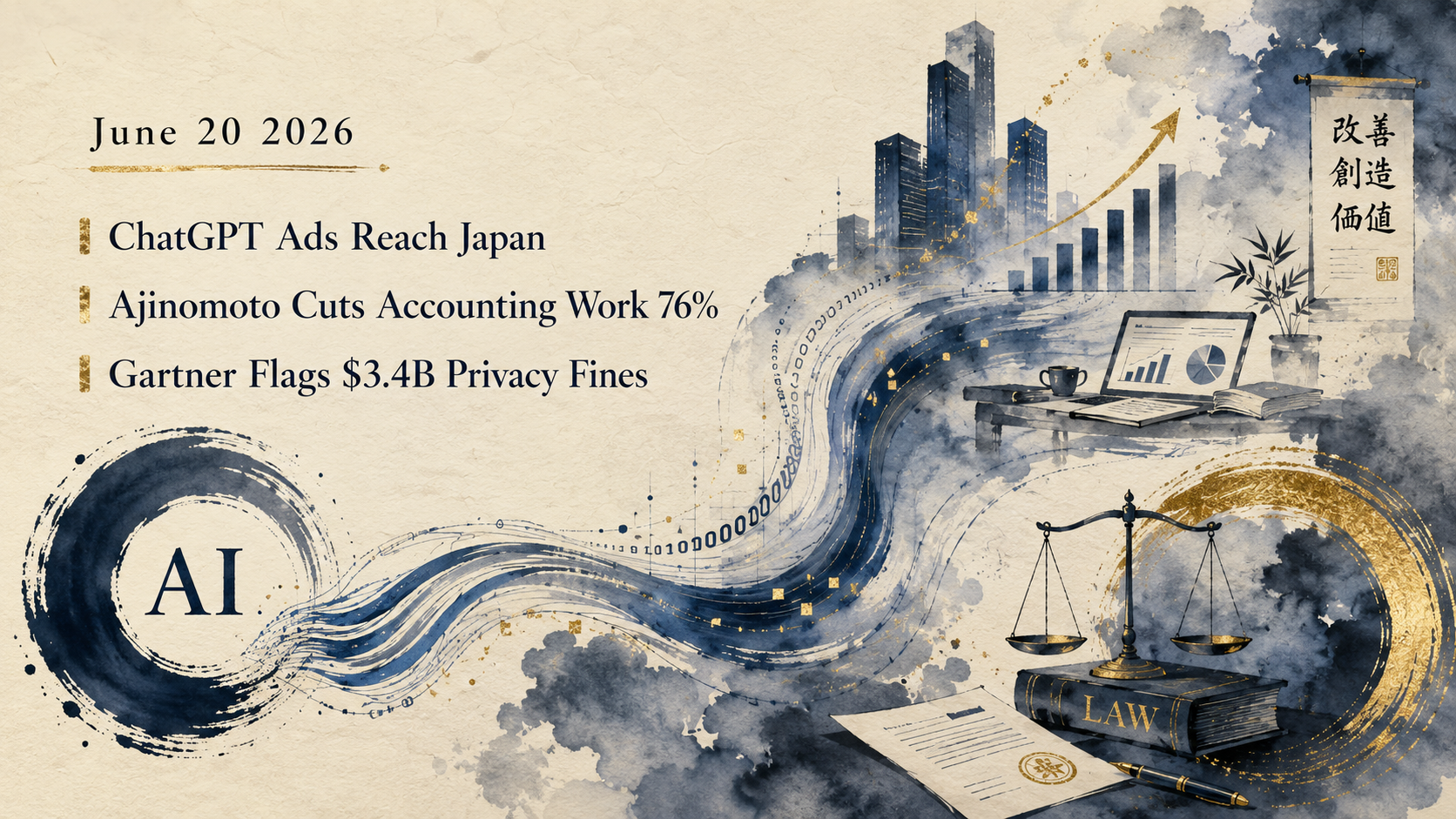
Today's Headlines
- ChatGPT's advertising test begins in Japan, covering the free plan and the 1,400-yen-per-month Go plan
- Ajinomoto Group deploys an accounting AI agent and cuts the workload of targeted tasks by 76%
- Gartner reports that U.S. privacy fines exceeded $3.4 billion in 2025 and urges CISOs to prepare for automated decision-making rules
This was a day when AI began to touch the bottom line and the rulebook directly.
A tool that used to be free now carries ads, work that once needed people is shifting to AI, and that very use is becoming a target for regulators. The three stories come from separate arenas, yet each marks the same turn: the question has moved from how to use AI toward how to monetize and govern it.
The novelty of the technology itself matters less now than how that technology lands on an organization's costs and its compliance obligations.
Today's Top Three
ChatGPT's Ad Test Arrives in Japan, Covering Free and Go Plans
OpenAI began testing advertisements inside ChatGPT in Japan on June 19.
The test covers adult users on the free plan and on the Go plan, priced at 1,400 yen per month. Users on the Plus, Pro, Business, Enterprise, and Education tiers are not included. The United States started the same test in February 2026, so Japan follows roughly four months later.
Ads are served based on the content of a user's conversation. OpenAI states, however, that advertising does not influence ChatGPT's responses. Only impression counts and click counts are shared with advertisers, and no personal data is passed along.
Users who want to hide the ads can upgrade to a higher tier through the "ad controls" in the app settings. By building an advertising revenue stream into a free conversational AI, the move stakes out the market that may follow search advertising.
Source: ChatGPT Ad Test Launches in Japan, and How to Turn It Off (ITmedia AI+)
Ajinomoto Group Deploys an Accounting AI Agent, Cutting the Targeted Workload by 76%
Ajinomoto Group introduced an AI agent into its accounting operations and reduced the workload of the targeted tasks by 76 percent.
Accounting carries a heavy share of routine work, such as checking and approving entries, and it consumes both people and time. The group assigned an AI agent to this work and shifted its staff toward the verification tasks that require human judgment. A 76 percent reduction signals that much of the routine processing could be handed to the agent.
The company's ability to adopt early rests on groundwork it laid in advance: organizing its data and standardizing its processes. AI agents perform best when the steps and the data they handle are already in order. What separated success from failure here was less the capability of the AI itself than the readiness of the business processes meant to receive it.
Source: Ajinomoto Group Cuts Accounting Workload 76% with an AI Agent (ITmedia)
Gartner Warns: U.S. Privacy Fines Topped $3.4 Billion in 2025, and CISOs Must Address Automated Decisions
The research firm Gartner reported that privacy-related fines in the United States reached $3.425 billion in 2025.
That figure exceeds the five-year average, and Gartner projects the growth will continue through 2028. Behind it lies the steady spread of state-level privacy laws. Privacy statutes are already in force in 22 states, covering more than half the U.S. population.
The firm points to automated decision-making systems (ADM) as the next focus of enforcement. Mechanisms in which AI reaches decisions without human involvement are emerging as a new target. As AI increasingly handles matters such as loan approvals and hiring screens, its transparency and accountability are coming under scrutiny.
Gartner urges chief information security officers to overhaul their privacy programs in close coordination with legal teams. Revisiting how consent is obtained and how data is protected, in line with regulatory requirements, becomes the key to limiting exposure to fines. The deeper AI adoption goes, the more plainly its use connects to questions of legal compliance.
Source: Gartner Sounds the Alarm: Privacy Enforcement Ramps Up — What Should CISOs Reconsider? (@IT)
Other Developments
Models
- OpenAI added a "Record and Replay" feature to its AI coding tool Codex, letting users record a desktop workflow and have the AI reproduce it. From a single demonstration, the AI infers timing, the screen regions it needs, the order of execution, and error handling, then adapts on subsequent runs. The feature is currently available only on macOS, with a rollout planned for the EEA, the UK, and Switzerland (ITmedia NEWS)
Research
- RIKEN named its AI for Science supercomputer "Rikyu," chosen from 856 public submissions. The name echoes the tea master Sen no Rikyu and his shu-ha-ri philosophy of learning, mapping the stages of imitation, departure, and transcendence onto AI's evolution. The system delivers 15.539 exaflops at FP8 precision (ITmedia AI+)
Policy
- Norway announced a near-total ban on AI use in elementary schools, citing concerns about the effect on children's cognitive and educational development. The move is among the strictest AI restrictions seen in European education (Reuters)
- Reports indicate that Anthropic's commercial metrics have held steady despite the U.S. government order that halted its Fable 5 and Mythos 5 models. Some observers suggest the friction has, if anything, underscored the models' capabilities, though such readings remain speculation. The editorial team covered the suspension itself in a June 13 special report (TechCrunch)
Business
- Osaka Metro deployed an AI assistant from PKSHA Technology to streamline more than 1,000 internal inquiries each month. The system automates work that previously required phone handling in 90 percent of cases and is designed for use across all 5,000 employees (ITmedia)
- Honda built an AI agent into its sales process to detect business opportunities ahead of time from customer data. The aim is to move away from a reactive, inquiry-driven model toward proactively generating higher-quality sales engagements (ITmedia Business Online)
- Reliance Industries, India's largest conglomerate, unveiled a plan to embed AI across calls, apps, and home devices, backed by a $110 billion investment in AI infrastructure. Building on more than 500 million Jio users, the company frames the effort as a national strategy to make India a creator of AI rather than a consumer of it (TechCrunch)
Other
- Elastic, a major enterprise search company, agreed to acquire Deductive AI — a startup that detects and resolves software bugs with AI — for up to $85 million. Elastic plans to fold the technology into its observability platform to strengthen automated incident response. The deal illustrates how incumbents are absorbing AI-powered operations tooling (TechCrunch)
Source: Selected by the editorial team from the AI news inbox (collected June 20, 2026 — 27 items, 0 primary and 27 secondary).