
This Week's Headlines
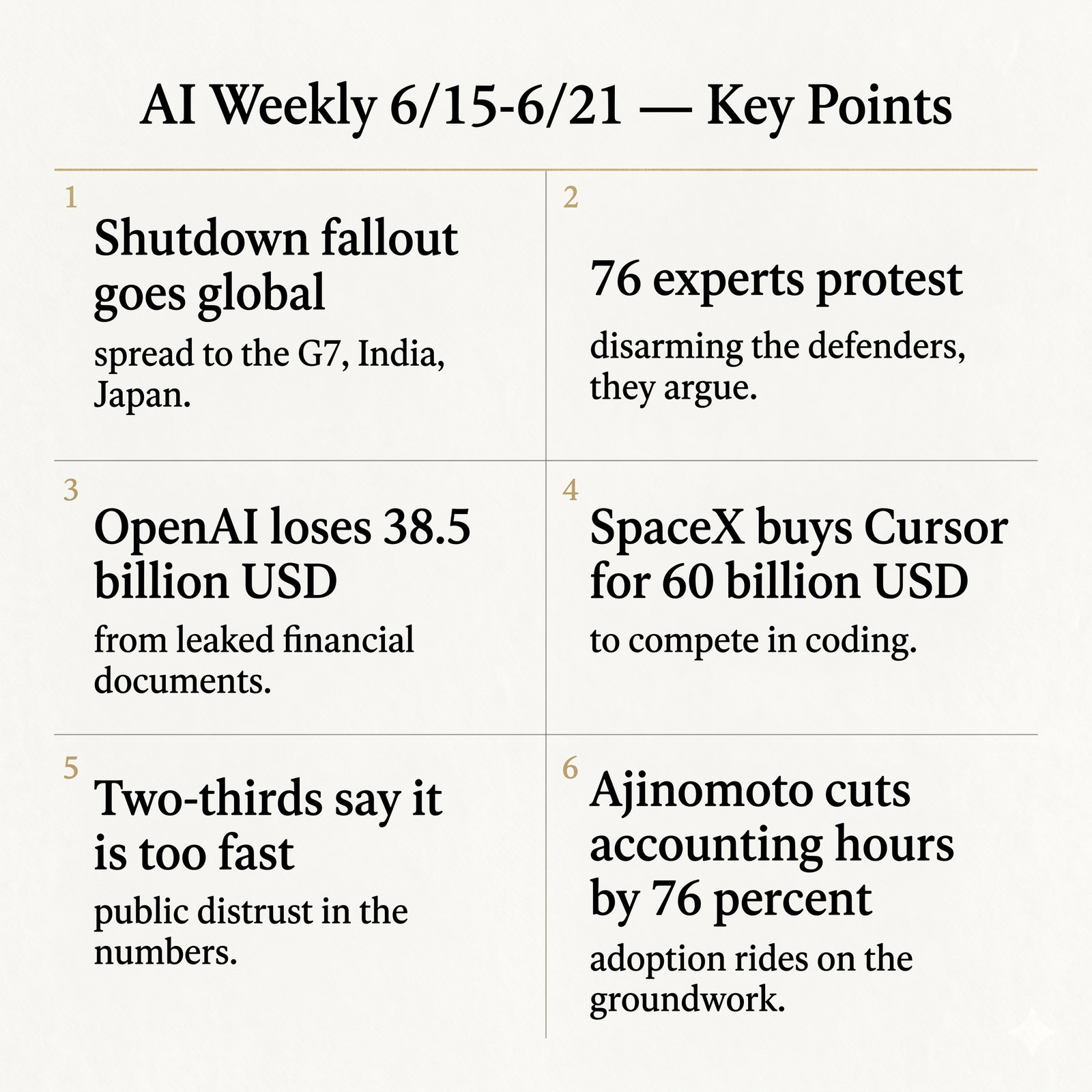
- The fallout from Anthropic's shutdown spread worldwide—India's sovereign-AI debate, a topic at the G7 summit, an open protest by 76 security experts, and a political statement in Japan
- The financial footing of the major AI labs surfaced all at once—OpenAI's $38.5 billion net loss, SpaceX's $60 billion acquisition of Cursor, and Anthropic freezing a billing change on the day it took effect
- Society began to pull back—about two-thirds of Americans say progress is "too fast," and Norway moved toward a near-total ban on AI in elementary schools
The second week of this site, "Ai," coincided with the moment the story moved from the front of the stage to the foundations beneath it.
For the past year, the AI conversation has been driven by one question: which model is smartest. Last week, that axis dropped a level further. Not the performance leaderboard, but who controls the frontier models, what they cost, and how far society trusts them—access, cost, and trust, three foundations, were each tested in a different arena at the same time.
The thread running through it all traced back to the previous weekend. Anthropic's top-tier Fable 5 and Mythos 5 went dark for all customers under a US export-control directive. The most advanced AI was switched off for reasons unrelated to its performance—and into the new week, that event kept rippling through national policy, corporate finance, and public opinion.
A note on scope: the shutdown itself was covered in our June 13 special and last week's weekly review. This piece covers the fallout that spread over the following week, alongside the moves on cost and trust that surfaced beside it.
The Week's Lead Stories
The fallout went global—access became a question of diplomacy and national strategy
The shutdown of Anthropic's top-tier models did not stay a domestic US matter; it spread into the policy and diplomacy of nation after nation.
India lit the fuse. Investors and policy figures voiced renewed concern about dependence on US-made AI, and venture investor Ankit Vaish was reported to have called it "an event that should make all of us fundamentally rethink how we approach sovereign AI in India." Some called on the government to create an AI and deep-tech fund on the order of 500 billion rupees a year. These were reported as the views of individuals, not official government policy.
The question soon reached the national table. At the G7 summit, France's President Macron warned that a situation in which the US could cut off access overnight is a matter of economic and national security. India's Prime Minister Modi argued for stable access to protect the critical infrastructure of democratic nations. Leaders began discussing a "trusted partner" scheme that would grant priority access to non-US governments and companies, conditioned on maintaining competitiveness against China.
From the defensive front came pushback against the measure itself. Seventy-six cybersecurity experts, including former Facebook security chief Alex Stamos, signed an open letter demanding it be reversed. Taking the most capable models away from defenders, they argued, hampers vulnerability discovery and software hardening. On the unpublished paper cited as grounds for the rule, Luta Security's Katie Moussouris noted that it merely asked the model to fix deliberately planted vulnerabilities—not an actual security bypass.
The recognition reached Japan's political arena as well. Takahiro Anno, leader of the Team Mirai party, said at a June 18 press conference that "the idyllic era of AI development is over," arguing that the country must pursue both domestic model development and the diplomacy needed to secure access to foreign models, with political risk in full view. Access to frontier AI is becoming a strategic resource between nations, on a level separate from technical evaluation—and over a single week, that framing was translated into the language of one country after another.
- As Anthropic suspends access, India debates its AI future (TechCrunch)
- World leaders want American AI—they just don't want America to be able to turn it off (TechCrunch)
- Cybersecurity vets protest the US government ban on Anthropic's models (TechCrunch)
- Anno: "The idyllic era of AI development is over" (ITmedia AI+)
The financial footing surfaced all at once—the stamina and cost behind the intelligence
In a week when talk of raw performance quieted, the numbers behind the major AI labs surfaced with unusual specificity.
OpenAI's were the rawest. According to leaked, audited financial documents for fiscal 2025, its net loss reached $38.5 billion. Revenue grew more than threefold, from $3.7 billion to $13.1 billion, while most of the headline loss came from non-cash charges tied to the conversion from non-profit to for-profit. Excluding those, the operating loss was $20.92 billion, with the single largest cost being $17.2 billion paid to Microsoft. Profitability is not expected until 2029, and as a leak during IPO preparation, it is likely to sharpen investor scrutiny.
On the cash-rich side, large acquisitions moved. SpaceX agreed to acquire the maker of the AI coding tool "Cursor" in a $60 billion all-stock deal. Cursor's annual recurring revenue has already crossed $4 billion, and combined with xAI, which merged into SpaceX in February 2026, the move sets up direct competition with Anthropic and OpenAI. In customer service, Salesforce announced it would acquire the AI agent "Fin" for $3.6 billion to strengthen its own Agentforce platform.
On billing, Anthropic froze a planned change to Claude Agent SDK pricing on June 15, the very day it was to take effect. With OpenAI reportedly weighing a sharp cut to API prices, a move to usage-based billing risked a competitive disadvantage. The wish to avoid customer churn from an unpopular change while an IPO filing is pending reportedly weighed in as well. It was a case of competitive pressure showing up differently on the attacking and defending sides.
In the field, cost visibility became a new theme. OpenAI added usage analytics and spend controls to ChatGPT Enterprise, building a way to see who uses how much and where the costs land. NEA's Tiffany Luck observed that the drive to "tokenmaxx"—to squeeze the most out of AI—has led some companies to burn through an annual budget in a few months, and that enterprises are turning toward measuring ROI and running multiple models in parallel. Corporate attention is moving from acquiring intelligence to managing what it costs to run it.
- Leaked financial docs show OpenAI's deep losses (Ars Technica)
- SpaceX to acquire Cursor to compete with Anthropic and OpenAI (Ars Technica)
- Anthropic pauses token-based billing for Claude Agent SDK (Ars Technica)
- Enterprises are still figuring out their AI ROI—NEA's Luck (TechCrunch)
Society began to pull back—a "too fast" chorus and a deficit of trust
Even as the technology pushed forward, numbers showing society stepping back from AI lined up in the same week.
In a Pew Research survey, about two-thirds of Americans said AI is advancing too quickly. Behind it sits a double distrust: 67% do not believe the government will regulate effectively, and 59% do not believe companies will develop AI safely. Only 16% see the social impact over the next 20 years as positive, falling to 14% among those under 30. At the same time, ChatGPT leads with 44% of US adults using it—proof that the breadth of adoption and the depth of public unease are spreading together.
The distrust extended to conversational AI itself. Signal president Meredith Whittaker said "these are not your friends—not conscious beings, not sentient interlocutors," urging users to keep their distance from the habit of treating chatbots as trusted partners. She singled out the cross-application access of tools like Microsoft Copilot, calling it "a kind of backdoor" and warning of broad permissions reaching credit cards, messages, and even a home address.
The wariness showed up in marketing, too. A US consumer survey found that 60% view the use of the word "AI" in brand messaging negatively—a result suggesting that foregrounding AI can backfire. In education, Norway's government moved toward a near-total ban on AI use at the elementary level, citing concerns for children's cognitive and learning development. It is one of the most far-reaching such measures in European education.
Even as the display of intelligence continues, society has grown more cautious. The performance leaderboard and the trust leaderboard can no longer be read on the same scale. For anyone responsible for deployment, the week put "how far can it be trusted?" beside "what can it do?"—with equal weight.
- Two-thirds of Americans think AI is advancing too quickly (The Verge)
- Signal's Meredith Whittaker: AI chatbots 'are not your friends' (TechCrunch)
- 60% of US consumers say "AI" in brand messaging is a turnoff (TechCrunch)
- Norway imposes a near-ban on AI in elementary school (Reuters)
By Category
Chips and Infrastructure
The labs reached for the foundations that run AI. Amazon entered early talks to sell its "Trainium" AI chip externally, shifting from running it only inside its own cloud toward selling silicon directly. CEO Andy Jassy said a chip business run as a standalone could generate around $50 billion in annual revenue. The production capacity of its foundry partner TSMC remains a supply bottleneck.
Power moved too. The US Federal Energy Regulatory Commission (FERC) ordered six major grid operators to prioritize transmission interconnection requests for AI data centers. With data-center power demand projected to roughly triple by 2035, interconnection delays have become a brake on infrastructure expansion.
Enterprise Adoption
Embedding AI agents into operations advanced with concrete numbers. Ajinomoto Group deployed an AI agent for accounting work and cut the hours for targeted tasks by 76%, helped by groundwork in data preparation and process standardization done in advance. Anthropic opened a Seoul office and announced partnerships spanning major Korean enterprises, startups, and research institutions at once, with NAVER adopting Claude Code across its entire engineering organization.
Research
Scientific applications advanced. OpenAI said a near-autonomous AI chemist improved a challenging reaction in medicinal chemistry, releasing on the same day a life-sciences evaluation benchmark, "LifeSciBench." Google's AI doctor "AMIE" showed management reasoning on par with 21 primary-care physicians in chronic-disease management, in research published in Nature. Demonstrations of capability and the building of evaluation standards are advancing together.
Policy and Regulation
Privacy enforcement is gathering pace. Research firm Gartner reported that US privacy-related fines reached $3.425 billion in 2025 and pointed to automated decision-making (ADM)—systems that judge without human involvement—as the next focus. As AI increasingly handles lending decisions and hiring screens, their transparency and accountability have entered a new phase of scrutiny.
- Amazon hopes to challenge Nvidia by selling its Trainium chips (TechCrunch)
- AI data centers get a government-mandated fast lane to the grid (TechCrunch)
- Ajinomoto Group cuts accounting hours 76% with an AI agent (ITmedia AI+)
- Anthropic opens a Seoul office and partners across Korea (Anthropic News)
- Google's AMIE matches physicians in chronic-disease management (Google Blog)
- Gartner warns privacy enforcement is intensifying (@IT)
What to Watch Next Week
The first focus is where the geopolitics of the shutdown heads next. Whether the "trusted partner" scheme discussed at the G7 moves toward concrete form, and whether national sovereign-AI debates drop from the language of policy into budgets and institutions. It is worth watching how far the new question of access continuity takes shape in the coming week.
On the business side, OpenAI's finances and Anthropic's IPO preparations will keep the market's attention. Now that the cost of running intelligence is visible, the criteria for selection are shifting from the performance ranking toward ROI and supply continuity. How firmly the parallel use of multiple models takes hold will start to shape the next configuration of partnerships and acquisitions.
Should access to frontier AI be assumed to keep running, without interruption? How far should supply continuity and cost management be written into a technology decision? And who adjusts the pace of progress when society's trust has not caught up?
Source: Selected by the editorial team from the AI news inbox (collected June 15-21, 2026; seven days).