This Week's Headlines
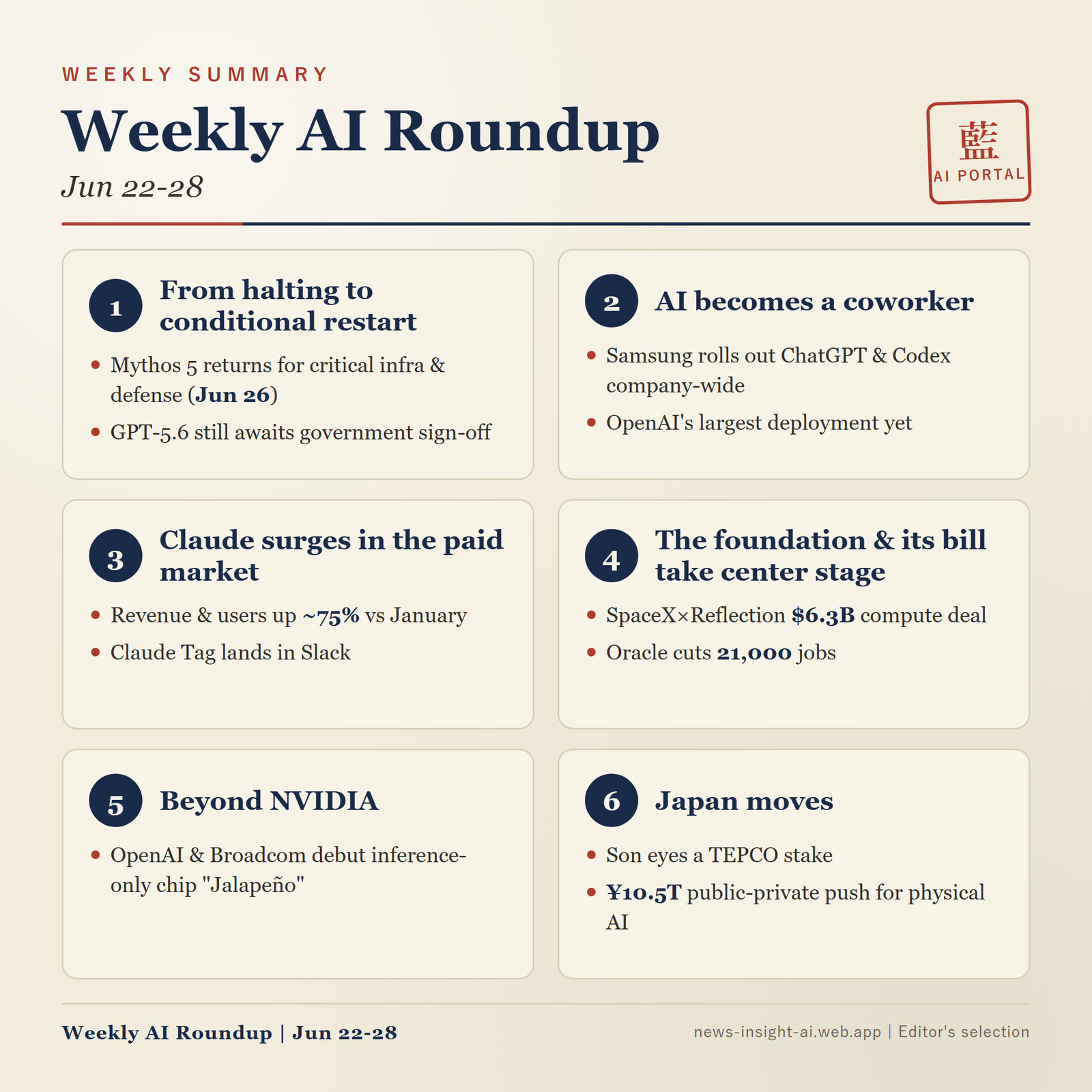
- Anthropic's Mythos moves from a blanket halt to a conditional return for select critical-infrastructure and defense organizations — and the same government-approval process reaches OpenAI's GPT-5.6
- AI becomes a workplace colleague — Samsung deploys ChatGPT company-wide, Anthropic stations Claude inside Slack, and Claude surges in the paid market
- Behind the race for capability, the foundation and its bill come forward — a SpaceX compute deal, Oracle's 21,000 layoffs, a custom inference chip, a utility stake, and a ¥10.5 trillion physical-AI plan
The theme of the week was that the access question carried over from the week before entered a new phase. Who may use the most advanced AI, and how far — that judgment stayed in the government's hands, on an axis separate from any measure of capability.
But the grip changed shape. A measure that had only stopped access shifted to restoring part of it under conditions. Around the same time, AI moved from object of experiment to member of the workforce, and the compute, power, and capital behind it surfaced in unusually concrete numbers. Access, the workplace, and the foundation — all three layers moved together again last week.
This Week's Lead Stories
From the Hand That Stops to the Hand That Restores — Government's Grip on Access Tightens, Then Loosens in Part
The access question around Anthropic's top models moved from a blanket halt to a conditional, partial return.
Early in the week, the motion was toward tightening. Anthropic began requiring identity verification through its partner Persona for certain features, asking for a government-issued ID such as a passport or driver's license along with a selfie. Around the same time, a commentary probed the roots of the restriction: Ars Technica argued that Anthropic's habit of framing its own models as "dangerous" more strongly than competitors may have shaped regulators' thinking.
The talks were difficult. The U.S. Commerce Department, citing national security, sought a full halt to foreign-national access to Fable 5 and Mythos 5. Anthropic countered that "applying this standard across the industry would effectively halt every new frontier-model deployment," and sent senior executives to negotiate in Washington.
The turn came over the weekend. Authorization arrived on June 26, and Mythos 5 began returning — to select U.S. critical-infrastructure and defense organizations, and in a form usable by more than 100 companies and government agencies. A full reopening to the public, and any expansion of scope, remain in the hands of ongoing talks. A measure that had only stopped access now returns in stages, paced by the progress of negotiations.
This approval process is no longer Anthropic's alone. OpenAI announced its next-generation GPT-5.6 family (Sol, Terra, Luna) but held back a general release at the U.S. government's request, limiting it to a few trusted partners. The company pushed back, saying "this kind of government-approval process should not become a permanent practice." Meanwhile, filling the regulatory gap, Asian startups have launched models they claim rival Mythos. The rule of who may use a model is becoming a premise for the whole industry.
- When the Trump administration cracks down on Anthropic, who benefits? (TechCrunch)
- How Anthropic may have talked itself into an AI export ban (Ars Technica)
- Anthropic executives keep negotiating in Washington (The Verge)
- U.S. government authorizes Mythos return for critical-infrastructure and defense organizations (ITmedia AI+)
- OpenAI limits GPT-5.6 rollout after government request, says restrictions shouldn't be the norm (TechCrunch)
AI Becomes a Workplace Colleague — Company-Wide Rollouts and Claude's Rise
Alongside the fight over access, the question of how to fold AI into daily work surfaced in concrete form.
The largest move was Samsung Electronics. The company deployed ChatGPT Enterprise and Codex to all of its employees in Korea and to global staff in the divisions behind Galaxy and home appliances. It is a reversal of the AI ban Samsung imposed after a 2023 leak of confidential information, and OpenAI's largest enterprise deployment to date.
There was also a move to bring AI closer to being a "member" than a "tool." Anthropic released "Claude Tag" in beta, letting teams invite Claude into a Slack channel as a team member. It is designed to accumulate channel context and handle asynchronous tasks in parallel; internally, Anthropic says 65% of its product teams' code is generated by this version.
User preference showed signs of shifting, too. According to an analysis of credit-card transaction data, Claude's paid-user count and revenue are up roughly 75% from January 2026. ChatGPT still leads in absolute terms, but Claude's presence in the paid consumer market is expanding fast.
A reframing of procurement accompanied these field moves. Microsoft CEO Satya Nadella argued that a company's competitive edge lies not in choosing a particular model but in building a "learning loop" inside the organization, where people and AI learn from each other. As model performance converges, the axis of selection shifts from comparing capability to designing the fit with the organization.
- Samsung Electronics deploys ChatGPT Enterprise and Codex company-wide (OpenAI News)
- Anthropic introduces Claude Tag for Slack (Anthropic News)
- Claude is winning over paid consumers, a market owned by ChatGPT (TechCrunch)
- Nadella on the "learning loop" as the key to enterprise survival (@IT)
Behind the Race for Capability, the Foundation and Its Bill Come Forward
As the talk of raw performance eased, the foundation that sustains AI — compute, chips, power, and capital — came forward with concrete numbers.
In compute, a large long-term contract moved. Reflection AI, an open-source lab founded by former Google DeepMind researchers, signed a $6.3 billion compute deal with SpaceX's data centers at $150 million a month. With restrictions tightening on closed models, it drew attention as a large-scale test of an open-weight strategy.
How that money gets made was laid bare as well. Oracle carried out 21,000 layoffs and is reportedly channeling the savings, combined with debt financing, into large-scale AI-infrastructure investment. Using cost-cutting and debt finance together is a new template for financial strategy in the AI investment race.
On chips, the moves to reduce single-source dependence on Nvidia came in a cluster. OpenAI, with Broadcom, unveiled "Jalapeño," a custom chip specialized for large-language-model inference. Following self-designed efforts at Google, Apple, and SpaceX, it aims at a structural cut in inference costs and less reliance on any one supplier.
The power and domestic-policy layer moved too. SoftBank Group's Masayoshi Son signaled interest in a stake in Tokyo Electric Power, with an eye on attracting data centers to Japan. The Japanese government and industry set a ¥10.5 trillion total-investment target for physical AI through 2040, backing a shift to the implementation phase of integrating robots and AI on factory and logistics floors. The center of gravity is moving from competing on capability to where, at what cost, and on how much power that capability runs.
- Open-source Reflection AI signs a $6.3B compute deal with SpaceX (TechCrunch)
- Oracle's 21,000 layoffs help drive its debt-fueled AI investments (Ars Technica)
- OpenAI and Broadcom unveil the "Jalapeño" inference chip (OpenAI News)
- Son signals interest in a TEPCO stake to anchor domestic data centers (ITmedia AI+)
- Japan's public and private sectors target ¥10.5 trillion for physical AI (ITmedia AI+)
Category Roundup
Models and Products
New models and features kept coming. Google added "Computer Use" to Gemini 3.5 Flash, letting AI agents operate a browser or desktop autonomously, with adversarial training against prompt injection and enterprise safety controls. Google also moved its "Interactions API" — which unifies access to Gemini models and agents — to general availability, positioning it as a standard base for agent development.
Hiring and Governance
The problem of AI unfairly rejecting people surfaced as well. A Stanford HAI study reported that a single vendor's AI hiring tool screened out 26% of Black applicants and 15% of Asian applicants in a discriminatory way. As more companies use the same vendor, the same candidate can be rejected in sequence across multiple firms — a structural exclusion that is fueling calls to audit hiring AI. Friction between companies deepened, too: Anthropic claimed that Alibaba copied and replicated Claude's capabilities at scale, and called for sanctions.
Education and the Field
In education, numbers showed the effect of adoption. Henry County Public Schools in Kentucky ran Gemini essay feedback aligned to state assessment standards, and reported that the share of students performing below grade level fell from 33% to 15% after adoption, while teachers' repetitive grading burden dropped sharply.
Worth Watching Next Week
The first focus is where the access-approval process heads. How far Mythos 5's scope widens toward the public, and whether the government approval for GPT-5.6 stays temporary or settles into a permanent practice. It is worth watching how the very mechanism OpenAI called something that "should not become the norm" is handled from here.
Second is the competition over enterprise adoption. Samsung's company-wide rollout and Claude's gains in the paid market suggest the axis of selection is moving from a ranking of capability to how AI fits into an organization. The open question is how far multi-model use, and Nadella's learning loop, become real procurement criteria.
Can access to frontier AI be treated as something that will simply stay available? How far should the cost of acquiring capability, and securing the power to run it, be written into an adoption plan? And when AI joins the workplace as a member, who carries responsibility for its judgments?
Source: The editorial team selected these stories from the AI news inbox (collected June 22–28, 2026 — seven days).