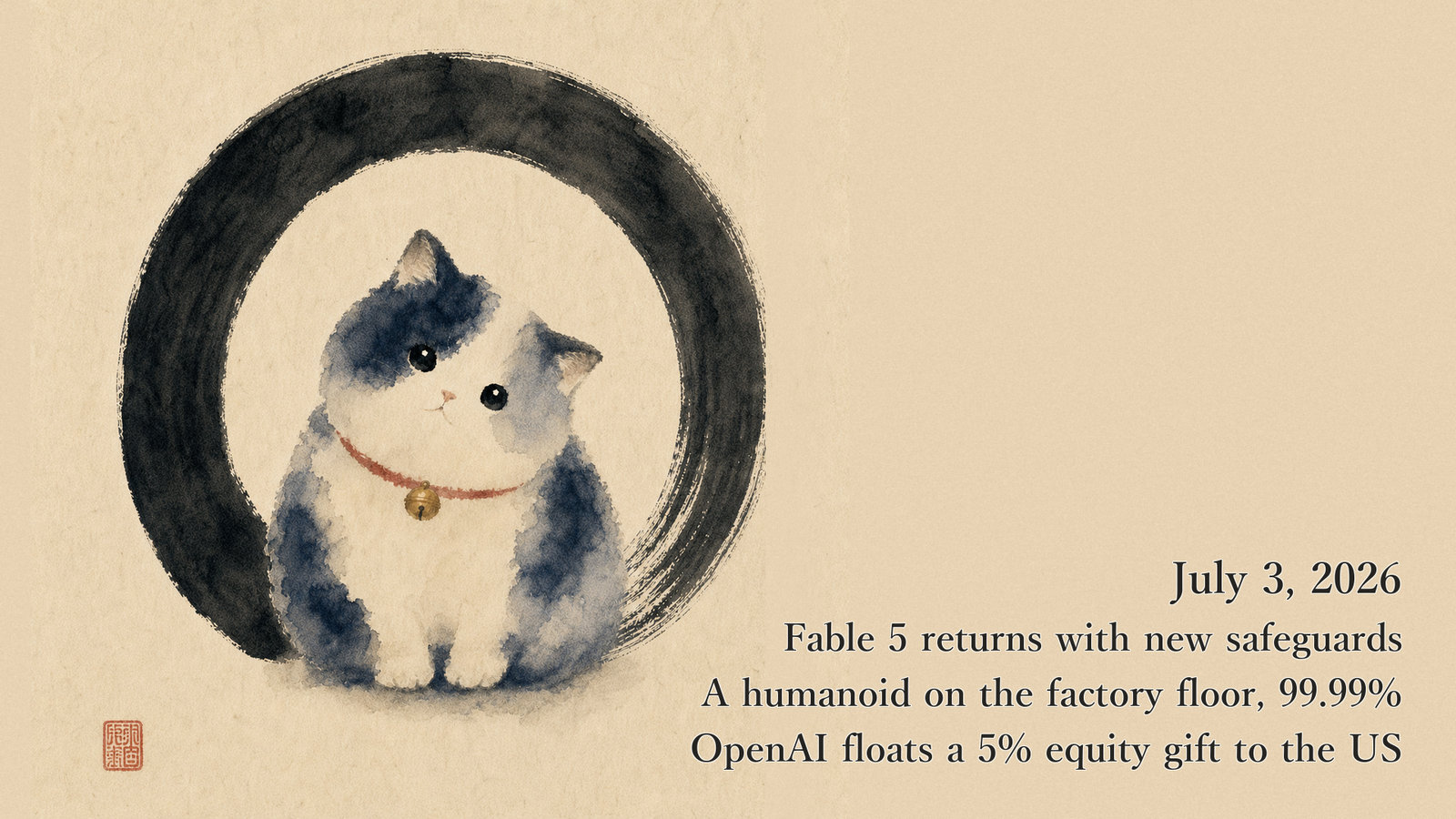
Today's Headlines
- Claude Fable 5, suspended at the U.S. government's direction, returns with tighter safety measures
- China's AGIBOT humanoid robot works a mass-production line for six days, claiming a 99.99% success rate
- OpenAI proposes donating 5% of its equity to a newly created U.S. fund
- Microsoft launches "Frontier," a $2.5 billion company dedicated to enterprise AI deployment
- Anthropic is in talks with Samsung over a custom AI chip
The lead story today was not a smarter model. It was about how AI is governed and how far it is being built into society and the workplace—questions of institutions and implementation.
A model restored after a safety review, a humanoid robot standing on a production line, and a proposed profit share with the government all surfaced on the same day. Each turns on the terms under which society accepts AI, a step ahead of whether AI keeps getting smarter. Beneath the performance race, AI is being reconciled with rules and real-world operations in concrete ways.
Today's Top Three
Claude Fable 5 returns with tighter safety measures (follow-up)
Anthropic's flagship model, Claude Fable 5, suspended at the U.S. government's direction, is available again after the company strengthened its safety measures.
The suspension began on June 12, when the U.S. government ordered Fable 5 and "Mythos 5" pulled over the risk—flagged in an Amazon security audit—that a jailbreak could bypass safeguards to surface software vulnerabilities. Anthropic argued the flaw was narrow, and the matter escalated into a standoff with the administration.
For the redeployment, Anthropic put four measures in place: access restrictions, monitoring of usage patterns, compute-resource management, and collaboration with outside security experts.
It also introduced a new "accountability management" system that detects and blocks dangerous usage patterns, which it says stops the reported attack technique in over 99% of cases. On the paid Pro, Max, Team, and select Enterprise plans, Fable 5 is available at up to 50% of weekly usage limits at no extra charge through July 7.
Prompted by a government safety review, the episode put an AI vendor's crisis response and accountability to a concrete test. It underscores how much weight safety reviews now carry when enterprises adopt AI.
- Anthropic restores Claude Fable 5 after US government-ordered suspension (ITmedia AI+)
- Claude Fable 5 returns as Anthropic's flagship becomes available again (PC Watch)
China's AGIBOT humanoid robot works a factory line for six days
China's AGIBOT livestreamed its G2 humanoid robot working a mass-production line for six days, claiming a 99.99% task success rate.
The setting was a tablet plant run by the communications-equipment maker Longcheer Technology. Over six days from June 23 to 28, the G2 logged more than 64 hours and, by the company's account, contributed to quality checks on 17,625 tablets.
What stands out is that the trial ran on an actual mass-production line rather than in a lab. It is a sign of humanoid robots moving from staged demonstrations toward real deployment on the factory floor.
OpenAI floats giving the U.S. a 5% equity stake
OpenAI has proposed donating 5% of its equity to a newly created U.S. sovereign wealth fund.
The idea was led by CEO Sam Altman and is reportedly aimed at easing political backlash against AI companies. The Trump administration, for its part, secured the offer of a 5% stake.
The figure, however, falls well short of what Senator Bernie Sanders had been pushing for. Sanders has separately introduced a bill to tax AI companies' equity at 50%, and the gap over how much of AI's windfall should return to the public remains wide.
How such an unprecedented public-private profit share would be structured will be a key signal for the direction of AI regulation and policymaking.
- OpenAI proposed donating 5% of its equity to a US sovereign wealth fund (TechCrunch)
- Trump gets OpenAI to offer US 5% stake, far lower than Sanders' target (Ars Technica)
- OpenAI floats giving Trump administration 5 percent cut of AI boom (The Verge)
Other Developments
Models & APIs
- Microsoft released "MagenticLite," an experimental small-scale AI agent framework built on the premise that tool integration and execution matter more than raw model intelligence. Specialized for browser tasks like form filling and logins, its Fara1.5-27B model scored over 90% on the Online-Mind2Web benchmark, pointing to an agent-development path that does not rely on ever-larger models. Microsoft unveils experimental small AI agent framework, prioritizing tool integration over raw intelligence (ITmedia AI+)
- Japan's three major robotics makers—Kawasaki Heavy Industries, Fanuc, and Yaskawa Electric—are partnering with Osaka University and tactile-sensor startup FingerVision to build a manufacturing-floor dataset for a Vision-Tactile-Language-Action (VTLA) model. The project was selected for GENIAC, Japan's government-backed AI research program, and aims to automate delicate hand-based tasks that have long resisted robotic automation. Kawasaki, Fanuc, and Yaskawa team up on physical-AI dataset for robots (ITmedia AI+)
Research & Papers
- OpenAI introduced "GeneBench-Pro," a benchmark measuring AI reasoning and judgment in computational biology. It comprises 129 expert-level problems that typically take human specialists 20 to 40 hours each, and even OpenAI's newest model, GPT-5.6 Sol, tops out at 31.5% accuracy in its Pro mode—underscoring how far AI remains from reliably automating high-stakes scientific judgment. OpenAI unveils new benchmark to test AI's scientific judgment (PC Watch)
Products & Features
- Serial entrepreneur Bhavin Turakhia is self-funding $30 million to build "Neo," an enterprise platform that unifies project management, documents, file storage, and AI in one product designed from scratch for AI rather than retrofitted onto legacy software. The bet takes aim at Microsoft Office's dominance in enterprise software. Indian entrepreneur bets $30M of his own money on an AI alternative to Microsoft Office (TechCrunch)
- GlobalFoundries announced plans to mass-produce silicon supporting the OCI MSA optical interconnect standard in 2027, targeting scale-up networking for AI infrastructure. The standard—approved by AMD, Broadcom, Meta, Microsoft, NVIDIA, and OpenAI—offers data centers a vendor-neutral alternative to proprietary links like NVIDIA's NVLink. GlobalFoundries to ship silicon supporting the OCI MSA optical interconnect standard in 2027 (EE Times Japan)
Regulation & Policy
- Privacy advocacy groups warned the U.S. Federal Trade Commission that Elon Musk's X poses a serious risk to Americans' privacy. How regulators respond to a major social platform's data practices is an issue that could ripple out to other platform operators. Musk's X poses "serious risk to Americans' privacy," advocates warn FTC (Ars Technica)
Business
- Microsoft is launching "Microsoft Frontier Company," a $2.5 billion venture staffed with 6,000 engineers dedicated to deploying AI inside large enterprises. It has already lined up partners including the London Stock Exchange Group, Unilever, and Accenture, a sign that the ability to embed AI into customers' workflows—not just build models—is becoming a new competitive front. Microsoft launches its own AI deployment company with $2.5 billion commitment (TechCrunch)
- Anthropic is in discussions with Samsung about a new custom AI chip, TechCrunch reports. Its intended use, server integration, and performance remain undecided, and Anthropic has said little about the talks. The move follows OpenAI's reveal last week of a custom inference chip called Jalapeño built with Broadcom, underscoring an accelerating race among leading AI labs to secure the silicon that underpins their compute. Anthropic is discussing a new custom chip with Samsung (TechCrunch)
- Google disclosed that its electricity consumption jumped 37% in 2025, driven largely by the buildout of AI data centers. The figure highlights the mounting strain generative AI's growth is placing on power grids and corporate emissions targets. Google's AI buildout drove 37% increase in electricity use in 2025 (Ars Technica)
Other
- OpenClaw, an AI agent that went viral in spring 2026, is now being used to automate dating and outreach, including auto-posted social content. As people hand control of personal accounts to AI agents, security researchers are flagging privacy risks and calling for human-in-the-loop approval. People are using AI agent OpenClaw to automate their dating lives (TechCrunch)
- An open-source tool called claude-real-video lets LLMs actually "watch" video by passing not just a transcript but scene-change keyframes extracted from the footage. Built on ffmpeg and Whisper and running entirely locally, it gives developers a practical way to feed real video understanding into agentic workflows. Claude-real-video: an open-source tool that lets any LLM watch a video (GitHub)
- TechCrunch flagged that sandwich chain Jersey Mike's IPO prospectus mentions "AI" 22 times while barely referencing real operational risks like weather. It is a symbol of a disclosure culture in which companies invoke AI regardless of business relevance, a sign that AI mention counts in IR documents are becoming noise for investors. Jersey Mike's IPO illustrates how bad the AI hype has become (TechCrunch)
Source: Selected by our editorial team from the AI news inbox collected on July 3, 2026 (30 items; 0 primary, 30 secondary).