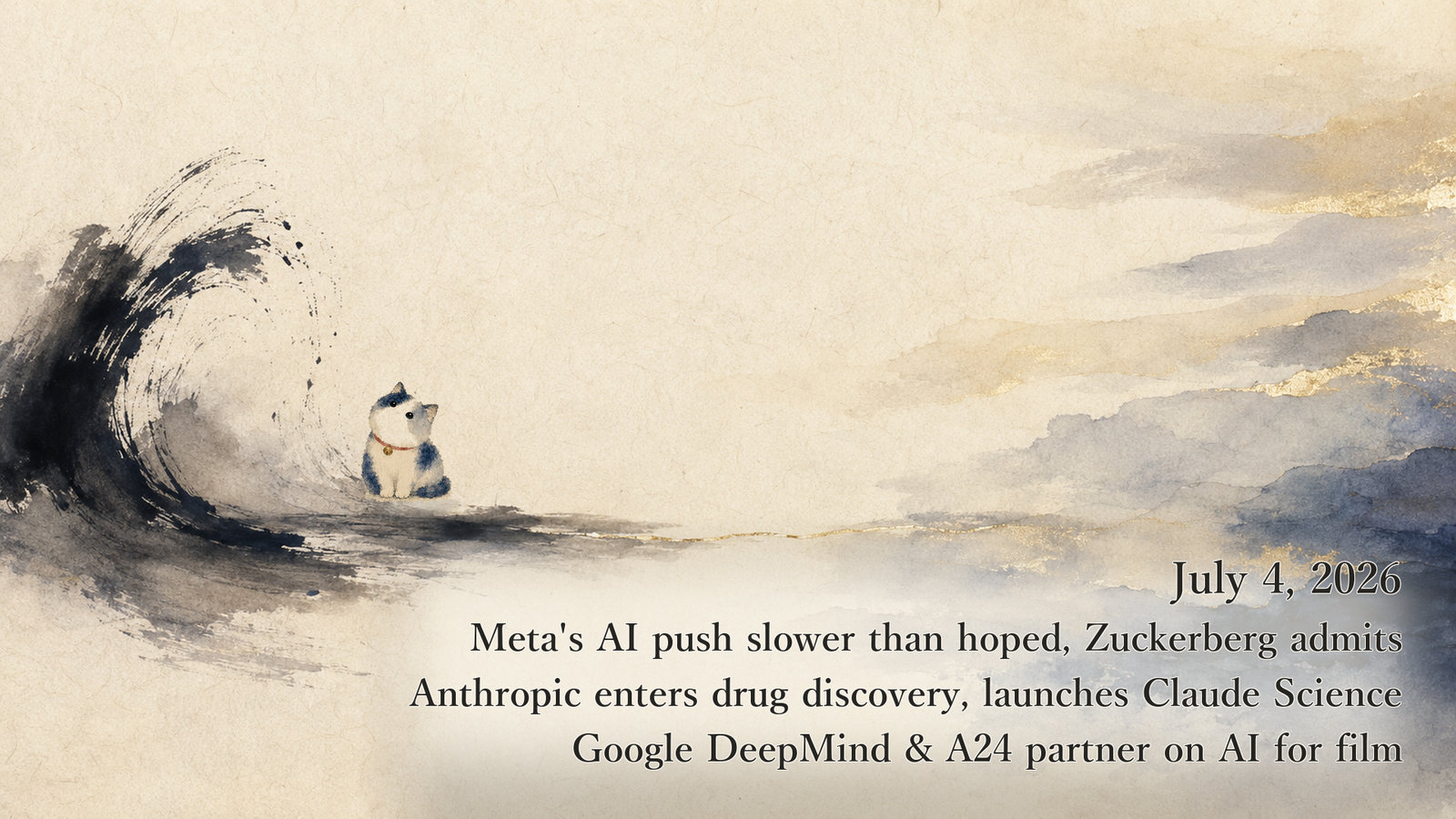
Today's Headlines
- Meta CEO Zuckerberg tells staff AI development hasn't accelerated as expected, even with Claude Code and a reorganization
- Anthropic moves into drug discovery for neglected diseases and launches Claude Science, an AI workbench for researchers
- Google DeepMind and A24 announce a first-of-its-kind multi-year research partnership on filmmaking AI
- AWS quietly pivots from "model choice" to an agent-centric architecture
- Game engine Godot bans AI-generated code after reviewer burnout
The lead story today was not a new model's performance. It was a candid admission that heavily funded AI development is lagging expectations, alongside moves to fit AI into concrete fields such as drug discovery and filmmaking.
The center of gravity is shifting from competing on intelligence scores toward where and how AI is actually useful. On the same day, a company being pressed on its return on investment and companies stepping into domain-specific deployment presented a striking contrast.
Today's Top Three
Meta admits AI development hasn't sped up as hoped, even with Claude Code and a reorg
Meta CEO Mark Zuckerberg told staff at a July 2 town hall that the company's push to accelerate AI development through Anthropic's Claude Code and an internal reorganization has "not sped things up as much as we expected."
Back at the January-to-February reorganization, leadership was optimistic and had placed high hopes on development tools like Claude Code. The restructuring was premised on speeding development up sharply.
That restructuring was large in scale: it cut roughly 10% of Meta's global workforce and redeployed about 7,000 employees to AI-related teams. Alongside it, the company plans capital spending of up to $145 billion on AI infrastructure in 2026.
Even so, Zuckerberg said he expects greater benefits to materialize within the next three to six months.
Coming right after such heavy investment and a large-scale redeployment of staff, the admission that things are "not as fast as hoped" becomes a test of whether those investment and staffing decisions were sound. It reflects a reality in which the productivity gains from generative AI are not appearing along the curve management drew.
- Meta's bet on Claude Code and a reorg to speed AI development falls short, Zuckerberg admits (ITmedia AI+)
- Mark Zuckerberg tells staff that AI agents haven't progressed as quickly as he'd hoped (TechCrunch)
Anthropic moves into drug discovery and launches Claude Science
Anthropic announced it will run its own drug-discovery programs targeting "neglected diseases," such as rare conditions that large pharmaceutical companies tend to overlook.
At a San Francisco event, the company also unveiled Claude Science, an AI workbench for researchers that sets up a working environment for using Claude in scientific research.
Running its own preclinical drug work serves two aims. One is to test in-house where Claude actually helps in science and where it runs into limits. The other is to use that track record as a foothold for winning biopharma companies as customers.
It is a notable step in which an AI company goes beyond supplying tools to prove its capabilities through results as a participant in a specialized field.
Google DeepMind and A24 announce a first-of-its-kind research partnership on filmmaking
Google DeepMind and film studio A24 announced a first-of-its-kind, multi-year research partnership for the creative industry.
Under the partnership, DeepMind researchers and filmmakers will work side by side, testing tools on real productions and improving them together. Google is also making an investment in A24.
What stands out is that working creators are brought in from the very start of development rather than added on later. It is an attempt to keep future AI tools shaped by the people doing the creative work, rather than imposed on them.
Other Developments
Models & APIs
- AWS is quietly shifting away from its longstanding "choose any model" pitch toward an agent-centric architecture that integrates multiple models and agents. A new tool, Amazon Bedrock AgentCore, manages models together, while a new service, AWS Context, feeds enterprise data to agents. At AWS Summit Japan 2026, Anthropic disclosed that Amazon's investment has reached up to $33 billion and showcased million-token processing on the custom Trainium chip. AWS's quiet strategy shift: reading the meaning of OpenAI and Anthropic taking the stage a day apart (ITmedia AI+)
- Two US AI firms published opposite findings on how Anthropic's Claude Fable 5 performed before and after its vulnerability-driven suspension. BridgeMind AI reported sharp drops in debugging and refactoring on coding benchmarks, while Arena.ai aggregated thousands of user ratings and found little change—raising the question of how to reconcile safety hardening with performance stability. Did Claude Fable 5's performance drop? Two US AI firms report opposite results (ITmedia AI+)
- Anthropic expanded Artifacts—its feature for instantly publishing Claude Code-generated web apps to a shareable URL—from Team and Enterprise plans to individual Pro and Max subscribers. Published pages update in real time for viewers, a move that competes with OpenAI's Sites sharing feature. Claude's Artifacts web-app sharing comes to Pro and Max plans (PC Watch)
- OpenAI's Codex CLI coding assistant, after a February 2026 update switched logging to the verbose "TRACE" level, wrote excessive logs to a local SQLite database and drove one user's disk writes to 37 terabytes in 21 days. Extrapolated over a year that could exceed a typical SSD's write endurance; OpenAI has shipped a partial fix that users say has not fully resolved the issue. OpenAI's Codex CLI logging bug wrote 37TB to an SSD in 21 days (ITmedia AI+)
Products & Features
- TechCrunch surveyed the leading AI-powered browsers—Perplexity's Comet, OpenAI's Atlas, and The Browser Company's Dia—arguing the battleground has shifted from displaying search results to which company's "agentic AI" acts on the user's behalf. Each is redesigning the browser as an assistant rather than a window onto the web, potentially unsettling the incumbent market structure. The browser wars aren't about search anymore (TechCrunch)
- JSOL added an AI-driven feature, JSTAMP-RealSync for Springback, to its JSTAMP press-forming simulation software that learns the gap between simulated and actual part shapes to improve correction accuracy. It could cut trial-and-error die-tuning from around 45 attempts to about five, sharply reducing design lead time and cost. Press-forming simulation software that uses AI to learn shape gaps against real parts (MONOist)
- Taiwan's Advantech unveiled a two-pronged physical-AI strategy—hardware through partnerships with chipmakers like NVIDIA and Intel, and software through its WEDA integration framework—and is building a third manufacturing site in Japan. The move aims to localize production and strengthen supply chains as edge-AI demand grows. Advantech tackles physical AI with a two-pronged strategy, adds a third Japan manufacturing site (MONOist)
Regulation & Policy
- Anthropic published details of the cyber-domain safety classifiers behind its Fable 5 model and introduced CJS, a new framework that scores jailbreak severity along four axes. The challenge is sharpening the line that blocks abuse without hindering legitimate defensive use, and the aim is to build a shared vocabulary for discussing the risk with governments and industry. More details on Fable 5's cyber safeguards and jailbreak framework (Anthropic News)
- A teacher writing in Science.org described replacing a blanket ban on generative AI with a negotiated classroom contract with students. Amid an ongoing debate over whether schools should ban or integrate AI, the consent-based approach has drawn interest from educators. Instead of banning AI, I made a classroom contract with my students (Science.org)
- LINE and SoftBank launched "News PR by LINE SoftBank" on July 1, a service that uses generative AI to edit press releases into news-style articles displayed on Yahoo News for 30,000 yen (excl. tax) per slot. The format blurs the line between advertising and editorial content, raising questions about disclosure and media literacy on a major platform. (Yahoo News is one of Japan's largest news portals.) AI-edited press releases go live on Yahoo News for 30,000 yen a slot (ITmedia AI+)
Other
- Godot, the open-source game engine, is moving to ban AI-generated code contributions after a surge of AI-assisted pull requests exhausted its reviewers. With concern that review exchanges absorbed by AI fail to develop the next generation of maintainers, the new policy requires code to be human-written, limiting AI to minor uses like code completion with disclosure required. Godot game engine to ban AI-generated code after reviewer burnout (ITmedia AI+)
- An ITmedia AI+ piece scrutinizes the claim that Anthropic's Mythos—a model unveiled in April capable of autonomously chaining vulnerability discovery through exploit development—makes defensive adoption mandatory. It argues the decisive factor for defenders is not the model itself but the surrounding "harness" of staged verification and cross-checking, and that automated detection and rapid remediation are the real countermeasures. Is it true you can't stay safe without Mythos? The "harness" that decides AI security (ITmedia AI+)
- SoloptiLinkAI, a Japanese service that builds business systems from plain-language requests like "build me a customer management system," runs by combining 105 different AI models. It claims to cut typical development costs from several million yen to roughly 600,000 yen upfront plus 200,000 yen to operate, and about 40 companies have adopted it since its March launch—potentially helping small and midsize firms build systems in-house. A service that builds business systems from plain Japanese instructions using 105 AI models (ITmedia)
- Midjourney released a behind-the-scenes video of the Midjourney Scanner, a water-based device that produces a full-body ultrasound scan in about 60 seconds, but key technical details remain undisclosed. The pivot from image generation into medical hardware is unusual, and independent imaging experts say the company has shown little evidence it overcomes ultrasound's known diagnostic limits. A behind-the-scenes look at Midjourney's medical scanner leaves many questions unanswered (The Verge)
Source: Selected by our editorial team from the AI news inbox collected on July 4, 2026 (23 items; 2 primary, 21 secondary).