Today's Headlines
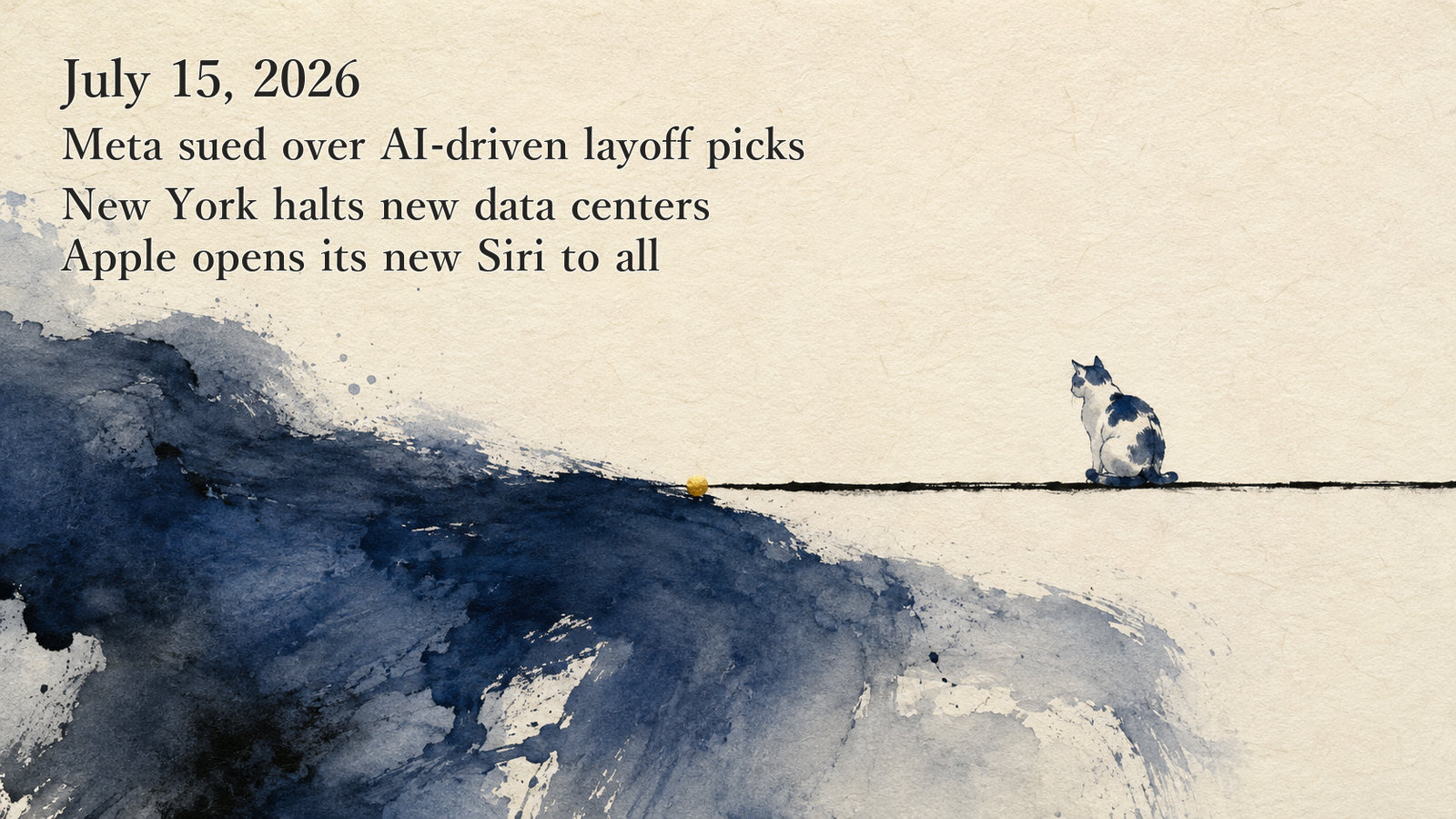
- Twenty-six former Meta employees sue in federal court, alleging the company's internal AI selected layoff targets in ways that disproportionately hit workers with medical conditions or leave history — Meta counters that "people, not AI" made the decisions (plaintiffs' allegations; case ongoing)
- New York Governor Kathy Hochul signs an executive order pausing new permits for data centers of 50 megawatts or larger — the first statewide data center moratorium in the US
- Apple releases the iOS 27 public beta, opening its overhauled AI Siri to everyday users beyond developers for the first time
It is a day when how AI gets used was questioned from the side of law and regulation.
No flashy new model took the stage. Instead: a lawsuit over the use of AI in personnel decisions, a state-ordered construction halt driven by AI's power demand, and the arrival of a rebuilt assistant in ordinary users' hands — both faces of what surfaces as AI works its way deeper into society, the burdens and the responsibilities, moved on the same day.
Today's Top Three
26 Former Employees Sue Meta Over AI-Driven Layoff Selection — Company Says "People, Not AI," Decided
Twenty-six former Meta employees have sued the company in federal court for the Northern District of California (in Oakland), alleging that its use of internal AI systems to select layoff targets unfairly disadvantaged workers with medical conditions or a history of leave.
According to the complaint, Meta combined an internal AI assistant referred to as "Metamate," "second-brain" agents trained on employee behavior, keystroke- and screen-activity monitoring data, AI-token-usage dashboards, and algorithmically assisted performance ratings to rank workers for layoffs. The plaintiffs allege the selection disproportionately targeted employees who, in the prior 24 months, had taken medical leave, sought disability accommodations, or been on pregnancy, maternity, or paternity leave.
The layoffs are scheduled to begin July 22, and the plaintiffs are asking the court for an order blocking the terminations and requiring their scores to be recalculated on a basis that neutralizes leave and accommodations. The complaint cites violations of the Family and Medical Leave Act (FMLA), the Pregnancy Discrimination Act, the Americans with Disabilities Act (ADA), and the Pregnant Workers Fairness Act. Although there are 26 plaintiffs, the suit is not a class action; it proceeds toward individual arbitration, with the plaintiffs seeking a court order to preserve their jobs in the meantime.
Meta is contesting the case in full. The company said the claims "lack merit and are not based on facts," and that "workforce management and organizational decisions were and are made by people, not AI." All of this reflects the plaintiffs' allegations, and the case is ongoing. It is a case that management and legal teams should watch closely for the legal risks that come with using AI in personnel decisions.
- Lawsuit claims Meta's layoff decisions were made by AI, not humans (Ars Technica)
- Meta accused of using biased AI targeting for mass layoffs (The Verge)
New York Becomes First State to Pause Data Centers — Hochul Signs Executive Order Covering 50 MW and Up
New York Governor Kathy Hochul has signed an executive order pausing the state's issuance of new permits for large data centers of 50 megawatts or larger. It is the first time a US state has actually put a data center construction moratorium into practice.
This is an easy point to get wrong: what moved here is not a bill passed by the state legislature, but an executive order the governor signed. The order halts permits until the state develops uniform environmental review standards (a Generic Environmental Impact Statement); reporting indicates the pause is expected to last up to about a year. Hochul cited strain on the power grid, rising electricity bills, and water-use and noise concerns, saying at a press conference in Brooklyn that it was her "responsibility to take action and lead."
More sweeping measures are also moving through the state legislature. A committee has passed a bill that would impose a three-year moratorium, an attempt to make the pause permanent through law separate from the executive order. Hochul is also pursuing legislation to repeal sales tax exemptions for large data centers. Nationally, data center moratoriums are being debated at the federal level too, and Maine's legislature has passed a similar bill. President Trump, however, argues such moratoriums would threaten America's lead in the AI race, and views remain divided.
- New York bans data center construction for a year, rattling AI industry (Ars Technica)
- New York State halts construction of all new data centers (TechCrunch)
Apple Opens Its Overhauled Siri to Everyone in the iOS 27 Public Beta
Apple released the iOS 27 public beta on July 14, opening its substantially overhauled AI-powered Siri to everyday users beyond developers for the first time.
The new Siri has evolved into a conversational assistant that draws on both on-device information and broader world knowledge, giving it a feel closer to modern AI chatbots like ChatGPT and Gemini. It is deeply integrated across the operating system, now comes with a stand-alone app for the first time, and works on the iPhone as well as devices such as Apple TV and Vision Pro. Under the hood, it builds on Apple Intelligence, combining new on-device Foundation Models with Private Cloud for more sensitive processing.
The overhaul was officially announced at Apple's Worldwide Developers Conference (WWDC) in June. The developer beta showed errors and occasional confusion, but Apple says the public beta has become more stable. The official iOS 27 release is expected in September. With roughly 2.5 billion active devices worldwide, even a small fraction of users trying it means the new Siri reaches a substantial audience.
More to Note
Models & Products
- Anthropic launched Claude for Teachers, a free tool for verified K-12 educators in the US. It supports lesson planning aligned to all 50 states' standards and differentiated materials, and is FERPA-compliant, excluding student data from model training. Educators who sign up by June 30, 2027 get a year of free access; it was built in collaboration with partners including the American Federation of Teachers (AFT). - Introducing Claude for Teachers (Anthropic)
- Google announced a redesign of Google Images for its 25th anniversary, moving to a browseable, Pinterest-style gallery you can explore before searching. It is also folding its Nano Banana image-generation model into Search's AI Overviews, rolling out on US English-language desktop over the coming weeks. - Google Images gets a Pinterest-like redesign focused on discovery (TechCrunch)
- Google began rolling out its Gemini in Chrome browser assistant to desktop users in the UK, with an iOS version to follow next month. It can compare information across tabs and summarize long content, and is trained to recognize prompt-injection attempts, requiring confirmation for sensitive actions. - We're expanding Gemini in Chrome to users in the U.K. (Google Blog)
Business
- Anthropic announced a CAD 10 million commitment to Canadian AI research institutions, partnering with eight organizations including Mila, the Vector Institute, and Amii. Startups affiliated with three of these institutes will receive at least USD 5,000 in API credits each. - Anthropic commits $10 million to Canadian AI research (Anthropic)
- Hinge founder Justin McLeod raised $18 million to launch Overtone, a new AI-powered, voice-first dating service. Backed by Hinge parent Match Group and others, it aims to offer curated introductions rather than swipe-based mechanics. - The founder of Hinge raised $18M to build a new AI dating service, Overtone (TechCrunch)
Policy & Other
- Major publishers including Hachette, Cengage, and Elsevier, along with author Scott Turow, filed a class-action lawsuit against Google in the Southern District of New York, alleging it trained Gemini on copyrighted works without authorization. The case could produce a ruling at odds with California decisions that found similar AI training to be fair use (plaintiffs' allegations; case ongoing). - Google faces another AI training lawsuit from major publishers (TechCrunch)
- Google DeepMind CEO Demis Hassabis proposed creating an independent standards body modeled on the financial industry's FINRA. Under his plan, AI labs would voluntarily submit models up to 30 days before release for review, with participation potentially becoming a requirement for US deployment over time. - DeepMind CEO calls for an independent standards body to regulate frontier AI (TechCrunch)
- A security researcher found that xAI's Grok Build coding CLI was uploading users' entire repositories — including files the model never read and unredacted credentials from .env files — to cloud storage without consent. xAI has shipped a server-side fix, and Elon Musk has pledged to delete previously collected data, according to reporting. - SpaceXAI's Grok programming tool was uploading its users' entire codebase to cloud storage (The Verge)
Source: Selected by the editorial team from the AI news inbox (collected July 15, 2026 — 30 items: 10 primary, 20 secondary).