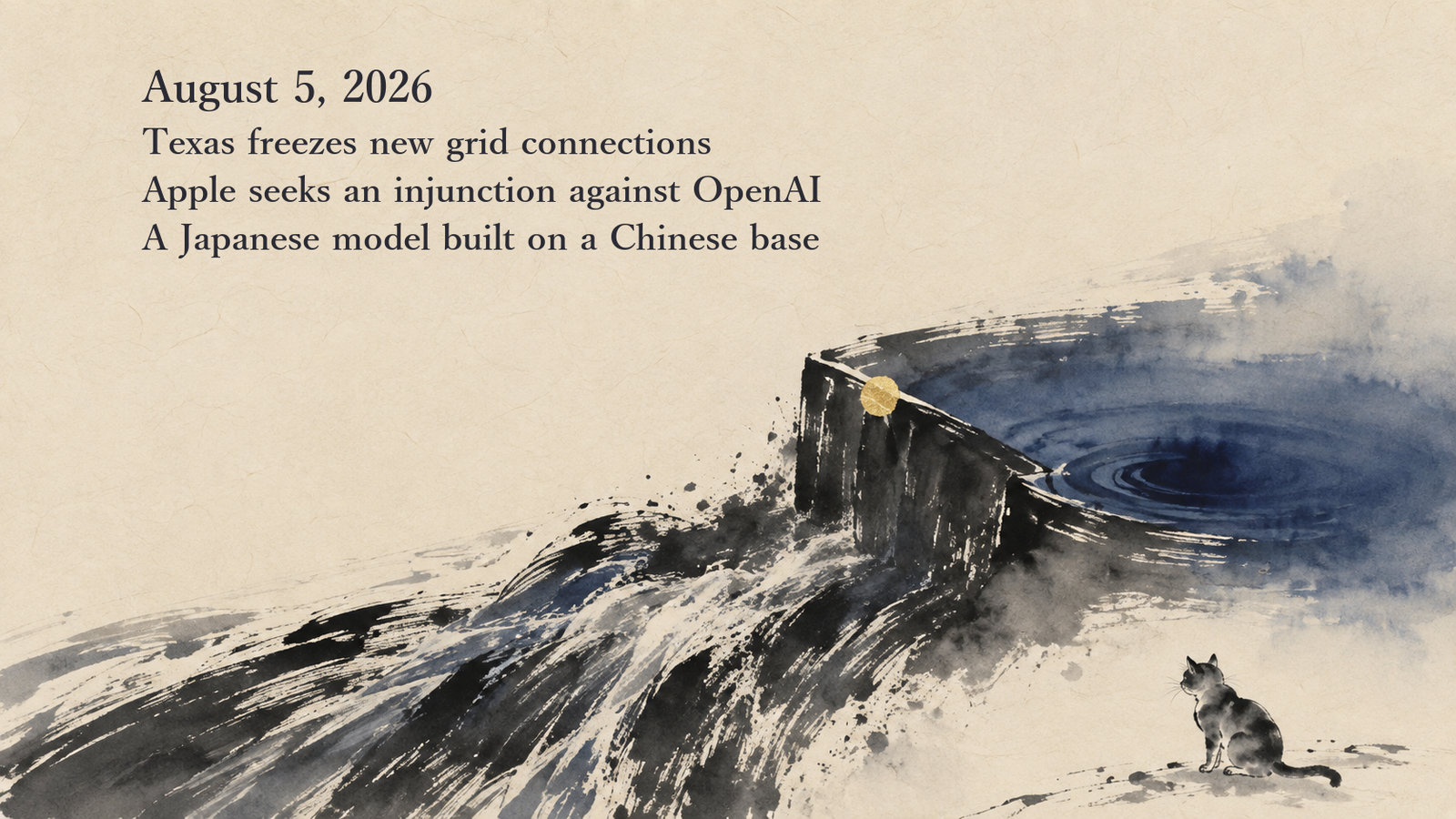
Today's Headlines
- Texas will require a state audit before any new data center can connect to the grid — the interconnection queue has gone from 233 gigawatts in January to 474 gigawatts
- Apple moves for a preliminary injunction and expedited discovery against OpenAI — 11 more former employees surface as possible witnesses or otherwise involved
- Sakana AI ships Sakana Namazu, tuned for Japanese — built on Moonshot AI's open model Kimi K2.6
- Mistral publishes Shieldstral, a 3-billion-parameter moderation model that judges text and images in one framework, under Apache 2.0
- Anthropic names former California Supreme Court Justice Tino Cuéllar as its first Chief Global Affairs Officer
Today's three stories are not about model performance. They are about what sits around the model — the electricity that runs it, the procedure that settles a dispute over it, and the open model it is built on — and about the terms moving on that side.
Those terms are not set by the people building the AI. Whether you may connect to the grid is held by the state and the grid operator; whether an injunction issues is decided by a court; and how you may use the model underneath you is set by whoever published it.
None of these conditions shows up on a benchmark scoreboard.
Today's Top Three
Texas makes a state audit the gate to a grid connection, after its queue doubled in under six months
Texas Governor Greg Abbott has ordered that every new data center project seeking a connection to the state's power grid must first pass a state audit.
The announcement came on August 3. Two bodies will run the audits — the Public Utility Commission of Texas (PUCT) and ERCOT, which operates the state grid — and no project seeking a connection moves forward until it has been through them.
Behind the order is a swelling interconnection queue. ERCOT's queue rose from 233 gigawatts in January to 474 gigawatts, more than doubling in under six months. About 90 percent of that is data centers, according to the grid operator.
For scale, the queue now represents more than five times ERCOT's total peak demand. Queued capacity is not capacity that gets built, yet on the application side alone the state is looking at plans several times the size of its own peak load.
The order also spells out what the audits will collect: on- and off-site demand for electricity and water, noise-mitigation efforts, light controls, use of tax incentives, and ownership details.
Texas hosts more data centers than any state except Virginia.
This is not new legislation. It is a measure taken on the grid-operations side, adding a state audit as a condition to a gate that already existed — whether a project may connect at all. A state that competed to attract these facilities is now checking what is inside them at the point of connection.
- Texas halts new data centers as governor calls for audits (TechCrunch)
- Texas says data centers must pass an audit before connecting to the grid (The Verge)
Apple seeks a preliminary injunction and expedited discovery against OpenAI, as 11 more ex-employees surface
Apple has moved for a preliminary injunction and expedited discovery in its civil trade-secrets case against OpenAI.
This follows the complaint filed on July 10, which this briefing covered on July 11 and July 14. The case is before the US District Court for the Northern District of California, and it is a civil suit between private parties rather than a criminal proceeding.
The motion asks for two things. The first is a preliminary injunction barring OpenAI from developing devices or products based on Apple's technology. According to Reuters, the request was filed on August 3 and would prohibit Chang Liu, Tang Yew Tan and OpenAI from accessing, obtaining, using or disclosing confidential information.
The second is expedited discovery. Its targets are named as Chang Liu, a senior systems engineer at OpenAI, Chief Hardware Officer Tang Yew Tan, OpenAI and its foundation, and io, the device startup co-founded by Jony Ive.
The 11 newly surfaced individuals are described in that filing. Apple told the court that its continuing investigation has identified 11 former employees who may have been witnesses or otherwise involved in the case. They have not been named as defendants, and the nature of any involvement has not been specified.
One example Apple offered concerns screenshots. Apple alleges that a former employee took screenshots of confidential documents relating to an unannounced Apple product before an interview at OpenAI. It also says several former employees contacted the company after the suit was filed, offering to return company devices.
OpenAI disputes all of it. The company said the injunction request is "both based on false information and completely unnecessary because we do not have, nor want, any of their trade secrets."
OpenAI answered in public as well. It posted a blog titled "Apple is getting this wrong" and published the email exchanges between the two companies' legal teams along with iMessages sent by Liu. It further claims Apple's outside counsel acknowledged having mixed up two Asian surnames and emailed the wrong person.
It is worth being precise about the stage. The case has not reached a hearing on the merits. What is being sought is interim relief that would freeze the situation before any ruling on the merits, plus discovery on a faster schedule than usual. Everything both sides have published is a party's account, not a finding by the court.
A litigant publishing its own negotiation emails and a named individual's personal messages is not how these disputes usually proceed. With that much material landing outside the courtroom first, the shape of this case is no longer being set by the filings alone.
- Apple says more ex-employees may have taken confidential data to OpenAI (TechCrunch)
- OpenAI drags Apple's lawsuit into the court of public opinion (The Verge)
Sakana AI ships Sakana Namazu, a Japanese-tuned LLM built on a Chinese open model
Sakana AI began offering Sakana Namazu, a large language model tuned for Japanese and for Japanese business contexts, as an API on August 3.
Underneath it is Kimi K2.6, an open model published by China's Moonshot AI. Sakana says it took that base and adapted it to Japanese and to Japanese working contexts using its own internal data.
The tuning is not only linguistic. The company says it also worked to reduce the model's tendency to dodge certain subjects and to skew its outputs.
Sakana cited two benchmarks. On JFBench, which measures Japanese instruction-following and response quality, it says Namazu scores 1.5 percent above the underlying Kimi K2.6; on FairPoliticsQA, which measures neutrality, it claims a 22.2 percent margin.
Pricing is pay-as-you-go: $0.95 per million input tokens and $4.00 per million output tokens, with no setup or monthly fee. Billing is in US dollars by default, with yen billing available on corporate plans.
Adoption is meant to be cheap in effort as well. The API is OpenAI-compatible, so existing code can switch by changing a single endpoint setting.
Structurally, then, a commercial model sold on its fluency in Japanese rests on weights published by a Chinese lab. The question of who releases open weights, and what gets built on top of them, has arrived inside products sold in Japan.
Other Developments
Models & APIs
Mistral AI released Shieldstral, a 3-billion-parameter open-weight moderation model that can review both text and images, under the Apache 2.0 license. The weights are distributed on Hugging Face.
What distinguishes it is that the standard being enforced is not baked into training. The policy is supplied at inference time as a plain-language question, so changing the standard requires no retraining, and text and images are judged in the same framework. Mistral says the model runs on a single 16GB NVIDIA GPU. The company also notes that it is a founding member of the Nvidia-led Open Secure AI Alliance.
Products
Google published a roundup of the AI announcements it made in July 2026. It runs from new models such as Gemini 3.6 Flash and Gemini Robotics ER 2 through Gemini Intelligence on new Galaxy Z devices, creative tools including Google Vids and Lyria 3.5, and wildfire detection via the FireSat satellites — a single view of how far the company's AI work now reaches.
Warp introduced Warp Agent CLI, a standalone coding agent that runs inside any terminal, including Ghostty, iTerm2 and VS Code. It multiplexes so sessions survive directory changes, and it distinguishes shell commands from natural-language prompts automatically. Both subscription and pay-as-you-go pricing are offered.
David Stemler, a longtime advertising executive, and Ryan Hansan, who previously founded a meal-delivery service, launched Wrinkles, an AI app for iOS and Android that uses your location to surface the history and local lore of nearby buildings and streets. It starts from 1.3 million points of interest across 177 countries, on top of which historians, museums, creators and brands can add their own stories.
EdotEnv, a Y Combinator S26 startup, launched on Hacker News with a platform that builds reinforcement-learning environments from market data to teach LLM agents the judgment involved in quantitative research. Static synthetic benchmarks saturate early; live markets, the company argues, keep training multi-step planning honest.
ASCII.jp benchmarked CHUWI's Copilot+ laptop, the CoreBook Air 226V, which sold direct for 126,000 yen as of July 31 — at least 30,000 to 50,000 yen below comparable machines. The review takes the price seriously because of CHUWI's March 2026 scandal, in which CPUs in models such as the CoreBook X were found to have been misrepresented through a modified BIOS.
Research
Microsoft, with Paige (now part of Tempus), unveiled PRISM2, a pathology foundation model trained on tissue images together with the text of real pathology reports. The study was published in Nature Medicine.
Across several benchmarks, including detection of prostate cancer, breast cancer and breast lymph node metastasis, it matched or exceeded specialized systems without a separate model built for each task. The full model weights have been published on Hugging Face for research use.
A systematic study of 60 AI benchmarks across 14 properties found that roughly half show signs of saturation, and that the rate rises the longer a benchmark has been public. What determines durability turned out to be expert curation rather than whether the test data is public, which suggests design choices can extend a benchmark's useful life. The paper has been accepted at ICML 2026.
After YouTuber Hank Green described his own AI use as "not healthy," this piece examines the grey zone between harmless use and the severe mental-health crises that dominate coverage. Public debate gravitates to the two extremes, the argument goes, while compulsive or dependent everyday use goes unexamined.
Policy & Regulation
SaferAI, an AI safety nonprofit, published an assessment of the dangerous-domain capabilities of GLM-5.2, the open-weight model from China's Z.ai. On cyberattack and bioweapon-relevant capability, it puts the model within months of OpenAI's GPT-5.5 and Anthropic's Claude Opus 4.7.
The evaluation was run through Z.ai's public API. SaferAI reports that GLM-5.2 declined none of the offensive-cyber and dual-use biology tasks it was given, while Claude Opus 4.7 refused so consistently that SaferAI could not complete the CyberGym benchmark. SaferAI notes that Z.ai has published neither a safety framework, nor commitments to pre-deployment testing, nor a risk assessment for GLM-5.2.
The group also observes that safety measures applied at a hosted API stop being enforceable once the weights are running on someone else's machine.
A follow-up: the Nvidia-led Open Secure AI Alliance, whose formation this briefing covered on July 28, stood up a working group called the Shared AI Findings Exchange, or SAFE, one week in. It is a framework for sharing AI security findings in confidence; proposals go out for public comment and are administered by the Linux Foundation, itself a member.
Membership has passed 120 companies and includes Adobe, BlackRock, Cisco, Intel, Microsoft and Visa. Anthropic, OpenAI and Google remain outside it, though OpenAI and Google did sign the open letter that prompted the group's creation. That letter, asking the White House to support rather than suppress open-source AI, drew more than 200 signatories.
Business
Anthropic named Mariano-Florentino (Tino) Cuéllar, who recently stepped down as president of the Carnegie Endowment for International Peace, as its first Chief Global Affairs Officer, a role covering global policy and government engagement.
As a Justice of the Supreme Court of California, Cuéllar wrote opinions on technology and privacy, international agreements and the separation of powers. He has led Stanford's Freeman Spogli Institute for International Studies and the Stanford Cyber Initiative, and co-led California's Frontier AI Working Group. He holds a professorship at Stanford Law School and is a senior fellow at the university's Institute for Human-Centered Artificial Intelligence.
He had served since January 2026 as a trustee of Anthropic's Long-Term Benefit Trust and stepped down from that role on joining. A successor will be chosen through the trust's usual process.
Bloomberg reported, citing people familiar with the matter, that Anthropic has signed a $10 billion, six-year compute deal with AI cloud startup Volta. Anthropic has not confirmed it. Volta was founded this year and is working with crypto-mining company Bitdeer to build a 133-megawatt data center in Norway, reportedly running Nvidia's Vera Rubin generation systems. The company takes part in Nvidia's Cloud Partner program.
Spotify is extending the tool that lets fans create AI covers and remixes with artists' consent to labels represented by Merlin, a licensing company covering more than 30,000 independent labels. Universal Music Group is already taking part. Credit and compensation for creators are built in, and Spotify frames the effort as distinct from fully AI-generated music.
TechCrunch and Hudson Labs analyzed seven years of Tesla earnings calls. The share of Elon Musk's talk time devoted to AI and robotics has risen from 15 to 20 percent in 2022 to roughly half today.
References to the humanoid robot Optimus alone accounted for at least 10 percent over the past year and reached about a third of the 2025 third-quarter call. Musk's time on autos and manufacturing now runs under a third, and on that same third-quarter call it was under 20 percent. CFO Vaibhav Taneja and VP of engineering Lars Moravy still spend around 30 percent of their time on the car business on recent calls.
AI infrastructure company Runware unveiled the Sonic Inference Pod, a transportable single-unit modular data center. Waterless closed-loop cooling lets it be stood up in days rather than the months or years a conventional build takes, the company says. Ten pods are already running across the US, Europe and Asia-Pacific, serving customers including Higgsfield AI and Wix, and Runware says it has secured 160 sites where pods can be placed. It points to running on existing power, without requiring new grid buildout, as the advantage.
Endeavor Optical Networks (EON), founded in May 2026, emerged from stealth with a plan to carry intercontinental data over satellite lasers rather than subsea fiber, backed by a $10.75 million seed round from General Catalyst and Andreessen Horowitz. Its early throughput target is 2.4 terabits per second, and a demonstration satellite due to launch by the end of 2027 is designed for an optical downlink of 800 gigabits to 1 terabit per second. Roughly 20 satellites would form dedicated links between two continents, with the initial fleet aiming for round-the-clock coverage.
Wasabi Technologies published the healthcare cut of its annual cloud storage survey. Among healthcare respondents, IT infrastructure such as storage and servers accounts for an average of 67 percent of AI budgets.
Within that same healthcare group, the most cited obstacle to AI adoption was storage-related — cost and data access — at 48 percent, and 62 percent said cloud storage ran over budget in 2025. Forty-one percent expect their AI investment to turn ROI-positive within 12 months, and 34 percent say it already has. The survey was conducted by the independent research firm Vanson Bourne in November and December 2025 across 12 countries including Japan, Australia and Canada. It covered 1,700 IT decision-makers involved in buying cloud storage, of whom 171 were in healthcare.
Also of Note
OpenAI's first influencer brand trip, marketed as "Summer Club," drew backlash on social media. It appears to have been held at a nature retreat outside New York City, and the lavish invitation landed badly amid ongoing argument over AI's environmental footprint and its effect on creative work.
Reddit is reportedly absorbing a wave of mass-produced promotional posts written with generative AI. Brands and marketers are chasing visibility in AI-powered search results, and the question is how the platform protects the discussion it is valued for.
Karin Miyamoto, a musician who came up through Japan's Hello! Project idol group system, published a blog post on August 3 describing how an idea for a music app pulled her into generative-AI "vibe coding" and then toward an AWS certification. The post drew responses online along the lines of "my favorite idol has quietly become an engineer."
She credits the turning point to hands-on mentoring from the chief executive and engineers at playground, a company that runs face-recognition e-ticketing services. On working with AI she names three priorities: staying conscious of what people can do that AI cannot reproduce, being rigorous about security checks, and having code reviewed by more than one AI. She says those three came as advice from Kentaro Kawabe, the former chairman of LINE and a Hello! Project fan himself.
Shionogi, the Japanese pharmaceutical company, built a "modular RAG" architecture to organize vast stores of confidential internal data and improve retrieval accuracy, lifting the accuracy of its generative-AI system from 50 percent to 90 percent. It credits a design that combines multiple retrieval tools to avoid uncertain answers, together with AWS-based governance, for the gain in reliability.
Source: Selected by the editorial desk from the AI news inbox (collected August 5, 2026 — 28 items, 7 primary and 21 secondary).