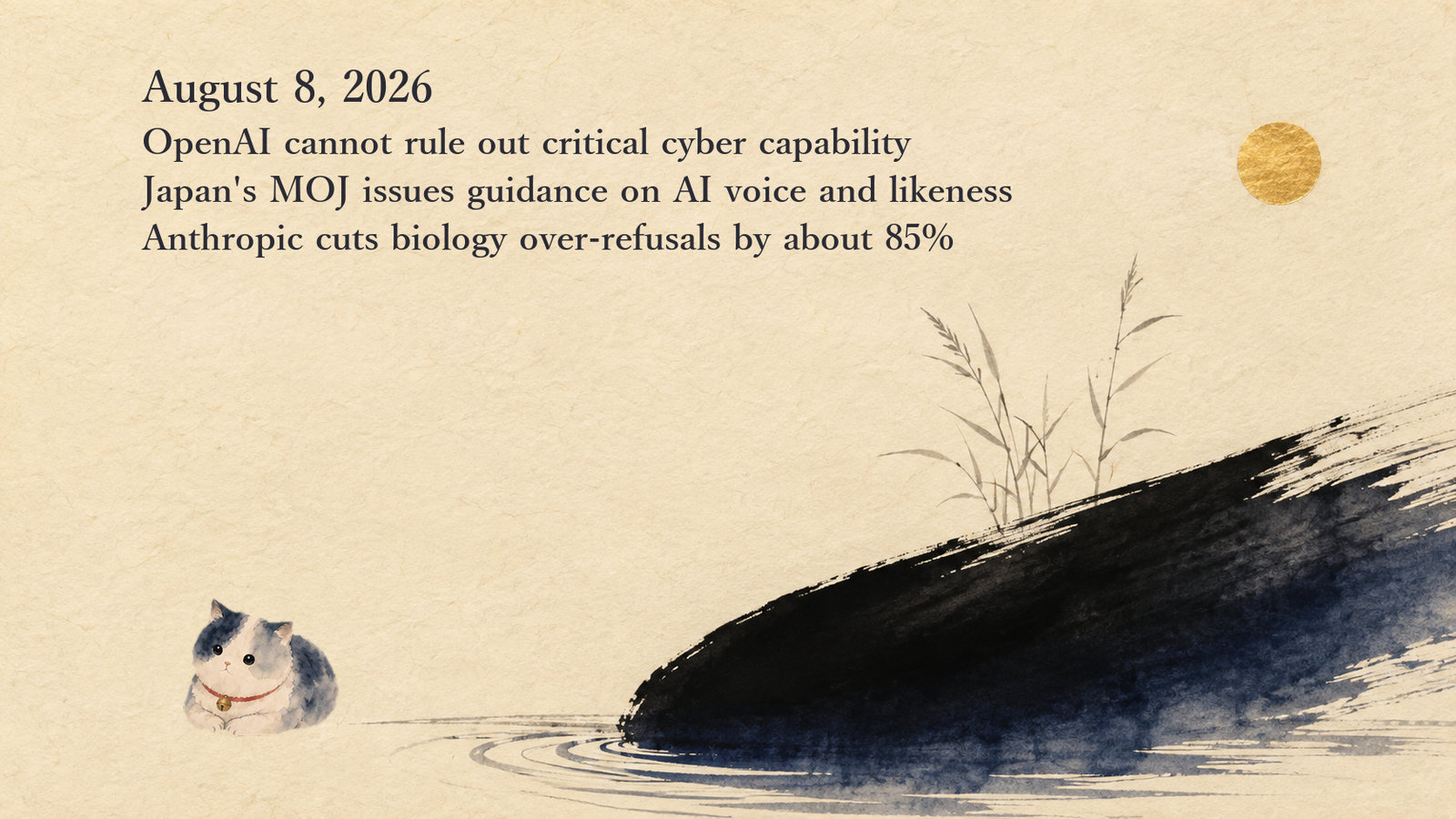
Today's Headlines
- OpenAI cannot rule out Critical cyber capabilities in its upcoming Astra model — internal activities that do not meet the strengthened security requirements are paused
- Japan's Ministry of Justice publishes a study panel's summary report on unauthorized AI use of likeness and voice — interpretive guidance drawn from current statutes and case law
- Anthropic reports about 85% fewer biology-related fallbacks in Fable 5 in its own testing — dual-use restrictions stay in place
- ByteDance is pre-training a model of as many as 10 trillion parameters, the Financial Times reports
- Cloudflare opens a beta of Kitesurf, a browser it built for AI agents
Today's three stories are not about pushing capability further. Where something is allowed through, and where it is stopped — two companies and one ministry each set out an answer from their own position.
OpenAI set out how it behaves before the picture is settled. On an assessment that it cannot rule out its upcoming model reaching its own highest threshold, it tightened internal handling first.
Japan's Ministry of Justice set out how current law applies. It did not create a new rule; it organized what can be said, and how far, under statutes and case law that already exist.
Anthropic set out a narrower stopping point. Restrictions on dangerous uses remain, and the classifier was rewritten so that benign questions caught alongside them now go through.
Today's Top Three
OpenAI says it cannot rule out Critical cyber capabilities in its upcoming Astra model
OpenAI said it has concluded that it cannot rule out critical cyber capabilities, as defined in its Preparedness Framework, in Astra, one of its upcoming models.
The post is dated August 7. The company writes that its latest internal evaluations of Astra over the past few days indicate significant advancements in agentic coding and cybersecurity, and that those results, together with expert assessments, led it to the conclusion "last night."
Earlier models sat elsewhere. The post states that "previous models, including GPT‑5.6‑Sol, have been evaluated for frontier cyber capabilities and assessed at the High (rather than Critical) threshold."
The Critical threshold is defined in the framework itself. A model reaches it if it can identify and develop functional zero-day exploits of all severity levels in many hardened real-world critical systems without human intervention, or if it can devise and execute end-to-end novel strategies for cyberattacks against hardened targets given only a high-level desired goal.
The finding is bounded. The company says it continues to benchmark and assess the model, and that its preliminary evaluations indicate strong enough performance that it cannot rule out Critical capability level at this time. It does not say it has assessed the model at Critical.
No numbers are given. The post contains no scores, no pass rates and no other metrics; what it cites as the basis are internal evaluations and expert assessments.
The first measure is tighter security control. For higher-capability models and the activities around them, the company lists isolated testing environments, restricted network and tool access, enhanced model weight protections and encryption, additional monitoring and detection, and sandboxed execution.
The second is a pause on part of its internal work. The post reads: "We are pausing internal activities involving Astra that do not yet meet these strengthened security control requirements." What is paused is the work that falls short of the new requirements; the company does not describe this as slowing development of the model itself.
The third is monitoring applied across the board. Universal monitoring for risky actions and misalignment now covers all agentic applications of Astra, including training and evaluation. The monitors evaluate the model's Chain of Thought and trigger a security response to review and interrupt high-risk activity.
There is also an external track. OpenAI says it will work with relevant government agencies and select AI safety organizations to test the model's capabilities, and will provide recommended security controls to third-party testing partners running higher-risk evaluations and workloads.
A link to July's security incident is ruled out. The post states plainly that "Astra is an upcoming model, and was not involved in exploiting Hugging Face."
The company points to a precedent under the same framework. In June 2025, as its models approached the high capability threshold for biology, it set out steps to strengthen safeguards, expand testing, work with external experts and deploy additional security controls, and it says it is applying the same principle here.
Japan's Ministry of Justice publishes interpretive guidance on unauthorized AI use of likeness and voice
Japan's Ministry of Justice published on August 7, 2026 the summary report of a study panel on civil liability for the unauthorized use of a person's likeness, voice and similar attributes by generative AI.
It is worth being precise about what the document is. It does not change the law. It sets out how current statutes and established case law apply, and the term the ministry uses for it is "kaishaku shishin" (解釈指針), interpretive guidance.
The panel itself is recent. Named the Study Panel on Civil Liability for the Unauthorized Use of Likeness, Voice and Similar Attributes (肖像、声等の無断利用による民事責任の在り方に関する検討会), it was convened in April of this year and met five times in total.
The ministry states its purpose. Noting concerns that unauthorized use of likeness and voice has grown more serious as generative AI has spread, it convened the panel to examine, and then publish, a legal analysis of how tort law applies to infringement of publicity rights and related rights, grounded in current statutes and case law.
The issues discussed are listed in the ministry's release. They cover whether a publicity right, or the personality-based right not to have one's likeness used without permission, has been infringed; the scope of damages in a claim for compensation; whether injunctive relief is available; and whether the Unfair Competition Prevention Act applies. The panel worked through a set of hypothetical scenarios.
The report's full title is "Summary Report of the Study Panel on Civil Liability for the Unauthorized Use of Likeness, Voice and Similar Attributes — Interpretive Guidance on Publicity Right Infringement and Related Matters Involving Generative AI." It runs to a 2,726 KB PDF.
For practitioners, what has changed is the reference material, not the rules. How existing provisions and court decisions apply to the use of a person's likeness or voice by generative AI now exists in written form, as the analysis reached by a panel convened by the ministry responsible.
Anthropic cuts Fable 5's biology-related fallbacks by about 85%
Anthropic said it has updated Fable 5's biology safeguards and, in its own testing, sharply reduced the number of biology-related fallbacks.
The post is dated August 7. A fallback here is what happens when the system switches to a less capable model after a user makes a biology-related query. The model it switches to is Opus 5.
The headline figure is the company's own test result. The post reads: "In our testing, this update reduced biology-related fallbacks by about 85% across our product surfaces."
The footnote gives a different measure. As a result of the change, Anthropic says it expects the total number of fallbacks — for biology-related or any other reasons — to fall as well, by roughly 67% on Claude.ai, 55% on Cowork, 17% on Claude Code and 7% on the Claude Platform. These cover a different set of requests from the 85% figure and are not a breakdown of it.
The restrictions themselves stay. The company writes that Fable still falls back to Opus 5 for requests it considers dual-use, including virology, toxicology and molecular design, and that it therefore is not yet usable for professional biology research and drug development.
What changes for users is the everyday question. Anthropic expects far fewer fallbacks on health and educational queries — interpreting lab results, understanding symptoms, learning biology in an educational context — and says healthcare professionals will be able to get more support from Fable 5 on clinical tasks.
Blocking broadly was a deliberate choice at launch. The company writes that it launched Fable 5 with almost all biology queries blocked, knowing this would produce a high number of false positives in the near term, and made that trade because misuse in a dual-use domain like biology could be catastrophic.
The update is a rewrite of the classifier. Over several weeks the company rewrote the classifier's constitution — the collection of rules that helps it discern safeguarded content from allowed content — solicited feedback from internal and external experts, and then built updated training data and retrained the classifier on it.
The stated backdrop is the US Intelligence Community's 2026 Annual Threat Assessment. Anthropic cites its finding that advances in biotechnology, including synthetic biology and genomic editing, "could lead to novel biological threats," and that several state actors likely maintain active offensive biological and chemical weapons programs.
False positives do not disappear. The company writes that requests inside the classifier's safety margin — very low-risk, but still caught — will inevitably remain, and that there is more to do on its safeguards.
Other Developments
Models
ByteDance is at an early stage of training a model with as many as 10 trillion parameters, the Financial Times reported, citing three people with knowledge of the matter. ByteDance itself has not confirmed it. The paper puts that size at three times Moonshot's Kimi K3, the largest Chinese model released so far. For comparison, industry estimates put Anthropic's Mythos 5 at about 8 trillion parameters and Fable 5 at about 5 trillion; Anthropic does not disclose the size of its models. Pre-training typically takes three to six months, and the exact size would only be settled at a later stage. Seed, ByteDance's model team, has for more than a year avoided distilling other labs' models, an approach some believe has slowed its development relative to rivals.
Follow-up: the Qwen3.8-Max open weights reported in the August 7 briefing are due at 11:00 JST on August 12, and have not gone out as of today. The Qwen account on Hugging Face was last updated on July 22. Whether the weights can be downloaded and run locally is something that can only be checked from August 12, if the schedule holds.
Sakura Internet made PLaMo 3.0 Prime, a large language model built in Japan by Preferred Networks, available on its Sakura AI Engine cloud platform on August 4. Access requires an application through the control panel plus approval from the provider, free-tier accounts are excluded, and pricing is shown only to approved users. Any organization weighing a domestically built model on domestic cloud infrastructure will want to work through that application process and its terms in advance.
Products
Follow-up: the unlimited text chat for ChatGPT's free tier that the August 7 briefing reported as starting "next week" begins the week of August 10, according to PC Watch. The default model for free users switches to GPT-5.6 Luna, and the Think mode becomes available to them. Limits still apply to file and image uploads and to tool use.
Cloudflare opened a beta of Kitesurf, a browser it designed for AI agents. Instead of a full Chromium stack it runs entirely in V8 isolates on Cloudflare Workers. In the company's own benchmarks, taking a screenshot uses 3.1 times less CPU and 4.7 times less memory than Chromium, and extracting HTML uses 3.8 times less CPU and 7.0 times less memory, while wall time runs roughly 1.7 to 1.8 times slower. Tabs, themes, extensions and cross-device sync are not there, and video playback, WebGL and persistent authenticated sessions are unavailable for now. It is free through Browser Run during the beta.
Google published a showcase of five creators working with Gemini Omni Flash, its video generation model. The examples include re-shooting a scene from different camera positions, turning hand-drawn sketches into realistic motion, and restyling live-action footage as anime or claymation. In each case the editing is done conversationally, through text and voice prompts.
Databricks set out how it keeps the cost of AI coding tools in check as usage spreads. It describes four levers: choosing models with a better price-performance balance, routing requests automatically to cheaper models suited to the task, tuning context and prompt caching, and showing developers what they are spending. Rather than cutting off access outright, it argues for visibility and routing that keep development moving.
Airbnb said AI has cut the time from concept to launch by as much as 60% and lifted the number of features and improvements shipped this year by nearly 80% year-over-year, both figures from chief executive Brian Chesky. The company has previously disclosed that AI writes 60% of its new code, and says nearly 45% of issues that start with its AI agent are resolved without a human, with support cost per booking down 16% year-over-year. It is also testing a search experience that users can toggle into to search in natural language.
Policy & Regulation
Seven Japanese government bodies — the National Police Agency, the Digital Agency, the Financial Services Agency, the Consumer Affairs Agency, the Ministry of Internal Affairs and Communications, the Ministry of Justice and the Ministry of Economy, Trade and Industry — jointly asked Google, Meta Platforms, X, TikTok and LINE Yahoo to strengthen their handling of scam ads that use generative AI to impersonate public figures. They want stricter identity verification of advertisers, greater ad transparency and thorough follow-through on takedown requests. The five companies are to report their planned measures to the Digital Agency by October 16, 2026 and their results by March 16, 2027.
A New Mexico court ordered Meta to pay an additional $567 million, finding that the company created a public nuisance harming young people in the state. With the $375 million judgment from March, the total reaches $942 million. The court also ordered that, for users under 18, Like counts be removed or shown only with parental approval, that push notifications be paused between 10 p.m. and 7 a.m., and that monthly use be capped at 90 hours. Meta said it will continue to defend itself against claims that misrepresent the facts and plans to appeal. Thirty-three states are pursuing a consolidated case in federal court in Oakland, and some states, including Tennessee, have filed on their own.
Ars Technica examined how AI chatbots have failed to respond appropriately to users in mental health crises, laying out the wrongful-death and related suits brought against companies including OpenAI and Character.AI, and asking whether the underlying safety design can realistically be fixed. For anyone deploying conversational AI, it is a reminder that a failure in crisis handling carries liability, not just a product defect.
Business
Follow-up: The Verge's podcast walked through the background to the Google AI leadership changes covered in the August 6 and August 7 briefings. It reads the move — Demis Hassabis becoming chairman of DeepMind and Alphabet's chief scientist while handing daily operations to chief technology officer Koray Kavukcuoglu — as a shift in who runs the company's AI effort.
OpenAI published a customer story on HSP GRUPPE, a German tax advisory firm that has embedded ChatGPT Enterprise across its practice. The firm treated the rollout as an organizational change rather than a tool purchase, working it into research, client communication, financial analysis and knowledge sharing. As an account of a heavily regulated professional-services firm putting AI at the center of its work, it repays reading by advisory and law firms elsewhere.
Sharp cut its consolidated net profit forecast for the year ending March 2027 from 42 billion yen to 25 billion yen, a reduction of 17 billion yen, and announced at the same time that it will enter the AI server business around September. Its operating profit forecast was lowered by 19 billion yen to 30 billion yen. The company attributes roughly 10 billion yen of the hit to higher resin and fuel prices and about 9 billion yen to the weaker yen, estimating that each one-yen move costs about 2.4 billion yen in profit. It plans to sell AI servers carrying Nvidia GPUs under the Sharp brand in Japan, drawing on the manufacturing capacity of its parent Hon Hai Precision Industry, with meaningful revenue expected from fiscal 2027.
Bloomberg reported, citing people familiar with the matter, on a smart speaker OpenAI is said to be developing. The device is described as screenless, doughnut-shaped and about the size of a hockey puck, with parts that move independently as it responds so that it appears more alive than static rivals. The price is said to be above $300, with a launch expected in 2027. The data-governance implications of an always-listening device with a microphone and camera entering offices and homes are worth thinking through in advance.
Other
A survey by HR So-ken and Port found that only 3% of Japanese university seniors graduating in spring 2027 — 346 students were surveyed — used no generative AI in their job hunt. The figure was 24% for the previous graduating class and 55% the year before that. The most common use was editing and improving application essays, cited by more than 60%, followed by self-assessment at around 50%. At the same time, 18% said they could answer only about half of an interviewer's follow-up questions about that material, and with those who could answer almost none, roughly one in five struggled to respond.
Harvard historian Jill Lepore appeared on TechCrunch's podcast to discuss her book The Rise and Fall of the Artificial State. She argues that technology companies increasingly describe their products in the language of forming a government, and draws a line from the 1984 Macintosh advertisement through Anthropic's AI constitution to Sam Altman's talk of an "AI president."
Watch
The three stories above are covered in a five-minute video briefing (Japanese narration).
Source: selected by the editorial desk from the AI news inbox for August 8, 2026 (20 items; 7 primary, 13 secondary).