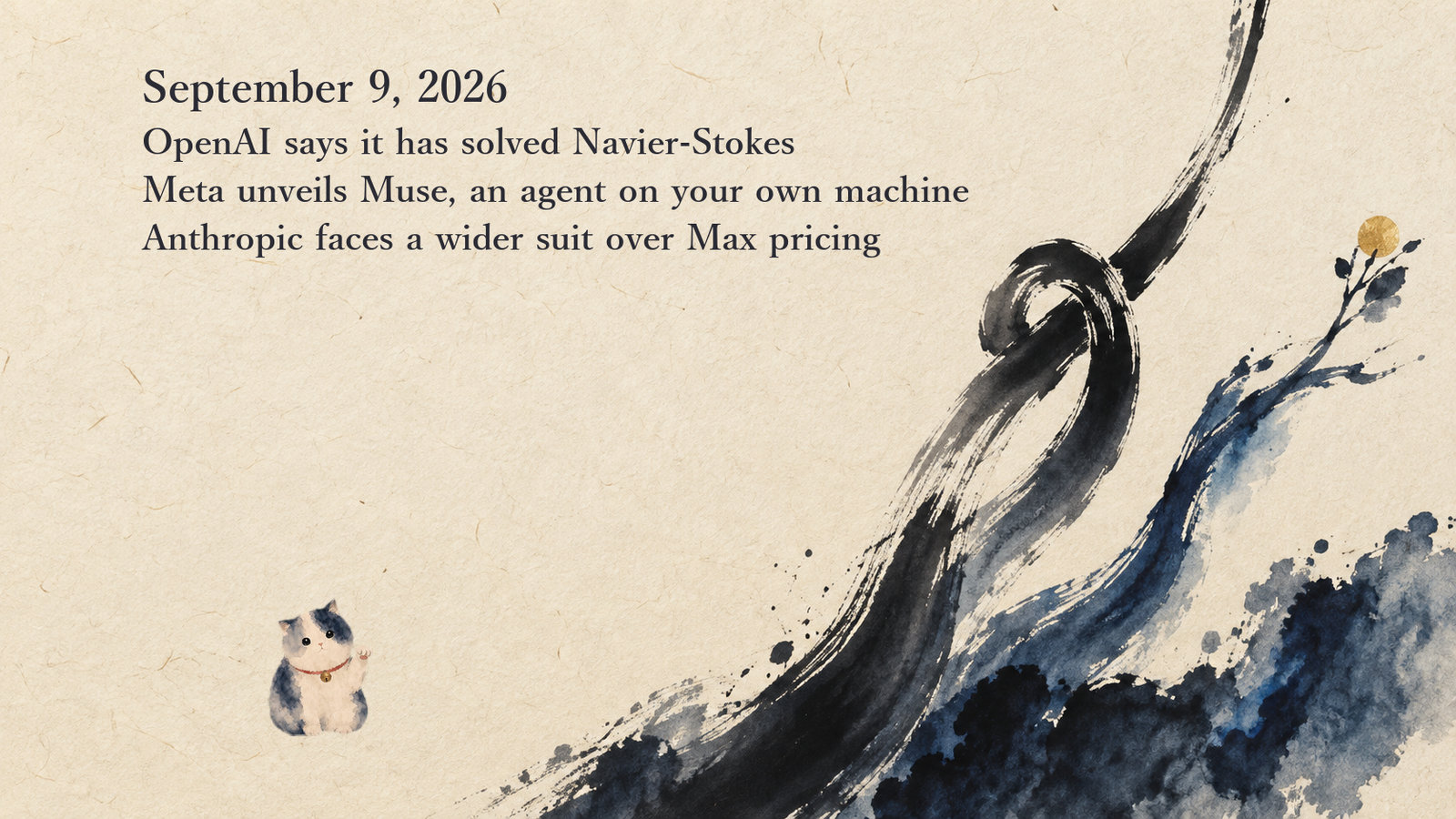
Today's Headlines
- OpenAI publishes a Navier–Stokes proof produced by an unreleased internal model, with a Lean formalization released the same day
- NYU professor Tristan Buckmaster criticizes how OpenAI announced the result, days after he and Anthropic's Levent Alpöge proved a forced Euler blowup
- Meta begins offering Muse, a personal AI agent that runs on a dedicated VM behind a separate approval agent called Sentinel
- Anthropic faces an expanded class action over the "5x" and "20x" usage claims for the Claude Max plan
- Google DeepMind releases AlphaGenome Atlas, molecular predictions for 9 billion possible single-letter changes in human DNA
A fluid problem that had stood open for roughly ninety years now has an answer. OpenAI released a writeup and a Lean formalization the same day, and says it does not intend to claim the Millennium Prize money.
Two more stories sit beside it. Meta started handing US users an agent that acts on their behalf, and Anthropic was sued over the way it advertises usage.
Today's Top Three
OpenAI publishes a Navier–Stokes proof produced by an unreleased internal model
OpenAI said on September 8 that an unreleased internal system produced a proof that the Navier–Stokes equations can develop a singularity in finite time, and released both a writeup and a formalization in Lean.
The result concerns a fluid that starts smooth and at rest, has a smooth force applied to it, keeps its energy finite throughout, and still reaches a state where its speed grows without bound within a finite time. OpenAI frames this as establishing statement "C" — and also "D" — in the Clay Mathematics Institute's official formulation. The solution is a vortex that spirals inward and stretches out like spaghetti, with the central region shrinking as it speeds up while total energy stays finite.
The system behind it is an internal model that OpenAI describes as significantly more capable than GPT-6 Astra. Training on it began August 28 and continues. On September 1, after hearing rumors that two Millennium Prize problems had been resolved, the company pointed agents at every open problem on the list. The group that reached the Navier–Stokes result ran on the order of 10,000 concurrent agents and arrived at its answer on September 5, roughly 88 hours after the first agents launched. Lean formalization and verification took GPT-6 Astra another 17 hours.
OpenAI put numbers on the scale. Across all attempted problems the agents sent 4.9 million messages and used about 300 billion output tokens; for Navier–Stokes alone the figures were 2.7 million messages and roughly 130 billion output tokens.
The same agents also cracked the Euler equations, the limit of the problem with the viscosity term removed. The variant they resolved is the unforced one, where no external force is applied, and nearly 100 agents worked for about 50 hours to produce it.
How the result was announced is now disputed. Tristan Buckmaster, a mathematics professor at NYU, announced three proofs on September 8 with Levent Alpöge, a mathematician employed by Anthropic, and wrote in his statement that information about their progress had reached OpenAI before it was public. The route the two had chosen — reaching the Clay problem through a smooth force, options C and D in the official statement — is one Buckmaster says almost nobody else was pursuing, and one he describes as a direction you do not arrive at in a few days by handing a model the problem statement.
Buckmaster also described the exchange that followed. He says Bubeck of OpenAI asked him to drop Alpöge's credit as part of a proposed compromise, and that when he pressed to make the dispute public, Bubeck replied, "Why would you ruin your career?"
OpenAI writes that neither its researchers nor its agents saw any of the pair's work before it was released publicly, and that it recognizes their priority on the forced Euler problem. The company's post confirms the September 1 start date and the conversations with the two mathematicians.
- On the Navier–Stokes Millennium Prize Problem (OpenAI)
- OpenAI fought dirty on career-making math problem, says NYU mathematician (TechCrunch)
Meta begins offering Muse, a personal AI agent, in the US
Meta introduced Muse on September 8, a personal AI agent that carries out tasks on a user's behalf, and began rolling it out in the US on iOS, Android and muse.ai.
Muse takes work like sending an email or booking travel, and when given a goal it builds a plan and advances it on its own. It can open a browser, fill out forms and negotiate. It keeps working after the app closes and comes back when something changes or when it needs approval. The model behind it is Muse Spark, which Meta calls its most capable to date, and people can talk to Muse either in its own app or inside WhatsApp.
Permissions are the center of the announcement. Muse runs on Muse Secure VM, a dedicated virtual machine in the cloud that also holds the credentials for any service the person connects. A separate Sentinel agent runs on that same machine, kept apart from Muse at the system level, and nothing Muse does reaches the internet unless Sentinel approves it. Muse uses stored credentials without seeing passwords or payment details, and shows a complete audit trail of what it has done and what it plans to do.
Control stays with the user in specific ways. People choose which apps Muse connects to and how much access each one gets — for email, whether it only reads or can also send. They can opt out of having their interactions train Meta's models, and they can tell Muse to forget specific things it has learned.
Payment runs through Link, built by Stripe, which issues a single-use card number so real card details stay hidden. Meta says a Muse Confidential VM, encrypted with a key only the user holds, arrives later this year. Support for AI glasses is listed as coming soon.
- Introducing Muse: The World's First Personal AI Agent Built for Everyone (Meta Newsroom)
- Meta debuts its Muse AI agent. Will consumers trust it? (TechCrunch)
Anthropic faces an expanded class action over Claude Max usage claims
Subscribers to Claude's top-tier Max plan filed an expanded class action against Anthropic on September 8, alleging that the way its usage limits were advertised misled consumers.
The dispute turns on a multiplier. Max sits above the $20-per-month Pro plan and is sold at $100 a month for "5x" the usage limits of Pro, or $200 a month for "20x". The complaint alleges those multipliers are promised only for five-hour chunks of time that are themselves subject to a weekly limit, which adds up to a much smaller increase in usable capacity.
The case is brought by Monica Vaca and Kati Daffan, both former Federal Trade Commission attorneys with 38 years at the agency between them. "There is a long line of precedent on false advertising," Vaca said. "It's commercial speech. You can't lie when you're marketing a product." The complaint was first filed in July, then withdrawn and refiled as an expanded class action.
In a motion to dismiss the earlier case, Anthropic argued that the session limits were reachable through hyperlinks in the purchase process, calling that "the digital equivalent of flipping a product over to read the back label." Vaca's answer is about how long that path is: reaching the word "session" takes clicking two separate hyperlinks, and learning what "session" means takes a trip to the Pro plan page. Anthropic did not respond to a request for comment.
The timeline is part of the claim. Anthropic announced the Max plan in April 2025 and introduced the weekly limits at issue in August of that year, as it pushed to compete with OpenAI.
Other Developments
Models
- OpenAI began offering ChatGPT Images 2.5 on September 8, with sharper detail and more precise editing, and added two models, GPT-Image-2.5 Flare and Sunburst, to the API. The company says people now create more than 3 billion images a week across ChatGPT Images and the GPT-Image models. Introducing ChatGPT Images 2.5 (OpenAI)
- Google updated its AI weather model to take in more raw satellite data, which it says improves forecast accuracy. Google's AI weather model now uses more raw satellite data (Ars Technica)
Research
- Google DeepMind released AlphaGenome Atlas, a catalog of molecular-level predictions for all 9 billion possible single-letter changes in the human genome, offered free for academic research. AlphaGenome Atlas: a predictive map of every possible DNA letter change in the human genome (Google DeepMind)
Policy & Courts
- OpenAI announced $5 million in grants for research on AI and teen development. Teen development research grants (OpenAI)
- Chrome moved to a two-week release cadence, citing the way AI has changed the security landscape. Chrome is now shipping updates every 2 weeks as AI changes the security landscape (TechCrunch)
- Ars Technica reported that ads on Facebook and Instagram for "nudify" apps used real photographs of young girls. Real photos of young girls were in nudify app ads on Facebook, Instagram (Ars Technica)
Business
- Google Cloud formed a new unit with Accenture to help enterprises deploy AI, an effort to close ground in the enterprise market. Google Cloud races to catch up in the AI deployment wars with Accenture deal (TechCrunch)
- 1Password said adopting Codex raised engineering productivity by 21 percent. 1Password (OpenAI)
- Missouri and Google signed a statewide partnership on AI education and workforce training. Missouri state education partnership (Google)
Source: selected by the editors from the AI news inbox collected on September 9, 2026 (29 items, 19 primary and 10 secondary).