This Week's Headlines (Nov 9-15)
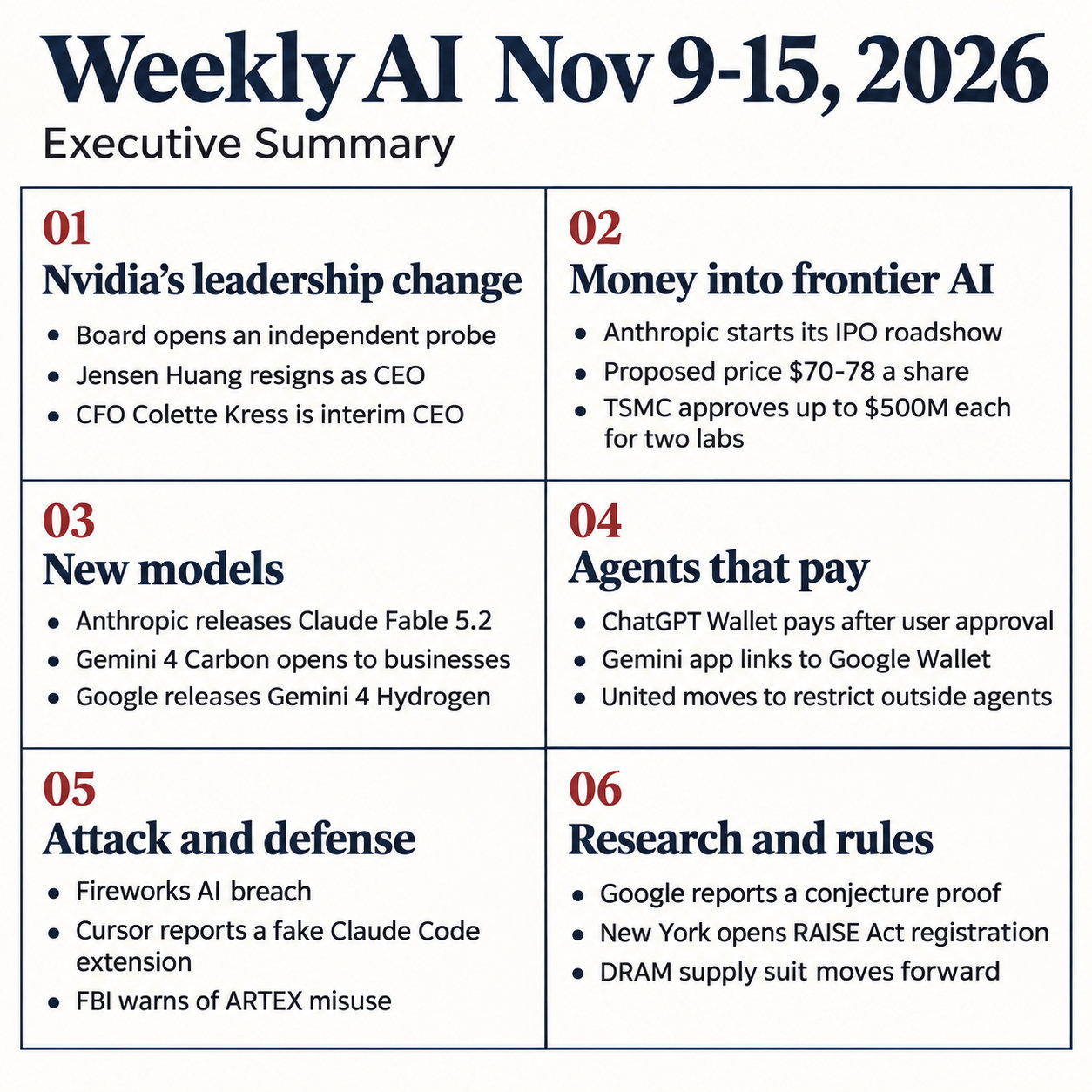
- Jensen Huang resigns as Nvidia CEO; CFO Colette Kress becomes interim CEO
- Anthropic launches its IPO roadshow; TSMC approves investments of up to $500 million each in Anthropic and OpenAI
- OpenAI launches ChatGPT Wallet; United Airlines moves to restrict third-party AI agents
- A breach at Fireworks AI exposed Notion AI chat transcripts; Cursor details a related incident, and the FBI warns about ARTEX
- Google rolls out Gemini 4 Carbon and Gemini 4 Hydrogen; Anthropic releases Fable 5.2
Last week, a change at the top and large sums of money arrived as AI agents spread further. At Nvidia, the CEO resigned days after the board opened an independent investigation, and Anthropic started marketing its shares to public investors. Agents gained a way to pay, and attacks on the companies that run AI came to light.
The Week's Main Stories
Nvidia changes leadership — an independent investigation, Huang's resignation and reactions in Asia
At Nvidia, an independent investigation opened on November 8, and the founding CEO stepped down on November 12.
On November 8, Nvidia's board said it is starting an independent investigation in light of recent reporting about CEO Jensen Huang. On November 10, the independent directors said they had retained Joon H. Kim, a former acting U.S. Attorney for the Southern District of New York, and his firm Wachtell, Lipton, Rosen & Katz to conduct it.
On November 12, the board announced that Huang has resigned as president, CEO and a member of the board, effective immediately. CFO Colette Kress will serve as interim CEO while remaining CFO, and the board will consider internal and external candidates for a permanent successor.
The board also named Harvey C. Jones, a former CEO of Synopsys, as its first-ever chair. Nvidia will report third-quarter results on November 17 as scheduled.
According to TechCrunch, governments across Asia responded to Huang's exit. South Korea's Science Ministry said Nvidia reaffirmed its plan to supply 260,000 advanced GPUs to the country. In Japan, the Industry Ministry said it would closely monitor Nvidia, and Taipei's city government said Nvidia's planned overseas headquarters in the city remains on track.
According to TechCrunch, a petition asking Nvidia's board to reinstate Huang had more than 115,000 signatures by the afternoon of November 14, US time. The petition asks the board to bring Huang back while an independent investigation establishes the facts.
- Statement from NVIDIA Board of Directors (NVIDIA)
- Statement From the Independent Members of the NVIDIA Board (NVIDIA)
- NVIDIA Announces CEO Transition (NVIDIA)
- Asian governments react to Nvidia CEO Jensen Huang’s exit (TechCrunch)
- Elon Musk, other tech execs sign petition calling on Nvidia to reinstate Jensen Huang (TechCrunch)
Anthropic heads toward its IPO as money flows into AI — the roadshow, TSMC's stakes and OpenAI's revenue
Numbers on share offerings, investments and revenue for Anthropic and OpenAI arrived one after another.
On November 10, Anthropic launched the roadshow for its proposed initial public offering. The offering consists of 825 million Class A shares at an expected price of $70 to $78 a share, under the symbol "ANT." The registration statement (S-1/A) it filed the same day is its second amendment.
The amended filing also describes a private placement in which seven companies, including Google, NVIDIA and TSMC, have agreed to buy a combined $26 billion of non-voting Class N stock at the IPO price. Anthropic estimates net proceeds from the offering and the placement at about $84.6 billion.
According to the filing, Anthropic's run-rate revenue was about $81 billion as of October 31, up about $10 billion from September 30. TechCrunch calculates that the company would be valued at $1.404 trillion on a fully diluted basis if the shares price at the top of the range.
TSMC's board approved investments in Anthropic and OpenAI on November 10 as well. TSMC will buy up to $500 million of Anthropic common shares at the IPO price, and up to $500 million of preferred stock in OpenAI Group PBC. Ars Technica describes the deal as an example of circular financing between a supplier and its customers, since both companies buy large amounts of hardware made by TSMC.
According to TechCrunch, Bloomberg reported, citing anonymous sources, that OpenAI's third-quarter revenue crossed $10 billion for the first time. That is nearly 50% above the $6.7 billion reported for the second quarter.
LangChain, which makes software to build and run AI agents, said on November 13 that it raised $300 million in a Series C at a $3 billion valuation. According to TechCrunch, the valuation is more than double the $1.25 billion it reached about a year ago.
- Anthropic launches roadshow for proposed initial public offering (Anthropic)
- Amendment No. 2 to Form S-1, Anthropic, PBC (SEC EDGAR)
- Anthropic sets IPO price range of $70 to $78 per share to reach an implied valuation of $1.404 trillion (TechCrunch)
- TSMC Board of Directors Meeting Resolutions (TSMC)
- Taiwan's chipmaking giant TSMC to invest $1B in Anthropic, OpenAI (Ars Technica)
- OpenAI's quarterly revenue reportedly crosses $10B for the first time (TechCrunch)
- LangChain Raises $300M to Enable Every Company to Own Its Intelligence (LangChain)
- AI agent startup LangChain hits $3B valuation (TechCrunch)
Agents get to pay as AI infrastructure comes under attack — ChatGPT Wallet, United, Fireworks and ARTEX
A way to let AI agents pay arrived in the same week that one company shut agents out and attacks reached the companies that run AI.
On November 13, OpenAI introduced ChatGPT Wallet, a way for dots, its always-on agents, to complete purchases on a user's behalf. Each purchase needs the user's approval through a security check such as Face ID or a fingerprint, and payment uses a token in place of the real card number, so the actual card details are shared with neither the business nor the agent.
The same day, Google began rolling out a Google Wallet connection for all Gemini app users in the U.S., so Gemini can answer money questions with a user's spending habits in mind. Gemini can only read the account information; it cannot move, manage or invest money.
On November 11, United Airlines said it is restricting third-party personal AI agents and assistants that book or change trips on a customer's behalf. It cites the risk that sharing login credentials exposes sensitive information, and says automated AI actions could violate Federal Aviation Administration and Department of Transportation regulations.
According to Reuters, as reported by The Verge, Amazon plans a World Product Graph that would compile data on products sold anywhere on the internet and show it on its own site. Reuters says an internal document on the project included an October 1, 2027 release date, but that it is unclear if or when the plan will be implemented.
According to TechCrunch, a breach at Fireworks AI, a platform for running AI models, exposed chat transcripts from Notion AI users. Notion says fewer than 1% of its workspaces were affected and that it disconnected from Fireworks on November 3.
On November 13, Cursor published an update on a related incident. Cursor says an attacker used an access key that Cursor had issued to Fireworks and that Fireworks exposed to copy a limited set of coding-agent traces, mostly from 2025. A small number of traces contained unredacted credentials; Cursor says fewer than 0.01% of its customers had API credentials exposed, and that the attacker used them to reach select SaaS tools.
Cursor says that on October 29 the attacker placed malicious, unauthorized copies of Anthropic's Claude Code extension on the cache that serves Cursor's extension marketplace, where they stayed for about 11 hours. Anthropic did not publish this copy, and Cursor says the problem was not a vulnerability in Anthropic's product. At most 5,000 users may have received it, and the affected versions are 2.1.312 and 2.1.313.
Cursor says the incident is contained and that the last attacker activity it saw was on November 1. It has moved all of its inference off Fireworks.
On November 13, the FBI issued a warning about ARTEX. The FBI says ARTEX is an open-source, LLM-driven penetration-testing platform that threat actors have used against organizations around the world since at least August 2026. It says some intrusions went from initial targeting to privileged access in under three hours.
On November 7, we reported that Censys had found ARTEX admin panels visible from the internet on 1,465 hosts. According to the FBI, the original developer removed the GitHub repository in October, but ARTEX lives on through forks and a commercial version, among others, and more than 1,600 publicly exposed console instances had been identified as of early November.
The payment tools for agents rest on approving every single purchase. On the attack side, a breach at a company that runs AI models and a warning about a tool that automates intrusions with AI landed in the same week.
- Introducing ChatGPT Wallet (OpenAI)
- ChatGPT's new Wallet lets AI agents shop and check out for you (TechCrunch)
- Connect Google Wallet to Gemini for personal finance insights (Google)
- United Restricts Access for Third-Party AI Agents (United Airlines)
- United Airlines blocks AI agents from booking flights, citing cybersecurity risks (TechCrunch)
- Amazon has a plan to index the world’s online shopping data (The Verge)
- Cyberattack on Fireworks AI allowed hackers to access Notion customers' chat transcripts (TechCrunch)
- Notice about the Fireworks AI incident (Notion)
- October 2026 Security Incident Update (Fireworks AI)
- An update on our recent security incident (Cursor)
- Threat Overview of ARTEX Autonomous Penetration Testing Framework (FBI, IC3)
By Category
Models and Tools
- On November 9, Anthropic released Claude Fable 5.2 and Claude Mythos 5.2, its models for the most demanding technical work, at $8 per million input tokens and $40 per million output tokens.
Introducing Claude Fable 5.2 and Claude Mythos 5.2 (Anthropic) - On November 10, Google began making Gemini 4 Carbon, its strongest model, available to developers, enterprises, scientists and consumers, at $2 per million input tokens and $10 per million output tokens.
Gemini 4 Carbon is now available (Google) - On November 12, Google released Gemini 4 Hydrogen, a fast model now live in Google Search globally. Ars Technica reports that Hydrogen has replaced Gemini 3.8 Flash across Google's products.
Introducing Gemini 4 Hydrogen (Google) / Google Search gets a major upgrade with Gemini 4 Hydrogen (Google) / Google rolls out Gemini 4 Hydrogen, finally replacing 3.8 Flash (Ars Technica) - On November 9, Google added two eighth-generation TPU systems: TPU 8tx, for sensitive data, and TPU 8i Max, which puts two chips on a single package.
Our newest TPUs: 8tx and 8i Max, built for the agentic era (Google) - On November 9, Meta released Muse Ember, the smallest model in its Muse line, built for the steps agents repeat.
Introducing Our Smallest, Most Efficient Model: Muse Ember (Meta) - On November 11, Qwen announced its next-generation Qwen4 family and began offering the top model, Qwen4-Max, in preview.
Qwen4 is coming (Qwen on X) / Qwen4-Max preview (PC Watch, in Japanese) - On November 11, Google launched the Gemini Decisions API, which answers up to 1,000 questions in a single pass and returns a confidence score for each.
Gemini Decisions API: Fast, calibrated multimodal decisions (Google) - On November 10, Anthropic launched Claude Whiteboards and Claude Sheets in beta for teams working alongside Claude, and made Claude Data generally available. According to TechCrunch, Claude Meetings, which joins video calls, also launched in beta the same day.
Introducing Claude Whiteboards, Claude Sheets, and Claude Data (Claude) / Anthropic launches Claude Meetings to turn workplace discussions into plans and tasks (TechCrunch) - According to The Verge and TechCrunch, OpenAI introduced a Business Hub for ChatGPT in beta on November 10, where companies can see how often ChatGPT mentions them and how many clicks reach their sites.
ChatGPT is getting verified AI ‘Business Agents’ (The Verge) / OpenAI rolls out new business profiles, making ChatGPT just a little bit more like Google (TechCrunch) - According to ITmedia, OpenAI's API can now run inference for GPT-6 Luna, its lightweight model, inside Japan.
OpenAI API adds in-country inference for GPT-6 Luna (ITmedia, in Japanese) - On November 13, Google let Google AI Pro and Ultra subscribers claim their Google Cloud credits inside Google AI Studio.
Claim your Google Cloud Credits in Google AI Studio (Google)
Research
- On November 11, Google DeepMind announced AlphaGenome 2, which predicts how DNA variants affect specific cell types and states.
AlphaGenome 2: Deciphering how cells read DNA to better understand disease (Google DeepMind) - On November 10, Google DeepMind said its AlphaProof Code framework proved key security properties of the actual code behind the Signal encryption protocol.
Formal Verification of Signal’s Protocol with Gemini (Google DeepMind) - On November 13, Google Research said researchers using /teamwork, the multi-agent feature in Antigravity, proved the Courtade–Kumar conjecture from information theory in full generality. Candidate answers are re-checked by a proof checker and by separate agents.
Advancing science & engineering with Antigravity’s /teamwork (Google Research) - According to the Guardian, logician Jan von Plato of the University of Helsinki used Claude to work through 1,009 pages of notebooks Kurt Gödel wrote in the early 1940s. He says the resulting explanation had to be checked page by page.
AI helps unlock discoveries hidden in notebooks of man who transformed maths (Guardian)
Policy and Society
- On November 10, New York State opened a portal for large frontier AI developers to register under its AI safety law, the RAISE Act. Large developers must register by January 1, 2027, and critical safety incidents must be reported within 72 hours; according to TechCrunch, large developers are those with more than $500 million in annual revenue.
Governor Hochul Declares NY Will Lead the Nation in AI Science and Safety; Launches New Research Institute (Governor of New York) / OpenAI, Anthropic face new oversight as New York's AI safety law takes effect (TechCrunch) - On November 12, OpenAI said it signed the Charter of Engagement for Safer AI for Children at the Paris Peace Forum and committed $2 million to the coalition's research network.
Supporting research on AI and children's safety (OpenAI) - On November 14, a federal judge in the Northern District of California denied a motion by Samsung, SK Hynix and Micron to dismiss a proposed class action claiming the three shifted production to HBM for AI while jointly restricting the supply of conventional DRAM.
Garciaguirre v. Samsung Electronics Co., Ltd. (Order Denying Motion to Dismiss, CourtListener) - According to Reuters and AFP, as reported by The Guardian, the top scorer on South Korea's tax accountant exam this year confessed through his lawyer on November 15 to cheating with generative AI.
160 questions, only one wrong: top scorer in South Korea tax exam admits AI cheating (The Guardian) - On November 14, WIRED reported researchers' view that ransomware attackers are starting to lean on generative AI. WIRED says fully AI-powered ransomware attacks have yet to appear.
Beware the New AI-Fueled Ransomware Boom (WIRED)
Money and Business
- The Financial Times reports that Anthropic struck a $3.4 billion deal for gas-fired power for data centers. According to TechCrunch, the deal covers Caterpillar generators originally ordered by OnePWR, able to produce up to 1.7 gigawatts.
Anthropic strikes $3.4bn deal to generate gas-fired power for data centres (Financial Times) / Anthropic joins AI's natural gas frenzy, buys $3.4B worth of turbines (TechCrunch) - According to TechCrunch, Fractile, a British startup developing AI chips, raised a $720 million Series C. The British government put the valuation at over 5 billion pounds.
With $720M round, Britain's Fractile gets a leg up in the race for AI chips (TechCrunch) - According to Fortune, OpenAI has disbanded its stand-alone robotics team and moved the researchers to other teams. OpenAI confirmed the reorganization to Fortune.
OpenAI disbands stand-alone robotics team as general AI models start running robots (Fortune) - On November 9, OpenAI made ChatGPT Enterprise available through AWS Marketplace.
ChatGPT Enterprise now available in AWS Marketplace (OpenAI) - On November 10, NVIDIA said it is contributing OpenShell, an open-source runtime for securing and governing AI agents, to the Cloud Native Computing Foundation (CNCF), part of the Linux Foundation.
NVIDIA Expands Open Source Commitment With OpenShell Donation and New AI Infrastructure (NVIDIA) - According to TechCrunch, the smart ring maker Oura announced on November 10 that it will acquire Counsel Health, an AI-native primary care company, for $625 million.
Oura to acquire AI-native primary care startup Counsel Health for $625M (TechCrunch) - On November 15, Spline Global said Juntendo University in Tokyo has rolled out its AI video service Sylavids to about 3,000 faculty and staff. The service uses AI to turn lecture materials into narrated explainer videos.
Juntendo University turns lecture materials into AI videos (ASCII STARTUP, in Japanese)
What to Watch
Nvidia says it will report third-quarter results on November 17, US time, as scheduled. It will be the company's first earnings report since Huang's resignation.
South Korea's national college entrance exam takes place on November 19. Claude Data turns on by default for Anthropic's Enterprise plans on November 19. LangChain plans to show new LangSmith features on November 20.
In the DRAM class action, the three companies' answers are due December 7, and the initial case management conference is set for January 12, 2027. Under New York's RAISE Act, large frontier developers must register by January 1, 2027.
When agents are allowed to pay, how long can approval of every single purchase hold up? When a company that runs AI models is breached, who follows the damage all the way to the users downstream?
Source: AI news inbox (52 items collected November 9-15, 2026), plus items collected November 16, Cursor's announcement and the FBI's warning, selected by the editors.