Today's Headlines
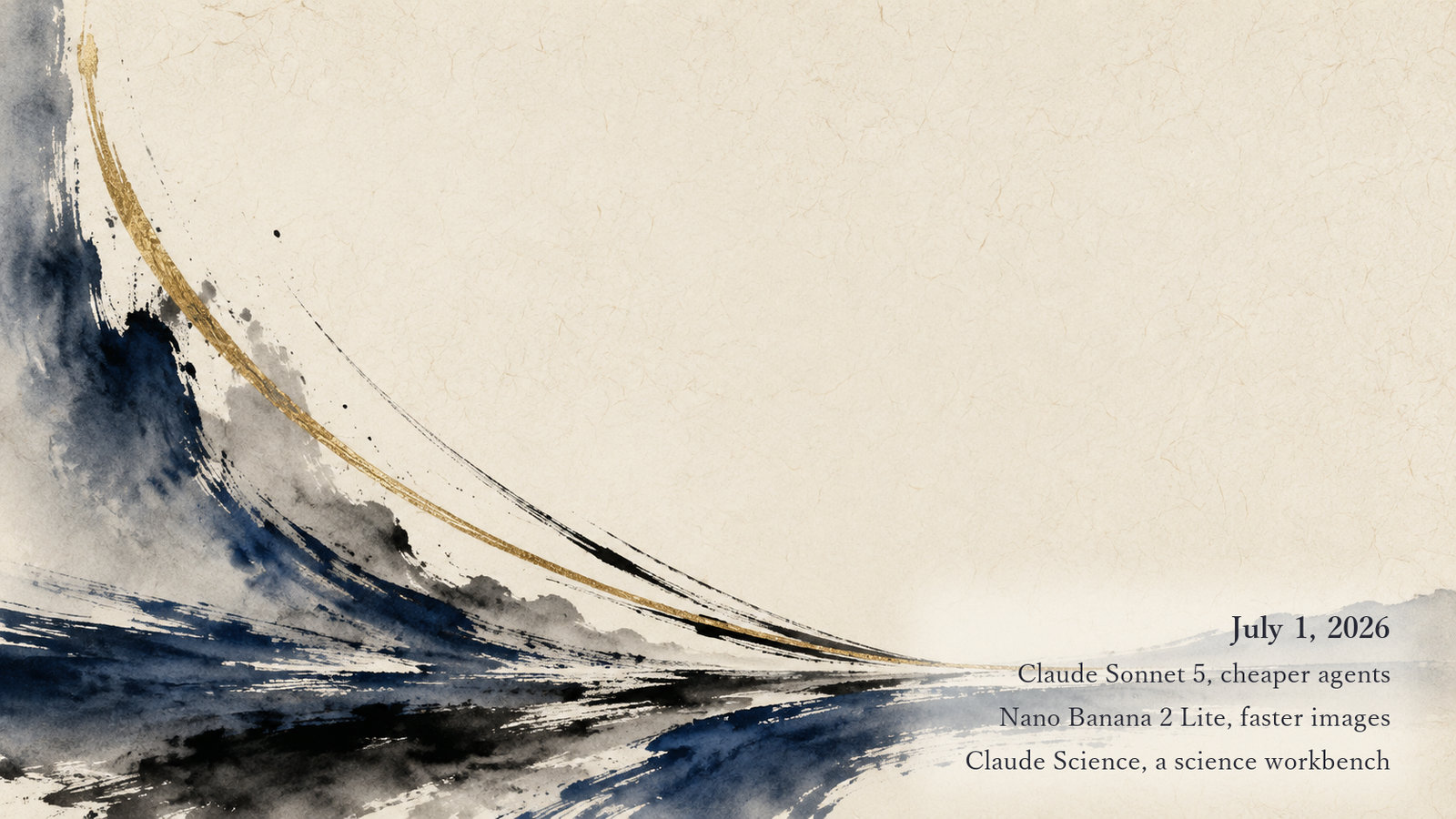
- Anthropic releases Claude Sonnet 5, bringing autonomous agent performance to a lower price tier
- Google ships Nano Banana 2 Lite and Gemini Omni Flash, generating images in about four seconds for a fraction of a cent
- Anthropic launches Claude Science, betting on a research "workbench" rather than a new model to win over scientists
Rather than another contest over raw model size, the theme of the day was how cheaply, quickly, and close to the workplace AI can be delivered.
On the same day, Anthropic and Google each announced ways to lower unit costs from different angles. One cut the price of running an agent on a chat model; the other cut the price of generating images and video. Anthropic added a second move that steps past the model itself and into the researcher's working environment. Attention is shifting from competing for the performance peak to spreading that performance thinly and widely across real work.
Today's Top Three
Anthropic releases Claude Sonnet 5, a mid-tier model for running agents cheaply
Anthropic has released Claude Sonnet 5, a refresh of its mid-tier model.
The headline change is that autonomous task handling, which previously required larger and costlier models, can now run in a cheaper price tier. Claude Sonnet 5 can make plans, operate tools such as browsers and terminals, and work without a human in the loop. Compared with the previous Sonnet 4.6, it improves on reasoning, tool use, coding, and knowledge work.
On price, Anthropic set launch pricing through August 31 at $2 per million input tokens and $10 per million output tokens. From September, that moves to $3 input and $15 output. The company positions this below its own higher-tier Opus 4.8, as well as GPT-5.5 and Gemini 3.1 Pro.
On benchmarks, the model scored 63.2% on agentic coding. That trails the higher-tier Opus 4.8 (69.2%) but beats the previous Sonnet 4.6 (58.1%). Anthropic says it slightly edges out Opus 4.8 on some knowledge work, with lower rates of undesirable behavior.
Practitioners have weighed in. Daniel Shepard, a senior engineer at the automation service Zapier, said: "It finished end to end. That used to stall halfway. For day-to-day automation, it's a no-brainer." Claude Sonnet 5 ships as the default model for both the free and paid Pro plans. It is a clear marker of the pricing competition of the agent era, where the contest is less about peak ability and more about what the same job costs to run.
- Anthropic launches Claude Sonnet 5 as a cheaper way to run agents (TechCrunch)
- Introducing Claude Sonnet 5 (Anthropic)
Google makes generation faster and cheaper with Nano Banana 2 Lite and Gemini Omni Flash
Google has shipped an image model, Nano Banana 2 Lite, and a multimodal model, Gemini Omni Flash.
Nano Banana 2 Lite is optimized for producing large volumes of images quickly. It generates an image in about four seconds at a cost of $0.034 per image at 1K resolution, much faster and cheaper than its predecessor. It is already available through Google AI Studio, the Gemini API, and the enterprise Gemini Enterprise Agent Platform, with the original Nano Banana now treated as legacy.
Gemini Omni Flash converts images, audio, and text into video. Video output is priced at $0.10 per second. Alongside it, Google released a demo app, Omni Product Studio, that turns still images into "cinematic e-commerce videos."
What unites the two announcements is a direction: making generation cheap enough to use as a tool for iteration. A few cents and a few seconds per image reframes image generation from a one-shot deliverable into a drafting step you repeat many times. In creative production, the practical dividing line is shifting from the quality ceiling toward how far the cost of iteration can fall.
- Google introduces a faster, cheaper image generator with Nano Banana 2 Lite (TechCrunch)
- Start building with Nano Banana 2 Lite and Gemini Omni Flash (Google DeepMind)
Anthropic's Claude Science bets on a workbench, not a new model
Anthropic has launched Claude Science, an AI workbench for researchers.
What stands out is that it is not a new, dedicated model. Claude Science runs on existing Claude models such as Opus 4.8 and is available without special access. Rather than selling a specialized model, Anthropic chose to build out the environment in which researchers do their daily work.
The workbench removes the need to move between separate databases and tools, letting computational research happen in one place. A central AI assistant acts as project manager and spins up sub-assistants for specialized tasks as needed. Pre-built toolkits cover genomics, protein structure, and chemistry, and the system connects to more than 60 scientific databases.
It also bakes in features tied to research reliability. Beyond a fact-checker that validates citations and calculations, it can output figures such as 3D protein structures together with the underlying code, runtime environment, and creation history for reproducibility. Researchers can also run analyses inside their own lab infrastructure rather than sending data to outside servers.
Claude Science is available in beta to Pro, Max, Team, and Enterprise subscribers. Anthropic says it will support 50 research projects with up to $30,000 in credits each, with applications closing on July 15. Early users include a neuroscientist at the Allen Institute and a team at the UCSF Brain Tumor Center. Unlike rivals that gate dedicated science models, Anthropic is entering the lab with an existing-model-plus-environment approach.
- Anthropic's Claude Science bets on workflow, not a new model, to win over scientists (TechCrunch)
- Claude Science, an AI workbench for scientists (Anthropic)
Other Developments
Models & APIs
- Google updated its Gemini Spark assistant with a macOS launch and connected-app integrations, among other changes. Gemini Spark updates: macOS launch, connected apps and more (Google Blog)
- X (formerly Twitter) began offering an MCP server to make its platform easier for AI tools to use. X now offers an MCP server to make its platform easier for AI tools to use (TechCrunch)
- Tenstorrent announced the TT-Ascalon S, a new CPU with 140% of the prior performance, aimed at agentic AI. Tenstorrent announces the TT-Ascalon S, a 140%-performance CPU for agentic AI (PC Watch, in Japanese)
Research
- OpenAI introduced a new evaluation benchmark, GeneBench-Pro. Introducing GeneBench-Pro (OpenAI)
- Google's NotebookLM gained the ability to summarize research into a short, TikTok-style video clip. Google's NotebookLM can sum up your research in a TikTok-style clip (The Verge)
Policy
- Researchers reported a new attack that lulls AI browsers into a "dream world" where guardrails no longer apply, letting their restrictions be bypassed. New attack provides one more reason why AI browsers are a bad idea (Ars Technica)
Business
- Etched, an AI-chip startup positioned as an Nvidia rival, reportedly reached a $5B valuation and $1B in sales. Nvidia competitor Etched hits $5B valuation, $1B in sales for AI chip (TechCrunch)
- Netflix is using an AI-generated voice of the late Gene Wilder in its Willy Wonka reality show. Netflix is using an AI-generated Gene Wilder voice in its Willy Wonka reality show (The Verge)
Source: Selected by the editorial team from the AI news inbox (collected July 1, 2026 — 30 items, 9 primary and 21 secondary).