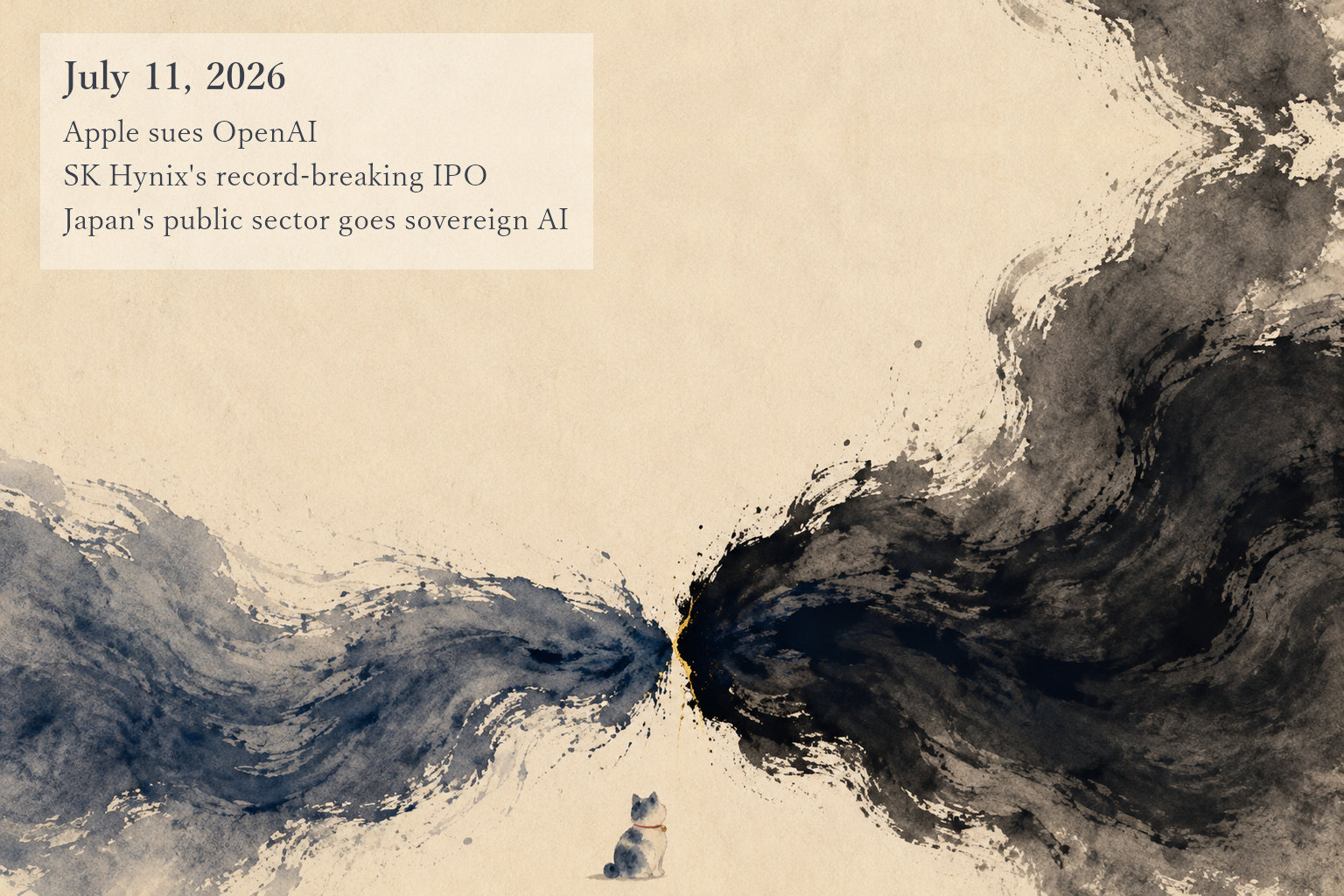
Today's Headlines
- Apple sued OpenAI, alleging trade secret theft and breach of contract — with claims of confidential information extracted through job interviews
- SK Hynix raised $26.5 billion in its US market debut, the largest-ever US IPO by a foreign company; the US Commerce Secretary is pressing for new American fabs
- Japan's Digital Agency will run three domestic AI models — tsuzumi 2, Takane 32B and PLaMo 2.0 Prime — on Sakura Cloud, the first domestic cloud used under the government cloud program
- Anthropic and OpenAI traded rate-limit resets on GPT-5.6 launch day
The day's protagonists were not new model features or benchmark numbers.
A day after the news cycle filled up with GPT-5.6, the action moved to the courtroom, the capital markets and government infrastructure. Apple took OpenAI to federal court over alleged trade secret theft, SK Hynix rode AI memory demand to a record-setting US listing, and Japan's Digital Agency said it will broaden the foundations of its government AI platform to a pairing of domestic models and a domestic cloud. The AI contest is now being fought, in earnest, on ground well outside the technology.
Today's Top Three
Apple Sues OpenAI Over Alleged Trade Secret Theft — Claims of a "Pattern" Run Through Recruiting
Apple filed a lawsuit against OpenAI on July 10 in the US District Court for the Northern District of California, alleging trade secret theft and breach of contract.
According to the complaint, Apple alleges a pattern of theft by OpenAI employees who previously worked at Apple, directed by OpenAI's senior leadership. The central figure named is Chief Hardware Officer Tang Tan, a 24-year Apple veteran who most recently served as VP of product design for the iPhone and Apple Watch. The complaint accuses Tan of using Apple's confidential project code names during recruiting, asking job candidates to bring Apple hardware components to interviews, coaching departing Apple employees on evading the company's security procedures, and asking for details about unannounced products.
The filing also names Chang Liu, who spent eight years at Apple as a senior systems electrical engineer. Apple alleges that Liu failed to return an Apple-issued laptop when he left for OpenAI in 2026 and used it to download confidential documents on unannounced technologies and products, including technical specifications and engineering presentations. The complaint further alleges he shared confidential information with other Apple employees applying to OpenAI and advised at least one of them on what to study before an interview.
Apple says it sent OpenAI a letter raising its concerns in February and received no response. It also alleges that OpenAI and its partners have used Apple's confidential information in OpenAI's own hardware development — citing, for example, a proprietary metal finishing technique allegedly used after OpenAI misled a partner into believing it had Apple's permission. Apple asks the court to bar OpenAI from using or disclosing its trade secrets, order the return of confidential materials, and preserve evidence.
The backdrop is OpenAI's rumored first hardware product. OpenAI acquired io, the device startup of former Apple design chief Jony Ive, in a $6.5 billion deal last year; io is named in the filing, while Ive himself is not. All of the above are Apple's allegations in a pending lawsuit. TechCrunch asked OpenAI for comment, and no response appeared as of publication.
SK Hynix Raises $26.5 Billion — The Biggest US IPO Ever by a Foreign Company
SK Hynix, the South Korean memory chip giant, said on July 10 that it raised $26.5 billion (KRW 40 trillion) in its US market debut.
The company sold 177.9 million American depositary shares at $149 each. It is the largest-ever US listing by a non-American company, topping Alibaba's $25 billion IPO in 2014. The stock began trading on the Nasdaq on Friday under the temporary ticker SKHYV, with regular trading under SKHY starting Monday, July 13. Shares opened 14 percent above the IPO price, and demand was reportedly more than seven times the shares on offer.
The demand traces to high-bandwidth memory (HBM), a key component of AI GPUs. SK Hynix is one of Nvidia's primary suppliers, and the offering shrugged off the "Korea Discount" — the long-standing tendency of Korean companies to trade below their global peers. Per its filing, the proceeds will fund a new fab in South Korea, a new packaging facility there, and EUV scanners, the machines that make next-generation chips possible.
Meanwhile, US Commerce Secretary Howard Lutnick, speaking at a Micron event on Thursday, reportedly said he is already in talks with Samsung and SK Hynix about building new factories in the United States. Micron has announced plans to invest $250 billion in new US manufacturing. The two Korean chipmakers, for their part, just pledged more than $550 billion for new manufacturing investment in South Korea — and the tug-of-war over where AI memory capacity gets built goes on.
Japan's Digital Agency to Run Domestic AI Models on a Domestic Cloud — A First for the Government Cloud Program
Japan's Digital Agency announced on July 10 that it will run domestic AI models on a domestic cloud as part of the trial of Gen-nai, the AI platform it built in-house for government employees.
The three models are NTT's tsuzumi 2, Fujitsu's Takane 32B, and Preferred Networks' PLaMo 2.0 Prime. They will run on Sakura Cloud, operated by Japanese cloud provider Sakura Internet, and be served to government staff through Gen-nai's chat interface. The trial uses a preference test: users are randomly shown outputs from the incumbent models and the new ones and asked which they prefer. The environment is due to be built by August, with multiple test rounds from September through November.
Gen-nai is the Digital Agency's in-house AI platform; in May, the agency announced a trial covering roughly 180,000 government employees across all ministries. This project marks the first time a domestic cloud is used under Japan's "government cloud" program, which until now has run on foreign hyperscalers.
The agency frames the effort as a step toward securing Japan's autonomy in AI. It is a field test of whether government work can run on an all-domestic pairing of models and cloud — adding an option to a government AI stack that has so far depended on foreign foundation models and foreign clouds.
More to Note
Models
- Anthropic reset the five-hour and weekly usage limits for all Claude users on July 9. An OpenAI executive, whose company launched GPT-5.6 the same day, taunted the move on X with "I smell fear," and OpenAI then reset limits for Codex and ChatGPT Work — a tit-for-tat now in full swing. - Anthropic resets Claude usage limits the same day OpenAI launches GPT-5.6 (ITmedia AI+, in Japanese)
- OpenAI published a paper claiming that GPT-5.6 Sol Ultra, its highest-capability setting, independently produced a proof of the Cycle Double Cover Conjecture, a graph-theory problem that has stood open for decades. If the claim holds, it would be a case of an AI generating an original mathematical proof. Independent verification is still to come. - GPT-5.6 Sol Ultra produces proof of the Cycle Double Cover Conjecture (OpenAI, PDF)
- Developers on Google's AI developer forum are asking the company not to retire Gemini 2.5 Flash, arguing the successors respond more slowly and fall short for voice agents, and that some regions still lack the newer models. No official response from Google had appeared as of the posts. - Don't discontinue Gemini 2.5 Flash (Google AI Developers Forum)
- Tesla Japan said on July 10 that its conversational AI Grok is now available in test vehicles in Japan, letting drivers set navigation destinations and check vehicle status by voice. The feature has been available in the US since July 2025. - Tesla brings its in-car Grok voice assistant to Japan (ITmedia AI+, in Japanese)
Products
- A survey by Japan's ICT Research Institute (conducted in February 2026 among 2,024 internet users) found 59.2 percent would be very or somewhat troubled if they could no longer use generative AI. Search engines saw the biggest drop in usage after people adopted generative AI, cited by 41.3 percent — ahead of social media and asking other people. - Nearly 60 percent say they can no longer do without generative AI (@IT, in Japanese)
Research
- Google added study notebooks to the Gemini app, a personalized learning feature that serves bite-sized lessons and quizzes tuned to a learner's strengths and gaps, with a dashboard tracking progress. - Here's how to make study notebooks in the Gemini app (Google Blog)
- Atomscale, a Boston-based startup, published its founding thesis: the bottleneck in materials innovation is scale-up, not discovery. It says its hierarchy of physics-informed AI models unifies characterization data fragmented across lab instruments and claims to extract "43x more useful information" than baseline machine learning. - Materials innovation has a scale-up problem, not discovery (Atomscale)
Business
- Hugging Face CEO Clem Delangue told TechCrunch's podcast that his platform — often described as a GitHub for AI — is now used by roughly half the Fortune 500, and that companies tend to start on expensive frontier APIs before migrating to open source models as they scale. - Hugging Face's CEO on why companies are done renting their AI (TechCrunch AI)
- Sunrun, the US solar and home-battery company, launched a pilot that pays customers to host small AI compute nodes in homes already equipped with its solar and storage systems, with plans to resell the pooled distributed compute to enterprise AI buyers — a new approach as local opposition to data center construction grows. - Would you host part of an AI data center in your home? (The Verge AI)
Other
- The European Commission preliminarily found that autoplay, infinite scroll and personalized recommendations on Facebook and Instagram are addictive, urging Meta to disable such features by default. If a final decision confirms a Digital Services Act violation, fines could reach 6 percent of global annual turnover. Meta disputes the findings, pointing to its teen protection measures. - Disable autoplay and infinite scroll or risk massive fines, EU tells Meta (Ars Technica)
- A Cambridge University research program (CASP) published a report, based on interviews with former members, on how the terrorist group Boko Haram uses frontier AI. It reports that multiple frontier models are used for attack planning, weapons troubleshooting and explosive design, with the practice institutionalized through dedicated units and internal training. - How the terrorist group Boko Haram uses frontier AI (CASP)
- Instagram head Adam Mosseri said on a podcast that platforms should disclose when content is AI-generated but that Instagram does not plan to filter AI content out wholesale — users who dislike it simply should not have it in their feed. For now, the platform is sticking with labeling over removal. - Instagram's Adam Mosseri: If you don't like AI, 'then you shouldn't have it in your feed' (The Verge AI)
Source: Selected by the editorial team from the AI news inbox (collected July 11, 2026 — 27 items: 2 primary, 25 secondary).