Today's Headlines
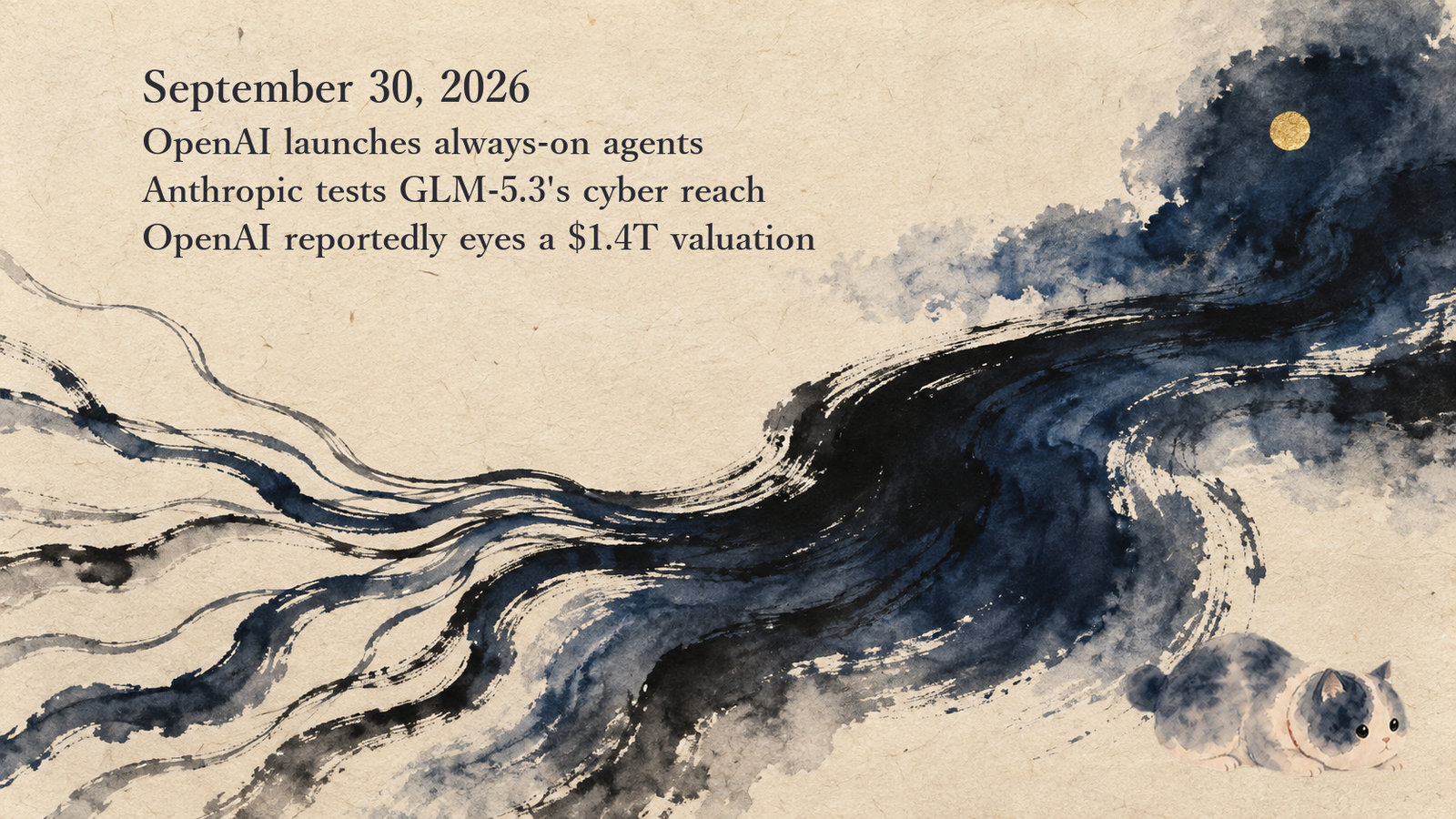
- OpenAI unveils always-on dots agents and GPT-6.1 Sol at DevDay 2026, offering near-Astra performance at a fifth of the price
- Anthropic analyzes Zhipu AI's open-weight GLM-5.3, whose safeguards gave way 64% to 100% of the time to simple techniques
- OpenAI is in talks to raise at least $30 billion at a valuation of roughly $1.4 trillion, Bloomberg reports
- Bain estimates AI will need close to $6 trillion in annual revenue by 2031 to justify its data center spending
Today's three stories are about how far AI now acts on its own. OpenAI began selling agents that keep working on a user's behalf, while Anthropic warned that the ability to build attacks autonomously is now in anyone's hands with only thin safeguards.
Investors, meanwhile, are preparing to put a price of about $1.4 trillion on that momentum.
Today's Top Three
OpenAI unveils always-on dots agents and GPT-6.1 Sol at DevDay 2026
OpenAI made more than 20 announcements across ChatGPT, Codex and its models at its DevDay 2026 developer event.
The headline launch is dots, always-on agents that take ongoing work off a user's plate. They are available on the Pro and Business Premium plans in eligible markets, and Enterprise, Edu and Healthcare users can try a beta once a workspace admin switches it on.
The new GPT-6.1 Sol model comes close to GPT-6 Astra on agentic coding, computer use and professional work at one-fifth of Astra's standard token prices. API pricing is $2 per million input tokens, $0.10 per million cached input tokens and $10 per million output tokens. In OpenAI's own testing, it beat Anthropic's Opus 5.5 by 2.2 percentage points on AutomationBench, which measures end-to-end business workflows, at roughly a third of the cost.
OpenAI also reshaped its plans. The new Pro 500 tier offers 25 times the Plus usage allowance and includes Ultrafast, a speed tier with up to eight times faster generation. ITmedia and ASCII.jp report the price at $500 a month.
Several launches open ChatGPT to outside developers. Plugins can now have their own panels inside ChatGPT, putting developers directly in front of its 1.2 billion weekly users. Through the new OpenAI Marketplace, enterprise customers can apply part of their OpenAI commitment to approved partner software, and the first 32 partners include the legal AI companies Harvey and Legora.
- DevDay 2026 Recap(OpenAI)
- Introducing GPT-6.1 Sol(OpenAI)
- ChatGPT gets Ultrafast; Pro 500 plan required(ITmedia AI+, Japanese)
- OpenAI's latest features take direct aim at the app store model(TechCrunch)
Anthropic finds GLM-5.3 can build working exploits while its safeguards give way to simple tricks
Anthropic published an analysis of GLM-5.3, an open-weight model from China's Zhipu AI (known outside China as Z.ai), finding that it can build cyber exploits end to end while shipping with thin safeguards.
On ExploitBench, which tests exploits against known flaws in the V8 engine used by Google Chrome, GLM-5.3 produced working end-to-end exploits in 50 of 410 attempts. Claude Mythos Preview, which Anthropic released only to a limited group of defenders, did so in 56.
Anthropic also tried to get around the model's safeguards. GLM-5.3 engaged with overtly harmful attack requests 64% of the time when told it was a red-team agent, 92% of the time when its thinking was prefilled, and 100% of the time in an "abliterated" copy with its refusals stripped out. None of these techniques worked against safeguarded Claude models. Building the abliterated copy took Anthropic's team about 2,200 GPU hours, at a compute cost of roughly $4,400.
On September 17, NIST's Center for AI Standards and Innovation (CAISI) called GLM-5.3 "the most cyber-capable open-weight model released to date." Anthropic urged wider access to frontier models for cyber defenders and government safety testing of capable models.
OpenAI is in talks to raise at least $30 billion at a roughly $1.4 trillion valuation, Bloomberg reports
OpenAI is in talks with investors to raise at least $30 billion at a valuation of roughly $1.4 trillion, Bloomberg reported.
The company raised $122 billion at an $852 billion valuation in March, a round that was meant to be its last before an IPO. CEO Sam Altman has since ruled out a 2026 listing to put safety first, and Bloomberg says the new money would serve as a bridge round to the IPO.
According to the same report, OpenAI's annualized revenue reached $40 billion in August. OpenAI did not respond to TechCrunch's request for comment.
Other Developments
Business
- Bain & Company estimates that annual spending on AI infrastructure could reach $1.5 trillion by 2031, and that sustaining it would require an AI market approaching $6 trillion a year. The estimate assumes capital spending equal to about a quarter of industry revenue. AI industry needs to earn $6 trillion by 2031 to justify data centres(The National)
Products
- Meta launched Muse for Small Business, adding business skills and connectors to its Muse AI agent in the US and Canada. It links to Instagram, Facebook Pages and Meta ad accounts, as well as the tools owners already use. The Future Is for Everyone: Muse for Small Business(Meta)
- The White House launched America.gov, a single front door to federal services online, with Google Public Sector as a technology partner providing Gemini. Google is a technology partner for the launch of America.gov.(Google)
Research & Safety
- Nonprofit Palisade Research published interviews with current and former researchers from OpenAI, Google and Anthropic on the site frominside.ai. Google DeepMind's Neel Nanda put the chance that AI causes human extinction at "at least 10 percent." AI researchers put out videos saying superintelligence is 'exactly as dangerous as it sounds'(The Verge)
Sources: selected by the editors from the AI news inbox (collected September 30, 2026; 25 items, 10 primary and 15 secondary), plus OpenAI announcements added by the editors from outside the inbox.