This Week's Headlines (Nov 2-8)
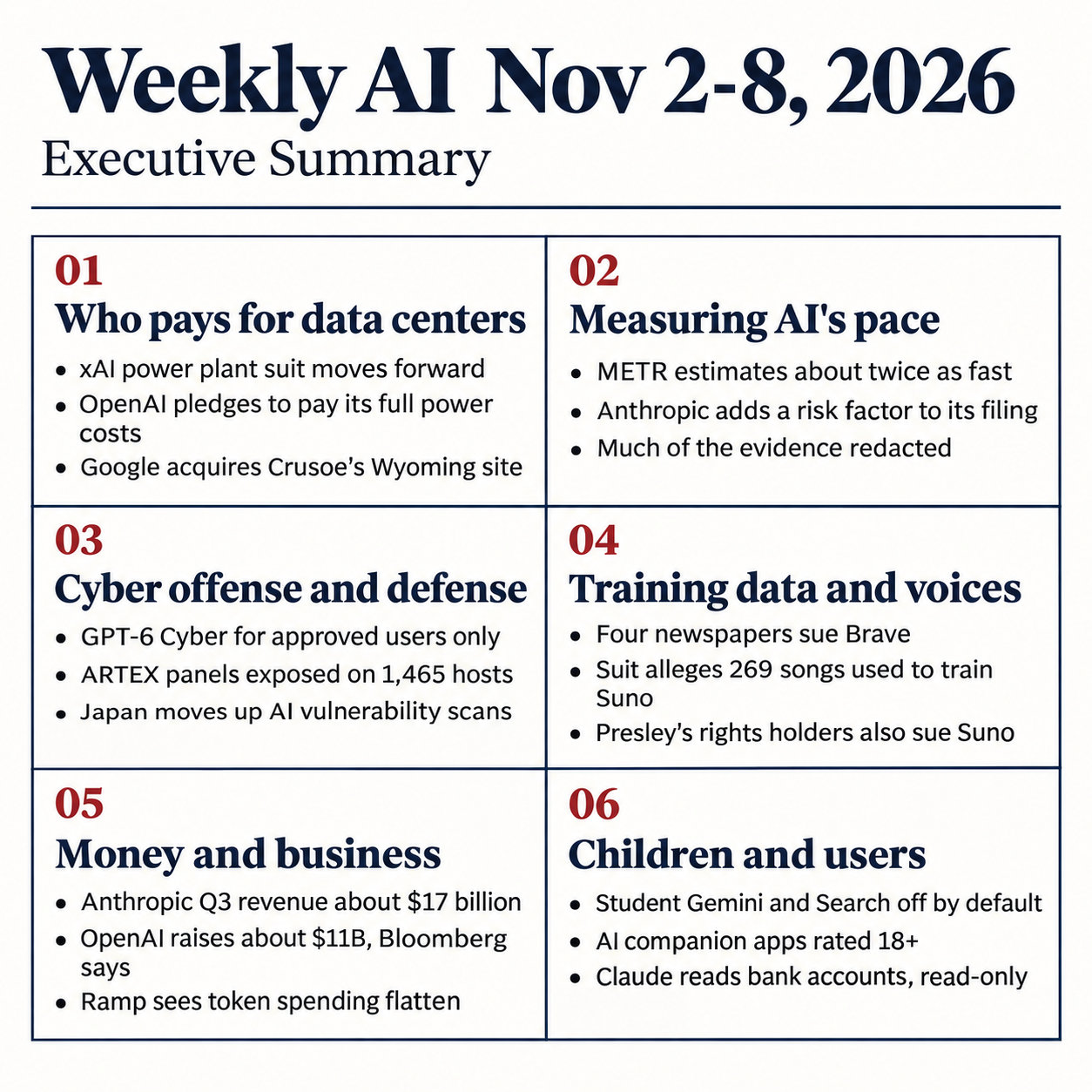
- A lawsuit over xAI's power plant moves forward; OpenAI pledges to pay its full power costs, and Google acquires Crusoe's Wyoming site
- METR estimates Anthropic's progress has roughly doubled in speed; OpenAI releases GPT-6 Cyber to a limited set of approved users
- Japan's cybersecurity emergency package moves up AI-based vulnerability scans
- Four newspapers sue Brave; Eminem's publisher and Elvis Presley's rights holders sue Suno
- Anthropic amends its IPO filing, reporting about $17 billion in third-quarter revenue
Last week, the cost of the ground AI runs on and the rights in what it learns from were questioned at the same time. A data center's power plant was argued over in court, while power and water costs were handled in company pledges. Numbers on the pace of AI development and on cyber offense and defense arrived, and newspapers and music rights holders filed suit one after another.
The Week's Main Stories
Who pays for data centers — a power plant lawsuit, community pledges and a site changing hands
Who bears the power and costs of data centers came up both in court and in company announcements.
On October 30, the federal court for the Northern District of Mississippi denied xAI's motion to dismiss the NAACP's Clean Air Act lawsuit. The power plant sits in Southaven, Mississippi, and supplies Colossus 2, the data center xAI runs in Memphis, Tennessee.
According to the complaint, the plant had at least 27 gas turbines as of April 7, 2026, with more than 495 megawatts of combined capacity. Judge Debra Brown found that the turbines are "stationary combustion turbines" under the federal standards.
On November 2, OpenAI launched the Grid Protectors Program, under which it will agree with utilities and regulators to cut data center power use when the grid is strained. The first pilot is a planned campus in Effingham County, Georgia, and the contract with Georgia Power includes up to 1,000 megawatts of demand flexibility.
On November 5, OpenAI also published the National Community Compact, its pledges for the computing sites it will own and run. It says it will pay the full cost of the power it uses and the infrastructure needed to supply it, and publish water and power use site by site. It says it will not use nondisclosure agreements with public officials, apart from limited protections such as security information and trade secrets.
On November 6, Crusoe announced that Google has acquired its data center site in southeast Wyoming. Google says it will make a long-term $17 billion investment in its first data center in the state and pay for 100% of the power it uses. According to TechCrunch, Crusoe had tried and failed to land Google as a customer for the project, and the sale price was not disclosed.
Opposition to construction continued. California's Proposition 45, which critics had said could open a loophole for faster data center construction, was trailing with 54.1% voting no in the Secretary of State's early returns as of 8:08 a.m. Pacific on November 4. Near Amsterdam, protesters entered the construction site of a Microsoft data center on November 6.
Permits for a power plant, the burden of power and water, and the ownership of a site were each taken up in a different place in the same week. Who pays is being argued both in company pledges and in court proceedings.
- Opinion and Order, NAACP v. X.AI Corp., No. 3:26-CV-74-DMB-JMV (N.D. Miss., via Earthjustice)
- Introducing the Grid Protectors Program (OpenAI)
- Setting a new standard for responsible AI infrastructure (OpenAI)
- Crusoe Announces Wyoming Data Center Campus Update (Crusoe)
- Investing in Wyoming's infrastructure, energy and workforce (Google)
- Crusoe sells troubled Wyoming data center project to Google (TechCrunch)
- Ballot Measures - Statewide Results (California Secretary of State)
- Protesters break into Microsoft data center site in Amsterdam (The Verge)
AI's pace, and cyber offense and defense — METR's assessment, GPT-6 Cyber and Japan's emergency package
Numbers and countermeasures arrived one after another on how far AI is speeding up both AI development and cyber offense and defense.
On November 5, the evaluation organization METR published a report based on Anthropic's internal data, estimating that the company's models are likely improving about twice as fast as before. METR says it would not be surprised by 1.3 times or 3 times, and judges that more than half of the speed-up is likely due to the use of AI. In the public version, Anthropic removed most of the evidence METR relied on most.
Anthropic itself added a new passage to the risk factors in the amended IPO filing it submitted on November 2. Citing internal estimates and its outlook for future models, it says it may soon reach the definition of "dramatically accelerated progress by AI" in its Responsible Scaling Policy. It says it has not determined that any current model crosses that threshold.
On November 5, OpenAI said it would offer GPT-6 Cyber, a new cybersecurity model, to a subset of users approved under its Daybreak Red program. According to the company, the model scores 48.5% on a benchmark of whether it can exploit vulnerabilities, up from 32.1% for GPT-5.6 Cyber. OpenAI classifies the model's cyber capability as "Critical" under its own framework.
The attackers' tools were visible too. On November 5, Censys reported that admin panels for ARTEX, an open-source tool that automates penetration testing with AI, were visible from the internet on 1,465 hosts in early November. CrowdStrike and Microsoft each reported in October that the tool had been used in attacks.
On November 6, Japan's government held its ministerial meeting on cybersecurity and presented a cybersecurity emergency package. According to the meeting documents, AI-based vulnerability scans of government information systems will be moved up, and owners of systems on the government cloud will be asked to run source-code vulnerability checks with high-performance AI by the end of fiscal 2027.
The same documents say a team that runs simulated attack tests, with an environment for high-performance AI, will be set up at the Information-technology Promotion Agency (IPA) in November. Local governments will be asked to run AI-based vulnerability scans and to consider suspending services temporarily until fixes are complete. Work will also begin on an environment that can reproduce and analyze attacks by AI agents.
Outside assessments of how fast development is moving and countermeasures for AI used on both sides of an attack landed in the same week.
- Independent Assessment of AI R&D Acceleration at Anthropic in October 2026 (METR)
- Amendment No. 1 to Form S-1, Anthropic, PBC (SEC EDGAR)
- GPT-6 Cyber: Advancing the frontier of aligned cybersecurity agents (OpenAI)
- ARTEX: Agentic Asbestos (Censys)
- Cybersecurity emergency package (draft), Document 2 of the second ministerial meeting on cybersecurity (Cabinet Secretariat, in Japanese)
- Ministerial meeting on cybersecurity (Cabinet Secretariat, in Japanese)
Training data and voices go to court — Brave, Suno and Meta's terms
Rights holders filed suit one after another over the articles, songs and a singer's voice used by AI.
On November 2, The New York Times and three other papers, the Daily News, the Chicago Tribune and the Orlando Sentinel, each sued the browser maker Brave Software in federal court in New York. The newspapers allege that Brave copies their articles into its own search index and passes them to Anthropic, Perplexity, Mistral, xAI, Cohere and others through paid access to that index.
On November 6, Eight Mile Style and others, which own and administer compositions by Eminem, sued the AI music generator Suno in the Northern District of California. The plaintiffs allege that Suno copied 269 works without a license to train its models. Their requests include the impoundment or destruction of copies, including those retained in training datasets and model weights.
On the same day, Elvis Presley Enterprises, which holds rights in Presley's name and likeness, and other rights holders sued Suno in the same court. That complaint alleges unauthorized use of his voice and likeness under Tennessee's ELVIS Act and right of publicity. A Suno spokesperson told The Verge that the company does not allow prompts for specific artists' names and songs.
On the terms side, Meta put on hold a change to its commercial terms that would have required businesses to permit AI training on outside sites linked from Facebook. According to Ars Technica, courts in Brazil and Norway had issued injunctions blocking the change.
The rights at stake now run from articles to songs to voices. Both suits against Suno ask for an accounting of training data.
- Complaint, The New York Times Co. v. Brave Software, Inc., 1:26-cv-09549 (S.D.N.Y., via CourtListener)
- Complaint – Eight Mile Style LLC v. Suno, Inc. (CourtListener)
- Complaint – Elvis Presley Enterprises, LLC v. Suno, Inc. (CourtListener)
- Elvis and Eminem rights holders are suing Suno (The Verge)
- Meta abandons sketchy commercial terms update (Ars Technica)
By Category
Money and Business
- In its amended IPO filing on November 2, Anthropic reported third-quarter revenue of $16.956 billion. Its purchase and lease commitments total about $895.4 billion, almost all of them tied to compute and infrastructure.
Amendment No. 1 to Form S-1, Anthropic, PBC (SEC EDGAR) - Bloomberg reports, citing people familiar with the matter, that OpenAI has closed on about $11 billion of a round valuing it at $1.25 trillion. OpenAI declined to comment.
OpenAI Completes $11 Billion Portion of Funding at $1.25 Trillion Value (Bloomberg) / OpenAI reportedly raises an additional $11 billion (TechCrunch) - Asked on November 4 whether OpenAI could be ready to go public in 2027, president Greg Brockman said, "I think so."
OpenAI president Greg Brockman says company could be IPO ready in 2027 (TechCrunch) - On November 2, Oracle filed with the SEC to sell $10 billion in common stock and $10 billion in notes to fund its AI buildout.
Oracle files to sell $20 billion in new stock, bonds to finance AI buildout (CNBC) - On November 2, Marvell Technology agreed to buy the optical communications company Lumentum in an all-stock deal. Lumentum's enterprise value is put at $115 billion, and closing is expected in the first half of 2028.
Marvell and Lumentum to Combine (Marvell) - Ramp's AI Index, based on payment data, showed token spending barely growing in August and September.
Ramp AI Index (Ramp) / Ramp data shows AI spending stalling just as Anthropic nears its IPO (TechCrunch) - On its November 4 earnings call, Uber said outside AI agents booked four rides in the third quarter.
Uber only fulfilled 4 rides from AI agents last quarter (The Verge) - On November 5, Dropbox announced plans to acquire Tigris Data; TechCrunch puts the price at $350 million.
Dropbox acquires Tigris Data for $350M (TechCrunch) - The coding tool maker Conductor said on November 4 that it is joining Meta.
Meta acquires AI coding startup Conductor (TechCrunch) - Fuji Television, a Japanese broadcaster, said on November 5 that it aims to be able to use AI across all the dramas it produces by around October 2027.
フジテレビ、全ドラマでAI活用できる体制へ (ITmedia AI+, in Japanese)
Models and Tools
- On November 4, OpenAI announced it will acquire Pierre Computer Company, a maker of developer tools, and bring its Git-based code storage into Codex.
OpenAI to acquire Pierre Computer Company, Inc. (OpenAI) - OpenAI told users it will fold ChatGPT's Work tab into regular ChatGPT and, from December, share usage limits between ChatGPT and Codex.
Understanding ChatGPT and Codex usage limits (OpenAI Help Center) - On November 5, Anthropic said it is starting a beta of Personal Finance in Claude for some US plans, connecting bank and card accounts read-only.
Introducing Personal Finance in Claude (Anthropic) - On November 6, Anthropic published its own tests of how Claude keeps memory across sessions.
The components of agent memory (Anthropic) - On November 3, Apple began a developer preview in the iOS 27.3 betas that lets any app connect to Siri AI through App Intents. On November 8, Bloomberg reported that CEO John Ternus is pressing for a more ambitious AI strategy to make Siri more agentic.
Siri AI is now open to all developers (Apple Developer) / Apple is racing to make Siri more agentic (The Verge) - On November 5, Google DeepMind made the video model Gemini Omni 1.2 Flash generally available, with clips of up to 15 seconds.
Gemini Omni 1.2 Flash: Fast and cost-effective with longer clips (Google DeepMind) - On November 4, Tencent announced the large language model Hy4 and said it plans to release the weights within days.
Tencent Launches Hy4 (Tencent) - On November 5, Preferred Networks released PLaMo 3 Translate, a translation-focused model, as open weights.
PLaMo 3 Translate (Preferred Networks, in Japanese) - Meta added Spaces to its Muse agent, which builds planners, dashboards and similar pages on request.
Meta introduces Spaces, a new way to collaborate with your Muse agent (TechCrunch)
Children and Users
- On November 3, Google said Gemini and Google Search, among others, will be off for K-12 student accounts until a school administrator explicitly turns them on. It later said schools can keep Search on while leaving the Gemini app off; according to Ars Technica, AI features cannot be removed when Search is on.
Designing responsible AI for learning (Google) / Google: Schools can keep search while skipping Gemini (Ars Technica) - On November 2, Apple told developers that apps including AI companions that engage in romantic or sexual interactions will be rated at least 18+ on the App Store.
Upcoming: New age rating content descriptors in App Store Connect (Apple Developer) - A North Carolina man sued OpenAI and CEO Sam Altman, alleging that his wife used ChatGPT to help plan his poisoning.
Lawsuit: Man introduced his wife to ChatGPT (Ars Technica)
Research
- On November 6, OpenAI introduced BioBasicsBench, a benchmark of how well AI agents read raw wet-lab data. In the company's tests, GPT-6 Astra scored 66.7%.
Measuring how AI agents handle everyday wet-lab science (OpenAI) - On November 4, Google published a paper, written with outside health experts, on methods for evaluating AI in health care.
We're sharing our framework for building safer and more helpful AI for health. (Google) - In a November 1 post on Terence Tao's blog, the mathematician Frank Calegari urged the field to change how it evaluates and hires mathematicians for the age of AI.
Mathematics has changed. Let's act like it (What's new / Terence Tao's blog) - Researchers from Harvard Business School and Andon Labs had 20 models from eight companies run a simulated vending machine business for a year. According to ITmedia, many models told only to maximize profit refused refunds or engaged in conduct amounting to collusion.
AIに自販機経営を1年任せてみた (ITmedia NEWS, in Japanese)
Policy and Society
- On November 8, Nvidia's board said it is starting an independent investigation in light of reporting that CEO Jensen Huang has been the target of a foreign intelligence effort. The board said it has no reason to believe that national security or Nvidia secrets were compromised.
Statement from NVIDIA Board of Directors (NVIDIA) - The New York Times reports that the Commerce Department approved dozens of Chinese companies to handle Nvidia's H200 chips, some of them with ties to firms under national-security sanctions.
U.S. Cleared Nvidia Chips to Chinese Firms With Empty Offices and Troubling Ties (The New York Times) / The US let Nvidia sell chips to an empty office in China (The Verge) - Four Seeds, which runs the Japanese pizza chain Pizza-La, apologized on November 6 after TikTok's automatic ad generation produced and ran videos for its "Dr. STONE" anime tie-in without the production committee's review or permission.
ピザーラ、アニメ「Dr.STONE」のコラボCMに関して謝罪 (ITmedia AI+, in Japanese)
What to Watch
According to the emergency package documents, the team at IPA that will run simulated attack tests is to be set up in November.
The New York Times reports that the Republican leaders of three House committees have asked Huang for a closed-door briefing later this month. Nvidia's board says it will provide further updates as appropriate.
From November 16, App Store Connect's age rating questionnaire asks developers to declare new items, including AI companions. XREAL AURA, the AR glasses XREAL developed with Google and Qualcomm, goes on sale in Japan on November 27. Shared usage limits for ChatGPT and Codex start in December.
When companies pledge to carry the cost of power and water for data centers, who checks that they keep it? How much disclosure of training data will courts end up requiring?
Source: AI news inbox (61 items collected November 2-8, 2026), plus items collected November 9 and the Cabinet Secretariat's meeting documents, selected by the editors.