Today's Headlines
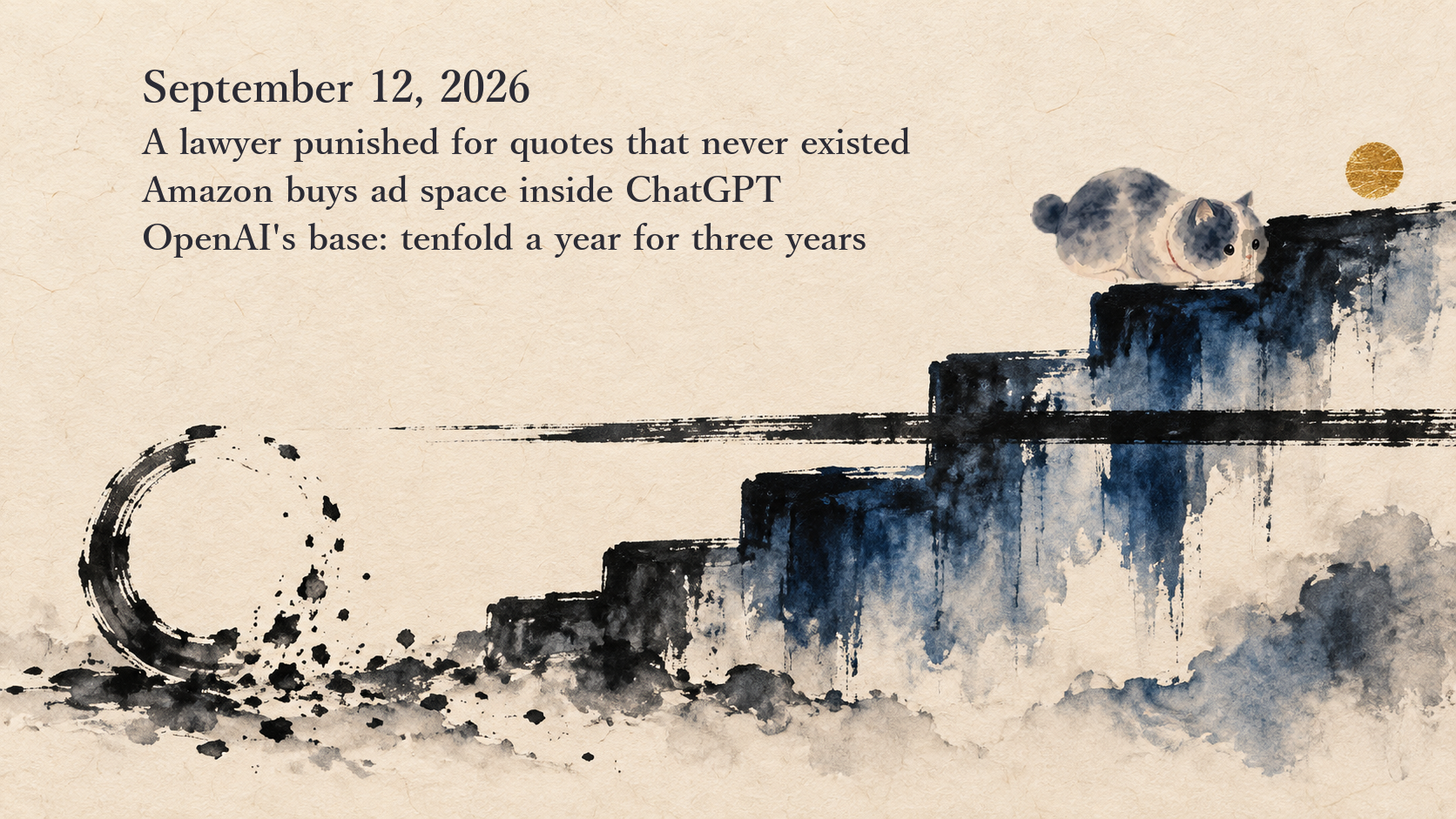
- The New Mexico Supreme Court holds a lawyer in direct contempt for quoting ChatGPT-fabricated testimony in a brief, fines him $5,000, and bars him from appearing before the court
- Amazon Ads partners with OpenAI so that Amazon DSP advertisers can buy conversational placements inside ChatGPT, starting as a US pilot
- OpenAI publishes an engineering account of Habitat, the internal storage platform handling more than 70 million requests per second
- Anthropic's September threat intelligence report: blocked attempts to use Claude for bioweapons-adjacent research, and five distillation campaigns traced to China-based labs
- Sakana AI says its new Fugu Ultra v2 beats GPT-6 Astra and Claude Fable 5.1 on the DeepSWE coding benchmark
What the New Mexico Supreme Court imposed was direct contempt against the lawyer personally. He had ChatGPT summarize the trial record, signed the resulting brief without checking it, and filed it — and that sequence produced a $5,000 sanction and a bar on appearing before the court.
The other two stories are about what the conversation window is now used for. Amazon is selling placements inside ChatGPT conversations to its own advertisers, and OpenAI has published the design of the system that absorbs a billion people's reads and writes every week.
Today's Top Three
The New Mexico Supreme Court holds a lawyer in direct contempt over ChatGPT-fabricated testimony
The New Mexico Supreme Court found attorney Stephen Aarons in direct contempt of court for quoting fabricated witness testimony, generated by ChatGPT, in a brief he filed.
The brief carried testimony from witnesses who never existed. The order names Officer Michelle Amarillo, Officer Sanchez, Manal Al-Jibury and Teresa Marquez as "wholly fabricated witnesses" and finds that their testimony appeared in the brief in chief.
Testimony attributed to real people was false as well. The order identifies false testimony from Danny Stanton about threats he received, false testimony from Linda Stanton about the threats her husband received, and false testimony from Mariah Chavez and Teresa Marquez about the shooter's clothing and appearance.
The case law he cited was real. What the order found was that he misrepresented the holdings of State v. Lopez, 2005-NMSC-018, and State v. Manus, 1979-NMSC-035. At the August 21 hearing, Justice C. Shannon Bacon told Aarons there is no "material distinction" between describing a real case inaccurately and citing a fake one, because the duty of candor to the court applies "with equal force" either way.
Aarons described at the hearing how it happened. He fed a machine-generated transcript of the murder trial into ChatGPT, along with the record proper, the statement of issues and part of the discovery, and the tool returned quotations that were never spoken. He used a version of ChatGPT running OpenAI's o3 model and said he assumed it had produced a bulletproof summary of the proceedings.
The order sets out two admissions. First, he did not verify the factual claims or the legal authority in the brief before signing and filing it. Second, he kept that failure from his client, along with the fact that the brief contained multiple factual and legal misrepresentations — and he never told his client about the show-cause proceedings or handed over copies of the pleadings.
Having considered his written response and oral argument, the court concluded that Aarons "demonstrated a lack of remorse and a lack of concern for his client." For authority, the order cites the superintending control granted by Article VI, Section 3 of the New Mexico Constitution, Rule 12-318 NMRA on briefing requirements, and Rule 12-312(D) NMRA on sanctions for failing to meet them.
The fine is $5,000. He must pay it to the State Bar of New Mexico Client Protection Fund within thirty days of the order and notify the court in writing once payment is made.
His appearances stop as well. Aarons is barred from appearing before the court pending the outcome of any Disciplinary Board investigation and proceedings, and the matter is referred to that board, with the court reserving further determinations once the board is done.
The underlying case resets. All briefing filed in the matter is stricken, the Law Office of the Public Defender is appointed to represent the defendant-appellant, and a new briefing order will issue once new counsel enters an appearance, with the appeal expected to be heard in the court's 2026-2027 term.
At the hearing, the justices set the choice of tool aside. Justice Michael Vigil said there is nothing wrong with using AI to help write a legal argument as long as the lawyer verifies it, adding that it makes no difference whether the help came from a C-student lawyer or an A-student lawyer if the work went out unchecked. Bacon made the same point from the other side: signing a brief that a first-year associate had simply made up would leave him in "the same exact soup."
The client took up a large share of the hearing. Bacon told Aarons that what was missing from his response was any account of what this had done to his client, and Chief Justice Julie Vargas said her concern was the criminal defendant who stays in custody until the matter is resolved.
Aarons asked the court to issue a standing order requiring every brief to carry a certificate of compliance about AI use. The justices treated the suggestion as a distraction and returned to the point that he failed to check the accuracy of what he signed.
Aarons has practiced criminal defense in New Mexico for more than forty years and was hired by the defendant's relatives to appeal a murder conviction. He filed the brief in August 2025. In a statement to Ars Technica he said he had not known at the time that AI could hallucinate facts, and that he hopes the Disciplinary Board treats it as an honest mistake.
Five justices signed the order per curiam. The court disposed of the matter by nonprecedential order under Rule 12-405(B) NMRA instead of a formal opinion, and the decision stays out of the New Mexico Appellate Reports.
- ChatGPT-using lawyer punished for citing fake testimony from made-up witnesses (Ars Technica)
- Dispositional Order of Direct Contempt, No. S-1-SC-40845 (Supreme Court of New Mexico, PDF)
Amazon partners with OpenAI to sell conversational ad placements inside ChatGPT
Amazon Ads announced a partnership with OpenAI that lets advertisers buy placements shown inside ChatGPT conversations through Amazon's demand-side platform.
The rollout covers a set of US advertisers. It runs as a pilot for now, and while ChatGPT Ads itself is already available in markets including Japan, the Amazon integration stays inside the US program.
The inventory being sold belongs to OpenAI. The deal makes OpenAI's ChatGPT Ads placements purchasable as a managed service through Amazon DSP, with Amazon's team helping set up and optimize campaigns, on both a CPC and a CPM basis.
OpenAI keeps control of delivery. Its own ad system decides where and how an ad appears inside ChatGPT, while Amazon supplies the buying and campaign-management layer.
Targeting draws on Amazon's first-party data. Amazon Ads representatives also supply "context hints" to align ads with suitable topics, conversations and keywords, and reporting comes back as impressions, clicks, cost per result, CPM and CPC.
Ads appear for Free and Go plan users. OpenAI began testing with logged-in US adults in February, and paid plans from Plus upward remain ad-free. The company says ads always carry a label that separates them from the answer, that conversation content stays away from advertisers, and that it sells no customer data.
The context is an advertising business growing fast. OpenAI's ad revenue has reached roughly $1 billion on an annualized basis, ChatGPT had 900 million weekly active users as of February, and the ad program now works with more than fifty ad-tech companies, Amazon among them as of this week.
Amazon has kept a tight lock on its own retail site, restricting access from outside AI platforms including ChatGPT, Claude and Gemini. On the advertising side, it is walking its advertisers onto the same screen.
- Amazon Ads and OpenAI partner to bring advertising to ChatGPT (Amazon Ads)
- Amazon partners with OpenAI on advertising inside ChatGPT (ITmedia NEWS, in Japanese)
OpenAI publishes the design of Habitat the storage platform behind a billion weekly users
OpenAI published an engineering account of Habitat, the internal storage platform that handles reads and writes for every one of its products.
Three numbers frame the scale. Habitat serves more than 70 million requests every second, supports products used by more than 1 billion people each week, and holds more than 500 petabytes of data, across almost 40 geographic regions.
It began as a small library. Habitat started in mid-2024 as a Python client-side library talking to a single database from ChatGPT's main server, built so that product engineers could skip schema lookup, routing, authorization, encryption and connection pooling.
Growth ran above 10x year over year for three straight years. Engineers usually build for a 10x jump and hope it holds for a few years while preparing the next one, OpenAI writes; here the next 10x arrived annually.
By mid-2025 the client-side design had reached its limit. A single change to the library required coordination across dozens of services — days for the feature flag, days more for shadowing, days again for a bug fix — and when one team rolled its service back to an older client for unrelated reasons, the outage the work was meant to prevent happened anyway. Habitat was pulled out into its own service.
The design decision at the center is a deliberately small API. Instead of letting clients write arbitrary SQL, Habitat exposes a simple NoSQL API, which OpenAI calls an explicit tradeoff to keep request cost predictable and constant. Clients that need complex querying get an offline secondary view streamed out through change data capture into Rockset.
The service moved from Python to Rust. In Q2 2026, two engineers working with Codex and GPT-5.5 rewrote the whole thing; the Rust version now serves 95 percent of production requests, runs 6x more CPU-efficient and 15x more memory-efficient than the Python one, and cuts both average and tail latency. Python goes away in the coming weeks.
Python's ceiling is on the record too. At its peak it served more than 20 million requests every second.
This is part one of two. Part two will cover the storage layer and the Azure Cosmos DB partnership, multi-tenancy reliability, and the layered approach to read performance.
Other Developments
Models and APIs
- China's Zhipu (Z.ai) published open weights for GLM-OCR, an optical character recognition model, on Hugging Face, continuing a steady run of open-weight document-processing releases from Chinese labs. GLM-OCR (Hugging Face)
- Sakana AI says its new Fugu Ultra v2 outperforms GPT-6 Astra, Claude Fable 5.1 and Claude Fable 5 on the DeepSWE coding benchmark, in the company's own announcement. Sakana withheld the scores, and all three models it claims to beat sit outside Fugu's partner integrations. The lower-tier Fugu Max added NVIDIA's Nemotron open-weight models as a partner. Sakana AI claims its latest Fugu beats GPT-6 Astra and Fable 5.1 on some benchmarks (ITmedia AI+, in Japanese)
Products
- OpenAI paused new sign-ups for its $200-a-month Pro plan on September 10, citing demand for its newest model, Astra. Product lead Thibault Sottiaux said Pro puts the heaviest load on the system and called the pause a minimal step to keep access broad. Existing Pro subscribers keep their plan, and the API, Go and Plus remain open. OpenAI puts Pro subscriptions on hold due to Astra demand (TechCrunch)
- Meta says it is changing the suggested prompts its AI chatbot surfaces, after a video spread showing Meta AI asking who the children in a user's car video were, then following up with questions about the daughters' ages and where they live. A spokesperson said the feature missed the mark. Meta AI is built into Facebook, Instagram, WhatsApp and Messenger. Meta says it's changing AI suggestions after posing invasive personal questions (The Verge)
Research
- RTK, a tool marketed as cutting AI coding costs by compressing terminal output, produced the opposite result in benchmarks by Quesma. Across 1,740 trials on Terminal-Bench 2.1, Claude Code cost 1 percent more with a 1 percent lower pass rate, and OpenCode with DeepSeek cost 17 percent more with a 2 percent lower pass rate. Quesma found that the compression triggers extra turns that erase the savings, and that terminal output accounts for only 7 to 40 percent of total input. RTK reports token savings, but our cost benchmarks disagree (Quesma)
- A survey of 1,104 Japanese adults in their twenties through fifties, run by a research unit under Change Holdings, found that 59.1 percent of respondents in their twenties would accept AI making a final decision, against 12.1 percent of those in their fifties. How far should AI decide? (@IT, in Japanese)
Policy and Regulation
- Anthropic disclosed that it blocked several attempts this year to use Claude for research that could feed bioweapons development, including users in countries barred from access such as Russia, China and Iran. The source is Anthropic's September threat intelligence report; yesterday's story on four unauthorized-access incidents came from a separate document, the company's alignment assessment of recent cybersecurity incidents. In one case a user spent weeks planning bird flu experiments, and safety filters confined the work to Anthropic's least capable model. The company stops short of attributing intent to harm. Claude users found ways around safeguards for bioweapons research (Ars Technica)
- In the same threat intelligence report, Anthropic detailed distillation campaigns it attributes to China-based AI labs: roughly 200 million exchanges observed and traced to five distinct campaigns, aimed at Claude's agentic and tool-use abilities, coding and data analysis, and reasoning. Separately, the company says Moonshot forwarded about 300,000 requests from Kimi to Claude Opus and collected more than 23 million responses for training. Anthropic details distillation campaigns from Alibaba, Moonshot AI, and DeepSeek (TechCrunch)
- Mathematician Andreas Thom accused OpenAI of dishonest conduct over where its training data came from. OpenAI acknowledged that a widely publicized result on non-sofic groups leaned heavily on prior work by Thom and a colleague and quietly revised its write-up, but when he asked whether his own ChatGPT conversations had entered the training data, the answer addressed only direct access to those conversations. New York University's Tristan Buckmaster raised a similar question first. Mathematicians want proof OpenAI didn't use their work (The Verge)
Business
- China's Moonshot AI is reportedly targeting $2 billion in annualized revenue by year end, roughly double its August run rate. Its open-weight K3 model generates as much as 300 billion tokens a day through OpenRouter. Kimi-maker Moonshot AI targets $2B in annual revenue (TechCrunch)
- UK AI data center company Nscale appointed former OpenAI executive Fidji Simo to its board. Simo led OpenAI's AGI division, left in July for health reasons, and still advises part-time; the board already includes Sheryl Sandberg, Susan Decker and Nick Clegg, and the company is eyeing an IPO this fall. Our September 6 edition reported that Nscale was in talks for $3.5 billion in pre-IPO financing. Nscale adds former OpenAI exec Fidji Simo to its board ahead of potential IPO (TechCrunch)
- NVIDIA CEO Jensen Huang restated a 70 percent revenue growth outlook for next year at a Goldman Sachs conference, repeating guidance from last month's earnings call. Analysts put this year's revenue near $400 billion, which TechCrunch calculates would mean roughly $680 billion next year. Orders for systems pairing 36 Grace CPUs with 72 Blackwell GPUs are growing 27 percent month over month, and Huang described a current GPU as an $8.5 million machine built from 2 million parts. Jensen Huang explains why Nvidia will grow an astounding 70% next year (TechCrunch)
- NEC ran one-on-one check-ins and stress surveys for the AI workers in the all-AI department it announced on September 1, surfacing stress from thin support and unclear task context. The structure has four tiers — AI governance, an AI dashboard, AI managers and AI workers — and NEC plans to take the model global through its BluStellar platform. NEC's all-AI department (ITmedia Business Online, in Japanese)
- At the J-HRTI Kanto Data Factory in Narashino, Chiba, a five-company consortium including Tsumura and Yamazen produces training data for physical AI. Operators pilot AgiBot humanoid robots with VR headsets and controllers, and footage from three cameras on the head and both wrists is annotated with English labels. The facility runs 35 robots, with plans to expand to ten sites nationwide in fiscal 2027 and to offer industry-specific models in fiscal 2028. Inside a data collection factory for physical AI (ITmedia AI+, in Japanese)
Source: selected by the editors from the AI news inbox (collected September 12, 2026 — 19 items, 3 primary and 16 secondary).