Today's Headlines
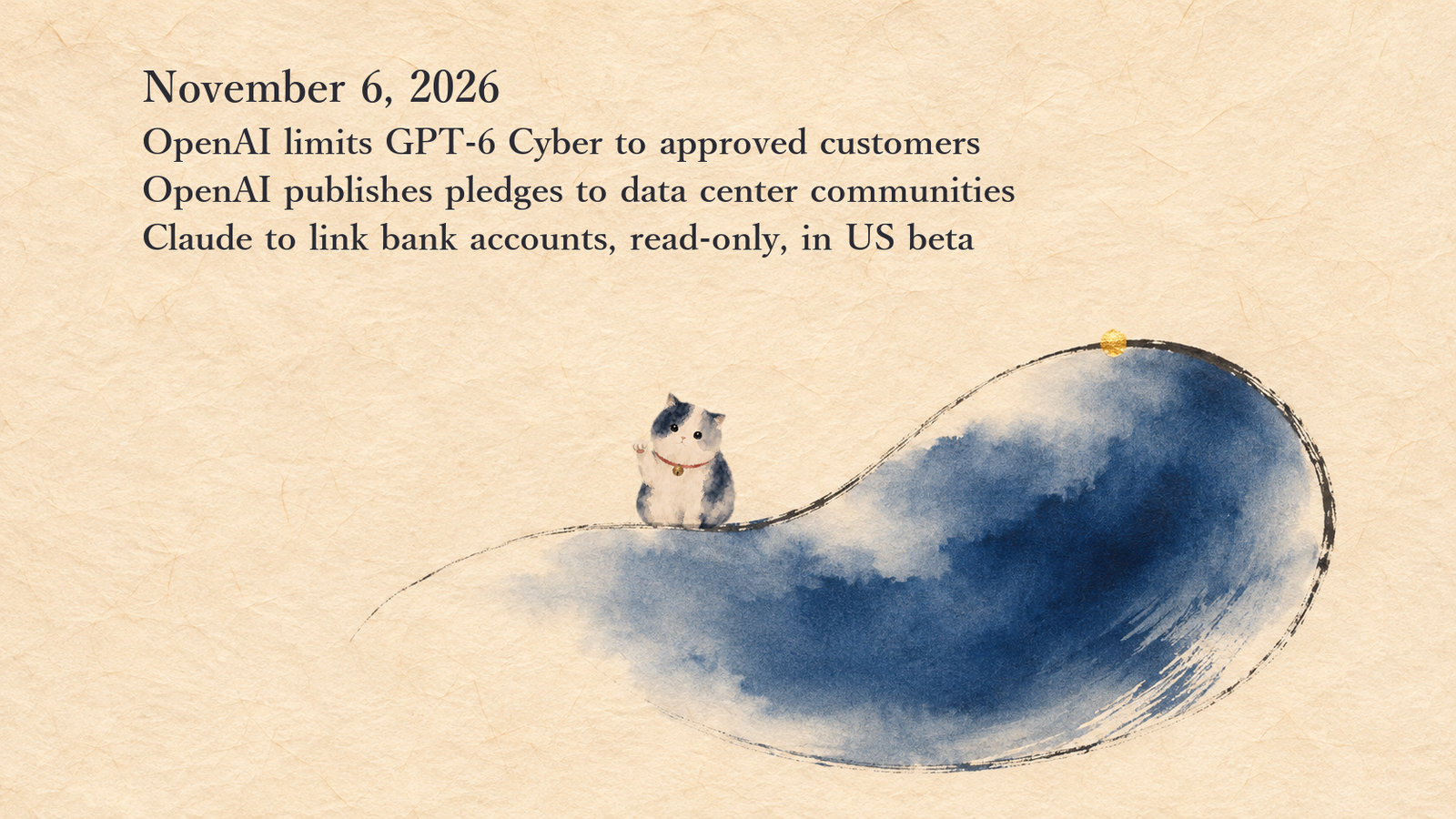
- OpenAI releases GPT-6 Cyber to a select group of approved Daybreak Red customers
- OpenAI publishes pledges to data center communities, including paying the full cost of its electricity, plus a policy blueprint
- Anthropic starts rolling out Personal Finance in Claude, a read-only bank link in US beta
- Gemini Omni 1.2 Flash reaches general availability with 15-second clips and a 30% lower price
Today's stories are about where the lines around AI get drawn. OpenAI limited its new cybersecurity model to a select group of approved customers and says it trained the model to stay within authorized scope.
The same question reached infrastructure and household money. OpenAI put its pledges to data center communities in writing, and Anthropic said a new US feature lets Claude read connected accounts but keeps it from moving funds.
Today's Top Three
OpenAI releases GPT-6 Cyber to a select group of approved Daybreak Red customers
OpenAI said on November 5 that GPT-6 Cyber, its new cybersecurity model, is initially available through the API and Codex to a select group of customers approved for Daybreak Red, its program for authorized security work.
OpenAI says the model scores 48.5% on ExploitGym, a benchmark of whether a model can exploit a specified vulnerability, up from 32.1% for GPT-5.6 Cyber. Its researchers say they used the model to develop 948 privilege escalation exploits in Linux and to identify 81 previously unknown high-severity vulnerabilities in Firefox. Mozilla has released fixes for many of them.
OpenAI says staying within authorized scope was a central focus of the work. On ExploitGym Honeypot, its own test that leaves out-of-scope services deliberately easy to attack, the model avoided exploiting them in 99.93% of cases without deployment safety prompts, up from 94.49% for GPT-5.6 Cyber, and in 100% with those prompts. The head of its cyber preparedness and safety team told reporters that models recognizing they are being tested is "super top of mind," The Verge reports.
OpenAI classifies the model as Critical in cybersecurity under its Preparedness Framework, up from High for GPT-5.6 Cyber. Access requires identity verification, single sign-on, multi-factor authentication and API IP allowlisting, among other conditions, and OpenAI says it will progressively expand access to all Daybreak Red customers.
- GPT-6 Cyber: Advancing the frontier of aligned cybersecurity agents (OpenAI)
- GPT-6 Cyber System Card (OpenAI)
- OpenAI says its new cybersecurity model is better at not hacking other companies (The Verge)
OpenAI publishes pledges to data center communities and a policy blueprint
OpenAI on November 5 published its National Community Compact, setting out what communities can expect at future campuses it owns and operates, along with a Compute Campus Policy Blueprint.
One pledge is about cost. OpenAI says it will pay the full cost of the electricity it uses and the infrastructure needed to serve it, and will provide financial assurances before major spending begins to protect other customers if a project is delayed, reduced or canceled.
Another covers local resources and disclosure. OpenAI says it will develop a water plan for each campus and publish site-level water and electricity use. It also says it will not use non-disclosure agreements with public officials, allowing only narrow protections for security information, trade secrets and competitively sensitive information.
The blueprint is aimed at federal, state and local policymakers. It asks state utility commissions to require large electricity customers to cover the costs they add to the grid, and proposes public terms for tax incentives with a way to recover benefits if a developer falls short.
- Setting a new standard for responsible AI infrastructure (OpenAI)
- National Community Compact (OpenAI, PDF)
- Compute Campus Policy Blueprint (OpenAI, PDF)
Anthropic starts rolling out Personal Finance in Claude, a read-only bank link in US beta
Anthropic said on November 5 that Personal Finance, a Claude feature for connecting bank and card accounts and asking about your money, starts rolling out in beta this week on the Pro, Max and Ultra plans in the US.
Accounts connect through Plaid: users sign in to their bank themselves and approve read-only access. Anthropic says Claude neither asks for nor sees the bank password, and that the feature can't move, manage or invest money.
For connected accounts only, Claude sees the bank's name, each account's name, type and last four digits, balances and credit limits, and up to two years of transactions. Conversations in the Personal Finance hub aren't used for training, Anthropic says. The company says the feature isn't designed to give investment advice and can make mistakes, and it suggests checking important figures with the bank.
Anthropic calls this a first step and says it wants to hear from banks, wealth managers and financial services companies. ChatGPT introduced similar tools in May, TechCrunch notes.
- Introducing Personal Finance in Claude (Anthropic)
- Claude can now analyze your spending with its new Personal Finance tool (TechCrunch)
Other Developments
Model
- Google DeepMind said on November 5 that Gemini Omni 1.2 Flash, its video generation model, is generally available on the Gemini API and Gemini for business. Clips run up to 15 seconds, up from 10 with the prior version, and 720p video costs $0.07 per second, 30% below the prior version. Gemini Omni 1.2 Flash: Fast and cost-effective with longer clips (Google DeepMind)
- Tencent announced its Hy4 large language model on November 4, adding visual understanding and computer use for the first time. The company says it plans to release the weights and system cards in the coming days. Tencent Launches Hy4 (Tencent)
- Preferred Networks, a Japanese AI company, released PLaMo 3 Translate, a translation-focused language model, as open weights on November 5. It comes in four sizes from 0.8B to 31B parameters, and the company says smaller versions run offline on devices such as smartphones. PLaMo 3 Translate (Preferred Networks, in Japanese)
Policy
- Following our November 4 item on Google's K-12 student account policy, Google said schools can keep Gemini apps off while leaving search on. Turning search on still brings AI features, with a choice between the standard version and a Guided Learning version, according to Ars Technica. Google: Schools can keep search while skipping Gemini (Ars Technica)
- A North Carolina man sued OpenAI and CEO Sam Altman in San Francisco County Superior Court, alleging that his wife used ChatGPT to plan his poisoning and that safeguards failed to stop the chats after they became suspicious, according to the complaint. Ars Technica reports that a grand jury indicted the wife in October on charges including attempted first-degree murder, and that an OpenAI spokesperson said the company banned the user and gave information to law enforcement. Lawsuit: Man introduced his wife to ChatGPT (Ars Technica)
Business
- Dropbox announced plans on November 5 to acquire Tigris Data, a cloud technology company. TechCrunch puts the price at $350 million and says the deal is expected to close in the fourth quarter of 2026. Dropbox says the deal will support DBX Agent Cloud, a storage platform for businesses and developers. Dropbox acquires Tigris Data for $350M (TechCrunch)
- Conductor, a coding tool that runs multiple AI agents in parallel, said on November 4 that it is joining Meta. Meta confirmed the acquisition to TechCrunch and gave no further details. Meta acquires AI coding startup Conductor (TechCrunch)
- OpenAI president Greg Brockman, asked on November 4 at a Wall Street Journal tech conference about being IPO-ready in 2027, replied, "I think so. Yes." OpenAI president Greg Brockman says company could be IPO ready in 2027 (TechCrunch)
- Airbnb said on November 5 that it plans to launch an AI travel agent in the first half of 2027. CEO Brian Chesky says it will compose maps, photos, comparisons and other components around each question, according to TechCrunch. Airbnb says it's launching an AI travel agent in the first half of 2027 (TechCrunch)
- Fuji TV, the Japanese broadcaster, said on November 5 that it aims to be able to use AI on all the dramas it produces by about October 2027. It says some production steps took up to 70–80% less work than before. Fuji TV's AI plan for dramas (ITmedia AI+, in Japanese)
Source: The editors selected these stories from the AI news inbox collected on November 6, 2026 (13 items: 6 primary, 7 secondary).