Today's Headlines
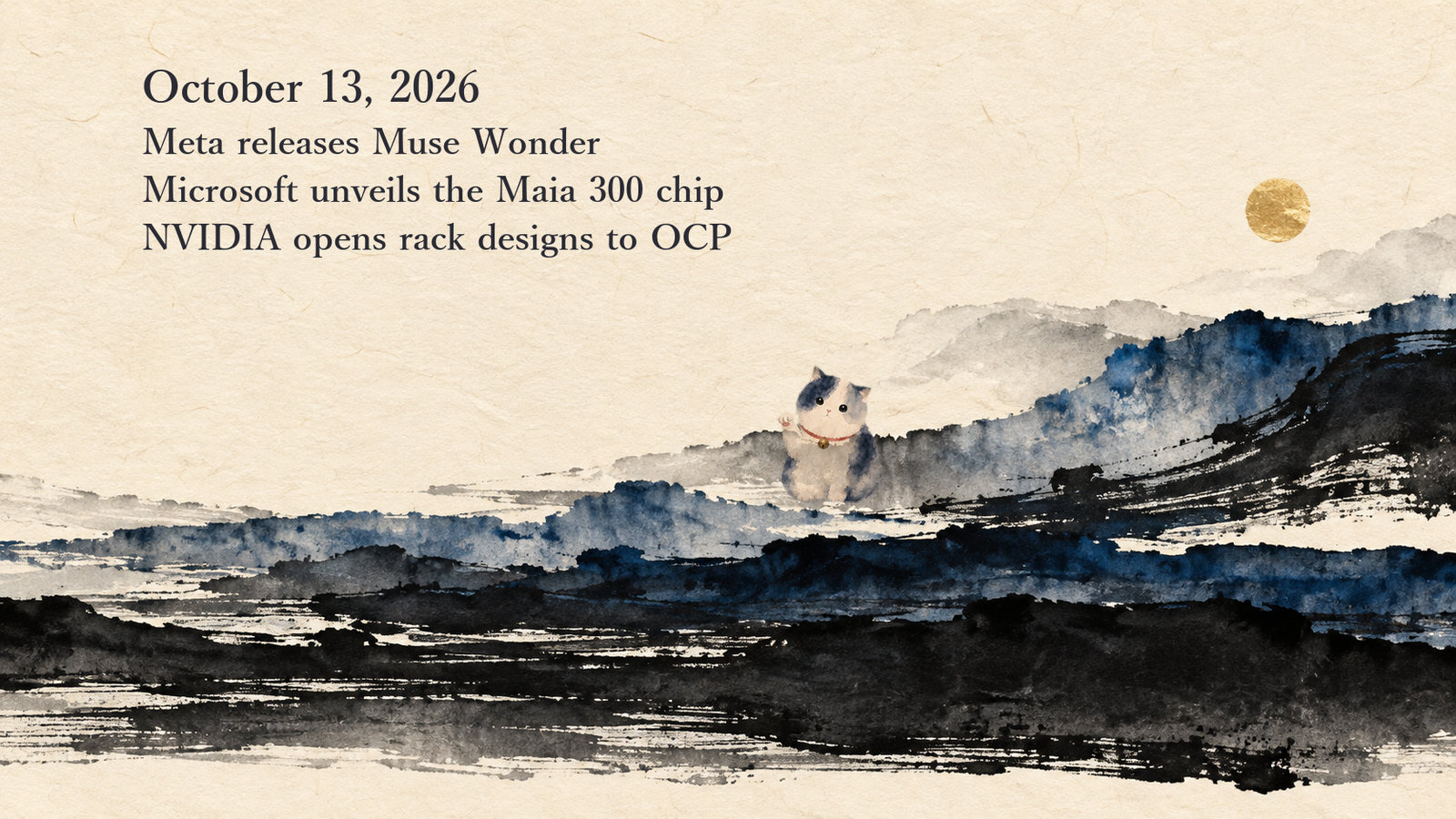
- Meta releases Muse Wonder, its most capable model, aimed at expert work and long memory
- Microsoft unveils Maia 300 and plans to make Maia its primary inference system from 2027
- NVIDIA contributes Vera Rubin rack designs to OCP as hyperscalers publish a grid-resilience standard
The day belonged to Meta and Microsoft. Meta released its most capable model yet, trained in its own data center. Microsoft announced an in-house AI chip that it plans to make the primary inference system for its own products from 2027.
NVIDIA went the other way, contributing its next-generation rack designs to an industry body. With Google, Meta and Microsoft, it also published a common specification for how AI facilities should behave when the power grid falters.
Today's Top Three
Meta releases Muse Wonder, its most capable model, aimed at expert work and long memory
Meta released Muse Wonder and a larger sibling, Muse Wonder Full, on October 12, calling them its most capable models to date.
Meta says the models deliver state-of-the-art performance on personal and professional agentic tasks. Its examples are everyday paperwork: navigating an insurance claim, understanding a lease, making sense of someone's finances. Law, finance, health and coding are the named strengths, and the legal evaluation includes Harvey's Legal Agent Benchmark (LAB), which asks a model to work from source documents and produce legal work product.
Two new capabilities anchor the launch. Active Memory carries what matters to a user across conversations and retrieves the relevant details when a task needs them. Active Focus keeps the model working toward a goal when a task gets hard, trying other approaches and checking in before anything important.
Muse Wonder is available now through the Meta Model API and the Muse Code coding product; Muse Wonder Full is available to Muse Code subscribers. TechCrunch reports API pricing of $4 per million input tokens and $20 per million output tokens.
Both models were trained at Prometheus, Meta's gigawatt-scale data center. TechCrunch describes the release as Meta's first frontier model since Scale AI founder Alexandr Wang restructured the company's AI efforts. Meta says a full report with additional safety evaluations is coming soon.
- Introducing Muse Wonder and Muse Wonder Full: Frontier Models for Agents (Meta)
- Muse Wonder (Meta AI Research)
- Meta releases its first frontier model, Muse Wonder (TechCrunch)
Microsoft unveils Maia 300 and plans to make Maia its primary inference system from 2027
Microsoft announced Maia 300, the third generation of its in-house AI chip, on October 12.
Production deployments begin in 2027, when Microsoft plans to scale the Maia family to multi-gigawatt deployments and make it the primary inference system for its products and services.
Microsoft expects Maia 300 to deliver 40% more tokens per megawatt than leading GPU-based systems. In a full 96-accelerator configuration, the company says, it delivers up to seven times the rack-scale token throughput of the previous Maia 200.
The design is inference-first, built for long-context, memory-heavy and multi-step agentic workloads. Compute chiplets are made on TSMC's N2P process, and eight HBM4 stacks provide 18.0 TB/s of peak memory bandwidth within a 950-watt power envelope.
Maia 200 already serves production workloads including Microsoft Copilot and runs OpenAI models as well as Microsoft's own MAI models. The Verge reports that Maia 300 will make Microsoft less reliant on Nvidia's GPUs.
- Microsoft to expand Azure Maia system to multi-gigawatt deployments (Microsoft)
- Microsoft's latest custom chip: Maia 300 (Microsoft)
- Microsoft's new AI chip makes it less reliant on Nvidia's GPUs (The Verge)
NVIDIA contributes Vera Rubin rack designs to OCP as hyperscalers publish a grid-resilience standard
NVIDIA contributed key rack and compute-tray designs for its next-generation Vera Rubin platform to the Open Compute Project (OCP), the industry body for open data center hardware.
The announcement came at the OCP Global Summit in San Jose. The updated MGX 1.2 specification adds rack-scale blind-mate liquid cooling and a liquid-cooled 5,000-amp busbar, and supports rack deployments of up to 250 kilowatts.
NVIDIA also added a rack design specification for its Vera CPU, aimed at agent workloads. The rack handles tool calling, orchestration and sandboxed execution, the work that lets AI agents act on applications, data and services.
On the power side, Google, Meta, Microsoft and NVIDIA published the OCP Grid Resilience Specification. It sets out how large AI facilities should behave during utility grid disturbances: stay connected, respond automatically, and return to near-full load in under two seconds.
NVIDIA, AMD, Google and Meta also published the Open Data Center Specification v0.7, a common blueprint for AI facility power, cooling and layout. NVIDIA says the open specs let equipment makers and operators start designing and building without waiting for each customer's proprietary requirements.
Other Developments
Models & APIs
- China's Z.ai introduced GLM-Legal, a model built for legal work, on October 12 and opened beta applications for API access and its AutoClaw desktop agent. Built on GLM-5.3-Flash, it scored a 19.2% all-pass rate on Harvey's LAB, which covers law-firm work across 24 practice areas, 12.5 points above its base model, according to the company. GLM-Legal: Advancing Agentic Legal Intelligence (Z.ai)
Policy
- Microsoft president Brad Smith told a BBC podcast that the UK, rather than the US or the EU, is best placed to lead global AI safety rules. He backed a legal duty to report breaches by rogue AI agents and approval by outside evaluators before an AI product is released. Microsoft president says UK is best placed to drive AI regulation (TechCrunch)
- A follow-up to the Ukrainian drone strike in our October 11 edition: Ars Technica reports that three of Yandex's largest data centers went offline between October 8 and October 11. All three supercomputers Yandex has used to train its YandexGPT model sit in the affected facilities. Russia was not ready for the data center war it started with Ukraine (Ars Technica)
Business
- WindBorne, which flies weather-sensing balloons, won a US Air Force contract worth up to $49 million to buy data from its fleet of about 700 balloons. The Air Force orders data by region and time as it needs it and has ordered $1.7 million so far; WindBorne also feeds the data into its own AI weather model. WindBorne wins a hefty US Air Force contract for its balloon data (TechCrunch)
- Ambi, founded by former Plaud executive Peter Mo, said it has raised $26 million across multiple rounds. Its app surfaces relevant information during meetings, and its all-day ambient capture is off by default. Former Plaud exec raises $26M for AI app that listens to you in the background (TechCrunch)
Source: Selected by the editors from the AI news inbox (collected October 13, 2026: 26 items, 4 primary and 22 secondary).