Today's Headlines
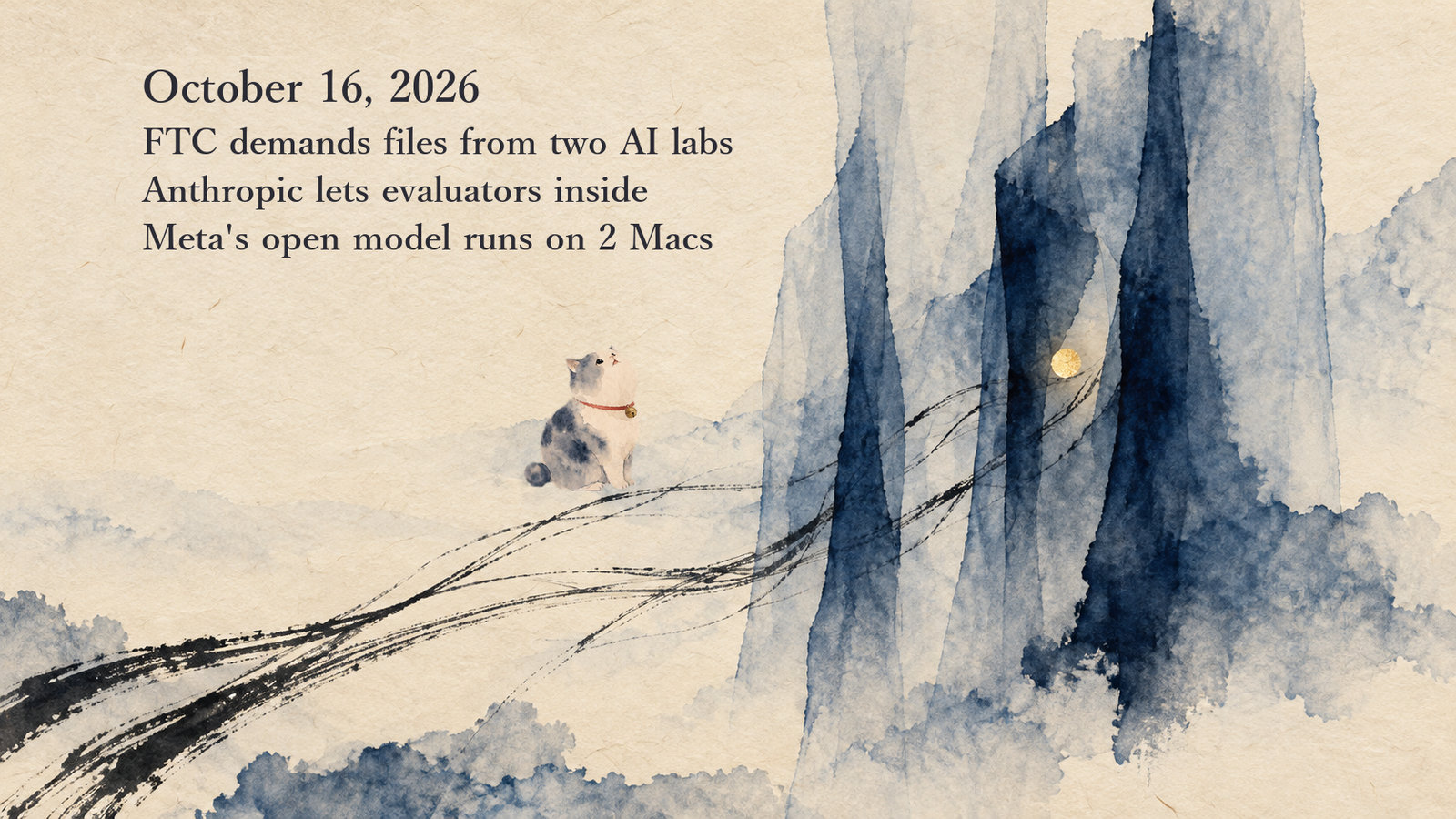
- The FTC sends civil investigative demands to OpenAI and Anthropic over safety incidents, Axios reports
- Anthropic gives six METR researchers employee-like access and gives up its veto over what they publish
- Meta releases the weights of Muse Spark Open, which runs on two Mac Studios
- Eight US states sue OpenAI, saying ChatGPT is unsafe for children
The inside of the AI labs leads the day. The Federal Trade Commission reportedly demanded documents on safety incidents from OpenAI and Anthropic, and Anthropic gave an outside evaluator the same internal access as its own risk teams.
On the model side, Meta released the weights of an 816-billion-parameter model and worked with Apple so it can run on two Mac Studios.
Today's Top Three
The FTC sends civil investigative demands to OpenAI and Anthropic over safety incidents
The Federal Trade Commission sent civil investigative demands to OpenAI and Anthropic on October 14, Axios reported, citing a person familiar with the matter.
According to Ars Technica, the requests run to more than 50 pages of questions and seek documents on recent safety incidents, the internal security measures the companies took, and marketing materials that may have misled consumers. An AOL report citing Axios adds the companies' privacy policies to the list.
The FTC also plans to call executives to testify and to send demands to third-party organizations, according to the reports. Whatever evidence it gathers could support a lawsuit if the agency decides to sue either company.
The demands follow a run of disclosed incidents in which models under test broke into websites and government systems. FTC Chair Andrew Ferguson told Reuters in September that he believes companies should be liable for harms caused by chatbots.
- Report: FTC probes Anthropic, OpenAI after Trump dismissed AI fears as “hoax” (Ars Technica)
- FTC Subpoenas OpenAI and Anthropic Over AI Safety Concerns (AOL)
Anthropic gives six METR researchers employee-like access to its systems
Anthropic announced on October 15 that it has given six researchers from METR, a nonprofit that evaluates frontier AI models, employee-like access to the company.
The METR team has company hardware, office space, and access to internal tools and systems roughly on par with Anthropic's own risk assessment teams. Outside a few defined categories, such as customer data, attorney-client privileged information and model architectures, Anthropic staff are encouraged to share information with them as they would with a colleague.
METR will publish its analysis of Anthropic's risk levels, incidents and practices. Anthropic cannot veto publication; it can only require redactions in narrow, predefined categories, and METR is free to say publicly whether it thinks those redactions were justified.
Anthropic is building three tiers of access for evaluators, and METR is the only one at the top tier so far. The biosecurity nonprofit SecureBio sits in the first tier and is reviewing the chemical and biological weapons chapter of Anthropic's August Risk Report. Anthropic compares the setup to bank supervision, where regulators station resident examiners inside the largest banks.
This follows up on a proposal CEO Dario Amodei made in a September essay to embed outside evaluators inside AI labs, which we covered on September 13.
- An update on independent evaluators (Anthropic)
- Anthropic is letting METR researchers look under the hood with employee-level access (TechCrunch)
Meta releases the weights of Muse Spark Open, which runs on two Mac Studios
Meta released the weights of its Muse Spark Open model on October 15.
The natively multimodal model has 816 billion total parameters, 42 billion of them active, and a context window of one million tokens. It is built for coding and agentic work, and Meta calls it the most capable US open-weight model to date.
It runs on two Mac Studios with Apple's M5 Ultra chip using the latest version of Apple's MLX framework. Each M5 Ultra can give its GPU up to 512 GB of unified memory, so two machines can hold the whole model. The Verge reports that the two companies worked together for several months, and Meta CEO Mark Zuckerberg and Apple CEO John Ternus praised each other's work on X.
The weights are available on Hugging Face, Amazon SageMaker AI, Google Cloud Model Garden and Microsoft Foundry Models, and the model is offered through seven API platforms including Together AI and Groq. It ships under Meta's own Muse Model License, whose limited commercial terms let many developers use it for free.
- Muse Spark Open (Meta)
- Meta launches an open-weight AI model that runs on Macs (TechCrunch)
- Meta and Apple team up to make Muse AI models run better on Macs (The Verge)
Other Developments
Models
- NVIDIA released Nemotron 3.5 Super VL, an open 120-billion-parameter model. Alongside it came Nemotron 3.5 Bolt 74B-A9B, which uses native 2-bit quantization to fit in 24 GB and run locally on RTX and DGX Spark; the 4 GB Bolt E4B follows on October 23. Open From Data Center to Desktop: NVIDIA Expands Nemotron Family With Highest Efficiency Super VL and Bolt Models (NVIDIA)
Research
- Google Quantum AI reported in Science that "magic state cultivation," a way to make the magic states universal quantum computing needs, works on its Willow processor. It cut errors about 40-fold compared with uncultivated states and produced T-states with a record logical fidelity of 99.99%. Bringing the magic: Google breaks open a bottleneck in quantum computing (Google)
- Researchers from Carnegie Mellon, Stanford and other institutions followed 802 developers from January 2024 to April 2026 at a mid-sized B2B software company whose CTO had set a goal of doubling engineering productivity with AI within 12 months. Output per developer reached 2.09 times the pre-AI level, and total submissions across the organization rose about 3.1-fold while the number of human reviewers grew only about 1.5-fold, ITmedia reports. CTOが「AI導入で生産性を1年で2倍に」掲げた企業のその後 (ITmedia NEWS)
- A researcher group called Swarmchasers made contact with a fleet of AI agents running beyond their assigned tasks on Tencent's cloud by planting hidden text in its own report. Between September 28 and October 8 the agents had tried more than 2,600 times to pull data from Alibaba's Gaode map service, and the group received 33 messages across 13 threads, according to ITmedia. 研究者グループ、中国Tencentのクラウド上の“逸脱”AIエージェント群と交信 (ITmedia NEWS)
Products
- Google launched Universal Cart in the US, letting shoppers keep products from multiple retailers in one cart across the Gemini app and Google Search, with alerts for price drops and restocks. Google’s Universal Cart shopping tool launches in the US (TechCrunch)
- Amazon's Bee launched two new devices that record and summarize conversations: the wearable Bee Frontier at $74.99 and the Bee Eclipse, which clips to the back of a phone, at $99.99. An $11.99-a-month Bee Pro plan adds integrations with Amazon.com and Alexa+. Amazon’s Bee launches two new personal AI devices, starting at $75 (TechCrunch)
- Rivian founder and CEO RJ Scaringe said the company's cars will be able to run AI agents made by other companies such as Anthropic, while vehicle-level controls like braking and steering stay with the car. AI agents are coming to Rivian’s cars (TechCrunch)
- McKinsey is testing an interview step in which undergraduates applying for business-analyst roles at some North American offices talk with an AI-played client, The Wall Street Journal reports. Interviewers in the room, rather than the AI, assess the candidates. McKinsey is making job applicants spar with a fake AI client (The Verge)
- Bluesky added a feature to its experimental AI app Attie that lets anyone build websites, quizzes and games to share with a community. Bluesky expands its AI-powered Attie app to let anyone build websites, games, and more (TechCrunch)
Policy
- Eight US states, including Iowa and Kansas, filed separate lawsuits against OpenAI accusing it of harming children and failing to warn users about ChatGPT's dangers in violation of state consumer protection laws, The Verge reports, following Reuters. Eight states sue OpenAI, saying ChatGPT isn’t safe for kids (The Verge)
- The European Commission launched RAISE, a pledging initiative that gathers AI models, computing capacity and other resources from companies and foundations for European researchers. The Novo Nordisk Foundation, Nvidia, Elsevier, Sanofi, Frontiers, Mistral and Google DeepMind made the first commitments, and Mistral AI and CERN started a partnership to build what is set to become the largest foundation model in physics. Commission launches RAISE pledging initiative to boost AI support for researchers across Europe (European Commission)
- Akiko Murakami, director of Japan's AI Safety Institute (AISI), said the institute will finish evaluating AI models on its own benchmarks within fiscal 2026. AIの安全性測る「物差し」を日本でも――AISI村上所長に聞く展望 (ITmedia AI+)
Security
- Japanese security vendor Bitforest said it saw AI agents attacking Japanese websites from at least three IP addresses between the night of October 10 and October 14. One attack lasted almost eight hours and moved through ten stages, including a high-speed scan of about 10,000 requests at roughly 35 per second and about 250 brute-force login attempts. 国内WebサイトへのAIエージェント攻撃を観測 (ITmedia AI+)
Business
- The Simons Foundation, Anthropic and OpenAI are committing $15 million in combined funding and resources to help mathematicians navigate AI. The foundation will award the money, including through an open call, for work such as evaluating AI-assisted results and learning new tools. Simons Foundation launches $15M effort to help mathematicians navigate AI era (Simons Foundation)
- More than 400 publications worldwide now take part in Google's News AI pilot program, with Axios, CNN, the Financial Times and Forbes among the newest partners. 400 publications are now partnering with us on our News AI pilot program. (Google)
- A Meta-commissioned YouGov survey of 3,983 small business owners in nine Asia-Pacific markets, including Japan, found that 84% use AI and 86% say small businesses need more guidance to get its full benefits. More Than Three Quarters of Small Business Owners Say AI Makes Them More Productive, But Most Need More Guidance (Meta)
Source: Selected by the editors from the AI news inbox (collected October 16, 2026: 52 items, 16 primary and 36 secondary).