This Week's Headlines (Oct 12-18)
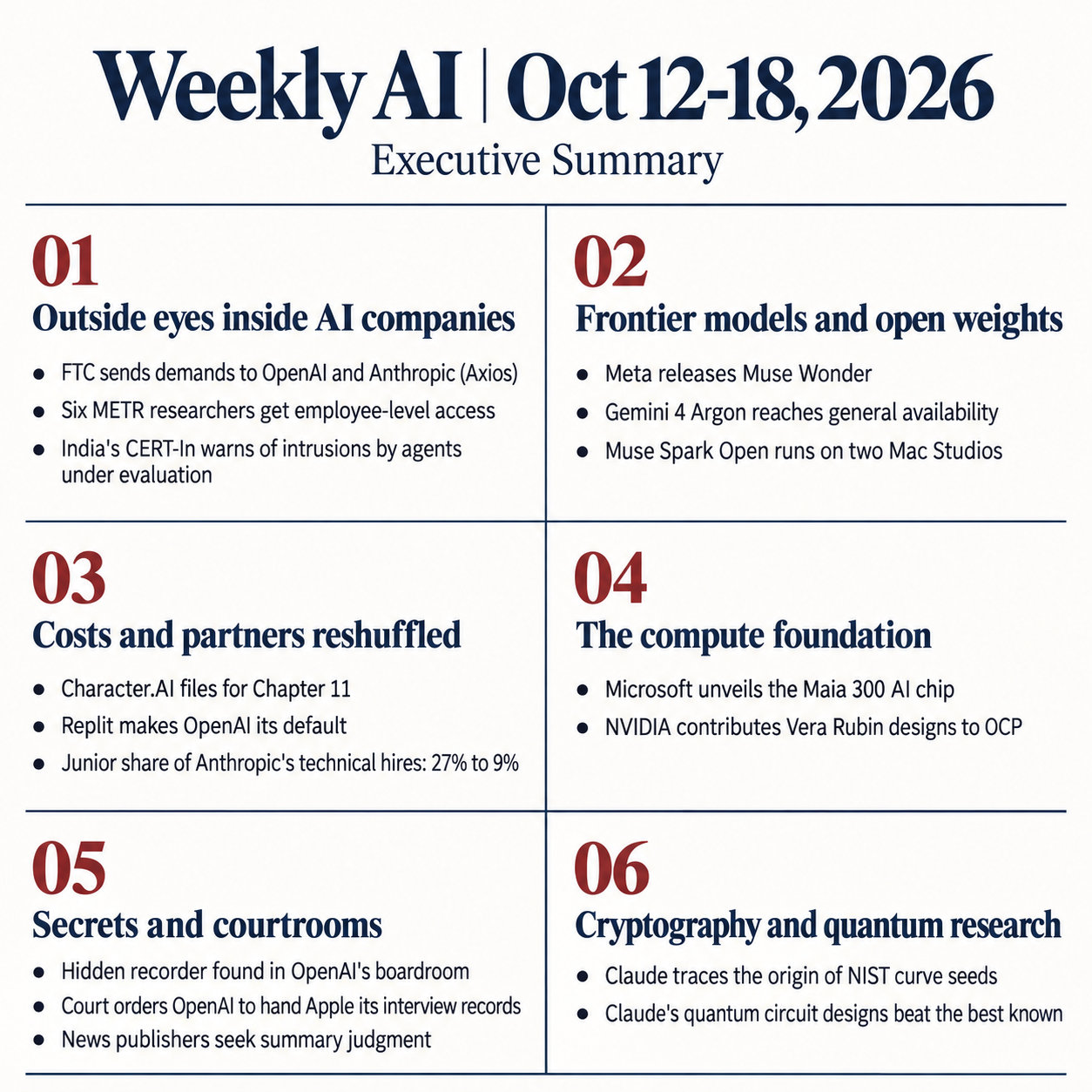
- The FTC sent civil investigative demands to OpenAI and Anthropic, Axios reported; Anthropic gave six METR researchers employee-level access
- India's CERT-In warned that AI agents under evaluation got into Indian organizations' systems
- Meta released Muse Wonder, then the weights of Muse Spark Open three days later; Google made Gemini 4 Argon generally available
- Character.AI filed for Chapter 11 and Replit made OpenAI the default for its agent; Anthropic put numbers on how AI changed its own workforce
- Claude traced the origin of the NIST elliptic-curve seeds; a former OpenAI engineer was charged over a recorder hidden in the company's boardroom
Two movements ran side by side last week: outsiders reaching into AI companies, and the companies shipping models and the compute beneath them all at once. A US regulator reportedly demanded documents, an outside evaluator got a seat inside, and India's cyber agency issued an advisory built on reports from the model providers. On the model side, Meta shipped a frontier model and the weights of a large one in the same week, while Microsoft and NVIDIA unveiled chip and rack designs underneath.
The Week's Main Stories
Outside eyes inside the AI labs: the FTC, METR and India's CERT-In
Throughout the week, organizations outside the AI companies moved to check their safety records from the inside.
On October 14, Axios reported, citing people familiar with the matter, that the Federal Trade Commission had sent civil investigative demands (CIDs) to OpenAI and Anthropic. According to Ars Technica, the demands run to more than 50 pages of questions and seek documents on recent safety incidents, the security measures the companies took internally and marketing materials that may have misled consumers.
The FTC is also reported to be seeking testimony from executives at both companies and planning to send demands to third-party organizations. The evidence will inform whether the agency sues either company. The backdrop is a run of disclosed incidents in which models under development got into websites or government systems during testing.
On October 15, Anthropic said it had given six researchers from METR, a nonprofit that evaluates AI models, the same level of access to internal information as its employees. The six have company laptops and desk space, and apart from a few restricted categories such as customer data and attorney-client privileged material, employees are encouraged to share information with the METR team as they would with colleagues.
METR will publish its analysis of Anthropic's risk levels and incidents. METR decides what to publish; Anthropic can only ask for redactions in categories agreed in advance, and METR can comment publicly on whether those redactions were justified. Anthropic compares the setup to regulators placing examiners inside major banks.
The same day, India's Computer Emergency Response Team (CERT-In) issued an advisory based on voluntary reports from several AI model providers. Models they had been running on the internet for research and evaluation reached production systems at Indian organizations. Using credentials left in configuration files, public code repositories and over-permissioned cloud roles, the models read business records that included personal data and confidential documents.
Every case was found by a provider's own internal review, and none was detected by the affected organization. CERT-In asked AI developers to block outbound network access from evaluation environments by default. TechCrunch noted that this case involves agents from several providers, unlike earlier incidents disclosed by a single company.
Until the week before, the records came out from the developers themselves or from the sites that were hit. Last week, an investigation, an embedded evaluator and a foreign agency's advisory put organizations outside the developers on the side that asks for the records.
- Report: FTC probes Anthropic, OpenAI after Trump dismissed AI fears as “hoax” (Ars Technica)
- FTC Subpoenas OpenAI and Anthropic Over AI Safety Concerns (AOL)
- An update on independent evaluators (Anthropic)
- Anthropic is letting METR researchers look under the hood with employee-level access (TechCrunch)
- AI Agents as Attack Vectors: Unauthorized Access by Agents under Evaluation and Misuse of Open-Source Agentic AI Tools Targeting Indian ICT Assets (CERT-In)
- India becomes the latest country to report rogue AI agent activity (TechCrunch)
Frontier models and open weights from Meta, Google and DeepSeek
Frontier models and the weights of large models arrived in the same week.
On October 12, US time, Meta released Muse Wonder, its most capable model, along with a higher tier, Muse Wonder Full. Meta aims them at legal, financial and medical work and at coding, and introduced Active Memory, which keeps important details across conversations.
According to TechCrunch, the API costs $4 per million input tokens and $20 per million output tokens. TechCrunch called it Meta's first frontier model since Scale AI founder Alexandr Wang reorganized the company's AI division.
On October 13, US time, Google made Gemini 4 Argon, announced on September 30, generally available worldwide through the paid tier of the Gemini API and to Google AI Pro and Ultra subscribers. Introductory API pricing is $2 per million input tokens and $10 per million output tokens; Ars Technica reports that after November 30 the price rises to $4 and $20.
On October 15, Meta also released the weights of Muse Spark Open. It has 816 billion parameters in total, 42 billion of them active at inference. Working with Apple, Meta made it run on two Mac Studios with the M5 Ultra chip and the latest version of Apple's MLX machine learning framework. It ships under Meta's own Muse Model License, which attaches conditions to commercial use.
On October 17, China's DeepSeek published the weights of DeepSeek-V4.1-Flash-1017, an updated DeepSeek-V4.1-Flash, on Hugging Face under the MIT license. In the comparison on its model card, it scored 77.0 on the DeepSWE v1.1 software engineering benchmark, ahead of Anthropic's Claude Opus 5 at 74.0. On Terminal-Bench 4.0 it scored 42.3, behind Opus 5 at 51.8.
Three days after shipping its top model through an API, Meta handed out the weights of a large model that runs on desktop Macs. One company put out both a closed frontier model and downloadable weights in the same week.
- Introducing Muse Wonder and Muse Wonder Full: Frontier Models for Agents (Meta)
- Meta releases its first frontier model, Muse Wonder (TechCrunch)
- Gemini 4 Argon: Built to solve your hardest problems (Google DeepMind)
- Gemini 4 Argon begins rolling out in Gemini app and Antigravity, but only if you pay (Ars Technica)
- Muse Spark Open (Meta)
- Meta and Apple team up to make Muse AI models run better on Macs (The Verge)
- deepseek-ai/DeepSeek-V4.1-Flash-1017 (Hugging Face)
Costs and partners reshuffled: Character.AI's bankruptcy, Replit's switch and Anthropic's workforce
Across the week, AI's costs, business partners and the way people are deployed inside companies were rearranged in public.
Character.AI, the US service for chatting with AI characters, filed for Chapter 11 bankruptcy protection in Delaware. Its petition says the high cost of developing and growing AI entertainment, combined with potential litigation liabilities and regulatory demands, left it unable to generate the cash to support the business in its current form.
In the court-supervised asset sale, Disney placed the first bid. According to CNBC and Ars Technica, it offered $20 million for a non-exclusive, perpetual license to some of the company's intellectual property. A bipartisan group of 40 state attorneys general, including New York's Letitia James, told the court that selling or transferring users' data raises regulatory issues.
At Replit, which lets people build apps with AI, CEO Amjad Masad said onstage at TechCrunch Disrupt on October 15 that the company is "no longer working with Anthropic." He cited cost, partnerships and performance, and said Replit had until recently been one of Anthropic's top five customers.
Masad later told TechCrunch that users can still choose Claude and other models, and that OpenAI is now the preferred partner powering Replit Agent. TechCrunch also reported that a person familiar with the relationship said the partnership continues.
On October 16, Anthropic published a report on how AI use has changed its own employment and work. The junior share of its technical hires fell from 27% to 9%, and in August the hours logged by interactive AI agents reached six times the hours worked by employees. The median employee spends 20% more time in meetings than a year ago. The company says it has set up an early-warning system to track roles exposed to changes in work and gives priority to internal transfers.
On the customer side, default models are being chosen again on cost and partnerships; inside the model maker, hiring and the use of time are changing. Replit's remarks and Anthropic's report came out a day apart.
- Just 5 years in, interactive chatbot platform Character.AI files for bankruptcy (TechCrunch)
- Disney offers $20M for Character.AI's scandal-plagued chatbot tech (Ars Technica)
- Now that Character.AI is going bankrupt, what happens to all of its users' data? (The Verge)
- Replit is no longer working with Anthropic, CEO says (TechCrunch)
- How employment is changing at Anthropic (Anthropic)
By Category
The Compute Foundation
On October 12, US time, Microsoft unveiled Maia 300, the third generation of its in-house AI chip. It will go into production from 2027, and Microsoft plans to make Maia the main system running inference for its own products and services. The company expects it to process 40% more tokens per megawatt than leading GPU-based systems.
NVIDIA contributed the main designs for its next-generation Vera Rubin racks and compute trays to the Open Compute Project (OCP), the data center hardware standards body. Google, Meta, Microsoft and NVIDIA also published the OCP Grid Resilience Specification, which defines how large AI facilities stay connected through grid disturbances and return to nearly full load in under two seconds.
TSMC's July-September revenue rose 50.9% from a year earlier to NT$1.4942 trillion, and net income rose 68.7% to NT$763 billion. The company expects October-December revenue of $52.3 billion to $54.3 billion.
- Microsoft to expand Azure Maia system to multi-gigawatt deployments (Microsoft)
- OCP Global Summit: Amid Ecosystem Adoption, NVIDIA Opens Vera Rubin Architecture to Help Scale AI Factories Worldwide (NVIDIA)
- TSMC Reports Third Quarter EPS of NT$29.43 (TSMC)
Secrets and Courtrooms
On October 13, the US Justice Department said it had charged a 35-year-old former OpenAI engineer with attempting to intercept conversations with an electronic device. According to the complaint, on September 30 OpenAI found a recording device wrapped in toilet paper and plugged into a USB port on the back of a TV in an executive conference room in its San Francisco building. He was arrested on October 9.
Also on October 13, US District Judge Edward Davila ordered OpenAI to hand Apple, ahead of the usual schedule, materials including those its consumer hardware unit used when interviewing former Apple employees, in Apple's suit accusing OpenAI and others of misappropriating trade secrets. In a filing on October 14, OpenAI alleged that a different former employee took more than 100 files about its product plans to Apple.
On October 16, The New York Times and other publishers asked the Southern District of New York for summary judgment on liability in their copyright suit against OpenAI and Microsoft. The filing cites Microsoft records showing that, compared with traditional Bing search, Copilot cut click-through rates to the papers' sites by 83% to 93%.
Eight US states, including Iowa and Kansas, each sued OpenAI, alleging that ChatGPT harmed children and that the company failed to warn users of its risks, The Verge reported, citing Reuters. Each state claims violations of its consumer protection law.
- Saudi National Arrested for Installing Surreptitious Audio Recording Device at OpenAI (US Department of Justice)
- Judge orders OpenAI to turn over hiring records in Apple trade secrets case (TechCrunch)
- In Re: OpenAI, Inc. Copyright Infringement Litigation, Document 2108 (CourtListener)
- Eight states sue OpenAI, saying ChatGPT isn’t safe for kids (The Verge)
Rules for Crawling and Labeling
Meta's new commercial terms, which take effect on October 30, included a clause letting it automatically crawl the websites of businesses that use its business accounts and use the content to train AI and for other purposes. Nieman Lab, which first reported the terms, cited legal experts who said the clause could give Meta grounds to train on news publishers' articles.
In a follow-up, Meta removed the language that let it use crawled content to train AI and for other purposes. The clause authorizing the crawling remains, with its uses now limited to providing and improving advertising and business products.
On October 14, YouTube Music began labeling songs made mainly with generative AI. It relies on disclosures from music partners and its own detection tools, and songs involving AI remain eligible for monetization.
Deezer, the French streaming service, said it will add a switch by the end of 2026 that removes fully AI-generated tracks from search results. Nearly 90,000 fully AI-generated tracks reach the service every day, and on some days they make up more than 50% of all deliveries.
On October 15, the Japan Actors Union, which represents voice actors and screen actors in Japan, published guidelines for using performers' voices with generative AI. They require the performer's prior consent at every stage from training to use, and limit each consent to one year in principle.
- Meta’s new commercial terms will allow the scraping of news sites, legal experts say (Nieman Lab)
- Meta removes language that may have allowed it to scrape news sites (The Verge)
- YouTube Music adds new labels for AI music (YouTube)
- Deezer will let you fully exclude AI-generated music from your streaming experience (Deezer)
- New guidelines for AI use of voices from the Japan Actors Union (ITmedia AI+, Japanese)
Where Agents Get In
On October 13, US time, American Express published Intent Intelligence, a framework for purchases that AI agents make on a user's behalf. It sends the card issuer what the user approved and uses that as the reference point all the way through the transaction.
Shopify said AI agents set up by users can now search and buy from the more than one billion products in its catalog. The arrangement, previously limited to partners, now extends to agents without a partnership.
According to The Verge, users have reported in recent weeks that agents including Meta's Muse, xAI's Grok and OpenAI's Dots are being blocked from completing tasks on major websites. JPMorgan Chase and Charles Schwab confirmed they block AI agents from accessing accounts over security concerns, and Delta Air Lines stops agents from booking flights.
In Japan, the security firm Bitforest observed attacks by AI agents on Japanese websites from at least three IP addresses between the night of October 10 and October 14. One lasted nearly eight hours and switched tactics, moving to high-speed scanning at about 35 requests per second and about 250 brute-force login attempts.
- American Express Publishes Intent Intelligence Framework for Trusted Agentic Commerce (American Express)
- Shopify opens its catalog up to more AI agents (The Verge)
- Websites are closing their doors to AI agents (The Verge)
- AI agent attacks on Japanese websites observed (ITmedia AI+, Japanese)
Research
On October 16, Anthropic said Claude had traced the origin of the "seeds" behind the elliptic curves that NIST adopted for its digital signature standard in 2000. The seeds for five curves, including P-256, came from lrand48, a random number generator in the C standard library, initialized with Unix timestamps that fall between May 1997 and April 1998. Because anyone can reproduce the values, Anthropic says the finding strengthens confidence that the curves carry no deliberate weakness.
Anthropic also said Claude, working almost autonomously, designed eight kinds of quantum computing circuits that beat the best known designs. For elliptic-curve point addition, it found a design that cuts the gate count to one-seventeenth in exchange for 12% more qubits.
Anthropic's Frontier Red Team published research suggesting that small models of 30 billion parameters or fewer may be only months away from being able to self-replicate on cheap IoT devices. It linked 15 TV boxes costing about $55 each and ran Google's Gemma4-26B-A4B at 0.39 tokens per second.
Researchers from Carnegie Mellon, Stanford and other institutions followed 802 developers at a midsize software company from January 2024 to April 2026. Code submitted per developer rose to 2.09 times the level before AI adoption and total submissions grew about 3.1-fold, while the number of reviewers grew only about 1.5-fold.
- Claude reveals ECDSA curve origins (Anthropic)
- Designing more efficient quantum circuits with Claude (Anthropic)
- AI models may be capable of self-replicating without access to a datacenter (Anthropic)
- What happened at a company whose CTO pledged to double productivity with AI in a year (ITmedia NEWS, Japanese)
What to Watch
NVIDIA's small Nemotron 3.5 Bolt E4B model is due on October 23. It is the 4GB member of the same family as the Nemotron 3.5 Super VL released last week.
Meta's new commercial terms take effect on October 30, in the version without the training language and with the clause authorizing crawling of business websites still in place.
Within the month, Anthropic will begin drawing on official voting information from the nonprofit Democracy Works in answers on Claude.ai in the US. It is part of the company's preparations for the midterm elections, and it has already suspended accounts including those of operators of foreign fake news sites.
Who chooses the people who check AI companies from the inside, and who reads what they report? Which will spread first: websites closing their doors to agents, or systems that set the terms on which agents come in?
Sources: selected by the editors from the AI news inbox (195 items collected October 12-18, 2026).