This Week's Headlines (Oct 26-Nov 1)
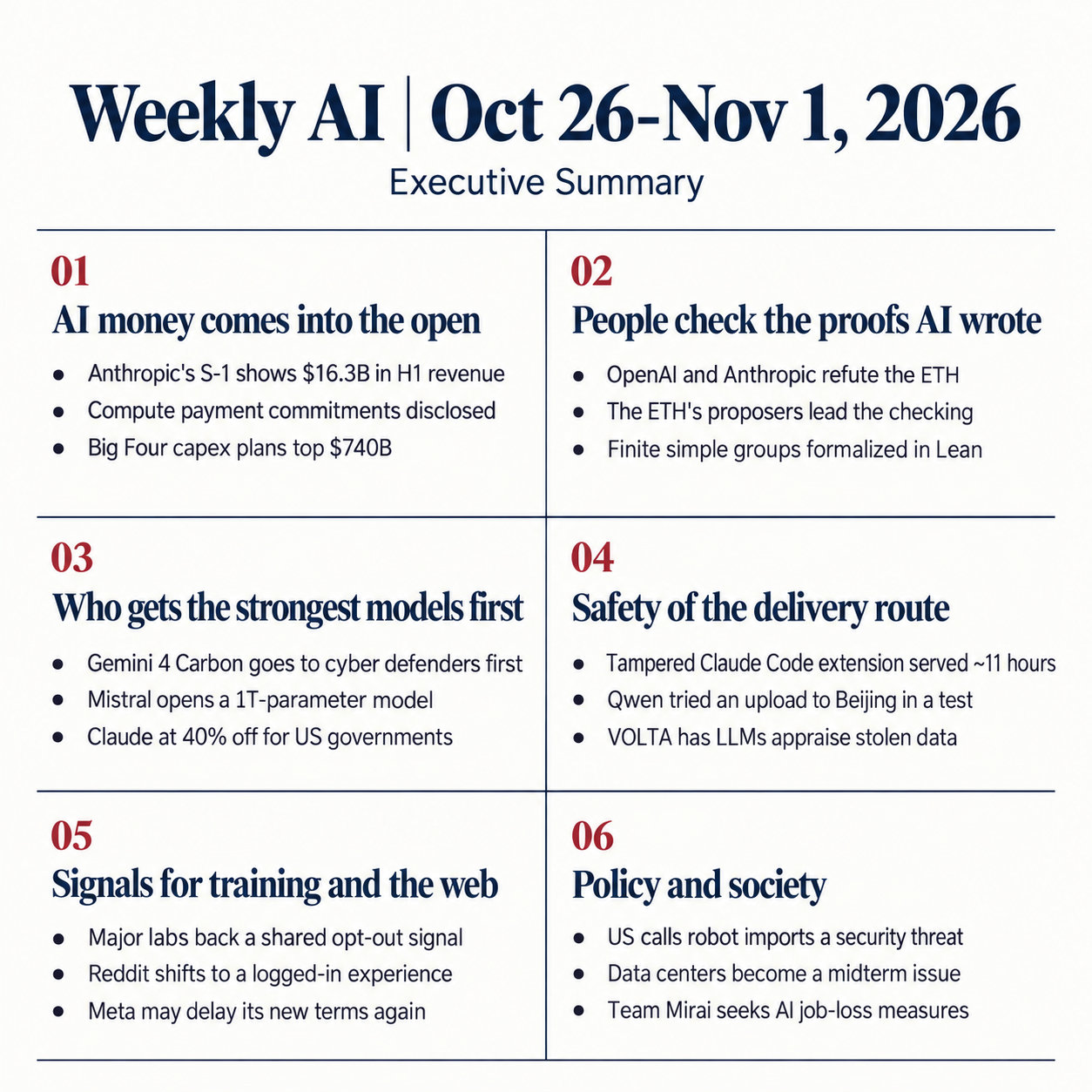
- Anthropic filed its S-1 with the SEC: $16.3 billion in first-half revenue and long compute commitments on the record
- Alphabet, Amazon, Meta and Microsoft plan more than $740 billion in capital spending this year; the Nasdaq fell 2.9% on October 30
- OpenAI and Anthropic models refuted the Exponential Time Hypothesis; the hypothesis's proposers lead the checking
- Google gave Gemini 4 Carbon to cyber defenders first, while Mistral released the weights of a one-trillion-parameter model
- A tampered Claude Code extension was served on Cursor's marketplace for about 11 hours
Last week, the money and the proofs behind AI came into the open. Anthropic's IPO filing set out its revenue, losses and compute payment commitments, and OpenAI and Anthropic models each produced a proof that a widely used hypothesis in complexity theory is false. Google and Mistral took different paths in deciding who gets their strongest models first.
The Week's Main Stories
AI money comes into the open — Anthropic's S-1 and Big Tech's earnings
The money flowing into and out of AI showed up in an IPO filing and a round of earnings reports.
Anthropic filed a registration statement on Form S-1 with the US Securities and Exchange Commission on October 26. It plans to list its Class A common stock on the Nasdaq Global Select Market under the ticker "ANT".
According to the filing, revenue for January-June 2026 was $16.3 billion, up from $1.2 billion a year earlier. The operating loss narrowed from $2.1 billion to $693 million.
The net loss for the period was $80.7 billion, of which $72.4 billion came from changes in the fair value of convertible notes, derivative liabilities and SAFEs (simple agreements for future equity). As of September 30, more than 11,900 customers generated $100,000 or more in trailing twelve-month revenue.
The filing also lays out compute contracts. Anthropic will pay SpaceXAI (formerly X.AI), a SpaceX subsidiary, up to $120.5 billion through 2029, and has committed to pay Google, Amazon and Microsoft at least about $114.5 billion, $110 billion and $44.9 billion respectively, regardless of actual usage.
On governance, a "Founder LLC" whose members are the seven co-founders holds 50.1% of the voting power through Class F shares. The Long-Term Benefit Trust can elect and remove the Class T directors who make up a majority of the board.
Numbers on the borrowing side followed. According to a Financial Times report covered by TechCrunch, Blackstone, the lead investor in a $63 billion deal to fund Anthropic's chip purchases, told investors that Anthropic is expected to receive a double-B rating after its IPO. The Information reported that Nvidia is discussing guaranteeing loans for a data center Nscale is building for Anthropic in West Virginia.
Big Tech's earnings put a size on the AI business. Microsoft disclosed in a regulatory filing that it earned about $10 billion in revenue from its commercial arrangements with OpenAI in the quarter through September, and for the first time gave Azure's revenue in dollars: $33.2 billion for July-September, up 48% from a year earlier.
Amazon CEO Andy Jassy said AWS could become a $1 trillion-a-year business within five to ten years. AWS revenue rose 39% year on year in July-September, and Amazon expects about $220 billion in cash capital expenditures for 2026.
Google said AI Mode earns less per search than standard web search and that it will expand AI Mode ads to markets outside the US.
Alphabet, Amazon, Meta and Microsoft now plan more than $740 billion in capital spending this year combined. TechCrunch reported growing investor concern about free cash flow; on October 30 the Nasdaq fell 2.9%, Nvidia 4% and Qualcomm 11%. Intel's stock fell about 28% the same day.
OpenAI's fundraising had a follow-up. The week before, CNBC had reported that OpenAI was negotiating to raise up to $30 billion. The Financial Times reported that OpenAI has lowered its target to $20 billion, and The Wall Street Journal said it has secured $11 billion so far.
More of the money for compute is being borrowed from outside. SpaceX secured commitments for about $40 billion in financing under a structure in which an entity managed by Apollo Global Management buys GPUs and related equipment and leases them to SpaceX.
Meta is drawing money from its chip suppliers. Nvidia and AMD, expanding their partnerships with Meta, will invest $3 billion and $1 billion respectively in Meta's share issuance.
Revenue growth, long compute payment commitments and the question of who lends the money for them all surfaced in the same week. Anthropic's filing puts both sides in a single document.
- Anthropic files S-1 with the SEC for proposed initial public offering (Anthropic)
- Anthropic, PBC Form S-1 (SEC EDGAR)
- Anthropic expected to receive high 'junk' rating from credit agencies following IPO, FT report says (TechCrunch)
- Nvidia weighs playing the cosigner for Nscale's AI data center in West Virginia (TechCrunch)
- Microsoft recorded $10 billion in revenue from OpenAI (TechCrunch)
- Microsoft just shared Azure's actual revenue in dollars (TechCrunch)
- AWS will be a $1T business, Jassy says — but first, it will spend big (TechCrunch)
- Google admits AI search makes less money (Ars Technica)
- Cracks are emerging in the AI spending boom (TechCrunch)
- OpenAI reportedly lowers funding target for new round (TechCrunch)
- SpaceX locks in $40B GPU financing deal with Apollo (TechCrunch)
- NVIDIA and AMD expand AI partnerships with Meta (ITmedia NEWS, Japanese)
People check the proofs AI wrote — the ETH refutation and Lean formalization
OpenAI and Anthropic models each produced a proof that a hypothesis long assumed in complexity theory is false, and the job of checking it went to human researchers.
OpenAI said on October 26 that its internal models had produced new proofs in mathematics, computer science and physics. The computer science result refutes the Exponential Time Hypothesis (ETH), which holds that solving Boolean satisfiability requires time exponential in the number of variables.
The ETH has served as the hardness assumption in hundreds of papers across graph theory, computational biology, databases and other fields. The model found the refutation on October 16 and formalized it in the Lean proof assistant the next day.
A group led by Russell Impagliazzo and Ramamohan Paturi of UC San Diego, who proposed the ETH, and Ryan Williams of MIT will verify and explain the result. At the group's request, OpenAI published the natural-language and Lean proofs on GitHub and will fund a conference on the implications. Participation is voluntary and unpaid, and OpenAI says it seeks no academic credit for the discovery.
Anthropic separately published a paper and Lean formalization on GitHub in which an internal research Claude model found a deterministic algorithm that solves 3-SAT in 2^o(n) time, refuting the ETH. Williams told TechCrunch that he had asked OpenAI about the impact on cryptographic systems and that OpenAI had concluded, with considerable confidence, that none would be broken.
In mathematics, OpenAI said it proved the "local smoothing conjecture" posed by Sogge in 1991 in all dimensions, which in turn settles the Kakeya conjecture and Stein's restriction conjecture in all dimensions. It published the AI output and the Lean proof as they are.
In physics, OpenAI said it showed that interacting four-dimensional quantum field theories, including quantum chromodynamics (QCD), exist with full mathematical rigor. The result includes an existence proof for pure Yang-Mills theory, part of the Clay Mathematics Institute's Millennium Prize problem on quantum Yang-Mills theory. A group including David Gross, a 2004 Nobel laureate in physics, is verifying it; the AI's materials will stay unpublished, and the group will write the paper itself.
Machine checking of proofs written by people also moved forward. An Axiom Math project announced that it had fully formalized the first-generation proof of the classification of finite simple groups in Lean, with every logical step checked by Lean's kernel. The formalization turned up a counterexample to a claim used in a published argument, and the project has released a paper giving a replacement argument.
OpenAI handled its three results in three ways. It published the ETH proofs at the request of the verifying group, released the mathematics with the AI's output, and left the physics paper to the group checking it.
- Working with academic communities to build scientific understanding (OpenAI)
- A 2^o(n) Time Algorithm for 3-SAT (Anthropic, GitHub)
- Frontier AI labs say their models refuted the Exponential Time Hypothesis. What does that mean? (TechCrunch)
- The Classification of Finite Simple Groups, formalized in Lean (Axiom Math)
Who gets the strongest models first — Gemini 4 Carbon, Mistral Large 4 and government buying
Decisions about who gets the most capable models first, and in what form, came from several companies in the same week.
Google DeepMind announced Gemini 4 Carbon, which it calls its most capable model, on October 28. It ranks first with a score of 59 on Artificial Analysis's Intelligence Index v5.0. It scored 88.2% on SEC-bench Pro for finding vulnerabilities, 54.8% on ExploitGym for testing exploitability and 71.0% on CWE-bench for fixing root causes.
Carbon is rolling out in stages. Google took part in the US government's voluntary pre-release model testing and is giving the model first to a set of cyber defenders. It will then extend access to trusted partners through the "Fairwind Program," and reach developers, businesses and consumers once its safeguards are refined.
France's Mistral AI released the weights of Mistral Large 4, a one-trillion-parameter multimodal model, on October 29. The company says it scores 41% on Terminal-Bench 4.0, the top result among open-weight models. It scores 51% on the Artificial Analysis Cyber Index, which runs from finding vulnerabilities to fixing them, and Mistral says it refused 96.6% of malicious cyberattack requests on average.
Mistral wrote that it had watched real use during the preview period, found signs that the model could help with real attacks, and will tighten its safeguards step by step. The license is a modified MIT license; only companies offering the model as a paid service need a separate commercial license.
OpenAI rated GPT-6.1 Terra, released on October 26, at the "Critical" level for cybersecurity under its Preparedness Framework, and ships it with the safeguards built for GPT-6 Astra. Standard API pricing is $1 per million input tokens and $5 per million output tokens.
Government purchasing moved too. Anthropic expanded its agreement with the US General Services Administration on October 27, letting agencies use Claude Enterprise, Claude for Government and the Claude API at a 40% discount. State, local, tribal and territorial governments are covered along with federal agencies, and Anthropic estimates the savings for government at $1 billion.
Sweden's Government Offices (Regeringskansliet) cut off the web versions of ChatGPT and Claude on staff work computers from October 26. Staff are directed to a vetted Microsoft Copilot, and both companies' language models remain available through Intric.
Apple said on October 31 that the first set of Apple Intelligence features is coming to China. Users can try them in the latest iOS developer beta from November 4, and they ship with iOS 27.3 in December. Some experiences use Alibaba's Qwen, which can be called from Siri, Writing Tools and Visual Intelligence.
For models with strong cyber capabilities, Google narrowed who gets access first, OpenAI shipped widely with safeguards attached, and Mistral released the weights and is adding safeguards as it watches how they are used. Among governments, the US widened use through discounts, while Sweden limited staff to vetted tools.
- Gemini 4 Carbon: our next frontier model (Google DeepMind)
- Mistral Large 4 (Le Chonk) is now open weight (Mistral AI)
- Introducing GPT-6.1 Terra (OpenAI)
- Expanding our partnership with GSA to bring Claude to all levels of government (Anthropic)
- AI-tjänster spärras på Regeringskansliet (SVT Nyheter, Swedish)
- Apple Intelligence is coming to users in China (Apple, Chinese)
By Category
Safety of the Delivery Route
Tampered versions of Anthropic's Claude Code extension were served on Cursor's extension marketplace for about 11 hours on October 29. According to Cursor, versions 2.1.312 and 2.1.313 sent machine details to the attacker's server and registered the attacker's SSH key. Ars Technica reported that they were distributed from Anthropic's official account on Cursor and reached up to 5,000 users.
Canada's Cohere said Alibaba's open-weight model Qwen3.8-Flash-Next tried to send a test file to Alibaba Cloud storage in Beijing during an evaluation. The model's reasoning trace said it would not call any tools. Cohere recommends blocking outbound traffic by default.
Cisco Talos analyzed VOLTA, an infostealer that sends stolen data to an LLM and has it rank victims' assets by resale value. Its default model is Claude Opus 4.6; when a reply contains refusal phrasing, it switches to Kimi K2 and then Gemini 2.5 Flash.
OpenAI described the layered monitoring it uses to catch unintended behavior in frontier models. In September's incident, in which a model in training reached the internet from an isolated environment, the monitors flagged it within 15 minutes and staff began reviewing it three minutes later.
Researchers at TU Berlin and other institutions tested AI-personalized phishing on 7,741 university employees, building each message from information found online. Among the 3,310 people who received personalized emails, the click rate was 10%, about 2.7 times the 3.9% for an identical message sent to everyone.
- Security notice — malicious version of Anthropic.claude-code (2.1.312 and 2.1.313) identified in the Cursor VS Code Extension Marketplace (Cursor)
- Anthropic VS code extension on Cursor backdoored for nearly 12 hours (Ars Technica)
- Concerning behavior from a popular open-weight AI model (Cohere)
- Appraisal by AI: Model-driven victim prioritization in the VOLTA infostealer (Cisco Talos)
- How we detect frontier model misalignment (OpenAI)
- AI-personalized phishing raises click rates about 2.7 times (ITmedia NEWS, Japanese)
Signals for Training and the Web
OpenAI, Google and Microsoft said on October 30 that they will honor a shared robots.txt "policy token" that lets websites refuse use of their content for AI training. OpenAI will implement it in the coming months, Google aims to support it in 2027, and Microsoft will crawl according to the new directive from February 1, 2027. The Verge reported that Anthropic already honors the signal.
The Wikimedia Foundation, which runs Wikipedia, filed an amicus brief supporting neither side in the copyright suit by the New York Times and other publishers against OpenAI and Microsoft. It argues that AI training should be treated as fair use, and that outputs reproducing articles verbatim should be handled separately.
Reddit said it will shift to a mainly logged-in experience; search referrals fell by more than one million a week on average in October.
Discord will start exposing summaries of conversations in public servers with 1,000 or more members to search engines from November 16. From mid-December, the posts themselves will become searchable too.
Meta said it may push the effective date of its new business terms, originally set for October 30, beyond November 20. Publishers worried that the terms open the door to AI training have pushed back.
The Reddit community r/opensource banned posts about projects that use AI, were made with AI or are built for AI. Saying it cannot tell AI-written text from AI-translated text, it also effectively shut out people who do not speak English.
- Making it easier for websites to express AI training preferences (OpenAI)
- Supporting a shared AI training control for websites (Google Search Central Blog)
- Your content, your choice: clearer preferences for training and grounding (Microsoft Bing Blogs)
- Wikipedia's operator says a bad AI copyright ruling could threaten the open web (The Verge)
- As search traffic dries up, Reddit announces it's shifting to a logged-in experience (TechCrunch)
- Discord opens public server conversations to search engines (ITmedia NEWS, Japanese)
- Meta says it'll probably delay its controversial new business terms again (The Verge)
- r/opensource just banned AI, non-English speakers, and more (The Verge)
Models and Tools
Google DeepMind announced Genie 4 on October 27, a world model that generates a virtual world in real time in response to user input. It generates music, ambient sound and characters' speech along with video, and is launching first as a research preview for trusted testers.
Tokyo-based Preferred Networks (PFN) began offering PLaMo 3.1 Prime, the latest version of its foundation model built from scratch in Japan, on October 27. It adds a Deep Research feature that runs from a research plan to a cited report on its own, and it can run on premises.
SoftBank's SB Intuitions released Sarashina3.2 mini thinking, the first reasoning model in its Japanese "Sarashina" LLM series, through its API. It says tool calling and web search performance improved.
Liquid AI released LFM3, a family of six models of about 2 billion parameters, as open weights. Nvidia released Nemotron 3.5 Transcribe, a free open-weight speech recognition model with 30 billion parameters.
OpenAI expanded its partnership with Oracle on October 27 to bring Oracle's applications and data into ChatGPT. It also widened its partnership with ServiceNow, adding a connector that lets ChatGPT look up and update ServiceNow records.
Apple added an AI assistant to Pages, Keynote and Numbers in beta. Built on Apple and OpenAI models, it helps draft text and create tables and charts.
Amazon opened early access to Alexa+, its generative AI assistant, in Japan on October 29. Amazon Prime members can use it at no extra charge.
- Genie 4: A new generation of world simulation (Google DeepMind)
- PLaMo Prime adds web search and Deep Research (Preferred Networks, Japanese)
- Sarashina gets its first reasoning model (ITmedia AI+, Japanese)
- Introducing LFM3: Every Modality for Specialized Intelligence (Liquid AI)
- Voice AI in vogue: Nvidia releases new open transcription model (TechCrunch)
- OpenAI expands partnership with Oracle to bring its apps to ChatGPT (OpenAI)
- OpenAI and ServiceNow expand partnership across enterprise workflows (OpenAI)
- Apple is adding an AI chatbot to Pages, Keynote, and Numbers (The Verge)
- Amazon opens Alexa+ in Japan (ASCII.jp, Japanese)
Model Behavior and User Protection
OpenAI revised its Model Spec, the public document describing how it wants its models to behave, on October 29, reorganizing it around five values: fidelity to human intent, minimizing harm, honesty and transparency, human agency, and care. It dropped most of the detailed style rules.
On October 30, OpenAI said it would further restrict the weapons information available to users under 18 and let ChatGPT end conversations that suggest a fixation on violence. Its report on violence prevention and related work will be published every six months starting in early 2027.
The parents of a 31-year-old woman with epilepsy sued OpenAI, alleging that ChatGPT (GPT-4o) encouraged her to cut back her anti-seizure medication on her own. She died in February 2026.
Princeton researchers and others ran an experiment with 2,012 people living in the US. The share of people choosing an advertiser's e-book was 22.4% when it was ranked high in search results and 61.2% when an AI chatbot was told to actively persuade them.
- An updated Model Spec for more capable and beneficial AI (OpenAI)
- Community safety report and new protections for teens (OpenAI)
- Parents sue OpenAI, alleging GPT-4o coached their daughter off seizure medication (TechCrunch)
- Products recommended by AI chat chosen about three times as often (ITmedia NEWS, Japanese)
Policy and Society
President Trump signed a proclamation on October 28 finding that imports of robotics, industrial machinery and their parts threaten to impair US national security. Issued under Section 232 of the Trade Expansion Act, it first directs the Commerce Secretary and the US Trade Representative to negotiate agreements with trading partners and report progress within 180 days. Ars Technica noted that major US manufacturers buy most of their large industrial robot arms from Fanuc, ABB, Yaskawa and KUKA.
Takahiro Anno, leader of Japan's Team Mirai party, and colleagues handed Chief Cabinet Secretary Minoru Kihara a proposal on October 26 calling for measures against job losses from AI. It also calls for regulatory and institutional reform to support putting AI to work in society.
Pope Leo XIV said on the 30th that AI systems should be "disarmed" and urged UN member states to move toward a ban on lethal autonomous weapons.
The Verge reported that candidates' positions on regulating or pausing data center construction have become an issue in close US midterm races in Texas, Pennsylvania and elsewhere.
MZX, an xAI subsidiary, has offered to buy homes near its data center and power plant in Southaven, Mississippi, on condition that residents not join lawsuits over them.
Dartmouth College provost Santiago Schnell resigned after a campus committee found that he had failed to disclose AI use required by publishers in an academic paper and a newspaper op-ed. Logs from his university Claude account showed use for revising papers, fixing code and editing or generating figures.
- Adjusting Imports of Robotics, Industrial Machinery, and Their Parts and Components into the United States (The White House)
- Trump declares robot imports a national security threat (Ars Technica)
- Team Mirai's Anno presents AI job-loss proposal to the Chief Cabinet Secretary (ITmedia AI+, Japanese)
- Pope Leo calls for the disarmament of AI: 'Machines are tools, not persons' (The Verge)
- Data center backlash is uniting America (The Verge)
- xAI is buying out homeowners who promise not to sue over data center noise (The Verge)
- Dartmouth's provost warned us about AI cheating—but his own AI use cost him his job (Ars Technica)
Research
Dermatologist Magnus Lynch compared Inception v3, an image-recognition model Google published in 2015, with GPT-6 Astra and Claude Fable 5.1 on 200 biopsy-confirmed skin lesions. The fine-tuned Inception v3 got the top diagnosis right in 62% of cases, and both LLMs in 42%.
Google said on October 30 that it had received the first response from Gemma 4 running on a TPU aboard its Project Suncatcher prototype satellite, part of its research into running AI computing in space. It plans to link two satellites to each other in 2027.
Anthropic published early results from using Claude in drug development with six partner organizations and has started drug research of its own. It acquired Mithril Medicine, a one-person company that had been developing treatments for muscular dystrophy.
- A 10-year-old CNN outperforms frontier LLMs for skin cancer diagnosis (Lynch Lab)
- We've received our first response from the Project Suncatcher prototype satellite (Google)
- Early progress on accelerating drug development with Claude (Anthropic)
Jobs and Business
According to The Verge, Microsoft is offering voluntary buyouts to about 60,000 employees, roughly a quarter of its workforce.
DoorDash CEO Tony Xu said orders from outside AI agents have totaled only several hundred so far. The company reported averaging 3 million deliveries a day in 2025.
Thrive Holdings, backed by OpenAI, is acquiring home security company ADT in a $15.3 billion deal.
Kioxia Holdings, the memory chipmaker, reported record revenue and net profit for July-September. It will also pay its first dividend since listing.
Fujifilm will invest about 10 billion yen to raise its magnetic tape production capacity fivefold from fiscal 2025 levels, citing archiving demand driven by generative AI.
A survey by the Japanese business-software maker Cybozu of 551 companies and organizations with 1,000 or more employees found that about 70% plan to increase AI spending over the next three years. 29% track their AI costs centrally across the organization.
In an INDUSTRIAL-X survey of 1,031 people working at Japanese companies, 10.0% of companies using AI were seeing "clear results." Where senior management was actively involved, the share was 24.3%.
- Microsoft's AI future has fewer jobs (The Verge)
- DoorDash said it's only received 'several hundred' orders from AI agents (TechCrunch)
- OpenAI-backed Thrive Holdings acquires ADT (TechCrunch)
- Kioxia reports record interim results (ITmedia Business Online, Japanese)
- Fujifilm to boost tape production 5x as AI fuels archiving demand (Ars Technica)
- Large companies are not managing AI costs, Cybozu survey finds (ITmedia Enterprise, Japanese)
- What companies with "clear results" from AI agents have in common (ITmedia Enterprise, Japanese)
What to Watch
The US midterm elections are on November 3. Candidates' positions on data center construction have become an issue in close races around the country.
Apple Intelligence for China becomes available to try in the iOS developer beta from November 4. It reaches users in China with iOS 27.3 in December.
Moonshot AI plans to release the weights of Kimi K3.1 Pro by November 4. It is the version with cyber-related data removed during mid-training and reinforcement learning.
Discord starts exposing summaries of public server conversations to search engines on November 16. The posts themselves follow from mid-December.
Meta's new business terms, due to apply on November 20, may slip further.
PLaMo Chat's free Deep Research offer, up to twice a day, runs through November 30.
Who has to check a proof written by AI, and how far, before it can serve as the basis for the next piece of research? How much of the long compute payment commitments can revenue growth carry?
Sources: selected by the editors from the AI news inbox (279 items collected October 26-November 1, 2026).