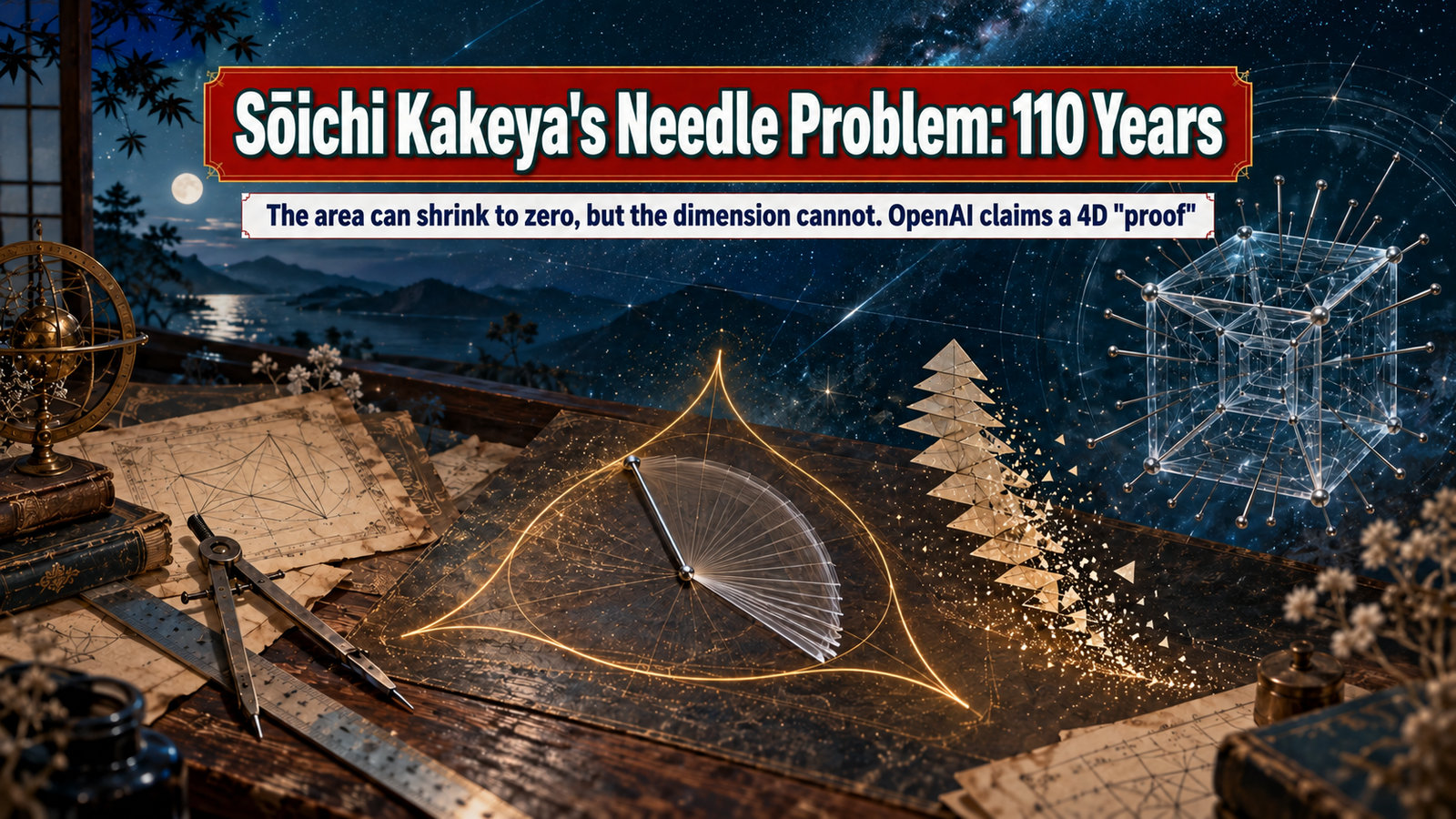
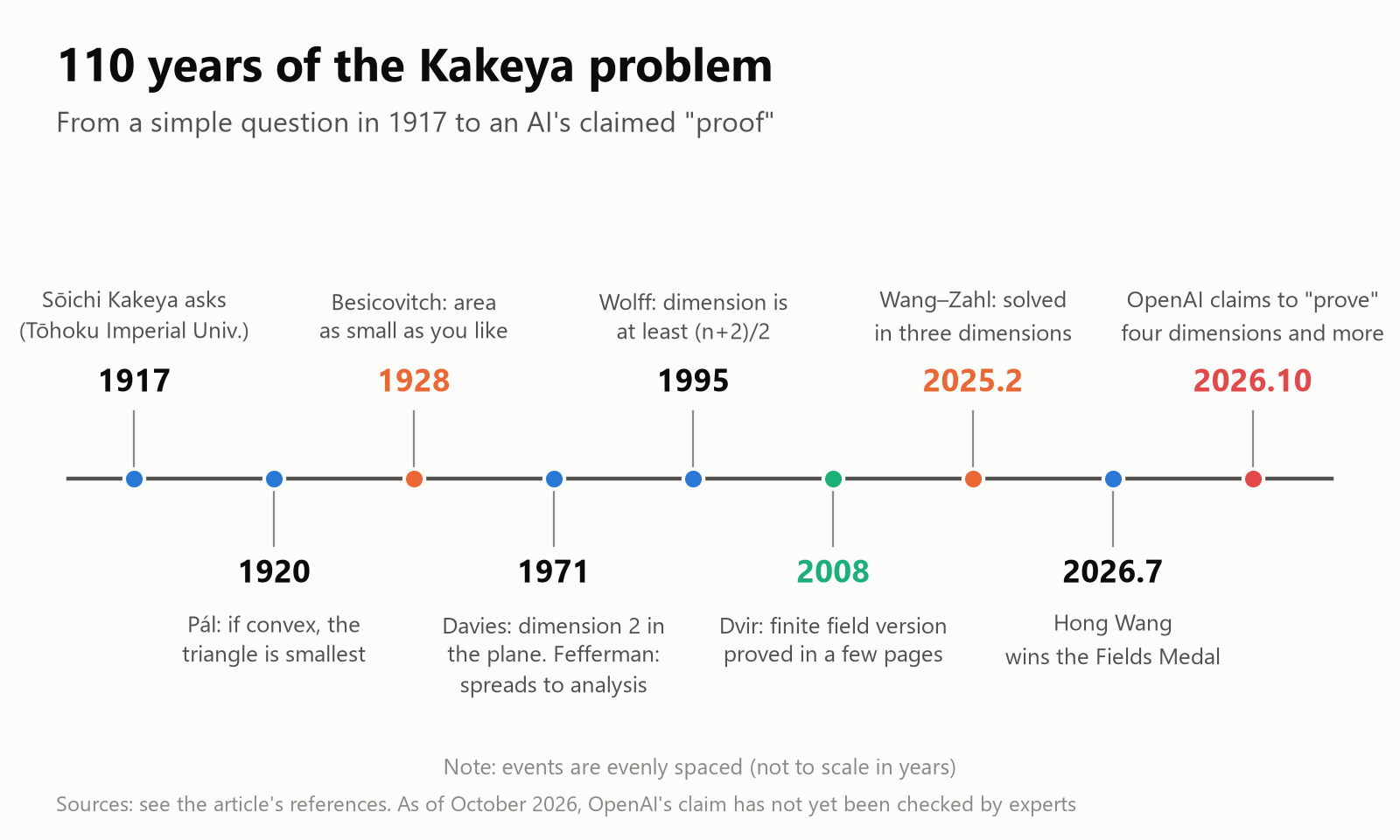
On the morning of October 7, 2026 (Japan time), among the 722 mathematical manuscripts OpenAI released all at once on GitHub was a problem bearing a Japanese name: "Kakeya." It is the "needle problem" posed in 1917 by Sōichi Kakeya, a mathematician at Tōhoku Imperial University.
The question goes like this. You want to spin a needle of length 1 all the way around on a flat desk. What is the smallest area you need to do it?
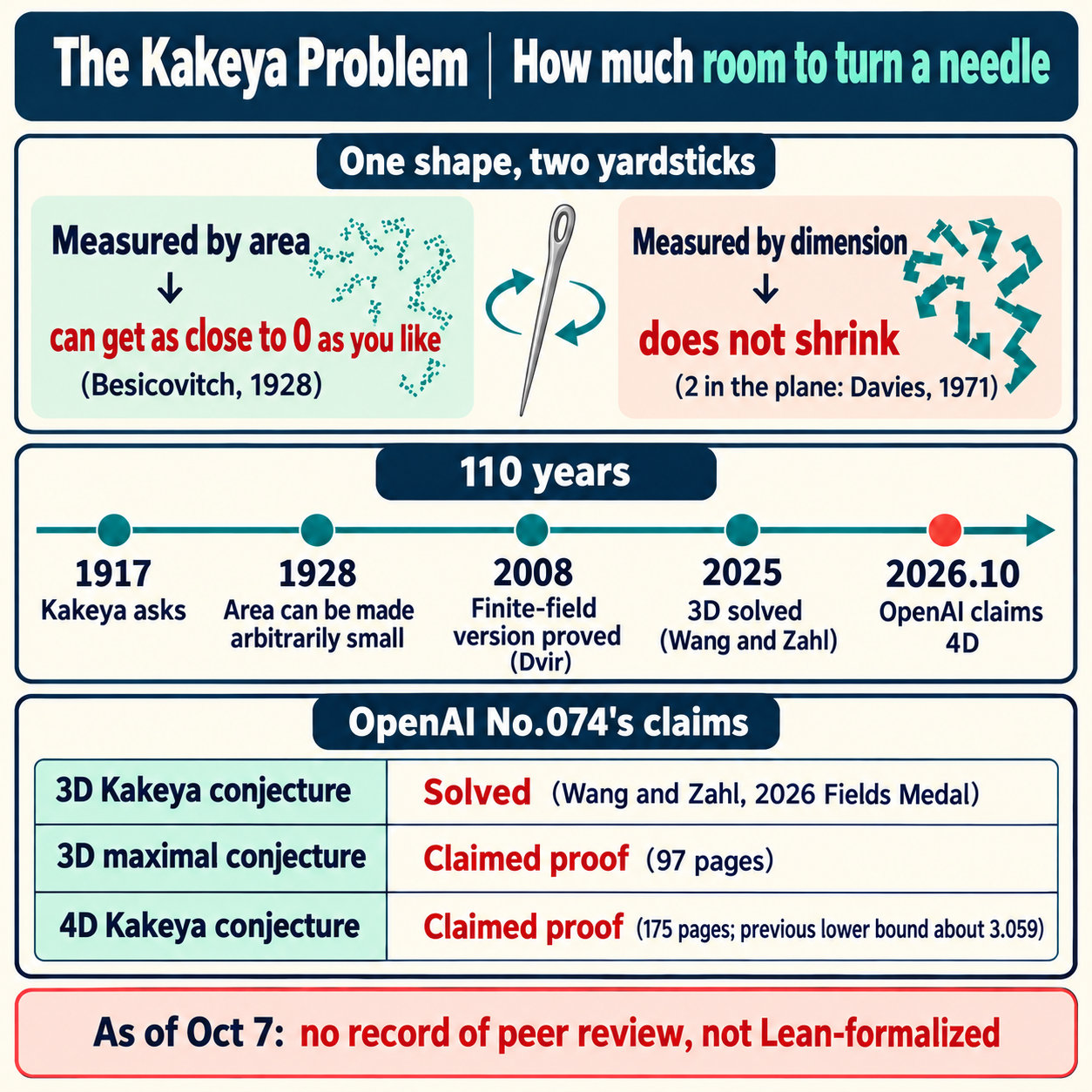
The answer: "as small as you like." After this strange answer appeared, the question changed shape into another yardstick, "dimension," and over 100 years it worked its way into the center of mathematics. In 2025 humans solved the three-dimensional case, and now OpenAI's AI claims to have "proved the four-dimensional case."
Checking that claim is still ahead.
1917: a question about turning a needle, born in Sendai
Sōichi Kakeya was born in 1886 in Tsubō Village, Fukayasu District, Hiroshima Prefecture (today part of the city of Fukuyama). He studied mathematics at Tokyo Imperial University and in 1912 became an assistant professor at Tōhoku Imperial University.
The needle problem was born during these Tōhoku years. In 1917 Kakeya, together with his colleague Matsusaburō Fujiwara, published the question in a scholarly journal based at Tōhoku.
Kakeya later moved to Tokyo. In 1928 he received the Imperial Prize of the Imperial Academy (today's Japan Academy), and that same year he gave an invited lecture at the International Congress of Mathematicians in Bologna. Late in life he also served as the first director of the Institute of Statistical Mathematics.
A story has come down that when the mathematician Kentaro Yano later asked him where the idea came from, Kakeya answered: "Samurai took their spears with them even into the privy. What would you do if you had to swing a spear around in a cramped space?" No such remark, however, has been found in Kakeya's research notes, and it has been confirmed that several people at Tōhoku University had a hand in shaping the problem.
The most straightforward answer is a circle of diameter 1. Put the middle of the needle at the center of the circle and simply spin it, and it makes a full turn.
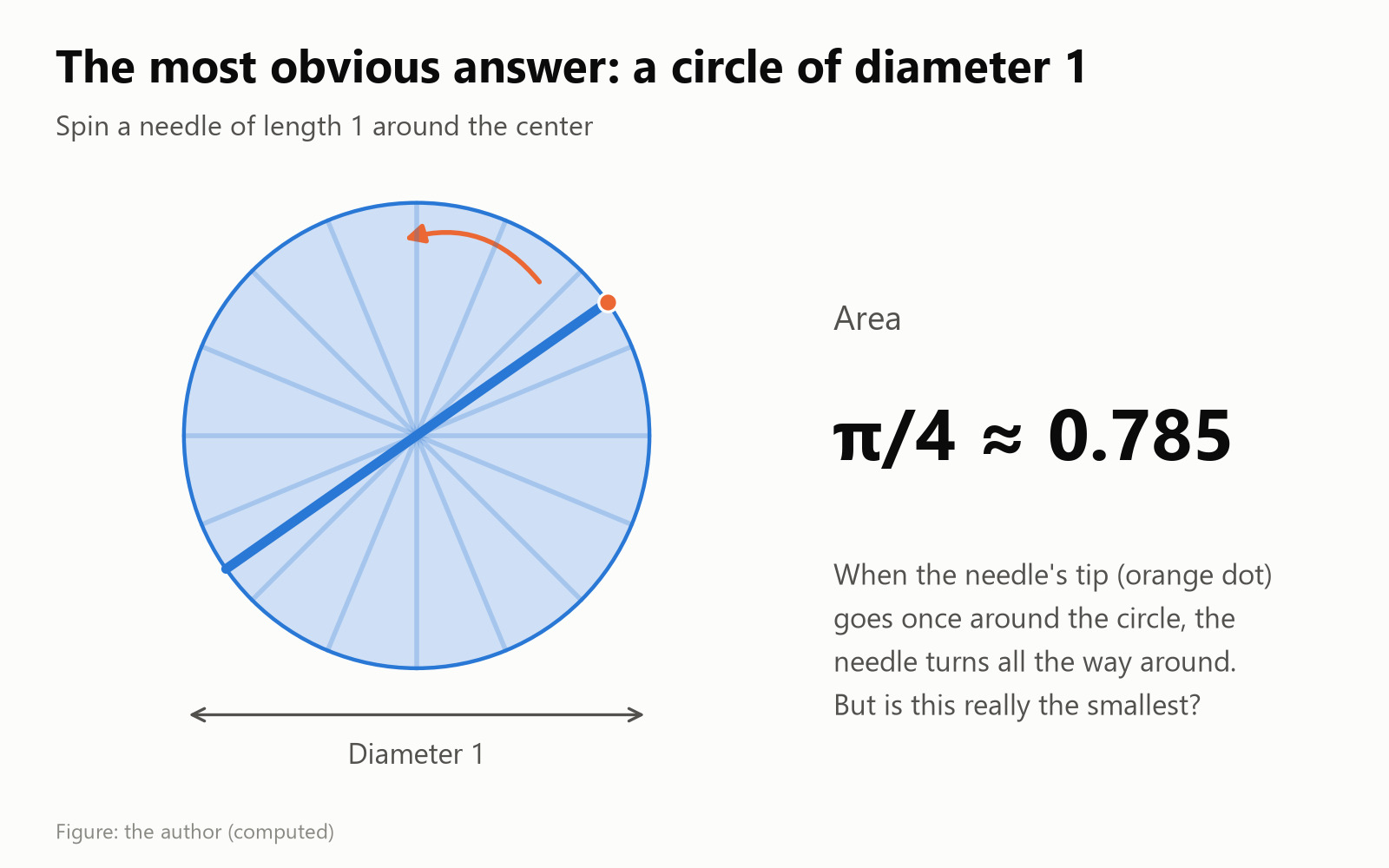
Its area is about 0.785. But smaller shapes exist. According to Japanese records, the first shape Kakeya pointed to was the plump, rice-ball-shaped "Reuleaux triangle" (area about 0.705).
A smaller answer was soon found: an equilateral triangle of height 1.
Rotate the needle 60 degrees about a vertex, slide it along a side, and rotate it 60 degrees again at the next vertex. Repeat this 3 times and the needle points the opposite way; keep going and it makes a full turn.
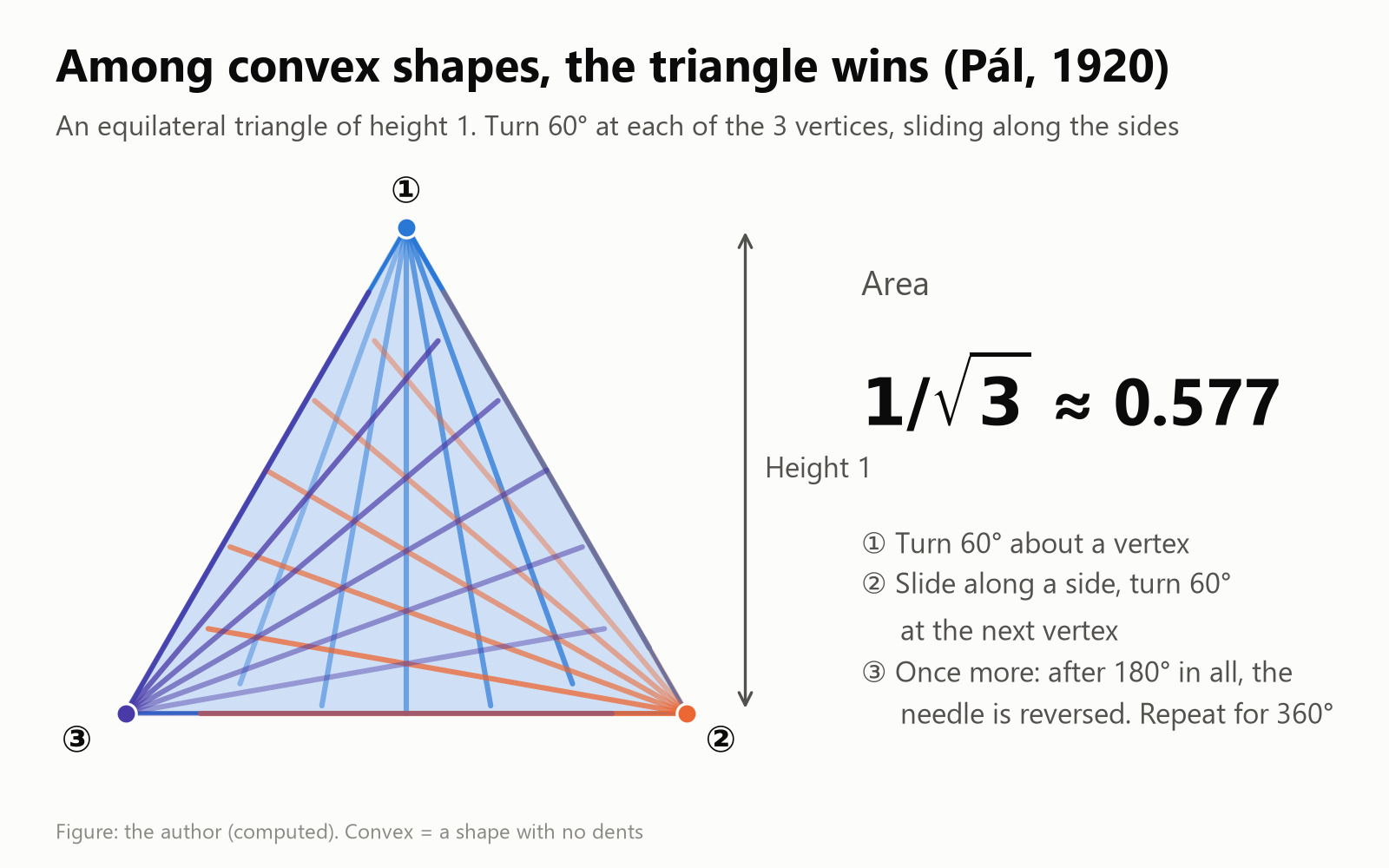
In 1920 the Hungarian mathematician Pál proved that, among shapes without dents (convex shapes), this equilateral triangle is the smallest. Its area is about 0.577.
The shape Kakeya thought might be the smallest
Allow dents, and you can go smaller. The shape Kakeya is said to have suspected was the minimum is a curve with three cusps called the "deltoid."
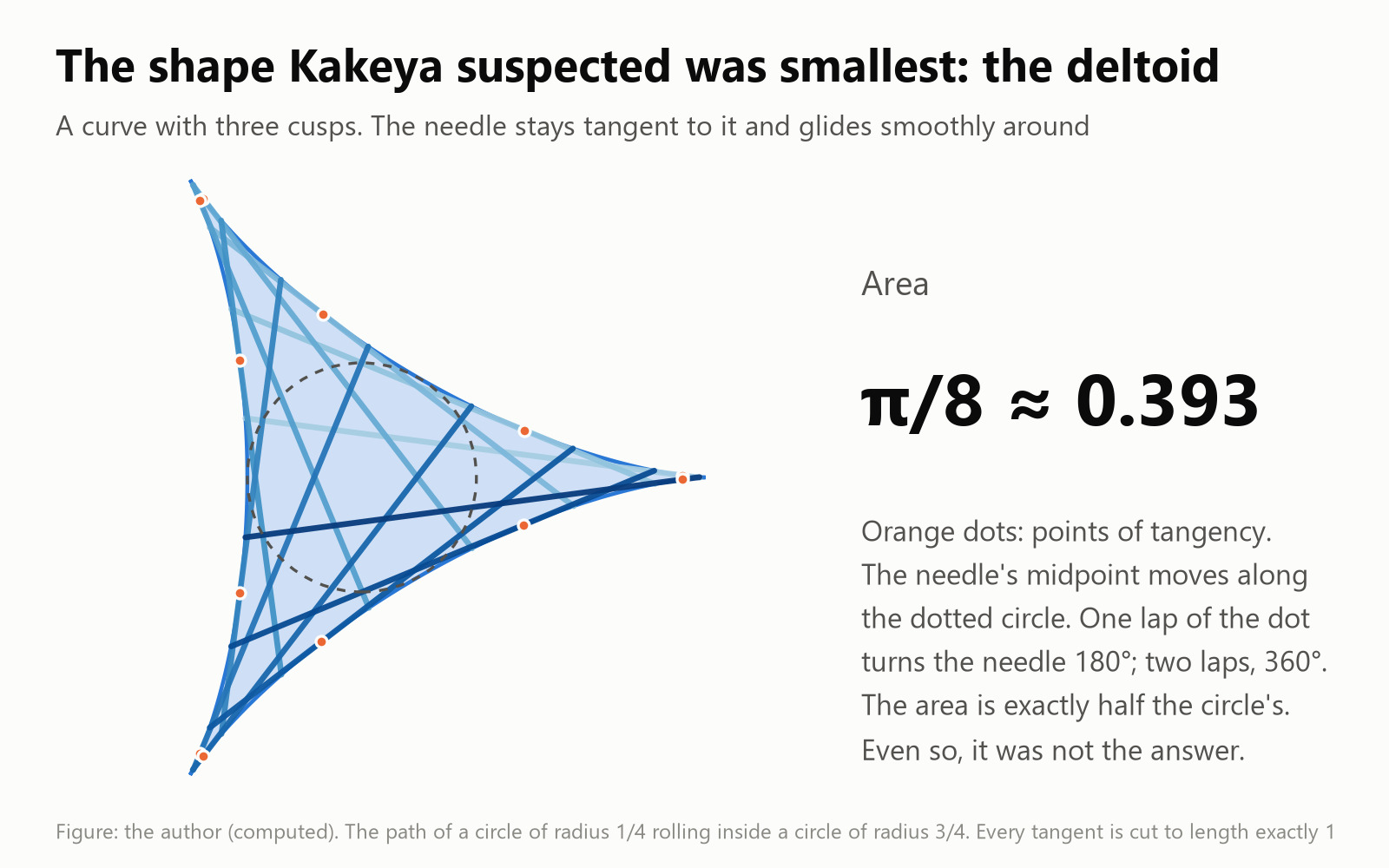
The deltoid is the path traced by a point on the rim of a circle of radius 1/4 as it rolls around the inside of a circle of radius 3/4. The curve has a special property: wherever you draw a tangent line, the length the curve cuts off is exactly 1. The needle can glide around, always tangent to the curve, changing direction smoothly.
Its area is π/8, about 0.393: exactly half that of the circle.
Beautiful in shape, neat in its arithmetic. It was only natural that many people took this to be the answer.
The answer is "as small as you like": Besicovitch's reversal
The man who overturned that answer was Abram Besicovitch, a mathematician born in the Russian Empire.
In 1919, in Perm during the Russian Civil War, Besicovitch was working on a different problem, one about integrals, when he ended up constructing a shape that contains line segments pointing in every direction and yet has area 0. The paper was buried amid Russia's political turmoil, and only a handful of people knew of it.
In 1928 he connected it to Kakeya's problem. The area of a shape in which a needle can be turned all the way around can be made as small as you like. Name any tiny number, 0.1 or 0.001, and a shape can be built in which the needle turns within an area smaller than that.
That same year the German mathematician Perron simplified the construction. Because of its shape, it is called the "Perron tree."
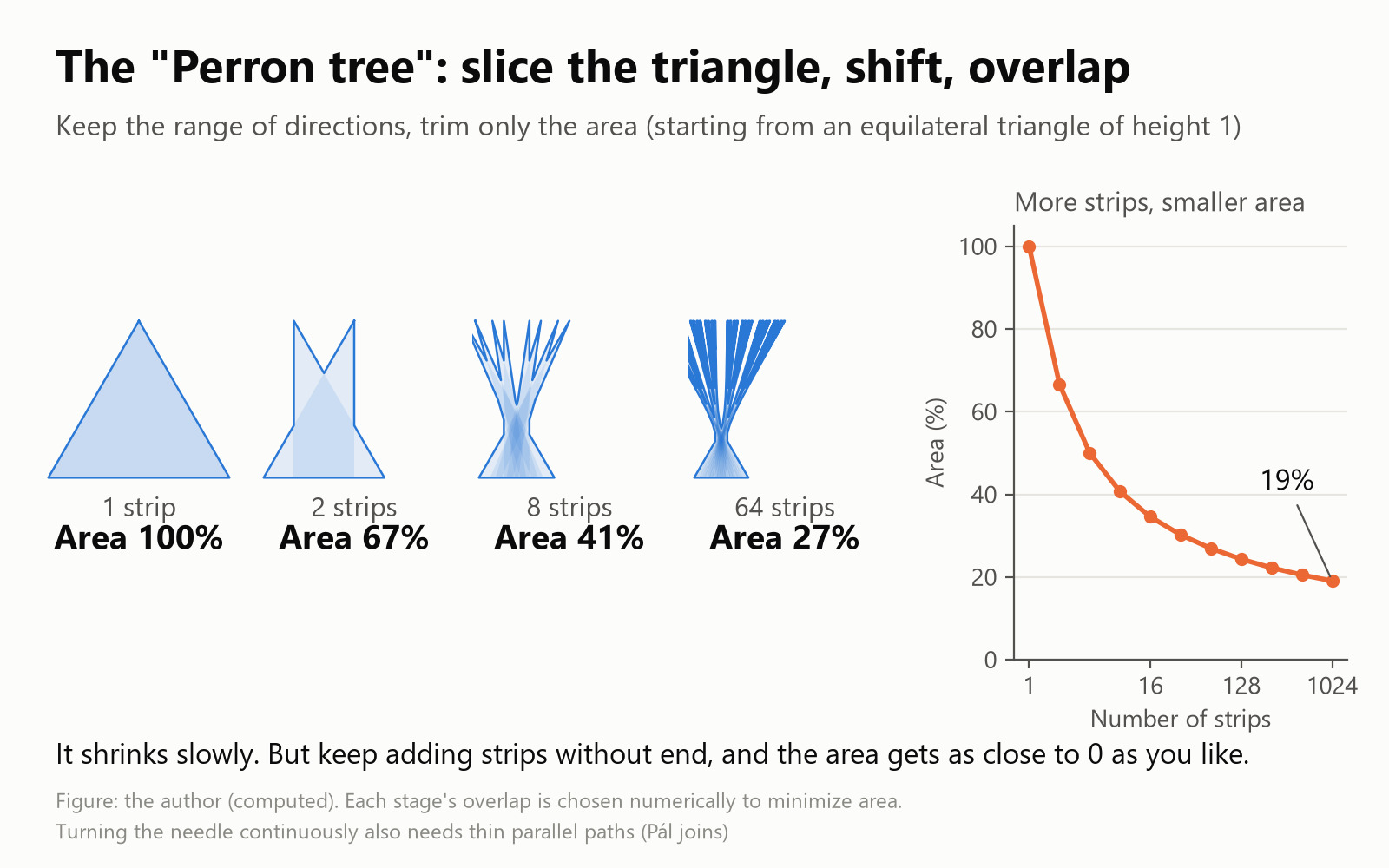
The method is to slice a triangle vertically into thin strips and slide neighboring strips sideways so they overlap. Each strip keeps its original orientation, so the shape as a whole still contains segments in the same range of directions as the original triangle. Whatever overlaps is area saved.
The figure starts from an equilateral triangle of height 1 and shows the result of optimizing the overlaps by calculation. Even cut into 1,024 strips, the area is still 19% of the original. It shrinks astonishingly slowly, but if you keep increasing the number of slices without end, the area gets as close to 0 as you like.
Actually turning the needle continuously takes one more trick. When it has to move over to a parallel position, sliding it a long way along a path shaped like the letter "N" makes the extra area it sweeps as small as you like. This way of joining the pieces was devised by Pál, whom we met earlier.
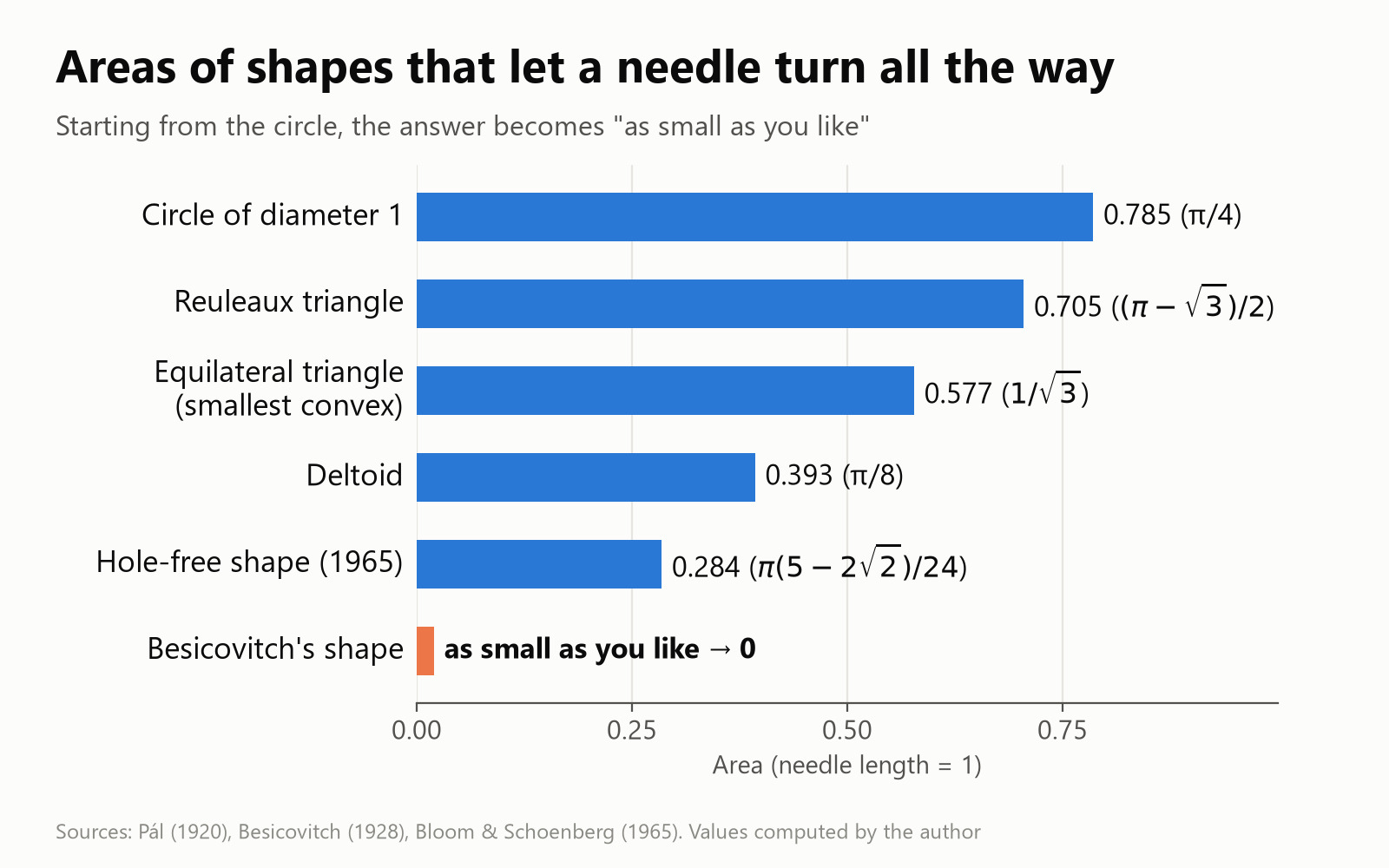
One caveat. The area of a shape in which the needle turns continuously can be made "as small as you like," but it always stays above 0. What can have area 0 is a shape that merely "contains segments in every direction."
Area 0, yet not "thin": the question turns to "dimension"
A shape with area 0 seems like a sparse set with almost nothing in it. Yet here the story enters a new phase.
Mathematics has a way of measuring "size" other than area. That is dimension.
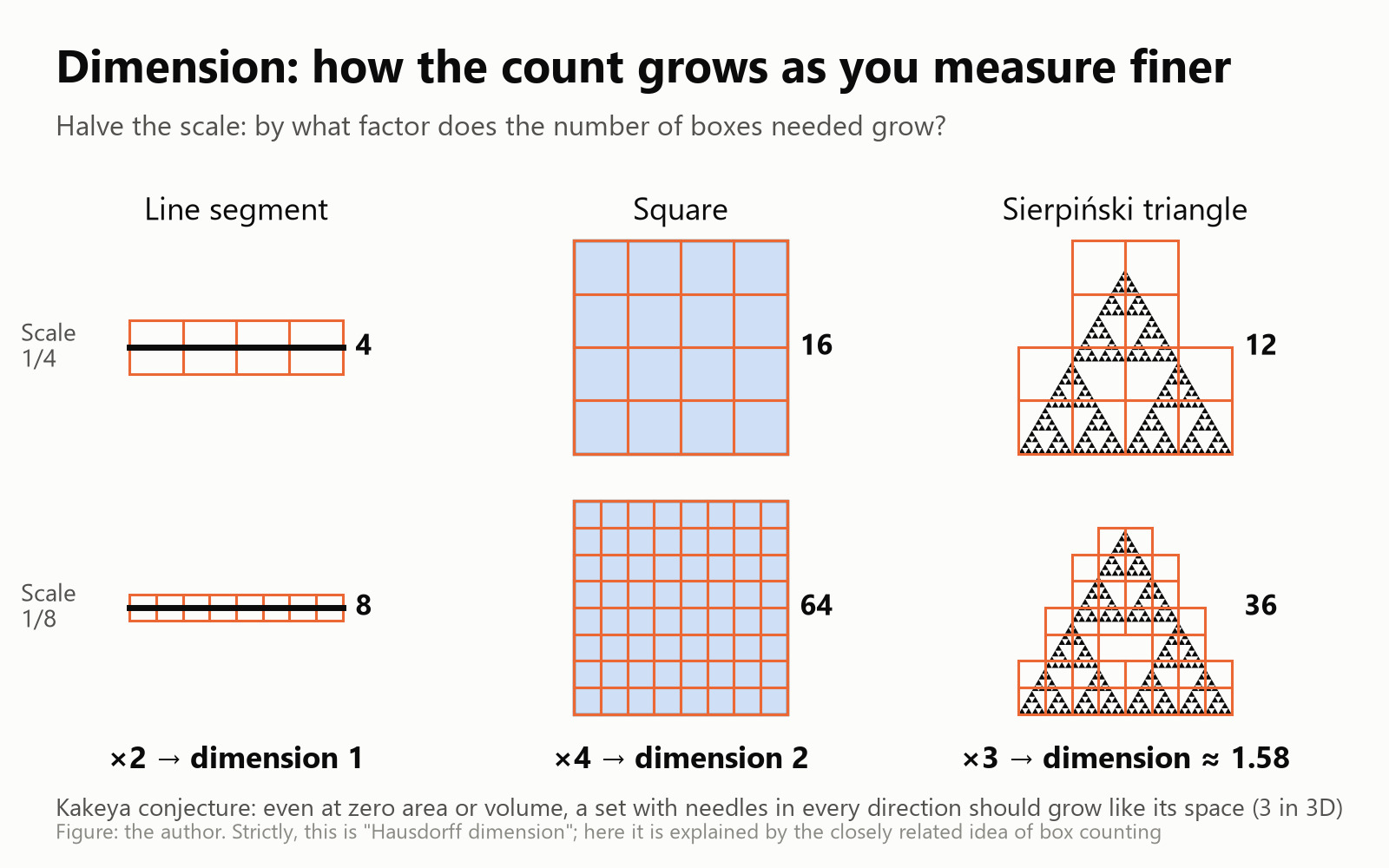
The number of boxes needed to cover a line segment doubles when you halve the scale. For a square, it quadruples.
The power of 2 that this factor corresponds to is the dimension. For the "Sierpiński triangle," made by repeatedly removing the middle of a triangle, the factor is 3, and the dimension comes out at an in-between value of about 1.58.
In 1971 Davies in Britain proved that a shape in the plane that "contains segments in every direction" always has dimension 2, even if its area is 0. Measured by area it is close to "nothing"; measured by dimension, it is no different from a shape that fills the whole plane.
What about three-dimensional space, then? A solid containing needles in every direction can have volume 0, but does its dimension stay at 3? This is the question now called the "Kakeya conjecture."
In the same year, 1971, Fefferman used Besicovitch's shape to show that a natural conjecture in "Fourier analysis," which represents functions by superimposing waves, fails. The way thin tubes overlap as they change direction turned out to be the very way waves overlap. From then on, the Kakeya conjecture was bound up with a large family of problems in analysis, becoming a hard problem that America's Quanta Magazine described as one that "has bedeviled mathematicians for 50 years."
In the finite world of grids, it fell in a few pages
In 2008 light came from an unexpected direction. Zeev Dvir, an Israeli-born computer scientist, proved the "finite field version" of the Kakeya conjecture.
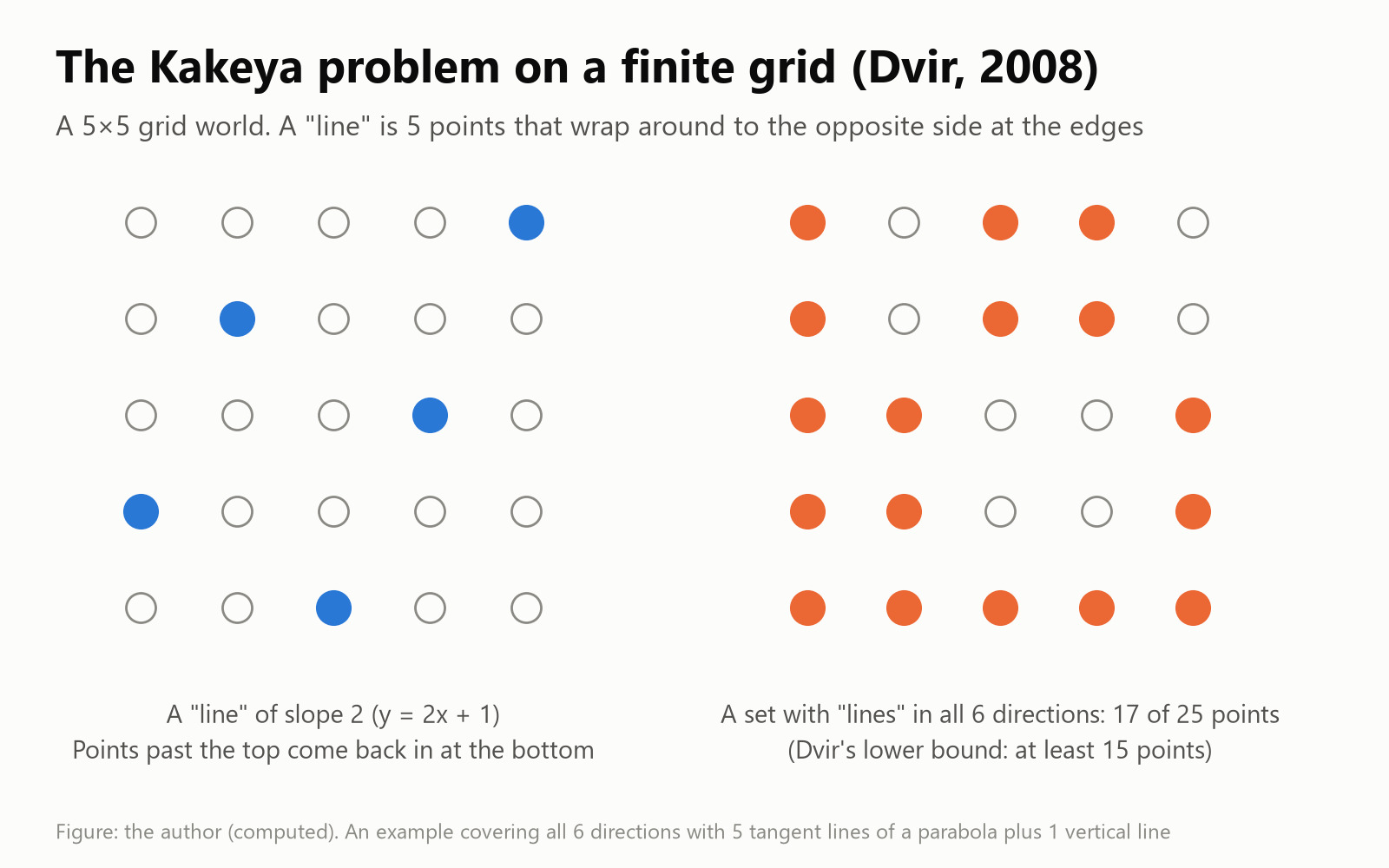
The stage is a grid world with only finitely many points. A "line" there is a row of points that, on reaching the edge, comes back in from the opposite side. Even in this world, the finite field conjecture said, a set containing lines in every direction should take up a sizable fraction of the whole.
Dvir's proof uses polynomials, a tool taught in middle school. If the set is too small, you can build a low-degree polynomial that passes through all of it, and a contradiction arises on each line.
That skeleton is almost the entire proof. The Fields medalist Terence Tao wrote on his blog: "The proof is so short that I can present it in full here."
The finite-world proof, however, could not be carried straight over to the Kakeya conjecture in continuous space. The main fortress was still standing.
2025: humans solve three dimensions
On February 24, 2025, Hong Wang of New York University and Joshua Zahl of the University of British Columbia posted a 127-page paper. Its conclusion: "Every Kakeya set in ℝ³ has Minkowski and Hausdorff dimension 3." The three-dimensional Kakeya conjecture was solved.
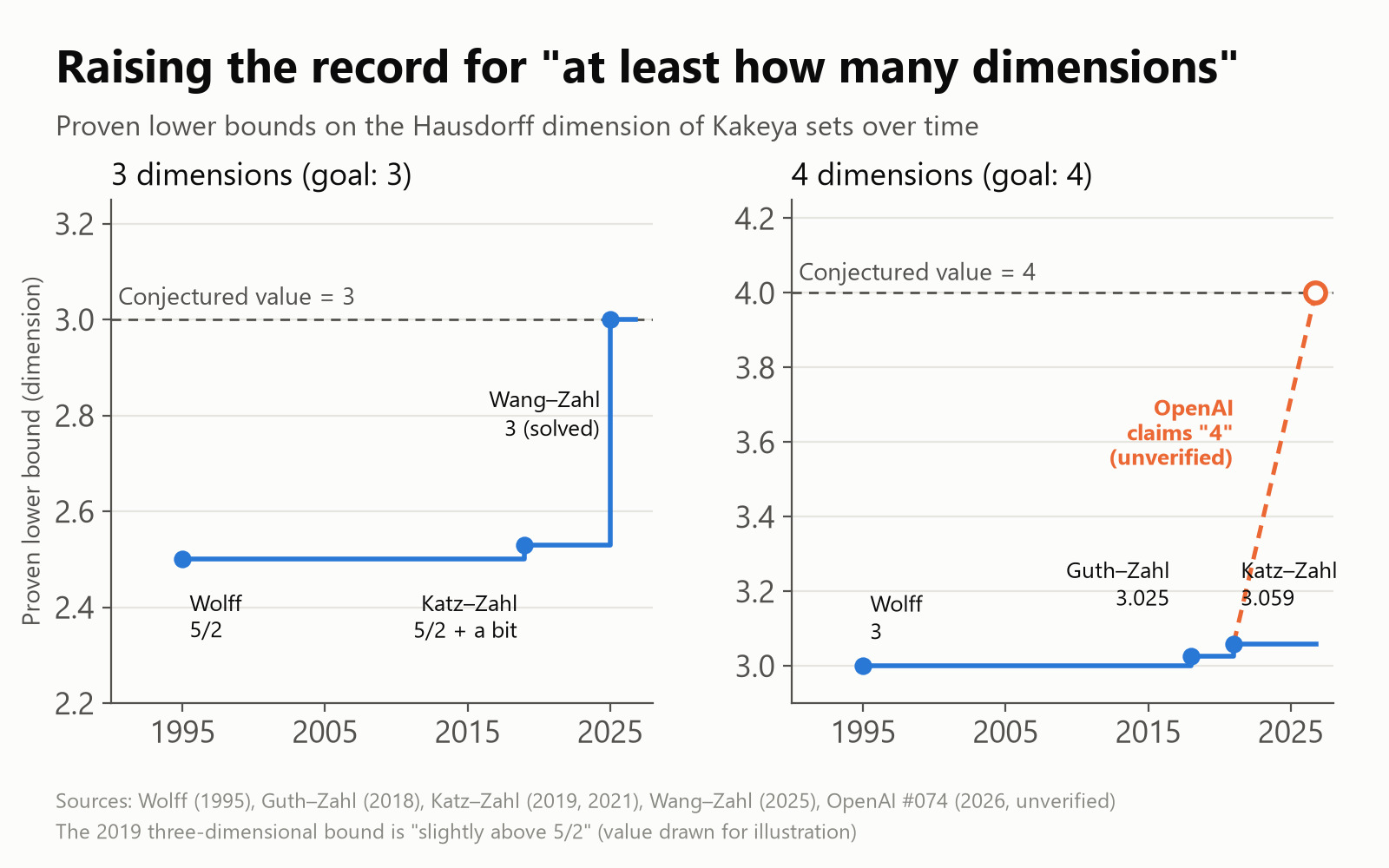
For 30 years after Wolff showed "at least 2.5" in 1995, the record crept up in tiny steps. From there it leapt all the way to 3.
In a Quanta Magazine article, Nets Katz of Rice University said, "This thing doesn't need hyping up. It's a once-in-a-century kind of result," and Tao said: "It's like perfecting a perpetual-motion machine. It's magical."
Hong Wang was born in 1991 in Guilin, China. She graduated from Peking University, went on to the École Polytechnique in France, and earned her PhD at the Massachusetts Institute of Technology in 2019.
On July 23, 2026, at the International Congress of Mathematicians in Philadelphia, she received the Fields Medal. The citation named "her proof of the Kakeya conjecture in three dimensions," and she was only the third woman ever to receive it.
A question born in Sendai in 1917 was solved 108 years later and, 109 years later, brought mathematics' highest honor.
What does OpenAI's "No. 074" claim?
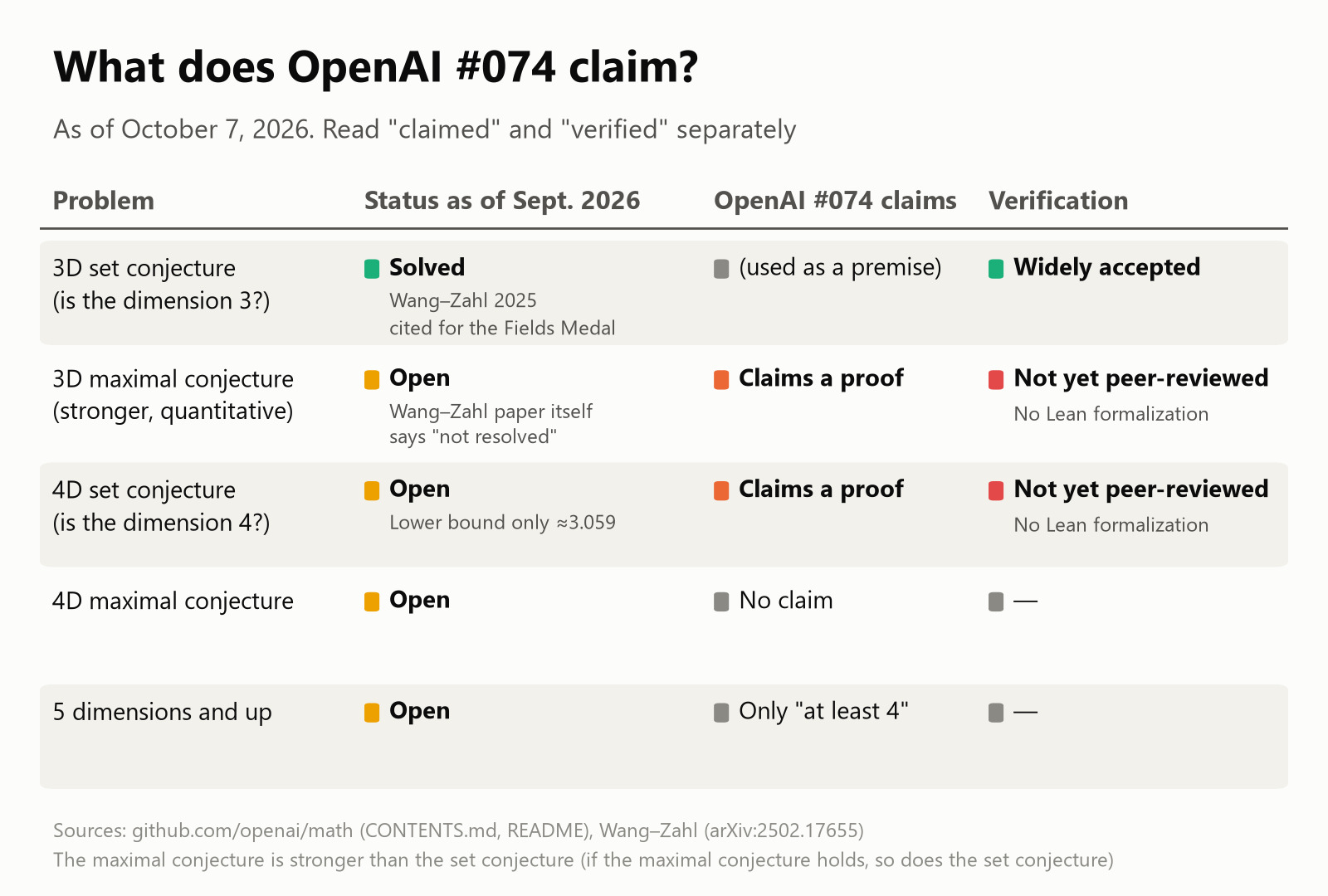
In this release OpenAI put out two papers as result number 074, "Kakeya in three and four dimensions." They make the following two claims.
- The three-dimensional "Kakeya maximal conjecture": 97 pages. A quantitatively strengthened version of the conjecture Wang and Zahl solved
- The four-dimensional Kakeya conjecture (Hausdorff dimension): 175 pages. A set in four-dimensional space containing line segments in every direction has dimension 4
What does the three-dimensional "maximal conjecture" add to Wang–Zahl?
Wang and Zahl's paper itself draws the line: "While we do not resolve the Kakeya maximal function conjecture in ℝ³, the weaker statement given in Theorem 1.2 is nonetheless sufficient to obtain Theorem 1.1 [that the dimension is 3]."
The maximal conjecture treats the shape as a bundle of thin tubes and guarantees, through an inequality in its most efficient form, that "even if you use only part of each tube, the tubes do not overlap too much." In Wang and Zahl's theorem, the estimate of what is lost in this "only part of each tube" case is coarse: it reaches the conclusion about dimension, and the maximal conjecture remains beyond it.
OpenAI's three-dimensional paper claims to close exactly this gap. If the maximal conjecture holds, the original Kakeya conjecture (dimension 3) follows automatically. In other words, it is a stronger claim that contains Wang and Zahl's result.
The starting point, though, is human work. The paper builds on an estimate from a "streamlined proof" (posted in January 2026) by three people: Wang and Zahl, joined by Larry Guth of the Massachusetts Institute of Technology, who was also Wang's doctoral advisor.
Four dimensions: "the dimension is 4"
In four dimensions, the best humans had proved was "at least about 3.059." OpenAI's paper claims to raise this in a single stroke to 4. The paper stresses that it imposes no technical conditions at all, such as whether the set is measurable.
The four-dimensional paper uses lemmas from the three-dimensional paper in the same release as components. If the three-dimensional claim falls, the four-dimensional proof loses those components.
The scope of the claim, it should be noted, stops at the three-dimensional maximal conjecture and the four-dimensional Kakeya conjecture; the four-dimensional "maximal conjecture" and the Kakeya conjecture in five or more dimensions lie outside it. For five dimensions and up, it offers only a by-product statement: "at least 4."
Between "claimed to have proved" and "proved"
OpenAI's repository includes results with a Lean formalization; Lean is a programming language in which a computer can check a proof line by line. Of the 372 result families, 235 link to Lean, and No. 074 is among the remaining 137 without a link.
The README states plainly: "Some of the unformalized results could have issues." As of October 7, 2026, records of experts peer-reviewing the 97-page and 175-page papers also stood at zero, as far as could be found.
Reactions are still at the breaking-news stage.
Paata Ivanisvili of the University of California, Irvine posted: "Kakeya in 3D won a Fields Medal. Kakeya in 4D was solved by AI. Let that sink in."
Rodrigo Porto of Princeton University was openly astonished too: "Kakeya maximal conjecture solved?! It's a stronger version of the Kakeya conjecture."
Andrew Sutherland of the Massachusetts Institute of Technology, on the other hand, told Scientific American that until the model is released and people can replicate the results, such claims should be treated "as unverified. We should ask for receipts."
The Advisory Group on Mathematics and Artificial Intelligence at the Institute for Advanced Study in Princeton, which OpenAI consulted, also issued a statement: "This release is the beginning, not the completion, of the process of human understanding and the incorporation of the work into mathematical knowledge."
Wang and Zahl's paper, too, was read closely by experts from the moment it appeared; expository papers and streamlined proofs followed, and only then did "solved" take hold. No. 074's several hundred pages have only just reached the entrance to that process.
Change the yardstick, and the same thing shows another face
The Kakeya problem survived for 110 years because, after the answer had once ended at "0," the question was reborn by changing how it measured.
Measured by area, next to nothing. Measured by dimension, full marks. The same shape received opposite verdicts, depending on a single yardstick.
The same thing happens at work.
A department that, measured by cost, ought to be trimmed turns out, measured by another metric, to be carrying the backbone of the business. Such cases are common. Once you decide which yardstick to measure with, half the answer is already settled.
The other lesson is to read "claims" and "verification" separately. The size of an announcement and the degree to which it has been checked are different things. What is certain about OpenAI's announcement this time goes only this far: "An AI has written proofs totaling more than 270 pages on the three-dimensional maximal conjecture and the four-dimensional Kakeya conjecture, and claims they are correct."
The single needle Kakeya turned on his desk is now about to be turned in four-dimensional space. Confirming whether it really made it all the way around will remain human work.
References
- The Kakeya maximal conjecture in three dimensions (OpenAI, GitHub)
- Every four-dimensional Kakeya set has full Hausdorff dimension (OpenAI, GitHub)
- openai/math README and CONTENTS (GitHub)
- Sharing AI progress in mathematics (OpenAI)
- Volume estimates for unions of convex sets, and the Kakeya set conjecture in three dimensions (Wang and Zahl, arXiv)
- A Survey of the Kakeya conjecture, 2000–2025 (Zahl, arXiv)
- 'Once in a Century' Proof Settles Math's Kakeya Conjecture (Quanta Magazine)
- On some problems of maxima and minima for the curve of constant breadth and the in-revolvable curve of the equilateral triangle (Tôhoku Mathematical Journal, J-STAGE)
- Sōichi Kakeya (Japanese Wikipedia)
- Sōichi Kakeya (Wikipedia)
- Kakeya set (Wikipedia)
- Abram Samoilovitch Besicovitch (MacTutor)
- On the size of Kakeya sets in finite fields (Dvir, arXiv)
- Dvir's proof of the finite field Kakeya conjecture (Terence Tao, What's new)
- Hong Wang (Wikipedia)
- Hong Wang Wins the Fields Medal (NYU Courant)
- Mathematician Hong Wang awarded the 2026 Fields Medal (CNRS)
- Josh Zahl and Hong Wang Prove the Kakeya Conjecture in Three Dimensions (UBC)
- OpenAI unleashes hundreds more math results upon a field already in shock (Scientific American)
- Mathematicians React With Shock And Wonder After OpenAI Releases Over 300 Math Proofs At Once (OfficeChai)
- OpenAI just posted hundreds more results on major math problems (Engadget)
- On OpenAI's release of mathematical results (AGMAI)