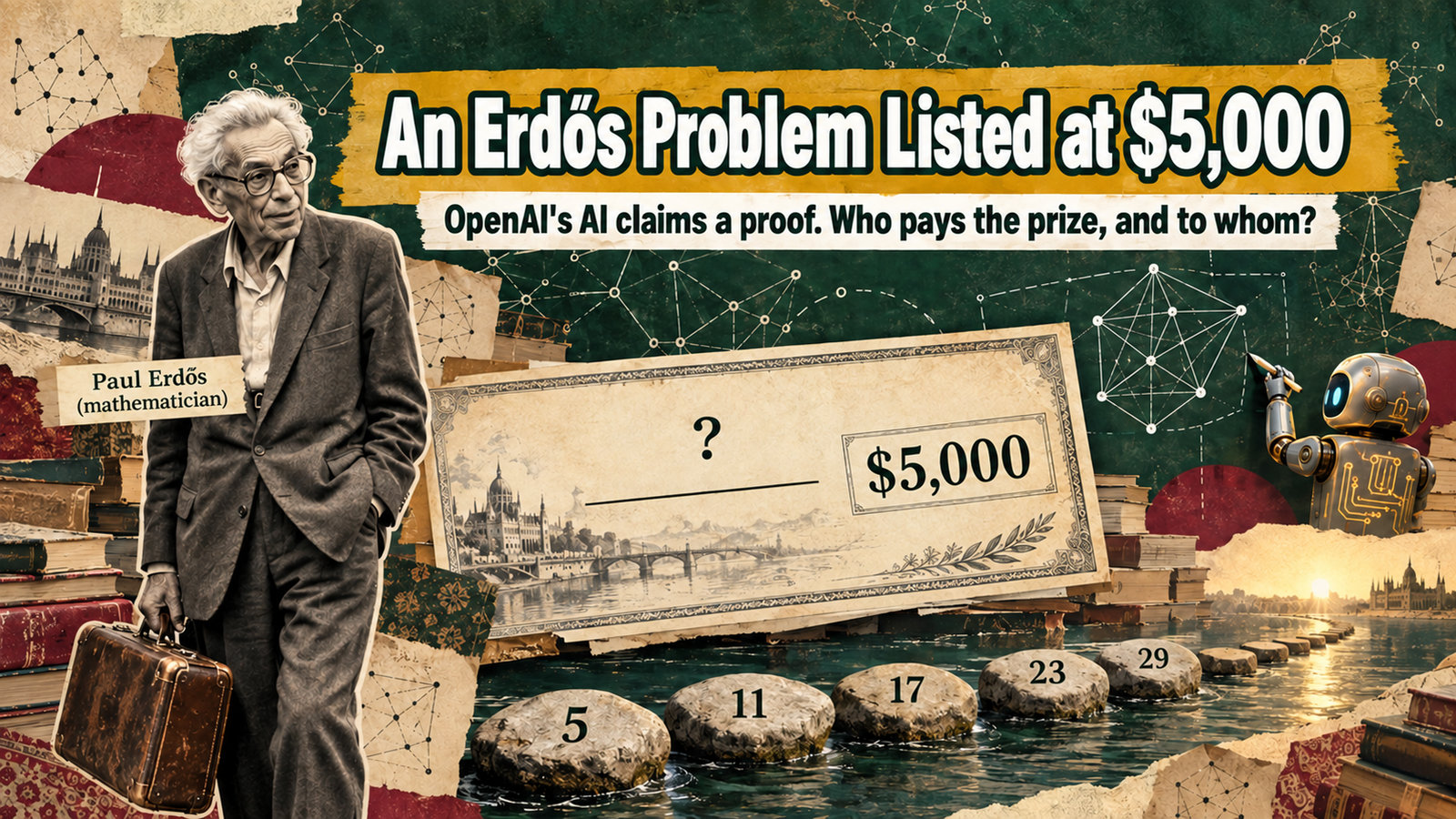
In October 2025, posts claiming that "GPT-5 solved 10 open Erdős problems" raced across social media, and before long most of them were deleted. What the AI had turned up was not new proofs but papers that were already sitting in the library.
A year later, on October 6, 2026 (US time), OpenAI released 722 mathematical manuscripts written by an unreleased internal AI model, and among them it claims to have "proved" a conjecture on which Erdős put a prize (the prize is currently $5,000, as displayed on the site that manages the problems).
The man who put up the prize had written this in the record of a 1976 lecture: "I do not expect to have to pay for it."
If the claim is genuine, who pays this prize, and to whom? Following the answer shows us how to read news that "AI solved it."
"Solved 10 problems" turned out to be answers found in the library
It started with a post by OpenAI executive Kevin Weil: "GPT-5 found solutions to 10 (!) previously unsolved Erdős problems and made progress on 11 others."
The first to react was Thomas Bloom, the mathematician who runs erdosproblems.com, a site that collects Erdős's problems. He called the post "a dramatic misrepresentation." On his site, "open" meant only that Bloom personally did not know of a paper that solved the problem.
What GPT-5 had actually done was track down existing papers that Bloom had not known about. Google DeepMind CEO Demis Hassabis wrote, "This is embarrassing," and Meta's Yann LeCun answered with sarcasm. OpenAI's researchers also acknowledged that only solutions already in the literature had been found, and many of the original posts were taken down.
Searching the literature is fine work in its own right. The ability to dig up scattered papers is of real use to researchers.
But "solved" and "found" are entirely different claims. The FAQ on Bloom's site had said so all along: "Do not assume that an 'unsolved' problem is in fact unsolved, and do your own literature search before investing significant effort into finding a solution."
The man who handed out problems and prizes from a single suitcase
Paul Erdős was born in Budapest in 1913. Over his lifetime he wrote about 1,500 papers, with as many as 511 coauthors. He had no settled home, and traveled the world with a single suitcase, moving from one mathematician's house to the next.
He would turn up at the door announcing, "My brain is open," finish a few papers in a matter of days, and head off to the next house. That way of life is portrayed in Paul Hoffman's biography The Man Who Loved Only Numbers (published in Japanese by Sōshisha) and in the 1993 documentary film N Is a Number.
His vocabulary was all his own, too. Children were "epsilons," after the symbol mathematicians use for a "small quantity"; God was the "SF (Supreme Fascist)." And the book in which God keeps only the most beautiful proofs, he called "The Book."
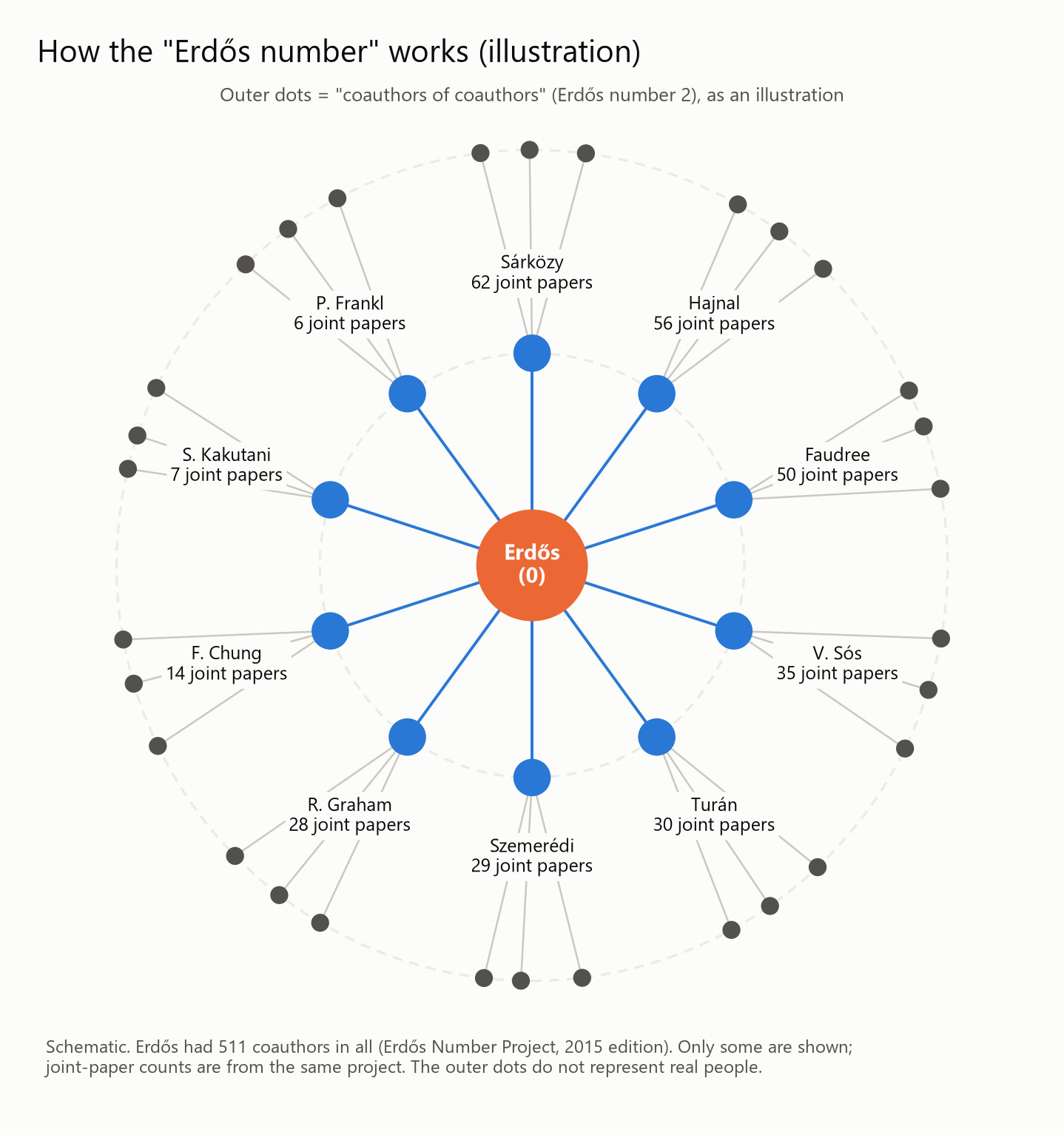
He had so many coauthors that his circle came up with the "Erdős number": Erdős himself is 0, his coauthors are 1, coauthors of coauthors are 2, and so on. The mathematician Casper Goffman put it into print in 1969.
And he put prizes on problems, in amounts ranging from $10 to $10,000.
Much of the prize money and lecture fees he received, it is said, went in turn to supporting students and to prizes for problems. The amount on a check was also a gauge of how hard Erdős judged a problem to be.
There is a Japan connection as well.
In February 1984, to coincide with Erdős's visit to Japan, the Research Institute for Mathematical Sciences at Kyoto University held a short-term workshop, at which Erdős himself spoke. The preface to the proceedings notes that he also lectured in other places, including Tokyo and Okayama, and that "his schedule was changed again and again." His coauthors include Shizuo Kakutani (7 joint papers), and one of them, Peter Frankl, has lived in Japan since 1988.
The homework he began with his close friend Turán
The story of the prizes begins with one close friend.
Erdős met Pál Turán on September 1, 1930, in the mathematics seminar room at the University of Budapest. By Erdős's own account, the two collaborated for 46 years and wrote 28 joint papers. Their contact broke off only during the war years of 1942–45, when Erdős was in the United States and Turán in Hungary.
During that war Turán, because he was Jewish, was conscripted into labor service. The letters the two exchanged once they resumed writing after the war survive in each man's recollections.
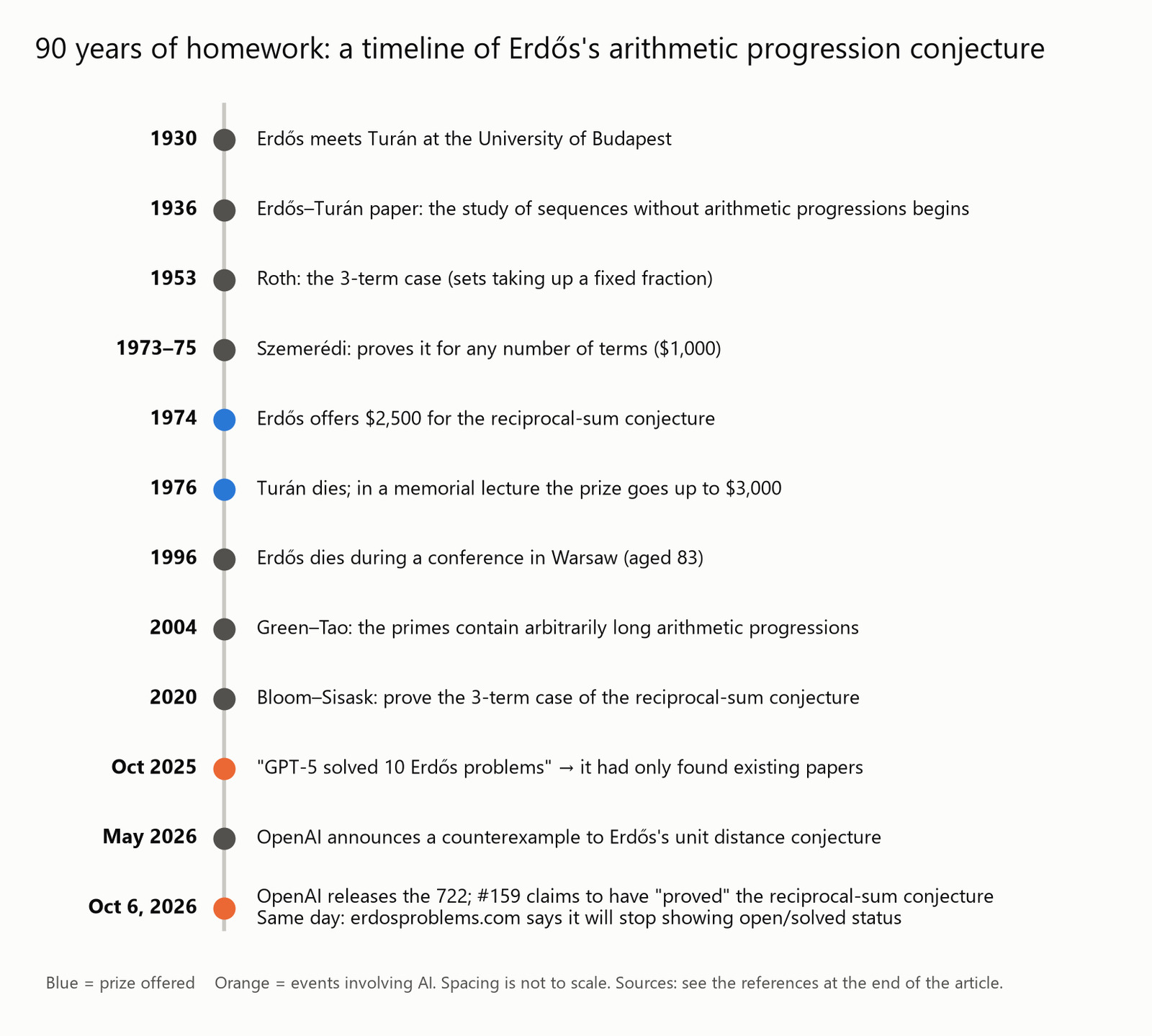
In 1936 the two posed a question in a joint paper: how large can a collection of numbers be if it contains no "arithmetic progression"? An arithmetic progression is a sequence that grows by the same amount each time, like 3, 5, 7 or 10, 20, 30.
As Erdős recalled it, in 1932 the two had conjectured that "any collection of numbers that takes up a fixed fraction of the whole contains arithmetic progressions of any length." The conjecture went unsolved for more than 40 years and carried a prize of $1,000; early in 1973 the Hungarian mathematician Endre Szemerédi proved it. The following year, 1974, Erdős paid the prize.
What does the $5,000 problem say?
Erdős had left behind a conjecture that went one step further. The clue is the arithmetic progressions hidden among the primes.

5, 11, 17, 23, 29 are 5 primes that grow by 6 each time. The next number, 35, is 5×7, so the run breaks off there.
The primes grow sparser the further out you go, and the share of all numbers they take up approaches 0. Even so, do they hide longer and longer arithmetic progressions?
What Erdős fixed on was the "sum of reciprocals." Take each number n in the collection, turn it into 1/n, and add them all up.
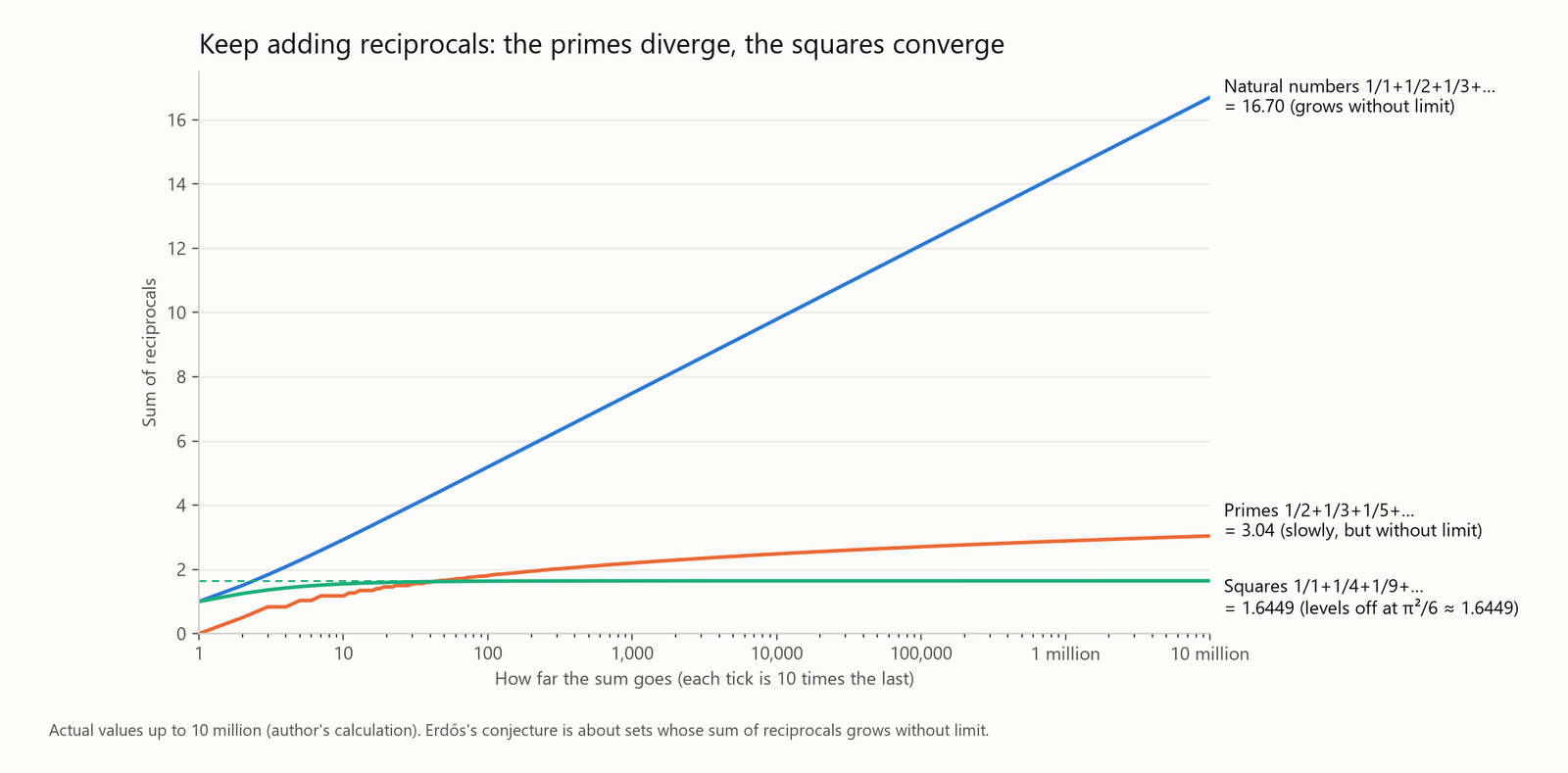
The reciprocals of the squares (1, 4, 9, 16…) level off around 1.6449 however many you add. The reciprocals of the primes, by contrast, reach only about 3.04 even when you add them all the way up to 10,000,000, yet slow as they are, they keep growing without limit. In mathematics, this state of "growing without limit" is called "diverging."
Erdős's conjecture puts it flatly:
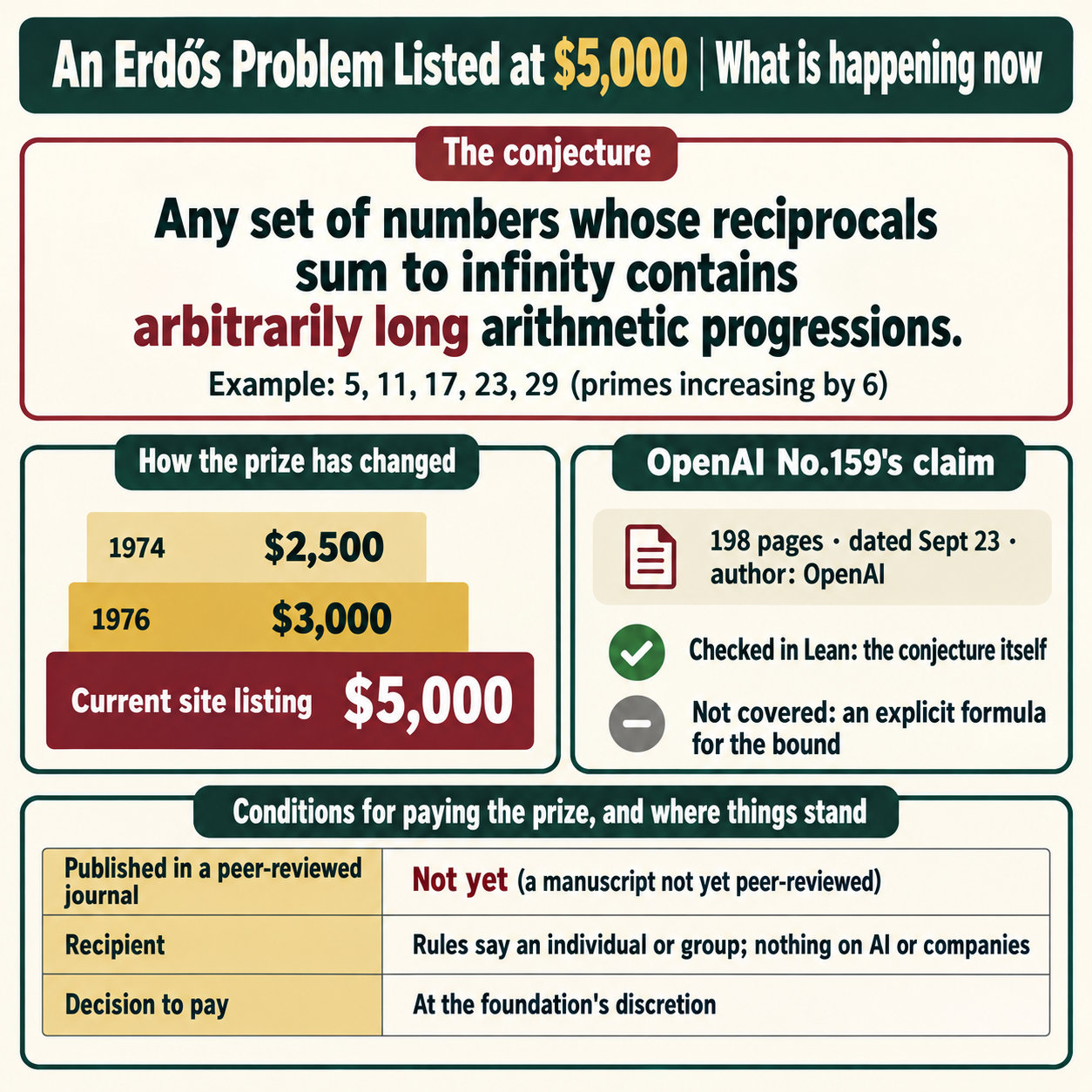
Every collection of numbers whose sum of reciprocals diverges contains arbitrarily long arithmetic progressions.
In a 1974 paper he put $2,500 on this conjecture. In 1976, the year Turán died, he raised it to $3,000 in a memorial lecture and added these lines:
If true this would imply that for every k there are k primes which form an arithmetic progression of k terms. This remark will convince the reader that the conjecture will be very hard to settle, and in fact I do not expect to have to pay for it and often said: I should leave some money for it if I leave (the second leave stands of course for death).
Today erdosproblems.com lists the prize for this problem at $5,000, as the highest amount on record. It is the only problem on the site with $5,000 attached.
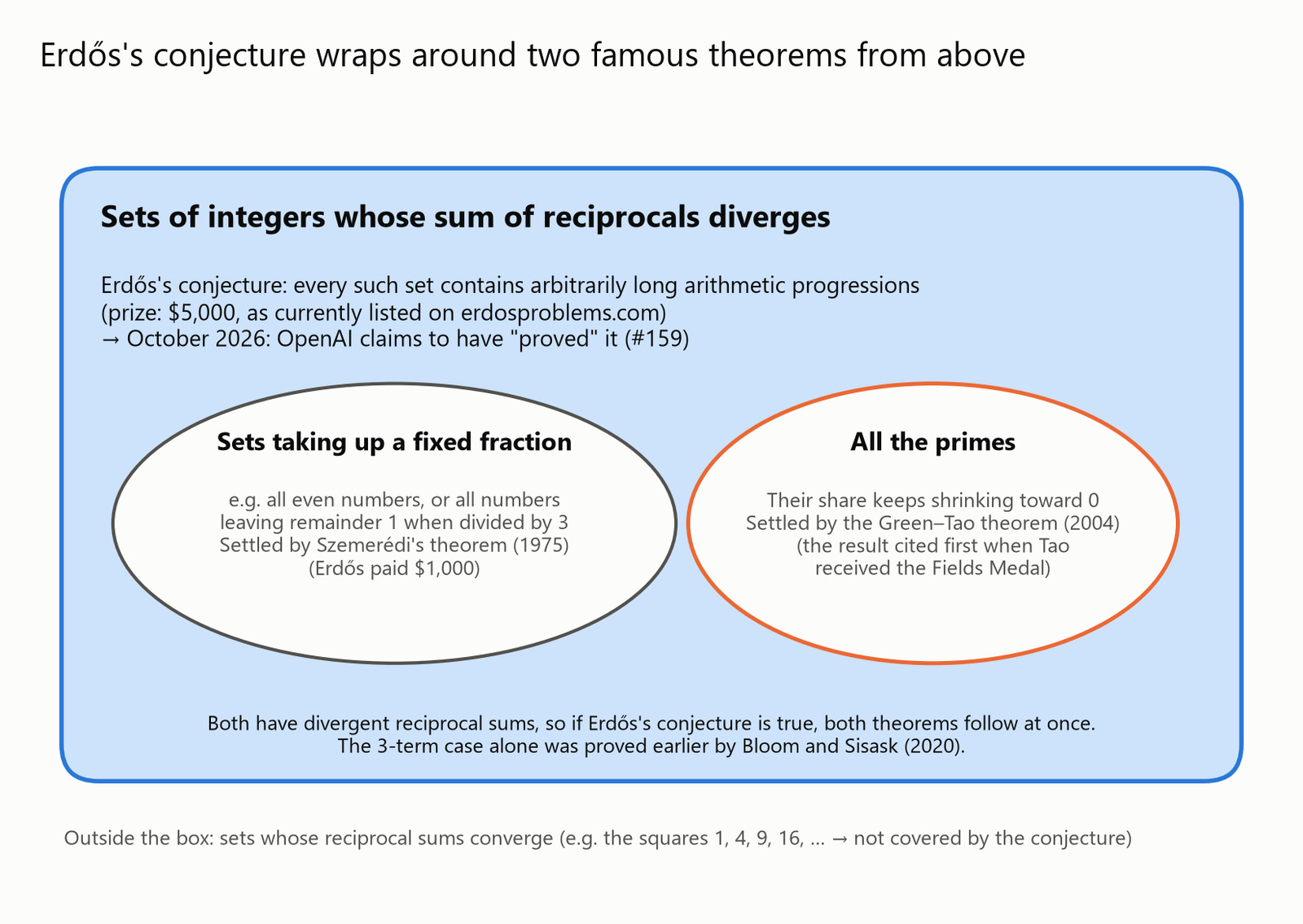
What makes this conjecture so large is that it swallows two famous theorems whole. A collection that takes up a fixed fraction of the numbers and the primes as a whole both have divergent reciprocal sums. If the conjecture is true, then Szemerédi's theorem and the theorem Ben Green and Terence Tao proved in 2004, that "the primes contain arbitrarily long arithmetic progressions," both follow at once.
The latter was the achievement the International Mathematical Union's press materials put first when Tao received the Fields Medal in 2006. Even so, the conjecture itself did not budge. In 2015 the Fields medalist Timothy Gowers called it "possibly the best known of all of Erdős's many conjectures," and noted that even the three-term case was unsolved. The people who proved that three-term case in 2020 were none other than Bloom and his collaborator Olof Sisask.
What OpenAI claims, and what the machine checked
The 722 manuscripts OpenAI released are organized into 372 "result families." According to its account, the model was posed approximately 4,000 problems, and each result used, on average, compute equivalent to about 3 hours of ChatGPT Pro thinking. The arithmetic progression conjecture is the 159th family.
The paper runs 198 pages; the author is listed as "OpenAI" and the date as September 23, 2026. It opens by declaring: "We prove Erdős's conjecture that every set of positive integers with divergent reciprocal sum contains arithmetic progressions of every finite length." The argument pushes down the upper bound on how large a collection without arithmetic progressions can be, then adds these bounds up so that the reciprocal sum is forced to stay finite.
The published summary of the reasoning also shows the instructions given to the model. The first was "Prove or disprove."
The next instruction, "Please give quasipolynomial bounds for k-th arithmetic progressions for all k>=3. Use the previous bounds you have done," asked for stronger upper bounds for every length of 3 terms or more, building on the first result and pushing further. The summary records, again and again, paths that were tried and ran into dead ends.
This is where "Lean" comes in. Lean is a language for having a computer check, line by line, whether a proof is logically correct. The explanatory document for No. 159 describes the scope verified in Lean as follows:
- Verified: a collection whose sum of reciprocals diverges contains an arithmetic progression of any requested length (the conjecture itself)
- Out of scope: the explicit formulas for the upper bounds that are the paper's main subject
The claim, then, is that the machine has checked the conjecture itself. What Lean guarantees, however, stops at "the formal statement as written follows from the proof as written"; whether the statement says what the paper's words say, or whether the result is new, lies outside that guarantee. The repository's own description also admits that results without Lean could have issues.
On the day of the release, Andrew Sutherland of MIT told a science magazine: "Until and unless they release the model and people can replicate their results, I think you should treat any claims about one-shotting problems with a single agent as unverified." As of October 7, the commentary we could find from mathematicians examining No. 159 by name came to zero.
Erdős's name appears 15 times among the 722
Erdős's shadow reaches beyond No. 159. Searching the list of the 722 (CONTENTS.md) for his name turns up 15 families. Adding the "Gaussian moat" (No. 028), a problem where Erdős's name has come up in questions of attribution, gives 16, which we have gathered into a single chart.
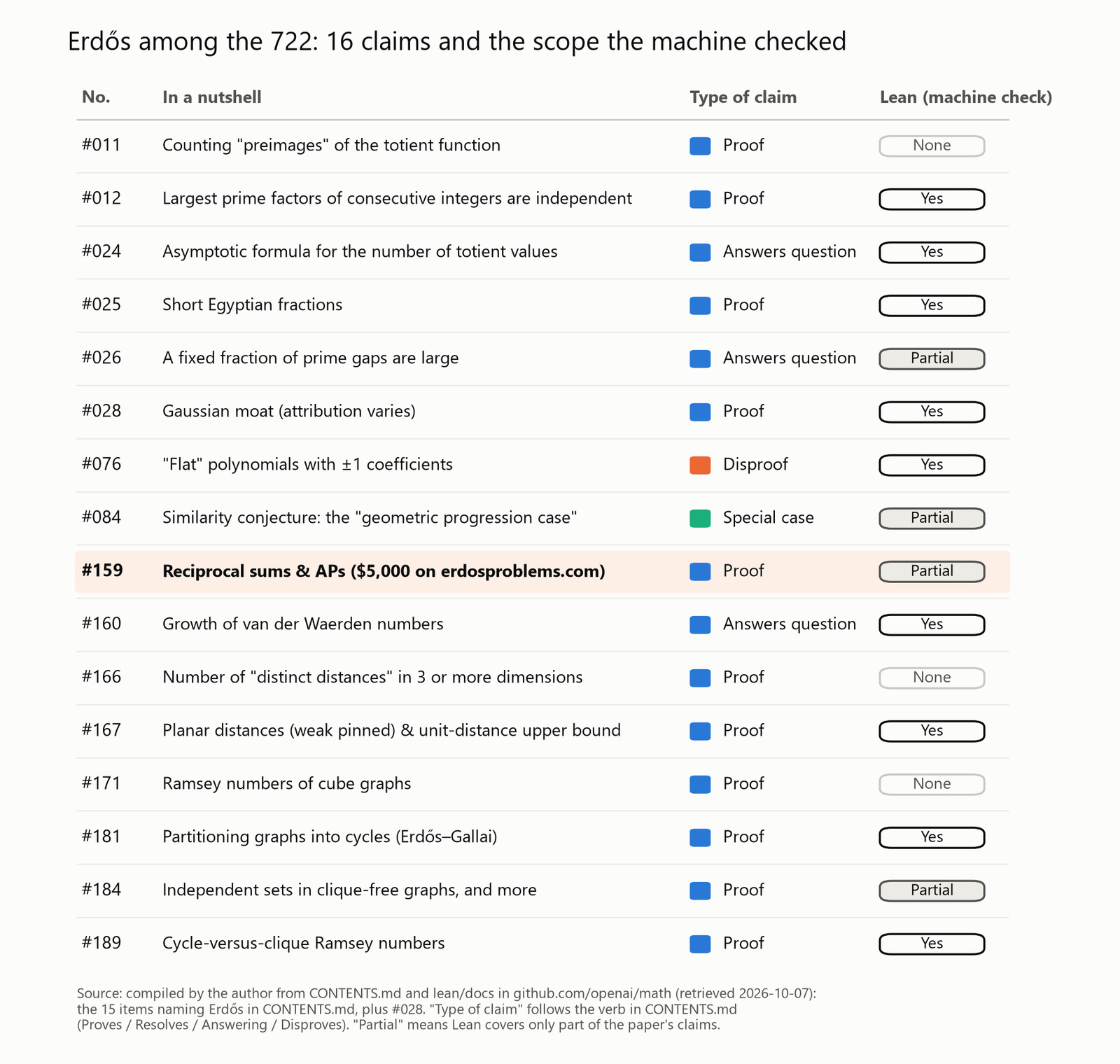
The kinds of claim vary.
"Proofs" of conjectures make up the majority, while No. 076 is a "disproof" and No. 084 stops at resolving a "special case" of a conjecture. As for Lean, 13 of the 16 have explanatory documents, and for 4 of these (No. 026, No. 084, No. 159 and No. 184) only part of the paper's claims is covered. The three still without a Lean document are No. 011, No. 166 and No. 171.
Two things stand out. The No. 167 paper cites the company's own earlier achievement, stating that it was "an OpenAI construction" that toppled Erdős's "unit distance conjecture" with a counterexample in May 2026. Of that counterexample, Gowers said that "if a human had written the paper and submitted it to the Annals of Mathematics ... I would have recommended acceptance without any hesitation," the Annals being one of mathematics' top journals.
The other is the distance from the Erdős problems site. A full-text search of the 23 papers in the 16 families found that only one, from No. 025, lists erdosproblems.com among its references. No. 159 cites not the site but Erdős's own 1974 paper directly.
No. 028's "Gaussian moat," incidentally, is a problem about which Erdős himself, in a 1977 paper, explained how it had come to circulate as his own, and wrote: "Thus the problem is returned to its rightful owners." Whose problem it was, and whose credit, was something Erdős himself cared about.
Seen from the side of the reference lists, too, Erdős's presence stands out. When we tallied the references of the 722 (public version as of October 8, 2026), the human mathematician cited by the most result families was Erdős, in 41 of the 372. Thirty years after his death, his papers sit on the front shelf of the AI's "parts warehouse."
The prize is paid only for peer-reviewed papers
Erdős died of a heart attack in September 1996, in the middle of a conference in Warsaw. He was 83. His joke about "leaving money when I leave" half came true.
Erdős never had a checking account, and his wallet was looked after by his longtime friend, the mathematician Ron Graham. After Erdős's death Graham kept paying prizes out of the remaining funds, and a solver could reportedly choose between a check Erdős had signed in his lifetime (a memento that cannot be cashed) and a cashable check from Graham. For a problem on gaps between primes that carried $10,000, Graham added $5,000 of his own to the payment to the 5 mathematicians who solved it.
Graham died in 2020, and the prizes have since passed to the Combinatorics Foundation. The foundation's rules are clear.
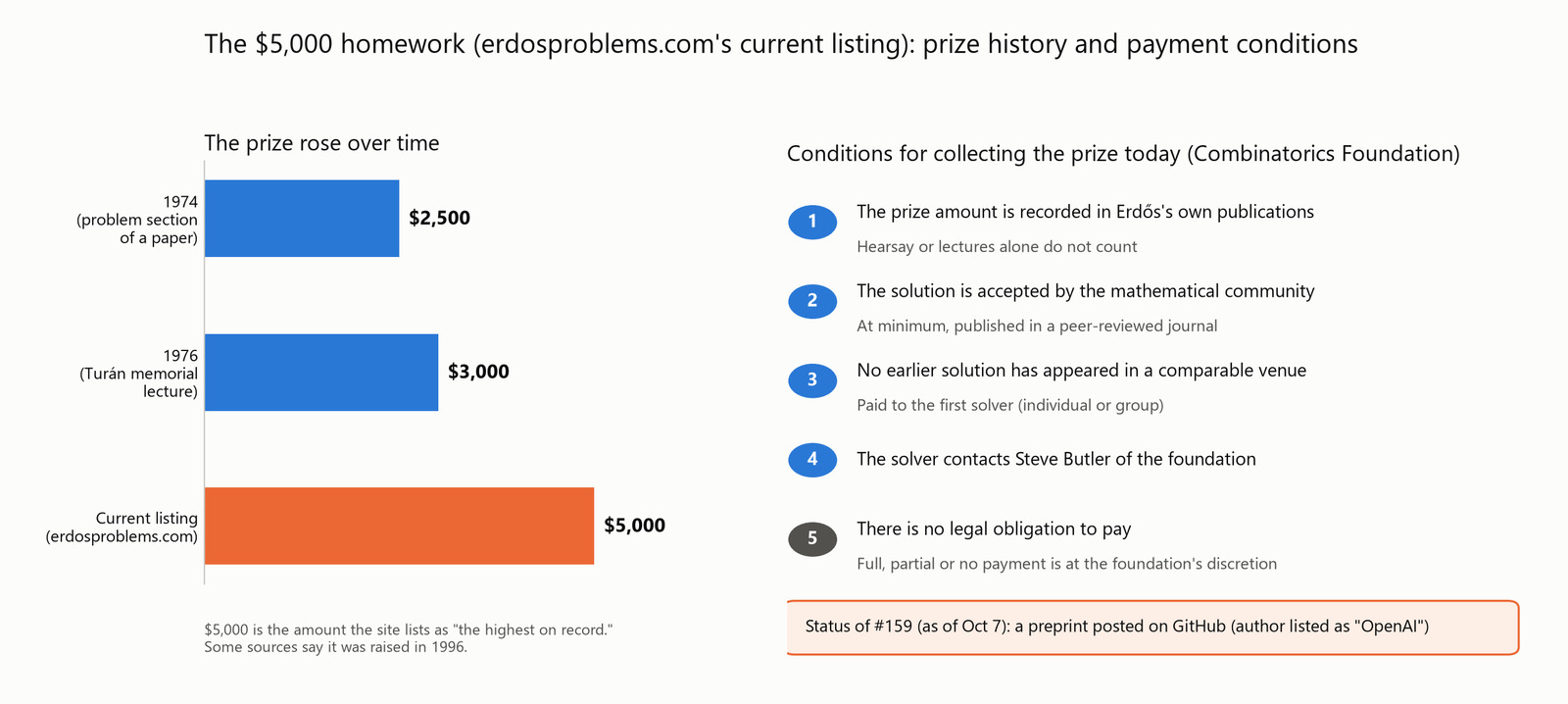
- Record of the amount: the prize amount must be written in one of Erdős's own publications (hearsay or lectures alone do not count)
- Acceptance by the mathematical community: at the very minimum, the solution must be published in a peer-reviewed journal
- Being first: no solution may have been published before in a similar venue
- Payee: the "person, or group" that first solved the problem
- Disclaimer: there is no legal obligation to pay; awarding all, part or none is at the foundation's discretion
Apply this to No. 159, and the $2,500 and the $3,000 are on record in Erdős's papers. For the $5,000 figure, the place where it appears in Erdős's own publications remains unconfirmed as far as we have checked. And as of October 7, No. 159 is a preprint (a manuscript not yet peer-reviewed) posted on GitHub, whose author is the company name "OpenAI."
The payee the rules provide for stops at a "person, or group"; on a problem solved by an AI, or a company as recipient, they are blank. Whether OpenAI will submit to a journal is, as far as we could find, also unannounced. A prize that Erdős, 50 years ago, wrote he did "not expect to have to pay" now sits before a recipient that the paying side's rules have not yet imagined.
The same day, the Erdős problems site dropped its "scoreboard"
On October 6, the same day OpenAI released the 722, Bloom posted a piece on the site titled "Changes." It makes no mention of OpenAI. The decision came after several weeks of gathering users' views.
The site started in May 2023 with about 200 problems and now hosts 1,221 problems, more than 9,000 comments and about 2,000 registered users. At the same time, he writes, many recent posts had turned into AI-generated proofs pasted in with no explanation, in order to stake priority claims.
There are four changes.
- Freeze comments and proof claims on individual problems for the time being
- Stop displaying "open" and "solved," and stop showing the number or percentage of solved problems
- Stop using language that says whose credit future solutions are
- Put the emphasis on high-quality expositions
Bloom explained that the point of removing the statuses was "to disincentivise people who are simply glory-chasing and copying problems into their AI to get an OPEN->SOLVED dopamine hit." He also wanted to keep people from drawing wrong conclusions from the "rate of solved problems."
The piece ends like this:
Use AI as you like -- but do not abandon mathematics as a human activity. [...] Be human. Let your brain be open.
Three questions to ask when reading "AI solved it"
Set last year's uproar beside this claim, and three points to check when reading news that "AI solved it" come into view.
- Was it really unsolved? Is the answer already somewhere in the literature? "Unsolved" may hold only on someone's records
- How much did the machine check? Which part of the claim does formal verification such as Lean actually cover?
- Who has accepted it? Has it been through peer review or third-party verification? This single point is also what the prize rules demand
These three are useful outside mathematics, too. They apply just as well to internal reports that "AI let us automate the work" or "AI caught the fraud." Did it simply pick up an answer that was already there? What range was verified? Has a third party checked it?
Bloom's decision to take down the scoreboard also speaks to how organizations are run. The moment a number like the solve count went on display, people appeared for whom moving the number became the goal in itself, and the understanding and discussion that had been the real purpose withered. A metric is only a stand-in for what you actually want to measure.
Erdős's prizes have worked the other way. The amount is only a gauge of difficulty, and what the current rules make a condition of payment is "a solution the mathematical community has accepted." A system that puts more weight on how a result is checked before payment than on the size of the reward has carried on for 30 years after his death.
Erdős once described his ideal death. He would be finishing an important proof on the blackboard when someone in the audience shouted, "What about the general case?" He would turn to them, smile, say "I'll leave that to the next generation," and keel over.
That "next generation" now includes machines. The question of whose name goes on the $5,000 check is still open, as homework.
References
- Mathematics manuscript collection (openai/math, GitHub)
- CONTENTS.md: list of the 722 (openai/math, GitHub)
- Quasipolynomial Bounds for Arithmetic Progressions (OpenAI, No. 159 paper, PDF)
- Scope of the Lean formalization for No. 159 (openai/math, GitHub)
- Reasoning summary for No. 159 (OpenAI, PDF)
- Sharing AI progress in mathematics (OpenAI)
- Erdős Problem 3 (erdosproblems.com)
- FAQ (erdosproblems.com)
- Changes (Thomas Bloom, erdosproblems.com, October 6, 2026)
- Erdős Problems: prize rules (Combinatorics Foundation)
- AI contributions to Erdős problems (teorth/erdosproblems Wiki)
- OpenAI's 'embarrassing' math (TechCrunch, October 19, 2025)
- Leading OpenAI researcher announced a GPT-5 math breakthrough that never happened (The Decoder)
- How AI Tore Through a Mathematical Community (Quanta Magazine, August 3, 2026)
- OpenAI Unleashes Hundreds More Math Results (Scientific American, October 6, 2026)
- Cash for Math: The Erdős Prizes Live On (Quanta Magazine, June 5, 2017)
- Problems (P. Erdős, Mathematica Balkanica, 1974, PDF)
- Problems in Number Theory and Combinatorics (P. Erdős, 1976 Manitoba Conference, PDF)
- Some Notes on Turán's Mathematical Work (P. Erdős, 1980, PDF)
- Erdős and arithmetic progressions (W. T. Gowers, arXiv, 2015)
- The primes contain arbitrarily long arithmetic progressions (B. Green, T. Tao, arXiv, 2004)
- Breaking the logarithmic barrier in Roth's theorem (T. F. Bloom, O. Sisask, arXiv, 2020)
- Fields Medal 2006: Terence Tao (International Mathematical Union, PDF)
- RIMS Kôkyûroku 521, "Problems in Combinatorial Analysis" (Research Institute for Mathematical Sciences, Kyoto University, 1984, PDF, in Japanese)
- Paul Erdős (English Wikipedia)
- Erdős conjecture on arithmetic progressions (English Wikipedia)
- The Man Who Loved Only Numbers, Japanese edition (Paul Hoffman, translated by Ritsuko Hiraishi, Sōshisha; National Diet Library Search)