On the morning of October 7, 2026, the list of 722 mathematical manuscripts OpenAI released contained a line that read "Proves the Gaussian moat conjecture." It is a problem first asked in 1962, and for 64 years no one had been able to settle it.
Say "Gaussian primes," though, and most people recall only the point in high school where complex numbers stopped them cold. The headlines flow past without anyone quite knowing what is being asked, or what is claimed to have been solved.
Put into words, the problem is almost disarmingly simple.
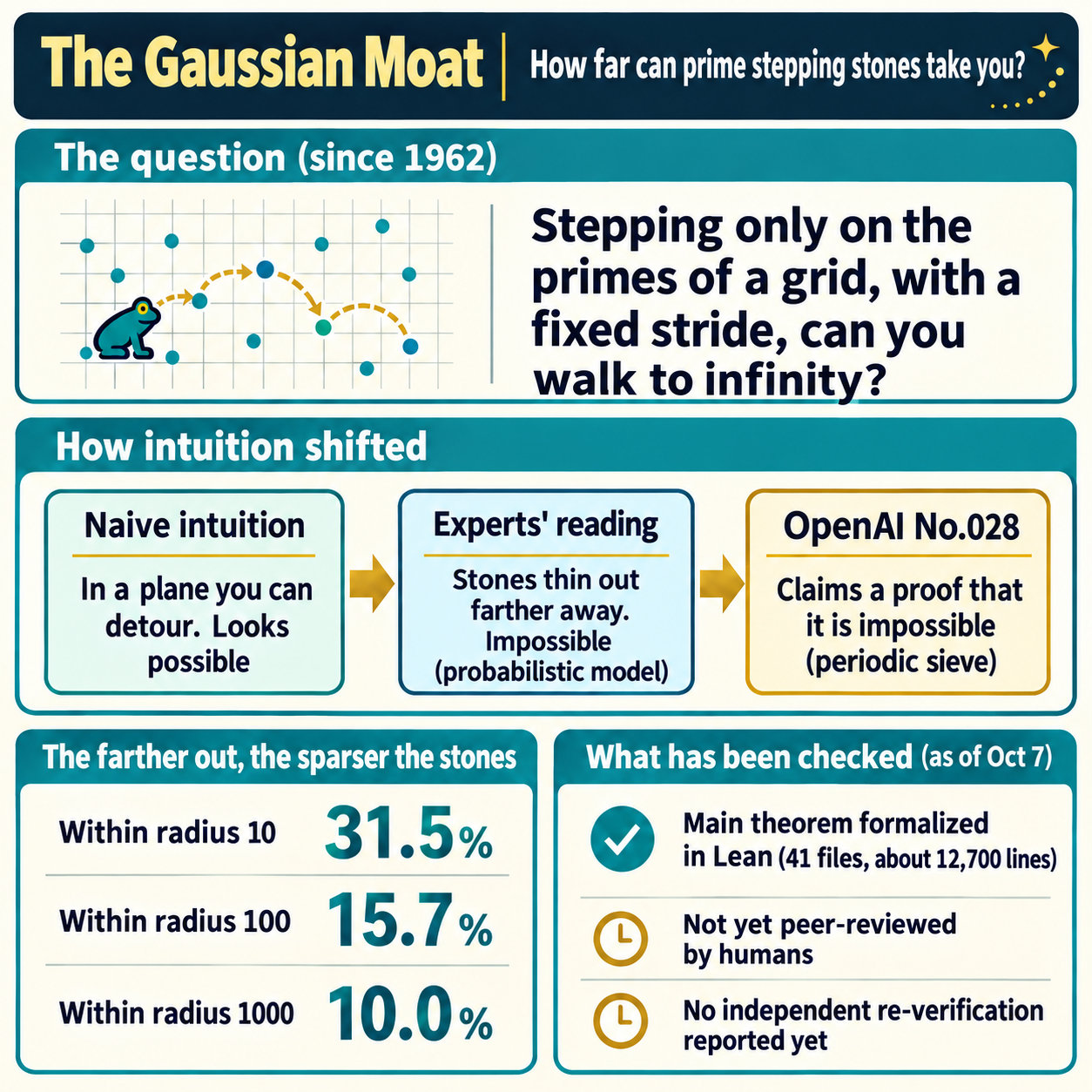
Stepping only on the "prime stones" scattered across a sheet of graph paper, keeping a fixed stride, can you go on as far as you like? The answer is no, claims OpenAI's No.028, and more than that: "wherever you start, the island you can reach has an upper limit on its size."
On graph paper, there is another world of primes
Take the plane of complex numbers and keep only the points where the vertical and horizontal grid lines cross. These are the points that can be written as a+bi with a and b integers: the crossings of graph paper. They are called "Gaussian integers."
Add or multiply these points together and you land on a crossing of the graph paper again. Expand (a+bi)(c+di) and you get (ac−bd)+(ad+bc)i, so the real part and the imaginary part both stay integers. Once addition and multiplication stay inside the world, words like "divides" and "cannot be broken down any further" take on meaning.
That is how one defines "Gaussian primes," which closely resemble the ordinary primes among the integers. The person who truly opened up this world was the German mathematician Carl Friedrich Gauss. In an 1832 paper on quartic residues (the rules for remainders of numbers raised to the fourth power), he showed that in this world of integers, too, factorization into primes comes out in exactly one way.
5 splits, and 3 does not
In the world of ordinary integers, 5 and 3 are both prime. Move to the world of graph paper, however, and 5 can be broken down as (2+i)(2−i). Expanding with i²=−1 gives 4−2i+2i−i²=4+1=5.
The 3, on the other hand, resists splitting in the graph-paper world no matter what you try, and stays prime. And 2 can be broken down as (1+i)(1−i), so here it is no longer prime.
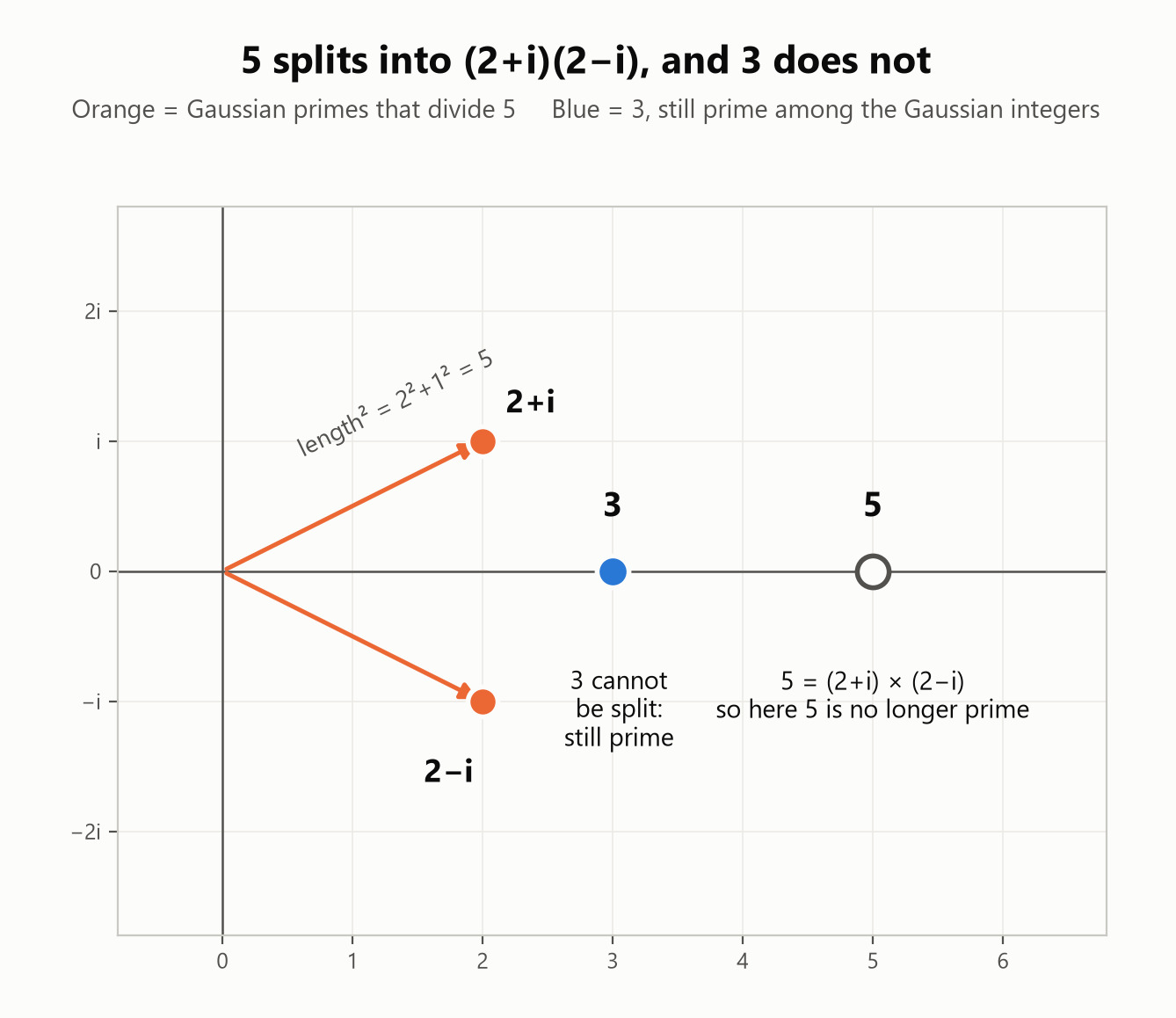
Whether a number is prime is decided not by the number itself but by the world in which you look at it.
That feeling is the doorway to Gaussian primes. It is also a picture of something we took to be a "natural property" turning out to depend on its surroundings.
The square of the length becomes the yardstick for primes
Just as we do not count ±1 as "prime factors" among ordinary integers, in the graph-paper world we leave the four numbers ±1 and ±i out of the count. Multiplying by them leaves size unchanged; they are numbers that, so to speak, "only change direction." 2+i and −1+2i, which is 2+i multiplied by i, are treated as members of the same prime's family.
The yardstick for telling them apart is the square of the distance from the origin, a²+b². Mathematicians call it the "norm."
This yardstick has a handy property: multiply two numbers and their yardstick values multiply too. 2+i and 2−i both have a squared length of 5, so their product has 5×5=25, that is, 5². From this property, it is known that Gaussian primes fall into exactly three kinds.
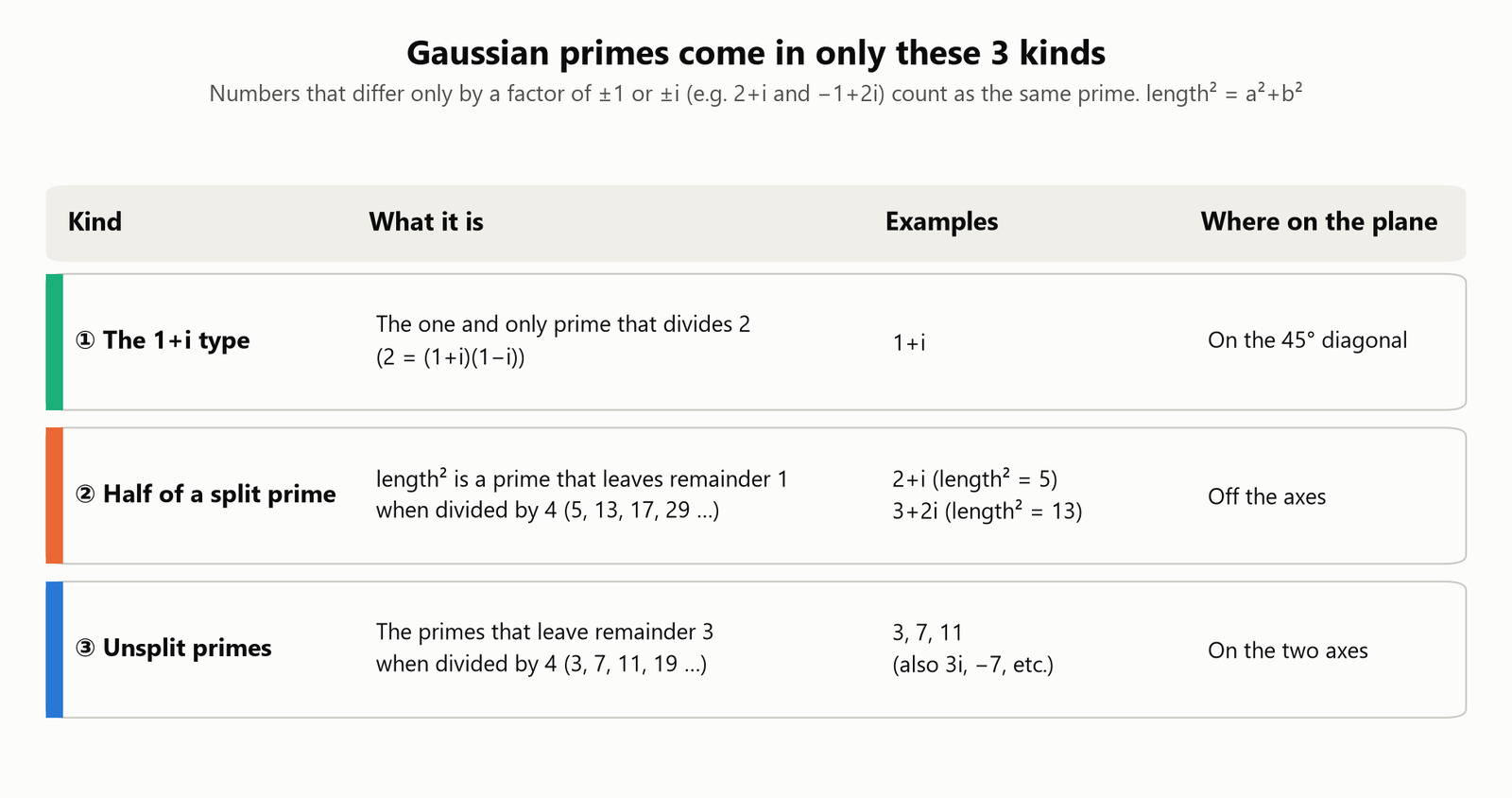
- 1+i and its family: The one and only kind of prime that divides 2.
- Points whose squared length is a prime "that leaves a remainder of 1 when divided by 4": These are the halves of primes such as 5, 13, 17 and 29, which split in two, like 2+i and 2−i.
- The primes "that leave a remainder of 3 when divided by 4" themselves: Numbers such as 3, 7 and 11, which stay unsplit on the axes even in the graph-paper world.
Behind the splitting of 5 and 13 lies Fermat's two-square theorem: "every prime that leaves a remainder of 1 when divided by 4 can be written as the sum of two squares." For example, 5=2²+1² and 13=3²+2².
Reflecting up and down or left and right, and rotating by 90 degrees through multiplication by i, carry primes to primes, so the layout of Gaussian primes is symmetric in eight directions.
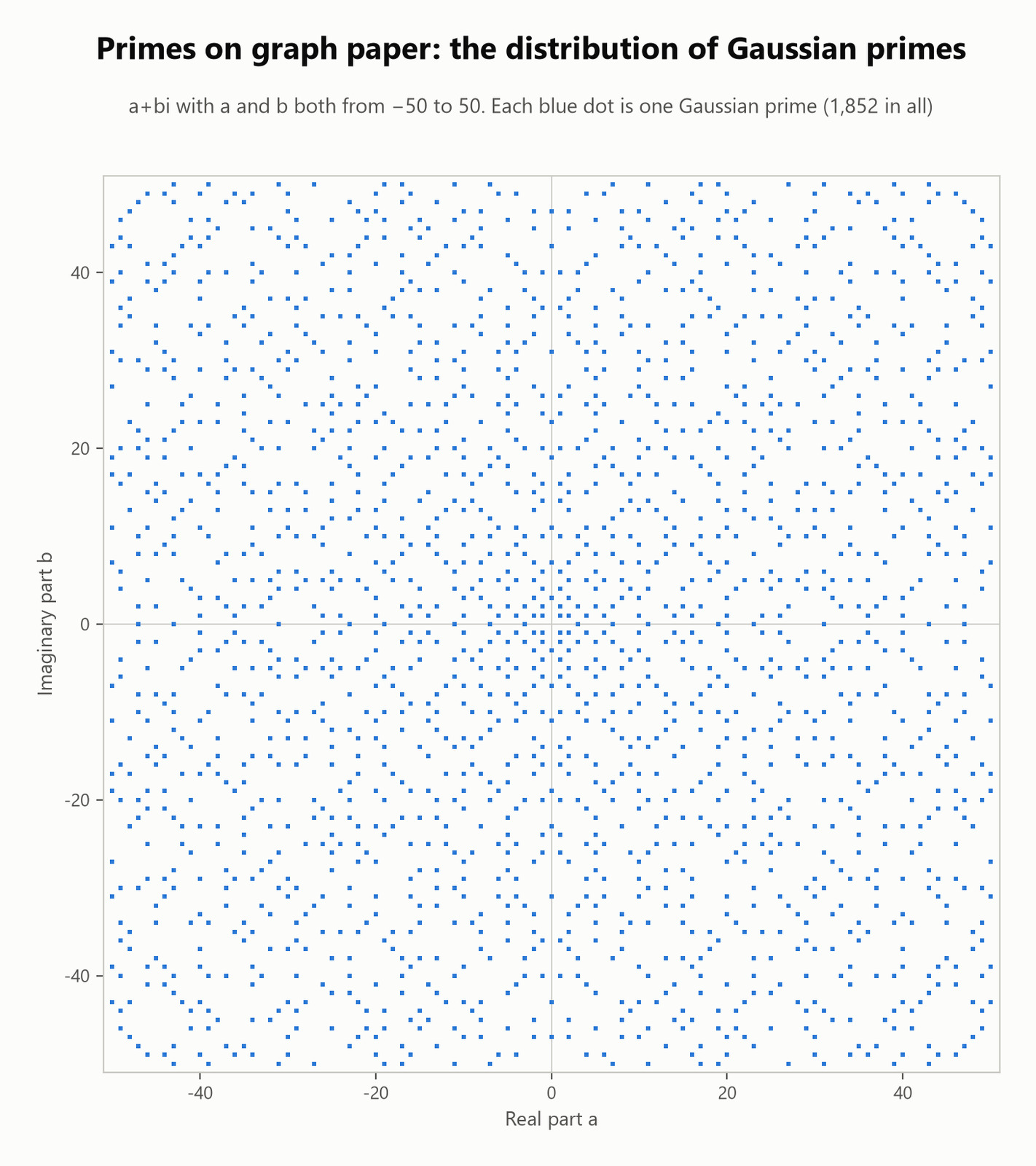
Plot the points and a pattern like lacework appears. It looks orderly, yet nowhere does it simply repeat.
Fix your stride and step only on primes
Think of this pattern as stepping stones floating on a pond, and picture a frog hopping from stone to stone, touching nothing else. The frog's hop is capped at a maximum of k.
It lands on each stone only once. Under these rules, can the frog keep hopping out to infinity?
That is the "Gaussian moat" problem. If the frog cannot get there, then the island it lives on must be ringed by a band of water wider than k: a "moat."
On a single number line, the answer comes quickly. n! (the product of 1 through n) plus 2 is divisible by 2, plus 3 is divisible by 3, and so on, so the n−1 numbers from n!+2 to n!+n are all composite.
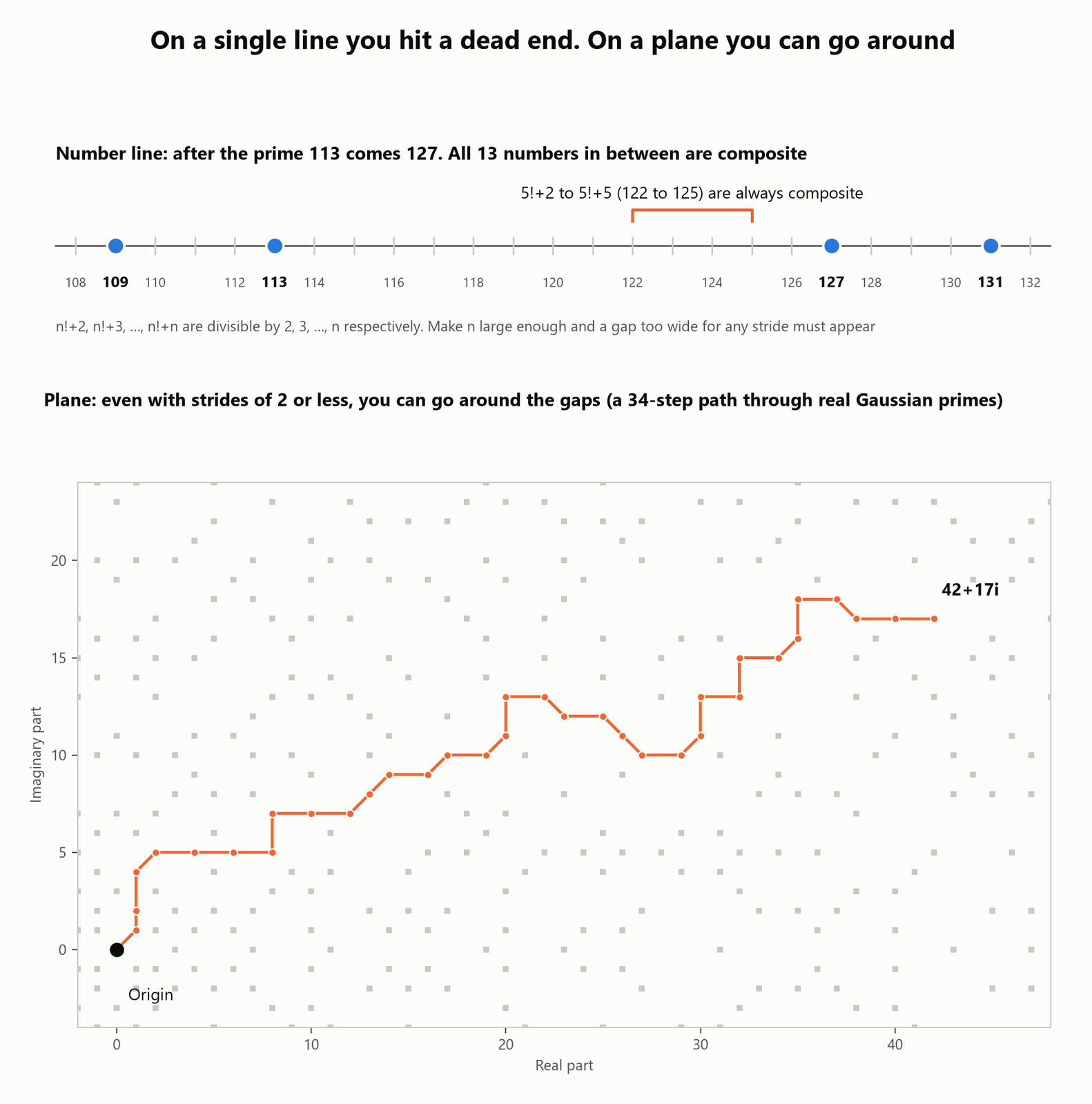
Since n can be as large as you like, a frog with legs of any length will, on the number line, sooner or later meet a gap it cannot jump. On a plane, however, things look different. If there is no stone ahead, you can simply go around to the side.
The lower half of the figure shows a 34-step path that links real Gaussian primes with hops of 2 or less. It dodges the gaps as it works its way up and to the right. On a plane you could surely go on forever: that is the naive intuition.
Where the question came from: Stockholm, 1962
The problem is said to have been raised by the American mathematician Basil Gordon at the International Congress of Mathematicians held in Stockholm in 1962. From there it spread by word of mouth.
The paper by J. H. Jordan and J. R. Rabung that published the first serious computational results in 1970 introduced it as "a conjecture of Paul Erdős." Their phrasing was on the "you can get there" side: "you can stroll from the origin of the complex plane to infinity using the Gaussian primes as stepping stones and be required only to take steps of finite length."
Erdős himself, in a 1977 paper, wrote that he had heard the problem from Motzkin at a meeting in Pasadena in November 1963, and that it was a problem posed by Gordon and Motzkin. He closed with the words "Thus the problem is returned to its rightful owners."
The farther out, the sparser the stepping stones
Why would anyone think you cannot get there? The key is the density of the stepping stones.
Count the share of graph-paper crossings that are Gaussian primes, and within a radius of 10 of the origin it is 31.5%. Within a radius of 100, though, it falls to 15.7%, and within a radius of 1000 to 10.0%.
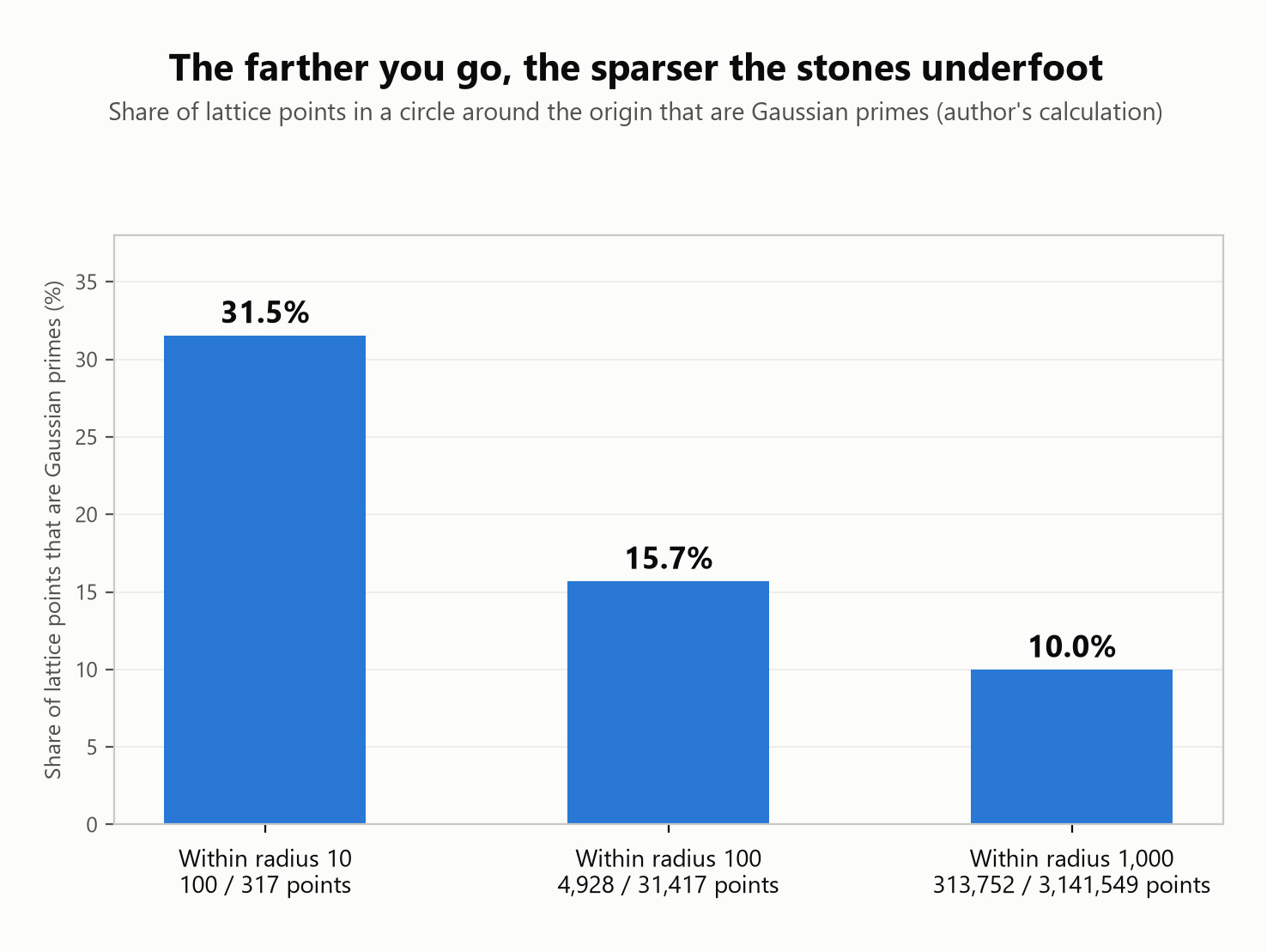
By the law that governs how many primes there are, the density of stones around distance r thins out roughly in inverse proportion to log r (the natural logarithm of r). Slowly, but surely, and without end.
A pond where the stepping stones spread farther apart the farther out you go, while the frog's legs stay the same length. Seen that way, it starts to seem that even on a plane you must get stuck sooner or later. And in fact, for small strides the moat is plain to see.
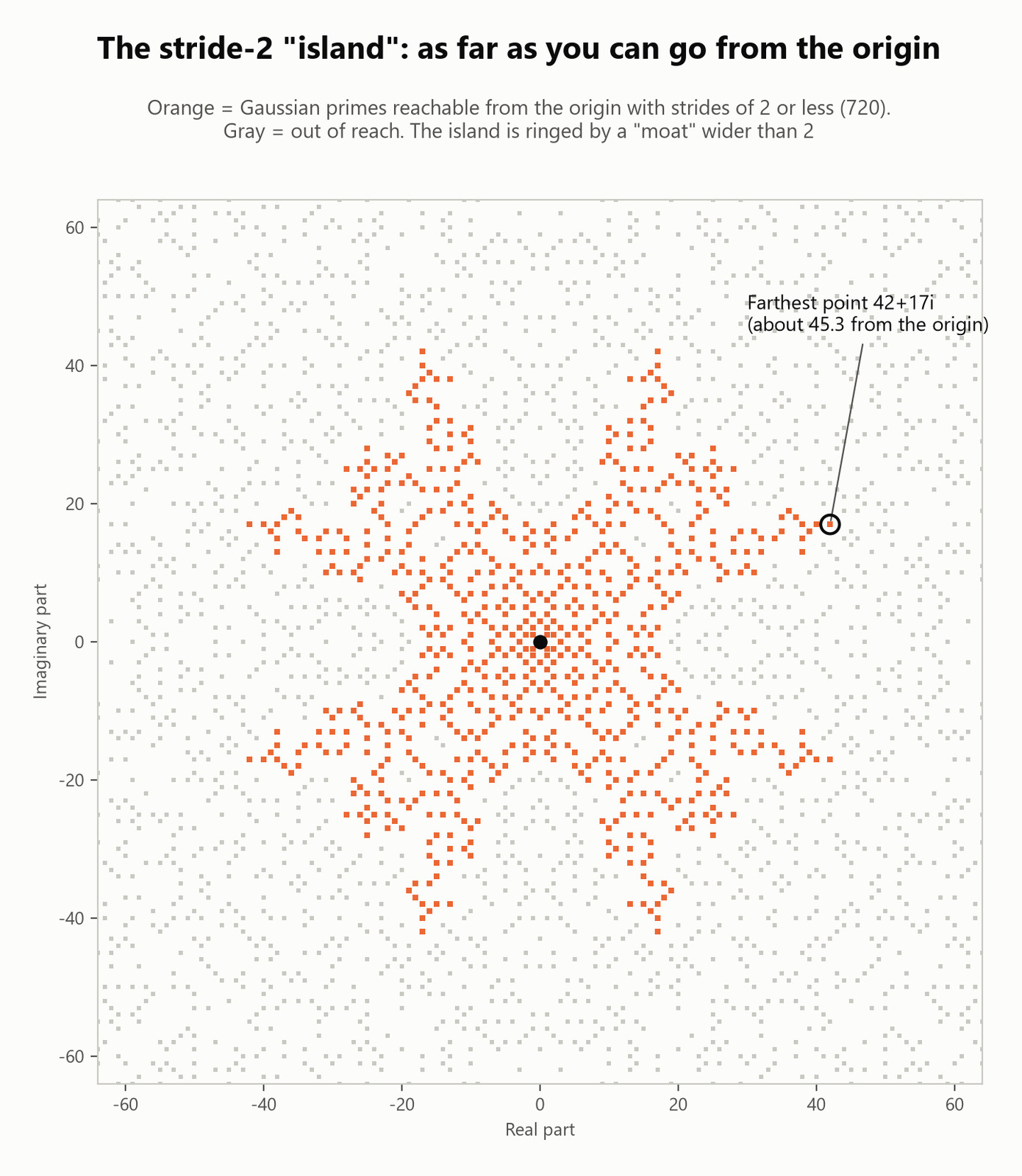
With a stride of 2, the Gaussian primes you can reach from the origin number only 720 in the entire plane. The farthest point is 42+17i, about 45.3 from the origin. Every stone outside this island lies more than 2 away from it.
Reproduce this "island" calculation yourself, and the numbers match those in the earlier literature exactly.
The record of moats dug up by computers
Make the stride larger and the island balloons, and that is where computers come in. The record has grown like this.
- 1970: Jordan and Rabung showed that a stride of 4 is needed (with less than 4, you cannot leave the origin's island).
- 1998: Ellen Gethner, Stan Wagon and Brian Wick showed by computation that you cannot get out even with a stride of √26 (about 5.1). Their paper "A Stroll Through the Gaussian Primes," published in the monthly journal of the Mathematical Association of America (MAA), received the Chauvenet Prize, awarded for outstanding expository articles, in 2002.
- 2004–2005: Nobuyuki Tsuchimura of the University of Tokyo confirmed that the origin's island is finite even with a stride of 6 (√36). The computation took about 80 hours on 38 CPUs, and would have taken 70 days on a single machine.
Tsuchimura's report shows that for a stride of √32 the farthest point of the island lies about 2.82 million from the origin, and that for a stride of 6 the distance reachable from the origin stays below about 80.02 million. On the other hand, no computation can show that "for every stride, a moat will always turn up eventually." What can be checked is always a finite range.
The experts read it as "you can't get there"
Most experts bet early on the "you can't get there" side. Erdős thought the answer was "almost certainly negative," and Tsuchimura's report, too, notes that "the opinions in the literature ... are inclined to the negative answer." The grounds for that view were given theoretical form in Ilan Vardi's 1998 paper "Prime percolation."
Percolation is the mathematics of "connected or cut off." If the tiny holes in a coffee filter are linked up enough, the water drains through; if they are sparse, it stops. If the trees in a forest stand close together, a wildfire spreads; if they are sparse, it burns out partway.
Vardi built a probabilistic model that treats Gaussian primes as points scattered at random. In that model, connections always break off in regions where the density is low enough. Since the density of primes becomes as low as you like far out, a walk with a fixed stride must stop somewhere: that was the reading.
This, however, is not a proof.
Primes are not random. For example, apart from 1+i and its family, Gaussian primes appear only at points where one of a and b is even and the other odd. Because of this, two points a distance of 1 apart are both prime only right next to the origin.
Primes carry many such habits layered on top of one another, some visible and some not. An argument of the form "if they were random, this would happen" cannot be carried over to the real primes as it stands.
That gap is what the 64 years were made of. A paper claiming a proof was posted in 2024 as well, but it was withdrawn the next day on the grounds that "The width of the moat was not correctly computed."
What does No.028 claim?
OpenAI's No.028 paper, "Bounded-Step Walks on Gaussian Primes" (dated September 26, 2026), claims the following theorem.
For any finite stride D, there is a finite number B_D such that every island of Gaussian primes linked by strides of D or less contains at most B_D stones.
It follows that a path advancing with strides of D or less, never stepping on the same stone twice, cannot continue for more than B_D steps. In other words, you cannot get to infinity.
This claim is a notch stronger than the answer to the problem. It holds that not just the origin's island but the island around any starting point is bounded in size by the same limit, B_D.
What the paper establishes, however, is only that B_D exists. It describes the bound itself as "nonexplicit." A figure such as how many stones an island can hold for a stride of 6 does not come out of this proof.
The skeleton of the proof: a "periodic sieve"
Roughly speaking, the idea of the proof is to use "periodicity" in place of randomness. First, choose several primes that leave a remainder of 1 when divided by 4.
Each one splits into two halves (for 5, 2+i and 2−i), and every point divisible by either half gets a "road closed" mark. The pattern of these marks repeats across the whole plane, like wallpaper made of a tile of fixed size.
The paper then claims that even with only finitely many chosen primes, this road-closed wallpaper alone keeps any walk with strides of D or less from going on forever. Apart from the families of the chosen primes themselves, every Gaussian prime sits on a point without a road-closed mark, so a walk on Gaussian primes stops as well. It is also this periodicity that puts an upper limit on the size of an island.
Suppose a single island contained two points at the same position in the wallpaper pattern. Then shifting the island by one period of the wallpaper would lay it over itself, and the island would have to extend forever.
That cannot happen to a finite island, so the number of stones on an island stays within the number of squares in one tile of the wallpaper. Add in the families of the primes used for the road closures, and the limit is still finite.
The hardest part is the claim that "finitely many primes are enough." Here the paper turns to information theory.
A walk that keeps dodging every road closure has to carry more and more information about "the remainder of its own position" for each chosen prime. Yet the amount of information a single step of length D or less can carry is limited. Choose enough primes, and the mismatch between the two becomes a contradiction: that is the line of argument.
The paper describes its approach as "methodologically related to" Terence Tao's "entropy-decrement argument." And the route itself, building a moat out of periodic road closures, is one that Ellen Gethner and Harold Stark carried out for small strides in 1997 and proposed as the strategy for larger ones.
What Lean has checked, and what no one has checked yet
This is the most important point in weighing the claim. OpenAI has published a formalization of No.028's main theorem in Lean, a proof assistant language. Lean is a language in which a computer checks whether each step of a proof follows the rules of logic.
What can be read from the published materials is as follows.
- The formalized statements: Both the statement that, for any real number D, you cannot line up infinitely many distinct Gaussian primes with strides of D or less, and the statement that the size of an island and the length of a walk stay within a bound B that depends only on D.
- The foundation used: The definitions of Gaussian integers and of primes are taken as they are from "Mathlib," Lean's shared mathematics library. Primes on the axes and the ±1 and ±i multiples of each prime are all included.
- The assumptions allowed: In the settings of the checking tool (Comparator), the only axioms permitted are the 3 used as standard in Lean (propositional extensionality, soundness of quotients, and the axiom of choice).
- What the published files contain: The proof itself runs to 41 files and about 12,700 lines. As far as a search of the published code shows, commands that leave a gap in the proof to be filled later (sorry) and custom axiom declarations number zero.
That puts No.028 among the 722 manuscripts whose machine backing reaches all the way to the main theorem. Even if there were a mistake somewhere in the paper's prose, as long as the Lean proof goes through correctly, the theorem it claims holds. Even so, steps remain before anyone can say flatly that it is "solved."
- It is not yet peer-reviewed. The paper is a preprint on GitHub at the stage before a journal's review.
- As far as we could find, reports of a third party reproducing the check still number zero. That the checks all pass is, as of the release, only OpenAI's own presentation.
- What Lean guarantees is the correctness of "the statement as written". In this case the statement is a short one that writes out the problem's definitions directly, so there is little room for a swap. Even so, that comparison is properly a job for experts.
The independent advisory group of mathematicians (AGMAI) issued a statement on the release saying that "This release is the beginning, not the completion, of the process of human understanding." The English Wikipedia entry "Gaussian moat," too, gained a sentence on October 7 noting that "OpenAI claimed a proof," while its opening still says the problem "remains unsolved." One day after the release, verification reports or assessments by mathematicians naming No.028 numbered zero, as far as we could find.
From "you could get there" to "you can't"
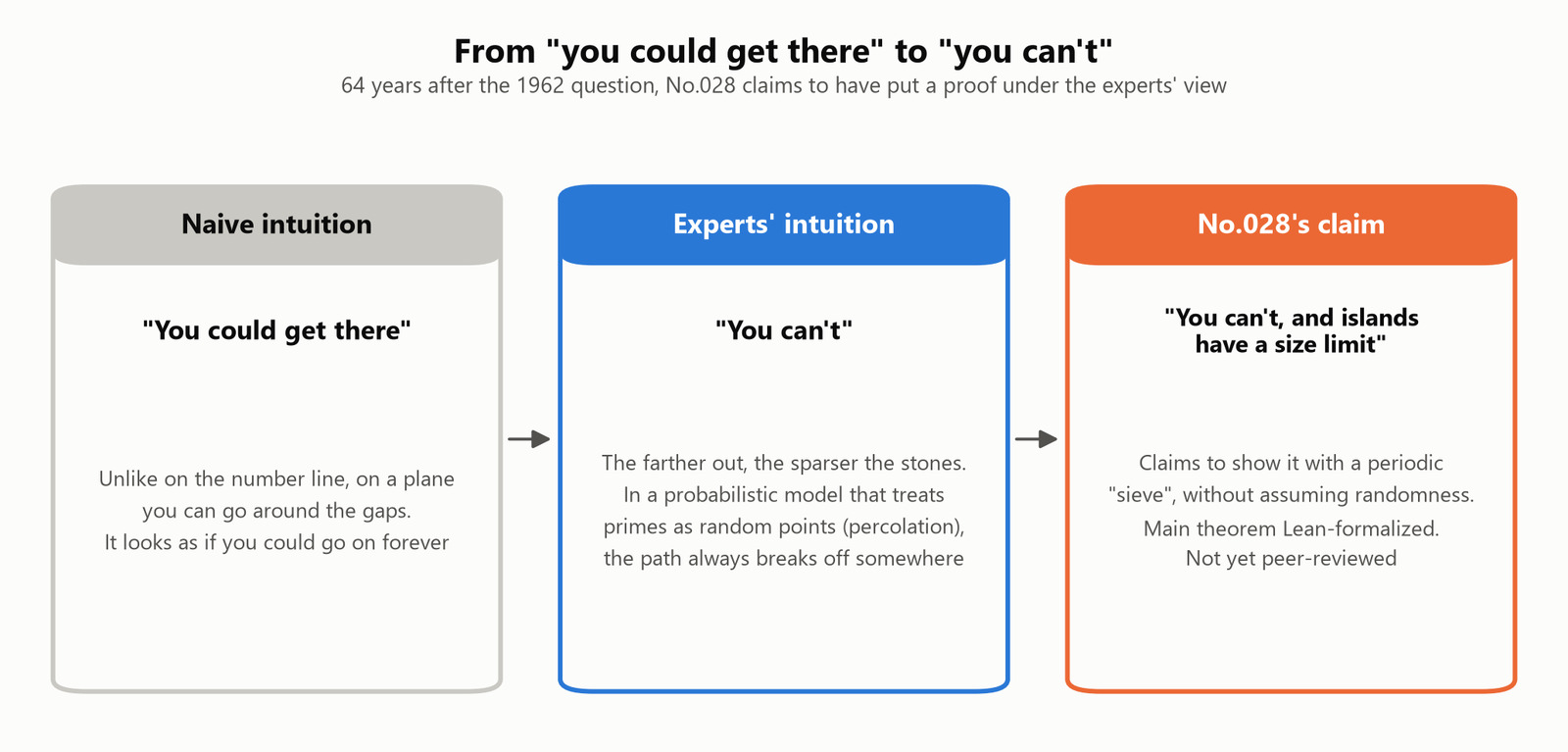
This problem is also a history of intuition moving in two stages. The naive intuition was "on a plane you can go around, so you could probably get there."
The experts' intuition was "the farther out, the sparser the stones, so you can't." And No.028 claims to have put a proof under the experts' reading.
What stands out here is not so much the conclusion as the way it was reached.
The experts' "you can't" rested on a probabilistic argument that treats the primes as random points. No.028 claims to draw the same conclusion without that assumption, from the regularity the primes do have: the periodic pattern of road closures. A conjecture turning out to be right and the reasons behind it being right are two different things.
In business, too, a forecast that "the market should move this way" often turns out to be right. Few organizations, though, can explain why the forecast was right in a form that can be checked.
For 64 years, computers pushed the moat records out bit by bit, and probabilistic models kept saying "probably not." Even so, all of it stayed short of "solved."
Between calling the conclusion correctly and building it into a form anyone can check, there runs a moat this deep. Whether No.028's claim has crossed that moat will finally be decided by the mathematicians who verify it from here on.
References
- Bounded-Step Walks on Gaussian Primes (OpenAI, preprint dated September 26, 2026)
- openai/math CONTENTS.md No.028 (GitHub)
- Uniformly bounded components of Gaussian-prime graphs: scope of the Lean formalization (GitHub)
- GaussianMoat Comparator statement file (GitHub)
- openai/math README (GitHub)
- On OpenAI's Release of Mathematical Results (AGMAI)
- A conjecture of Paul Erdös concerning Gaussian primes (Mathematics of Computation, 1970)
- Problems and results on combinatorial number theory III (P. Erdős, 1977)
- A Stroll Through the Gaussian Primes (American Mathematical Monthly, 1998)
- Chauvenet Prize winners (UBC)
- Prime percolation (I. Vardi, Experimental Mathematics, 1998)
- Computational Results for Gaussian Moat Problem (Nobuyuki Tsuchimura, University of Tokyo, METR 2004-13)
- Computational Results for Gaussian Moat Problem (IEICE Transactions, 2005)
- On the Gaussian Moat Problem (arXiv:2401.08441, withdrawn)
- Gaussian moat (Wikipedia)
- Gaussian integer (Wikipedia)
- Problem No.952 (Erdős Problems)
- A Theorem about Gaussian Moats (Theorem of the Day)