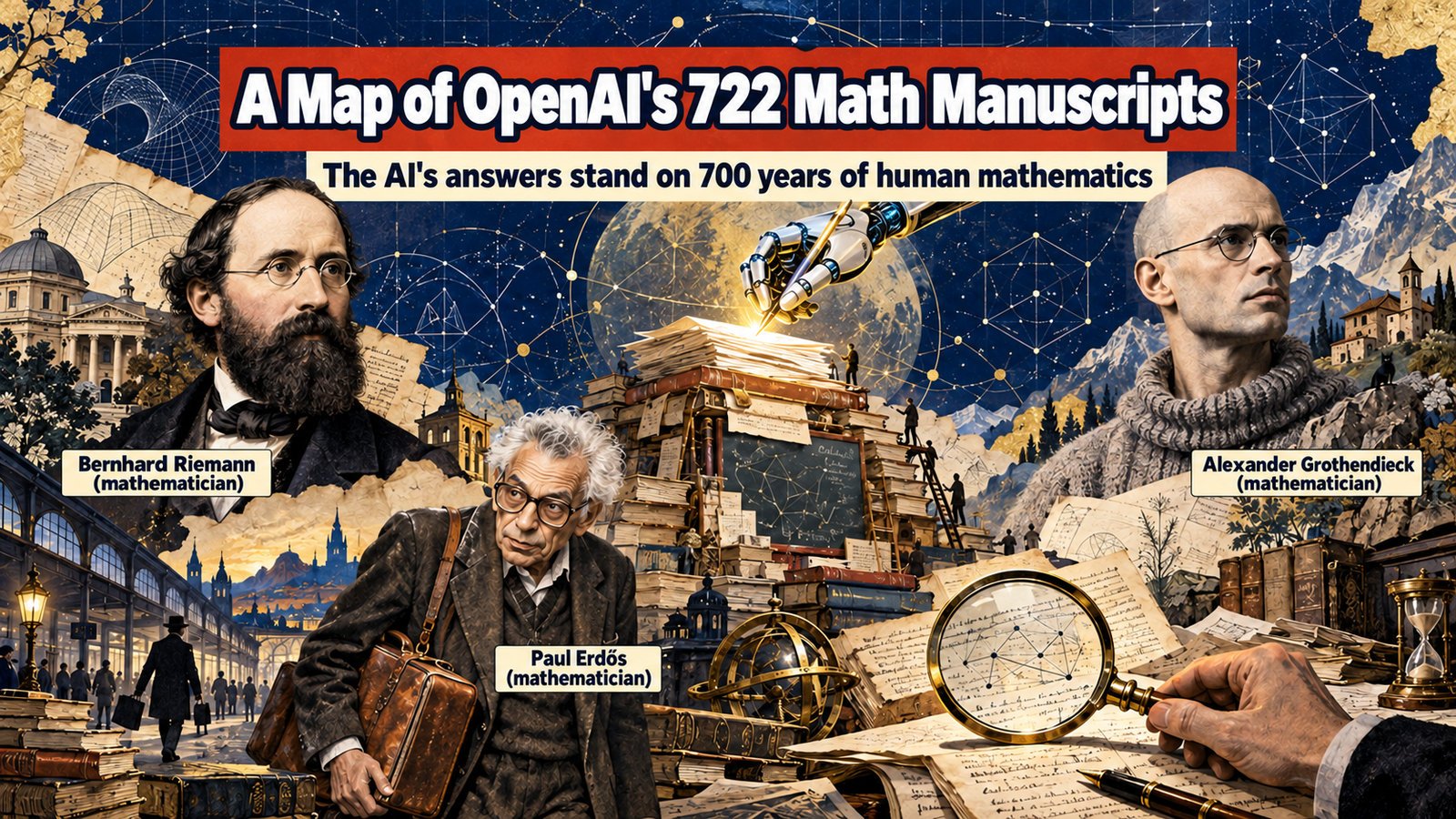
On the morning of October 7, 2026, the headlines in Japan lined up: "OpenAI claims its in-house AI proved a hard problem related to the Riemann hypothesis." The manuscripts posted to GitHub numbered 722, and the list ran through names most people have only ever met in textbooks: the Riemann hypothesis, the Hodge conjecture, the Birch and Swinnerton-Dyer (BSD) conjecture.
Has mathematics already slipped out of human hands? Follow only the headlines, and feeling that way is natural.
Open up the 722, though, and the view changes. The human the AI's manuscripts cite most often is Erdős, the mathematician who roamed the world with a single suitcase, handing out homework with prize money attached. Another manuscript takes on a conjecture Grothendieck left in a letter 43 years ago, and sets at its core tools that researchers in Kyoto spent 30 years sharpening.
This story is a little too interesting to file away as "AI has left humans behind."
October 7: 722 manuscripts land on GitHub
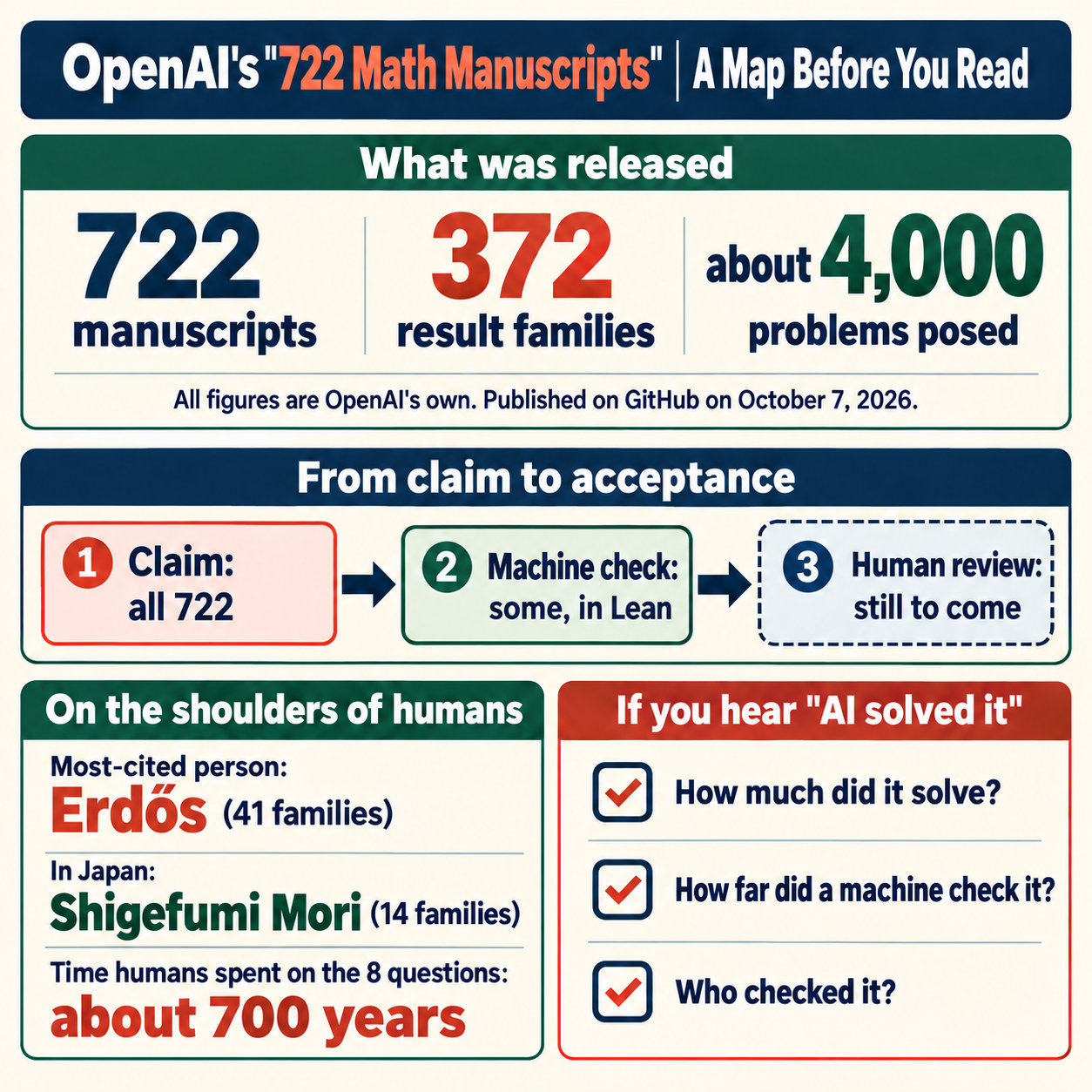
In the early hours of October 7, Japan time, OpenAI made public a GitHub repository called "openai/math." Inside are 722 mathematical manuscripts that the company says were generated by an unreleased internal model. Related manuscripts are bundled into 372 "result families," and every one of them lists its author as "OpenAI."
According to the README, the model was posed approximately 4,000 problems over the course of the evaluation, and most of the results were obtained with the same procedure. The compute per result averaged roughly three hours of ChatGPT Pro thinking. The work on the quasi-Riemann hypothesis and on the Hodge conjecture (CM), however, is listed among the "exceptions to this fixed procedure."
Each of these numbers counts something different. About 4,000 is the number of problems posed, 372 is the number of bundles, and 722 is the number of manuscripts. Divide 722 by 4,000, and what comes out is something other than a "success rate."
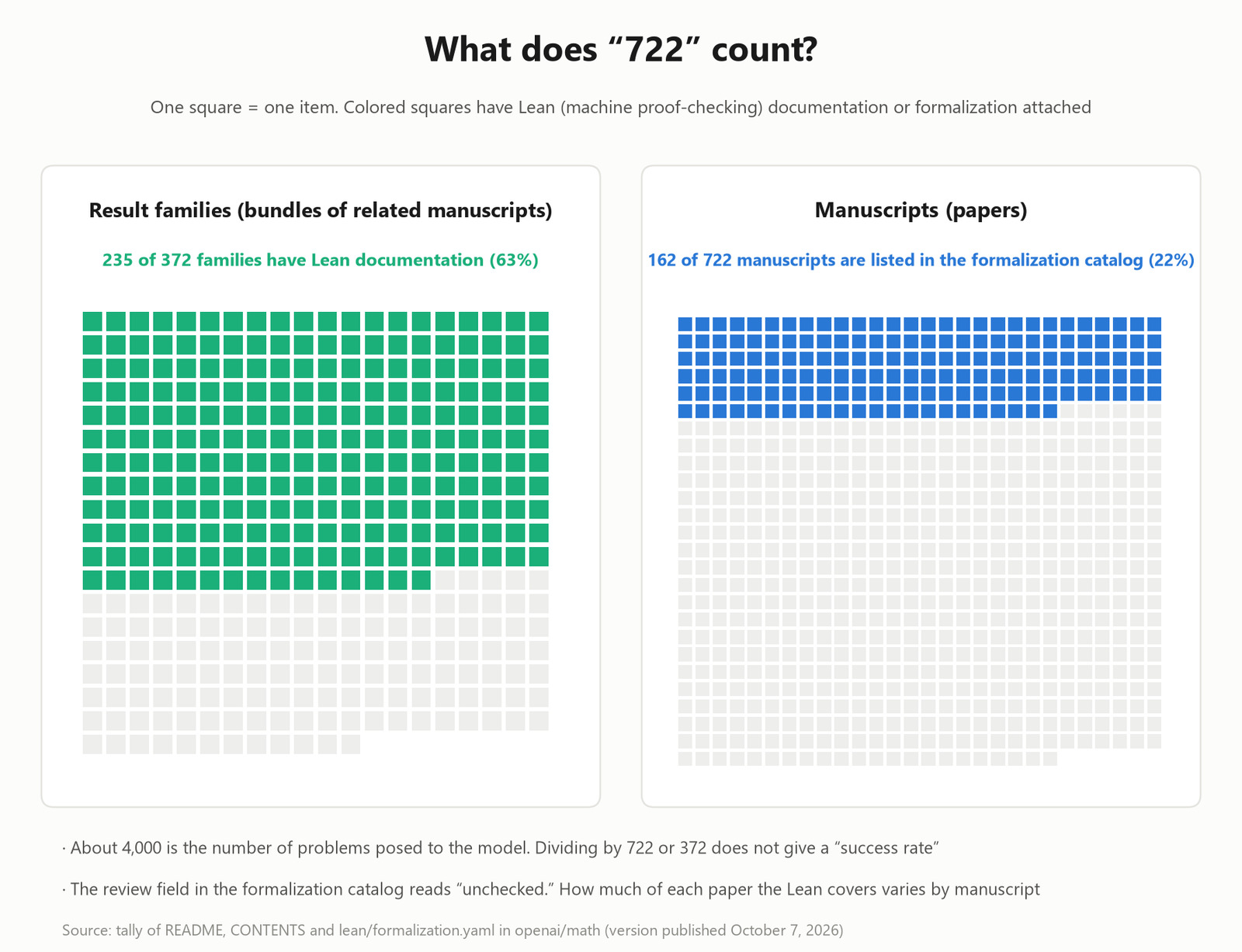
The README makes this caveat from the very start:
"Some of the unformalized results could have issues. We will endeavor to fix any such issues quickly."
Between "proved" and "verified"
All 722 are manuscripts in which OpenAI claims to have "proved" something. Before any of them is accepted as mathematical knowledge, there are at least three stages.
- Claim: The paper has been written and made public. All 722 are at this stage
- Machine check: The proof has been rewritten in a language called Lean, and a computer has checked its logic line by line
- Human confirmation: Experts have worked through the paper and publicly accepted it as correct
Lean is a formidable inspector. Neither the shortcut "this part is obvious" nor trust in a prestigious journal gets past it.
What Lean guarantees, however, stops at the fit between the "formalized statement" and its proof. Whether the rewritten statement really is the conjecture mathematicians mean, and whether the rest of the paper is correct, lie outside its reach. A user who rebuilt the Lean proof for the quasi-Riemann hypothesis on their own machine added the same caveat: "this checks the Lean proof, not the paper."
Line up the eight claims covered in this series against this yardstick, and they look like this.

For half of them, four in all, the Lean check reaches the main theorem or the conjecture itself; the other four were released with a written proof alone. And as of October 7, as far as we could find, the number of experts who had read any of the eight papers through and publicly accepted it as correct was zero.
Human proofs have taken years to verify, too
The wait is not because an AI wrote them. Proofs written by humans have also needed a long time, and other people's eyes, before they were settled.
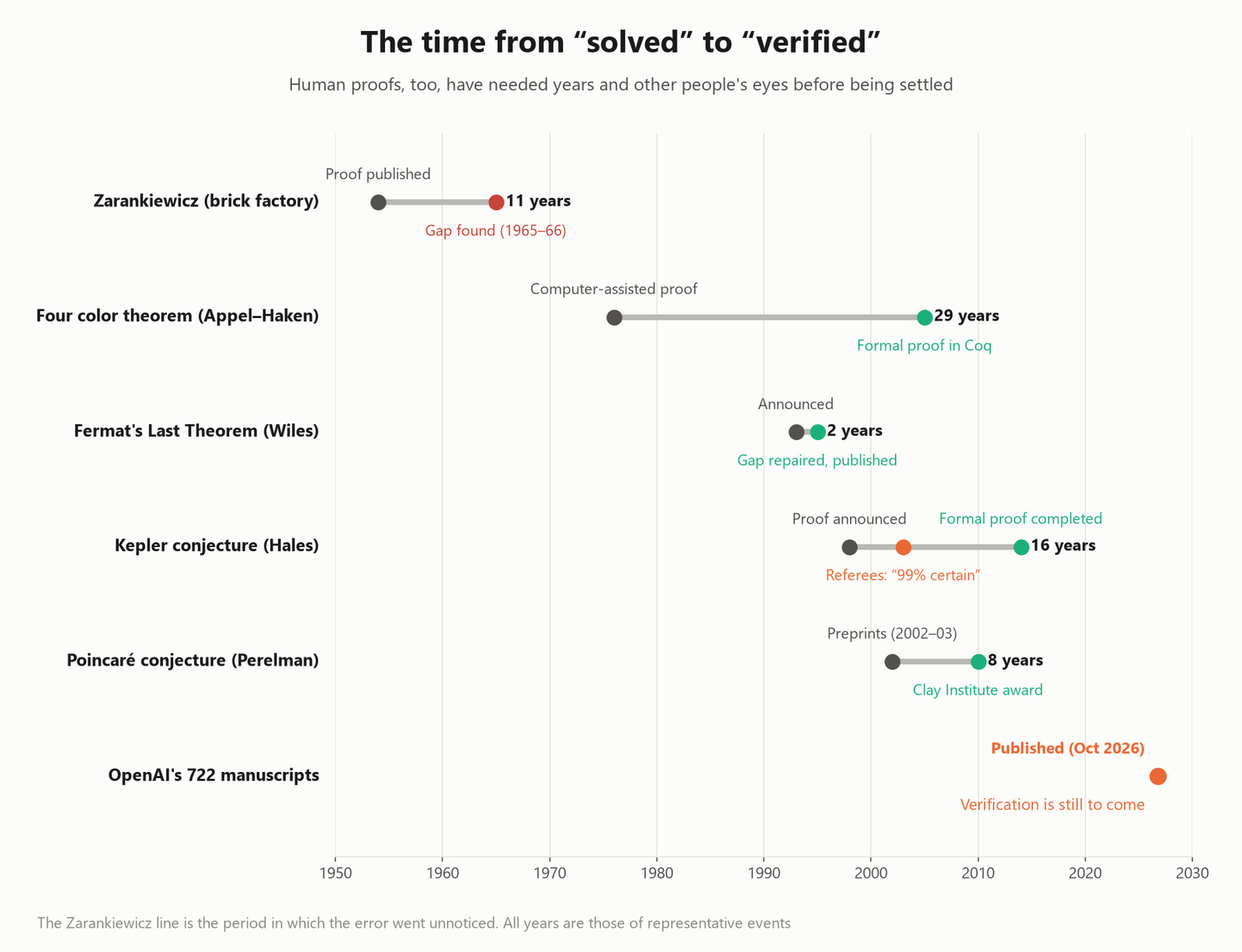
The most painful example sits inside this very series. In 1954, Zarankiewicz published a paper in a prestigious journal claiming to have proved Turán's brick factory problem. The hole in its induction was found 11 years later, and in the meantime the proof was treated as a theorem.
The 1976 proof of the four color theorem leaned on computers and set off a debate over whether it "could really be called a proof"; a formal proof in the proof assistant Coq was completed in 2005. For the proof of the Kepler conjecture announced in 1998, the referees, after years of work, could say only that they were "99% certain," and the formal proof was completed in 2014.
The lead role on the verifying side still belongs to humans. The Clay Mathematics Institute, which runs the Millennium Prize, likewise makes it a condition of an award that at least two years have passed since publication in a qualifying outlet and that the result has gained general acceptance in the worldwide mathematics community.
The AI's manuscripts stand on human shoulders
Count every entry in the reference lists of the 722, and you begin to see whose work the AI's manuscripts stand on. The tally covers human literature only, leaving out citations of OpenAI's own manuscripts.
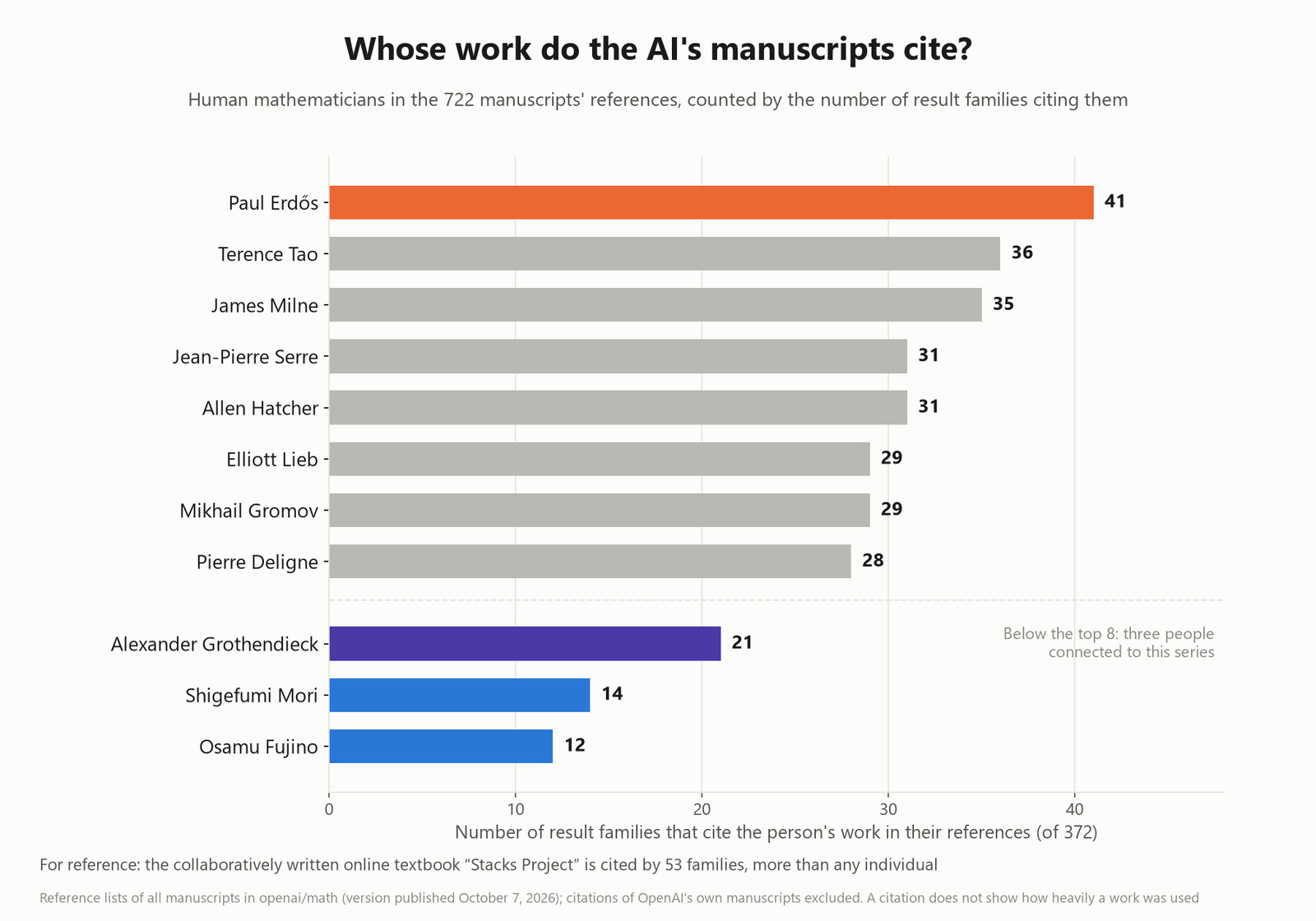
Counted by the number of result families that cite them, the top name is Paul Erdős, with 41 of the 372 families. The problems and papers that a mathematician who died 30 years ago left scattered around the world sit on the front row of the AI's "parts shelf."
Among Japanese researchers, Shigefumi Mori is cited most (14 families), and the families citing researchers connected with Kyoto University (including its Research Institute for Mathematical Sciences) came to around 60 of the 372, a rough estimate based on affiliations we sorted by hand. Beyond any individual, the most cited source was the Stacks Project (53 families), an online textbook that researchers around the world write and extend together. Who counts as "the most cited," though, changes with the way you count.
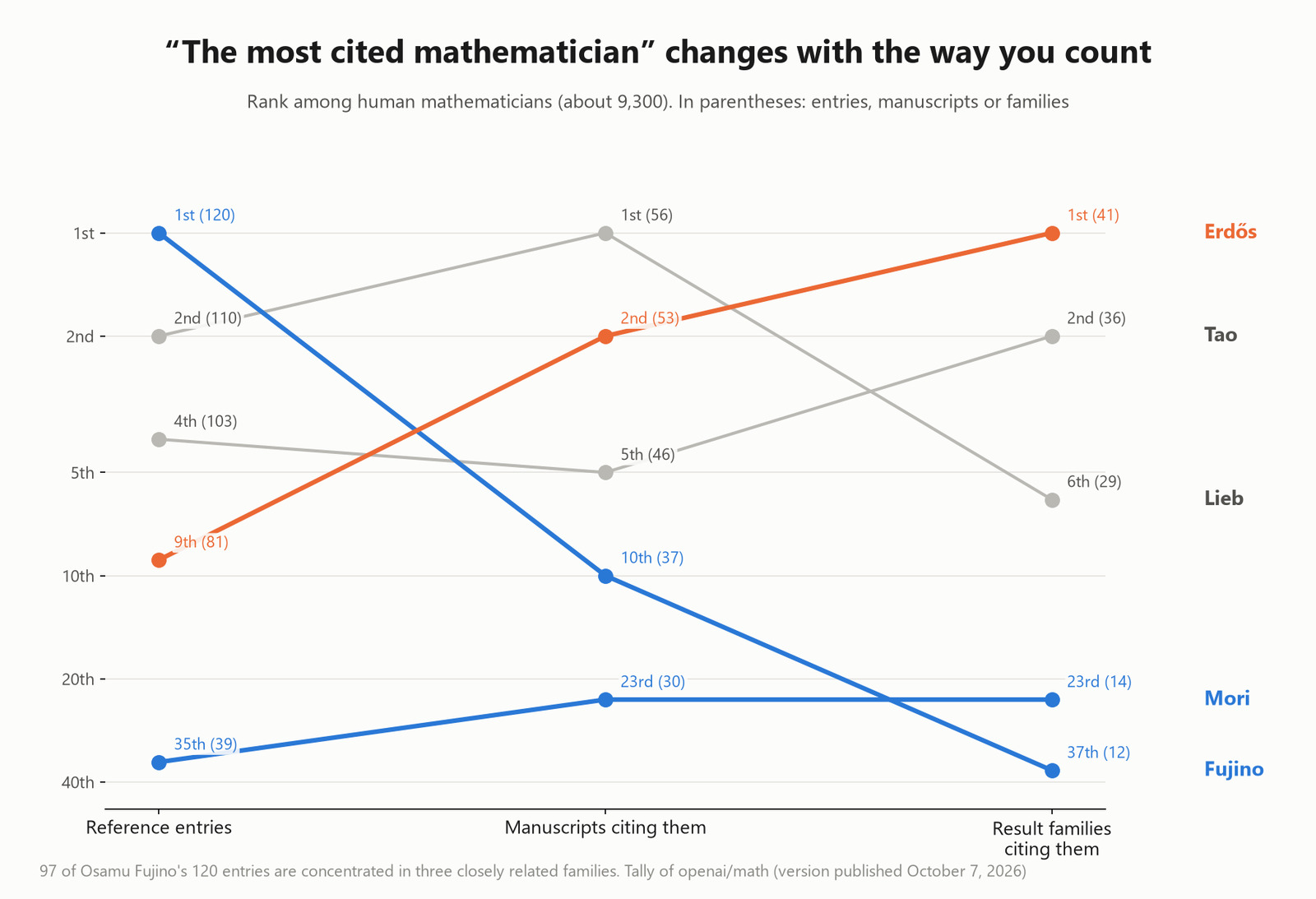
Counted by number of references, first place goes to Professor Osamu Fujino of Kyoto University (the minimal model program), with 120. Most of those are concentrated in a small group of closely related manuscripts, and recounted by the number of families that cite him, the figure is 12. None of these rankings is wrong; they differ in what was counted.
Here lies an unexpectedly human side to the AI's work. The fields where the AI produced many results were ones where humans had built up a well-stocked toolbox. In a cluster of work on the minimal model program, Fujino's theorems serve as standard parts, and in the anabelian geometry manuscripts, theorems by Shinichi Mochizuki and Shota Tsujimura sit at the core.
The AI's manuscripts are also stacked on the AI's own earlier output. There are 596 citations between OpenAI manuscripts, and the paper on the BSD conjecture, too, is built on one of the company's own papers that no one has yet verified.
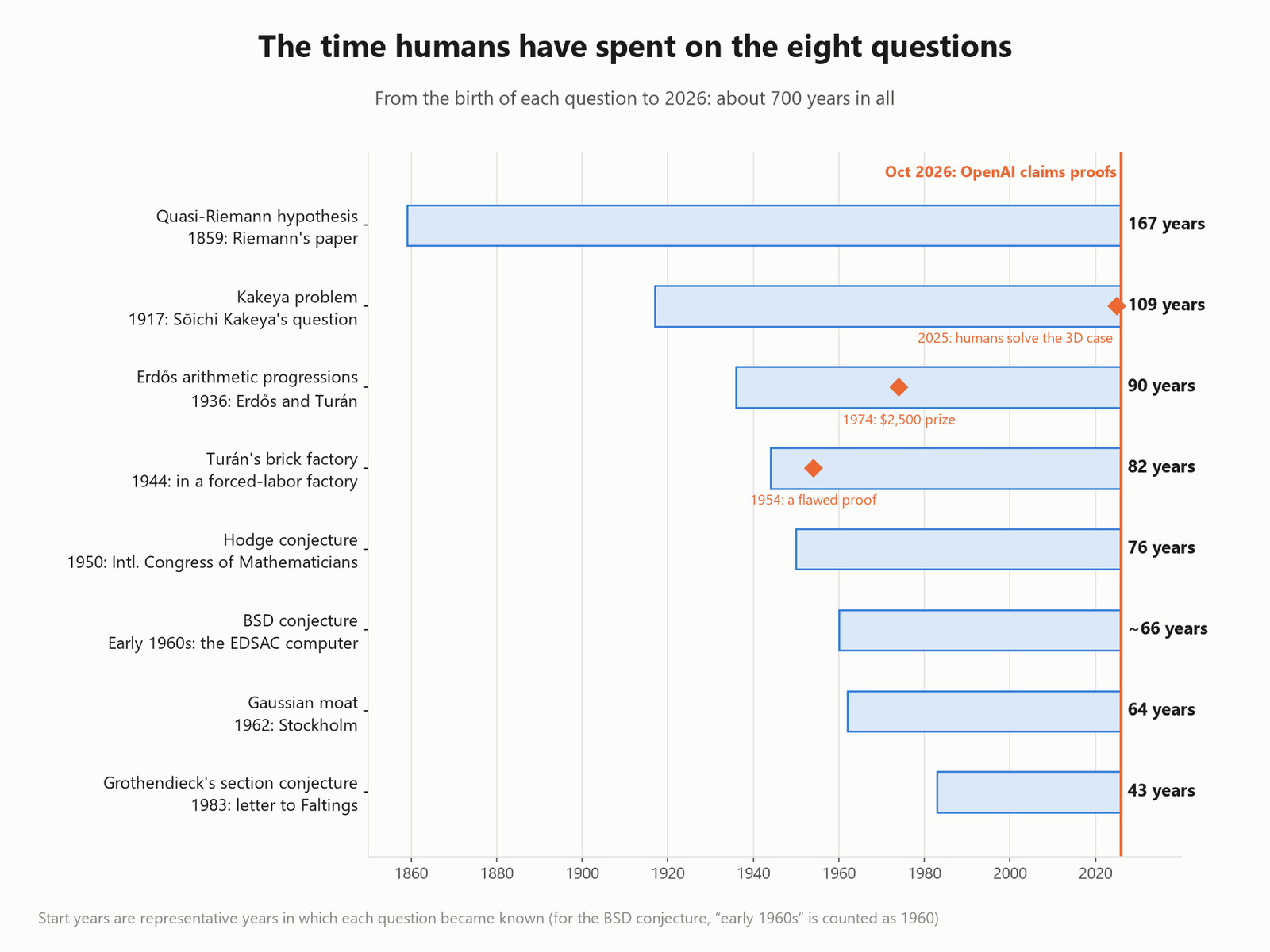
From the births of the eight questions to this year, the time adds up to about 700 years. The answers the AI claims are written on top of those 700 years of ways of asking and tools for answering.
Is solving the goal?
On September 11, about four weeks before the release, Fields medalists published a declaration titled "A Severe Misalignment of AI in Mathematics." The 28 signatories include Shigefumi Mori, Pierre Deligne, Peter Scholze and Terence Tao. The declaration contains this sentence:
"But solving problems is only a tool and proxy for achieving the primary goal of conceptual understanding and insight."
The idea is that solving is not admirable in itself; what gives it meaning is that the process of solving deepens our understanding of mathematics, and through it our understanding of the world. Thomas Bloom, the mathematician who runs the Erdős problems site, also decided on October 6 (US time), the same day as the release, to stop labeling problems "open" or "solved" and to stop showing how many had been solved.
This perspective matters. If only the answer arrives and no one can explain what is inside it, it is still short of becoming part of mathematics. Even so, reaching a conclusion has real value in itself.
- Assumptions, and "from some point we cannot name," drop away: Number theory has many theorems that assume the Riemann hypothesis, and theorems whose constants cannot be computed explicitly because of a possible exceptional zero. If the quasi-Riemann claim is correct, some of them shed their assumptions or their limitations. A Hacker News commenter who identified as a number theorist wrote that this result would cut 3 pages out of their own 2018 paper, and went on: "there are likely hundreds of papers like this."
- A counterexample stops the digging in the wrong direction: The 722 also include counterexamples that overturn conjectures. No.196 claims to have built a counterexample to the "zero-divisor conjecture," which goes back to Higman's 1940 doctoral thesis and which Kaplansky posed as a problem in 1956. The construction of the counterexample has been formalized in Lean, and if the claim is correct, the road of digging on in the belief that the conjecture "must hold" ends there.
- A settled conclusion becomes the next foundation: For both the four color theorem and the Kepler conjecture, debate lingered over proofs that leaned on computers. Even so, once the conclusions were settled, those who came after could build on them with confidence.
Deeper understanding is what gives the work its meaning. And on top of that, reaching a conclusion carries a real value of its own.
For first-time readers: how to walk the eight
We have written one article for each of the eight questions. Each one stands on its own, so you can start anywhere, but if equations are not your thing, we suggest beginning with the questions you can follow through pictures.
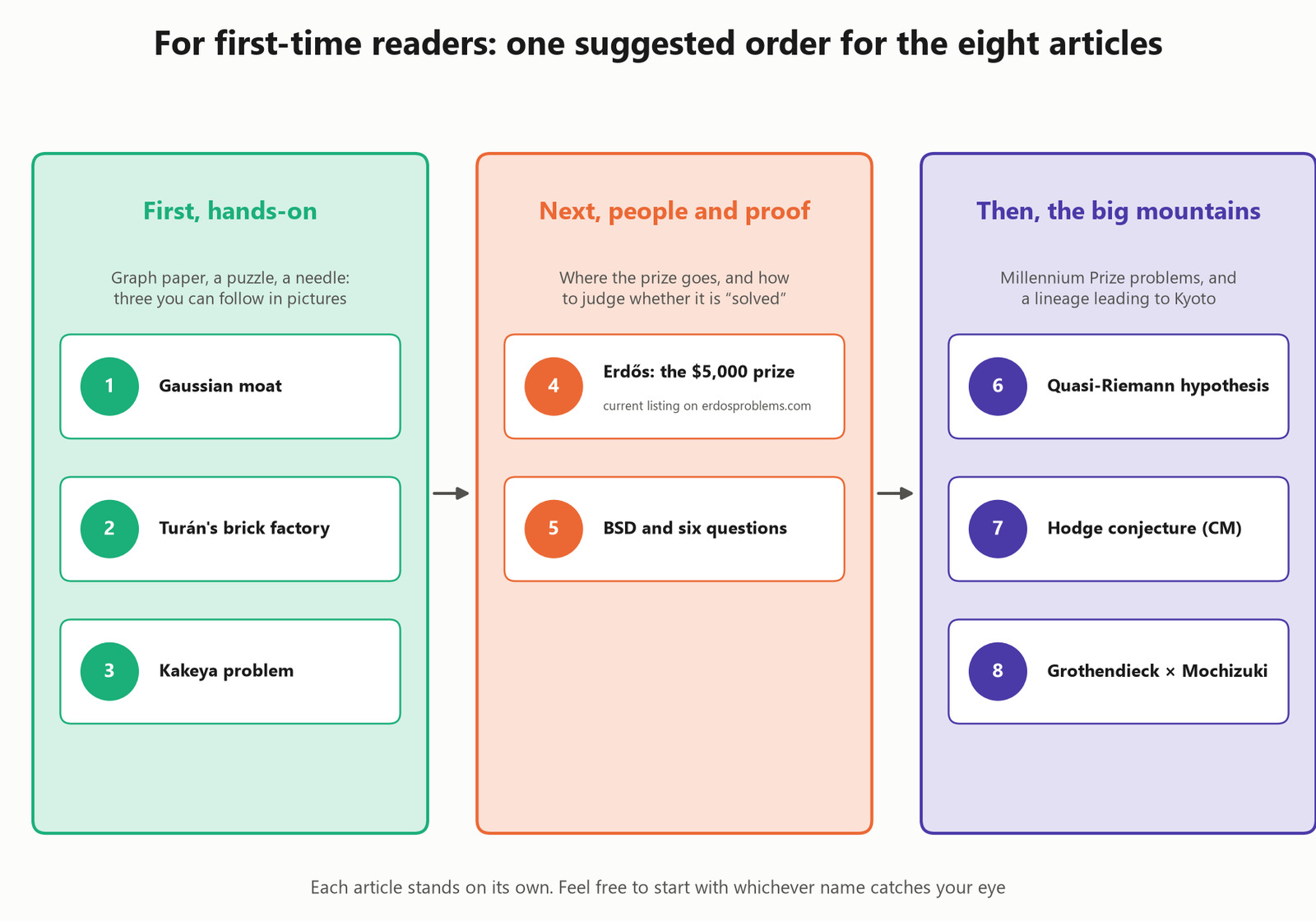
1. Stepping stones on graph paper: the Gaussian moat
Stepping only on the "prime stones" scattered over the crossings of graph paper, keeping a fixed stride, can you walk on forever? To this question, first asked in 1962, No.028 claims to have answered: "No. Wherever you start, the island you can reach has an upper limit on its size." The Lean check reaches the main theorem.
Through figures drawn from real data, you can follow the records of moats dug up by computers, and the gap between the naive intuition that "on a plane you could always walk around" and the intuition of the experts. A good first read.
2. A question born in a forced-labor factory: Turán's brick factory
In 1944 the mathematician Turán, conscripted into forced labor, watched trucks jump the rails at every crossing and asked himself, "what is the minimum number of crossings?" Eighty-two years later, No.165 claims to have solved both this problem and its sibling, Hill's conjecture, and comes with a formal proof in Lean. The backbone of the article is the history of a proof that was once considered "solved" and fell apart 11 years later.
You can enter through the puzzle of three houses and their electricity, gas and water. The difference between "it can be drawn" and "it cannot be done with fewer" is a yardstick you can carry straight into a meeting room.
3. The smallest room for turning a needle around: Kakeya
In 1917, Sōichi Kakeya of Tohoku Imperial University asked for "the smallest area needed to turn a needle of length 1 all the way around." After the strange answer that it "can be made as small as you like," the question was reborn as a question about "dimension." In 2025 humans solved the three-dimensional case, work that led to a Fields Medal, and No.074 claims to have proved the four-dimensional case. It comes with no Lean, and verification is still ahead.
Through drawings of shapes, you can follow 110 years of a question that bears a Japanese name. Change the yardstick, and the same object shows you its opposite face.
4. $5,000, payable to whom? Erdős
For a conjecture on arithmetic progressions about which Erdős wrote that he did "not expect to have to pay for it," No.159 claims a proof, and the conjecture itself has passed a Lean check. The prize rules, however, call for publication in a peer-reviewed journal and say nothing about what happens when the solver is an AI or a company.
The contrast with the "solved 10 problems" uproar a year earlier is another reason to read it. Three questions, "Was it really unsolved?", "How far did the machine check?" and "Who accepted it?", apply just as well to the reports on AI use inside your own company.
5. Six questions for judging "solved": the BSD conjecture
The rumor that "OpenAI solved the BSD conjecture" moved prediction-market prices before the release. What was actually published, No.002, is a paper claiming a precise formula for elliptic curves of rank up to 1, a different scope from the Millennium Prize question. It comes with no Lean, and its foundation includes one of the company's own papers that has not yet been verified.
The six questions, among them "How much did they solve?" and "Who verified it?", also work on the "industry first" and "99% accuracy" news that lands on your desk.
6. A stake driven halfway up a 167-year mountain: the quasi-Riemann hypothesis
The Riemann hypothesis itself remains open. No.003 claims that the zeros of the zeta function never appear to the right of real part 7/8, and its main theorem passed a Lean check using the standard definitions as they are. Human verification of the applications and of the roughly 200-page paper itself is still to come.
To the simple question "How far up the mountain are we now?", the article answers in terms of how many digits the error in counting primes runs to.
7. Can a clay pattern be built from LEGO? The Hodge conjecture (CM)
The Hodge conjecture asks whether "the pattern of a shape's holes (a clay sculpture) can be rebuilt from blocks drawn by equations (LEGO)." No.032 claims to have proved it inside a box called "CM abelian varieties," which for decades has been singled out with an "if only we could prove this part." It comes with no Lean, and published confirmation by outside experts is still to come.
It reads as a 130-year story, from Poincaré's Analysis Situs to Perelman.
8. A 1983 letter and a toolbox from Kyoto: Grothendieck × Mochizuki
No.019 claims to have proved the local version of the "section conjecture" that Grothendieck set down in a 1983 letter. At the geometric core of the proof, a theorem published in 2023 by Shinichi Mochizuki and Shota Tsujimura is built in, by name. It comes with no Lean, and whether it is correct rests on the eyes of experts in anabelian geometry.
Here you meet another side of Mochizuki, apart from the controversy over the ABC conjecture. The article also introduces what Mochizuki himself has written about AI and formalization.
When you hear "AI solved it"
Across the eight articles, three questions come into view.
- How far: Is the "solved" in the headline the same scope as what the paper claims?
- How far the machine went: Which parts of the claim does a check such as Lean actually reach?
- Who: Have experts other than the people who announced it checked it?
The same holds outside mathematics. When a report or proposal written by AI lands in front of you, asking the same three questions is enough to show its true size, somewhere between "amazing" and "suspicious."
The AI wrote 722 manuscripts. Yet those manuscripts were written on top of Erdős's homework, Grothendieck's letter, Kyoto's toolbox and Kakeya's needle. And the final check on whether the answers are right falls to humans, too.
It would be a waste to dismiss this as "humans can no longer keep up." Seven hundred years of questions have taken the shape of answers and come back into human hands.
References
- openai/math README and CONTENTS (GitHub)
- Lean formalization catalog formalization.yaml (OpenAI, GitHub)
- Sharing AI progress in mathematics (OpenAI)
- A Torsion-Free Group Algebra with Zero Divisors (OpenAI, GitHub)
- Scope of the No.196 Lean formalization (OpenAI, GitHub)
- openai-zeta-proof-check, a third-party rebuild report (GitHub)
- A Severe Misalignment of AI in Mathematics (Math and AI)
- On OpenAI's Release of Mathematical Results (AGMAI)
- Changes (Thomas Bloom, erdosproblems.com)
- Comment by a poster identifying as a number theorist (Hacker News)
- Millennium Prize Rules (Clay Mathematics Institute)
- Turán's brick factory problem (Wikipedia)
- Four color theorem (Wikipedia)
- Kepler conjecture (Wikipedia)
- Kaplansky's conjectures (Wikipedia)
- OpenAI unleashes hundreds more math results upon a field already in shock (Scientific American)
- OpenAI claims its in-house AI proved a hard problem related to the Riemann hypothesis (ITmedia NEWS, in Japanese)