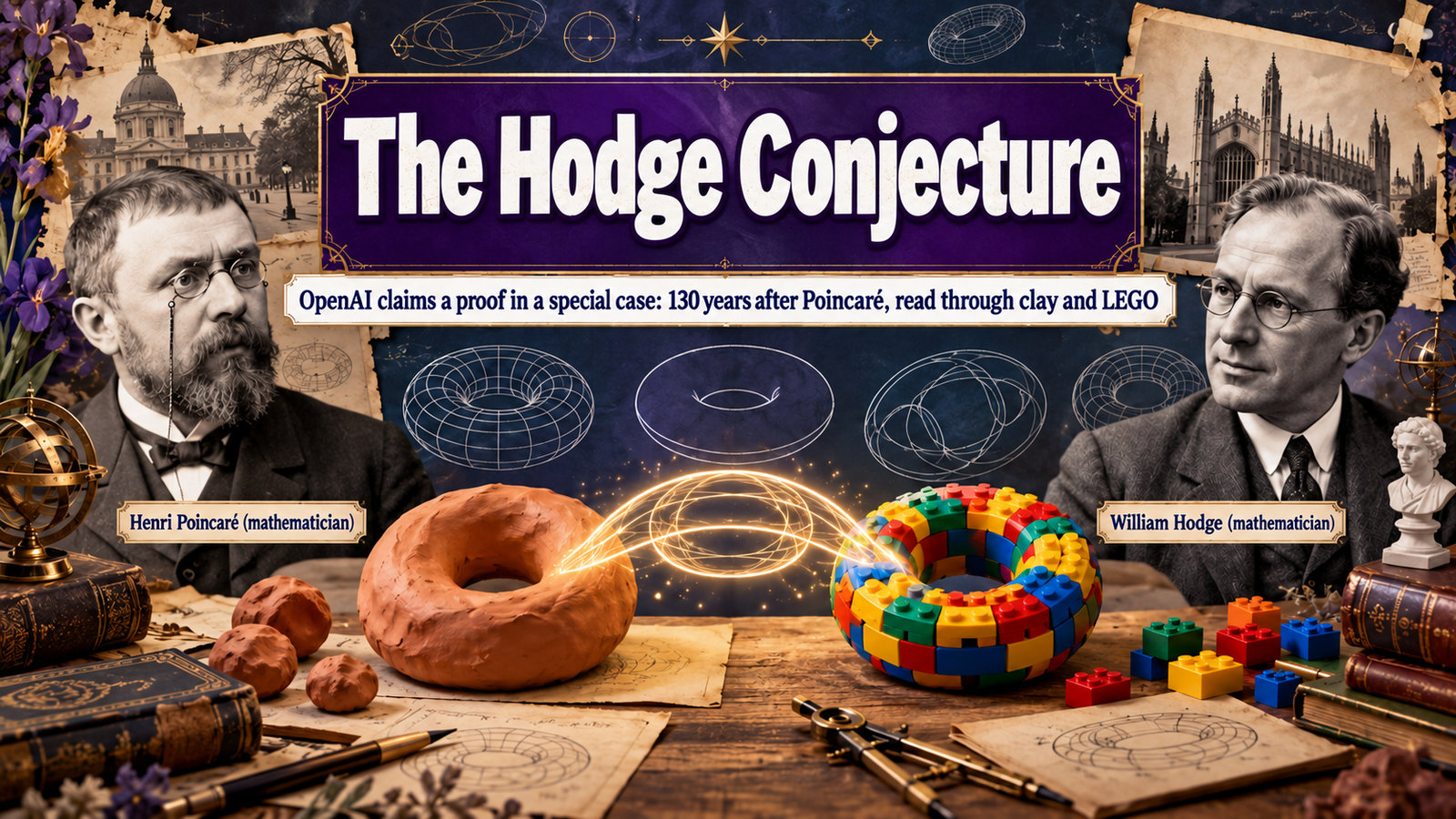
On the morning of October 7, plenty of readers must have seen the headline "OpenAI proves the Hodge conjecture," opened the article, and stalled at the line "complex abelian varieties with complex multiplication."
Small wonder. When NHK's math program Warawanai Sugaku took up the Hodge conjecture, the episode's blurb billed it as "the hardest ever in the show's history!"
The Hodge conjecture as a Millennium Prize Problem, with its $1 million prize, remains unsolved. What OpenAI claims to have proved concerns only the inside of one special box, called "CM abelian varieties." And as of October 7, public reports of any outside expert checking that proof still stood at zero.
Mathematicians still cannot ignore this paper, because that box is the one that has been singled out for decades with the words "if only we could prove it here."
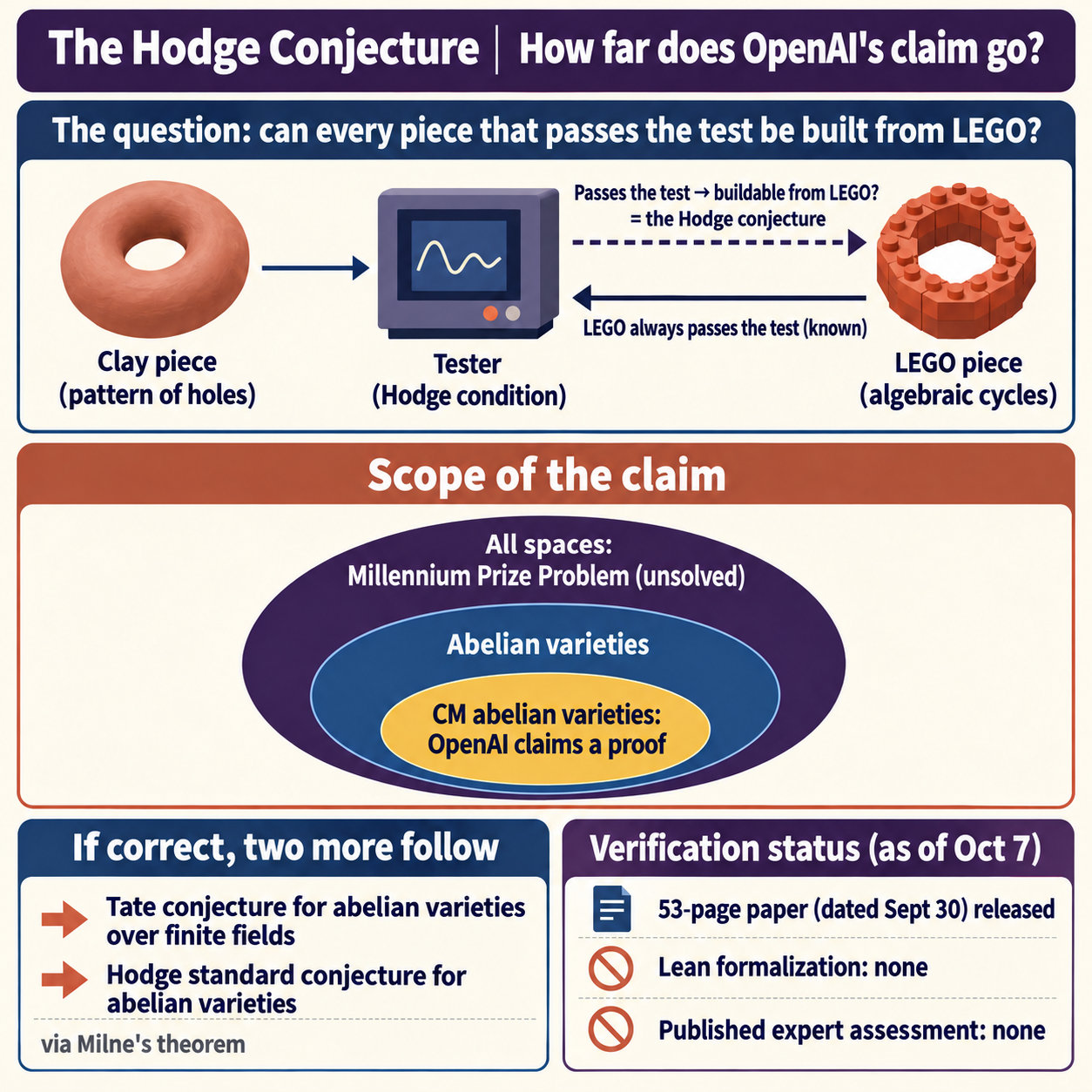
A 53-page manuscript on GitHub
In the early hours of October 7, Japan time, OpenAI published a repository called openai/math on GitHub. It holds 722 mathematical manuscripts, said to have been written by an unreleased internal model, sorted into 372 result families.
The 32nd family contains the subject of this piece, "The rational Hodge conjecture for CM abelian varieties." The author line reads only "OpenAI," the date is September 30, and the text runs to 53 pages. The opening abstract states it without hesitation:
"We prove the rational Hodge conjecture for complex abelian varieties with complex multiplication: every rational Hodge class on such a variety is a rational linear combination of algebraic cycle classes."
In the introduction it widens the scope further, to "in every dimension and codimension."
Works in clay and works in LEGO
The shapes the Hodge conjecture deals with are smooth, closed "spaces" drawn by equations. Picture the surface of a doughnut, except that the spaces actually in play are that surface inflated into many more dimensions.
Inside such a space, you can place two kinds of "works":
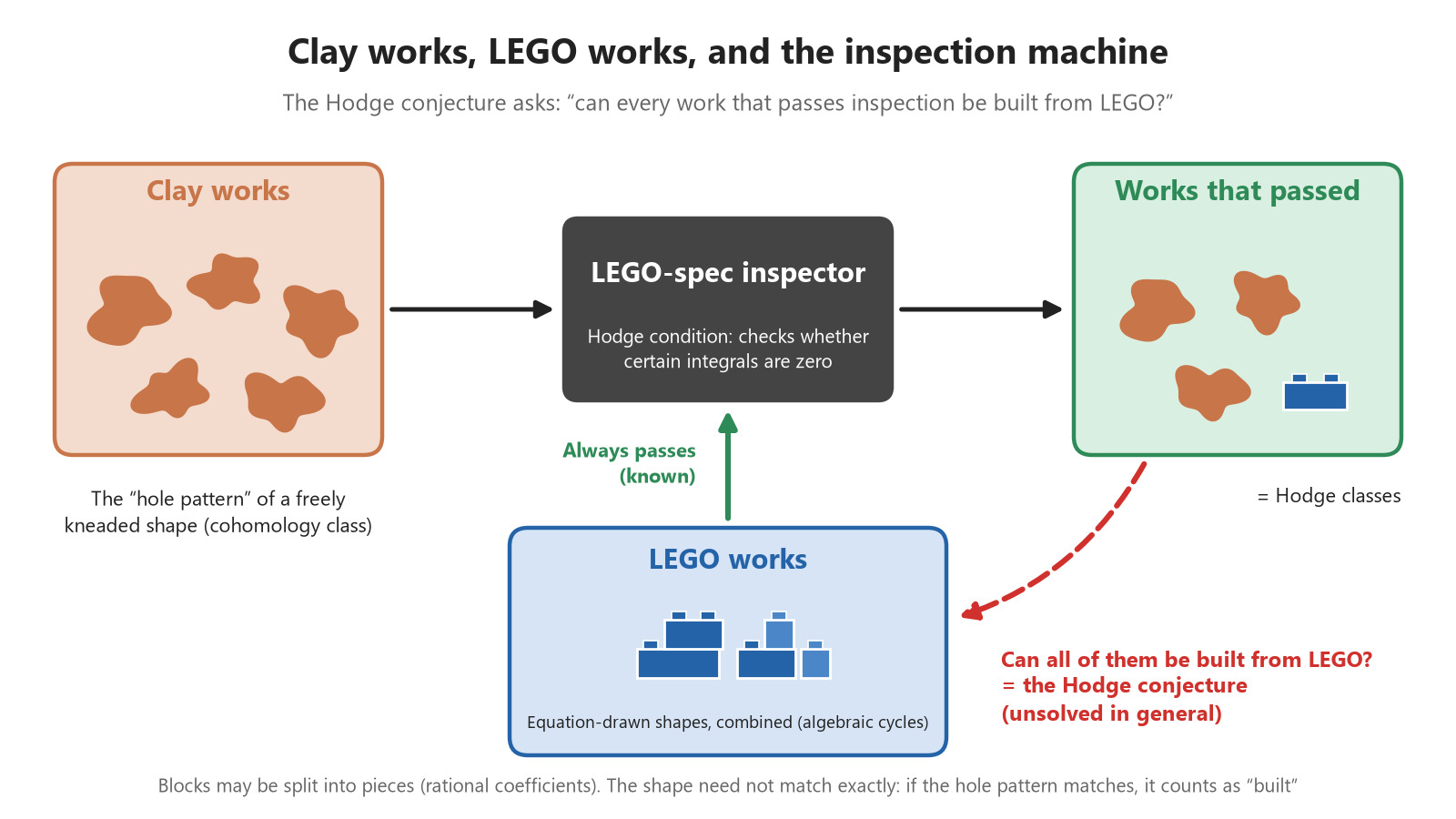
- Works in clay: shapes kneaded freely and set down inside the space. What mathematicians look at is not the shape itself but its "hole pattern," the way it wraps around the holes in the space. The technical term is a cohomology class.
- Works in LEGO: shapes drawn by polynomial equations (subvarieties), placed inside the space as bricks and combined. The technical term is an algebraic cycle.
A LEGO work, once placed, also wraps around the holes in the space and leaves a hole pattern. The question is: "Can this clay work's hole pattern be reproduced in LEGO?" The shapes need not be identical; if the way they wrap around the holes matches, it passes.
The algebraic geometer Burt Totaro has described the difference in character between the two: "real submanifolds are flexible, whereas complex submanifolds are quite rigid, and it is a challenge to relate the two."
Clay is soft and LEGO is hard. The question is how far those hard bricks can reproduce the patterns of soft clay.
The LEGO comparison itself has a precedent. In 2017, in the English-speaking world, the Oxford mathematician Tom Crawford wrote in an explainer for general readers: "Hodge is basically asking whether maths is the same as Lego."
If it passes the inspection machine, is it real LEGO?
A hole pattern can be put through a "LEGO-standard inspection machine." The test checks whether certain integrals vanish; technically, it is the condition of being "of type (p, p)," commonly called the Hodge condition.
Genuine LEGO works always pass this test. That direction is already known, and the Clay Mathematics Institute's official problem description also explains that classes of algebraic cycles are always of type (p, p). The Hodge conjecture asks the reverse.
Can every work that passes the test really be built out of LEGO? Or is there, mixed in somewhere, a clay fake good enough to slip past the inspection? In the words of the official problem description:
"On a projective non-singular algebraic variety over C, any Hodge class is a rational linear combination of classes cl(Z) of algebraic cycles."
A "Hodge class" here is a work that has passed the inspection.
You are allowed to split the bricks
The Hodge conjecture comes with one relaxed rule. You may not only remove bricks (subtract them) but also split them into halves or thirds and use the pieces. In mathematical language this is "allowing rational coefficients," and it is the "rational" in the paper's title.
The strict rule that forbids splitting, the version with integer coefficients, has already been disproved. In the early 1960s (the paper is dated 1961 in some sources and 1962 in others), Atiyah and Hirzebruch gave an example of a work that passes the inspection but cannot be built without splitting bricks.
Hodge himself, who proposed the conjecture, seems at first to have had the no-splitting rule in mind. Pierre Deligne, who wrote the official problem description, notes:
"When Hodge formulated his conjecture, he had not realized it could hold only rationally"
The thicknesses at the ends can be built. The middle is the hard part
Works have a "thickness." In a 4-dimensional space, you can place works that are points (0-dimensional), lines (1-dimensional), surfaces (2-dimensional) or walls (3-dimensional). Dimensions here are counted in complex numbers.
For the thickest works, the walls, Solomon Lefschetz showed in 1924 that anything passing the inspection can always be built in LEGO. The result is called the (1,1) theorem, and it came a full quarter century before Hodge stated his conjecture. Combined with another theorem, it shows that "line" works can be built too, so the conjecture holds in full for spaces of dimension 3 or less.
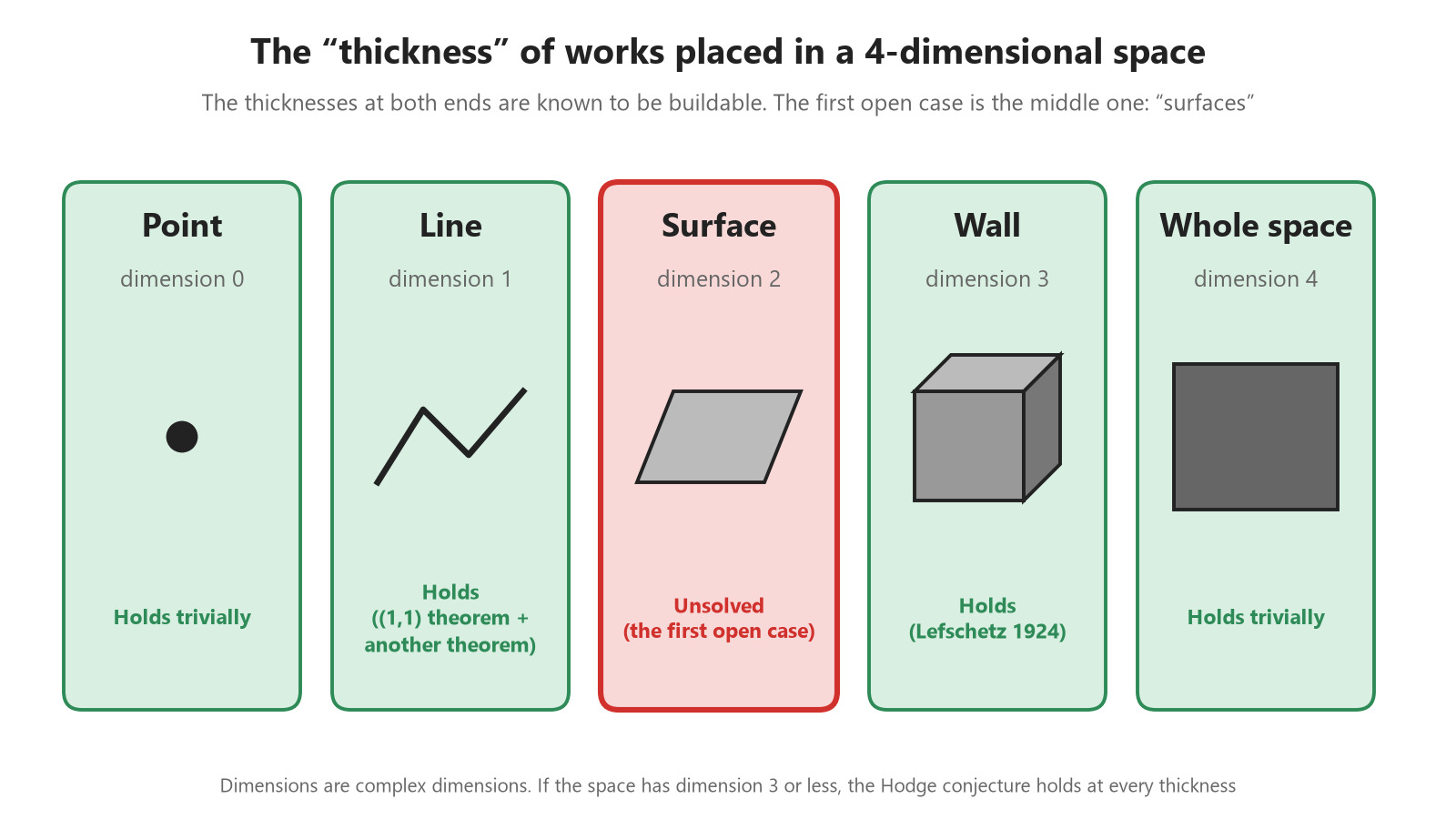
What remains is the middle. Totaro writes that the first open case is 2-dimensional works in a 4-dimensional space, and that for general spaces even that case "still seems far out of reach."
The clay side was built by Poincaré
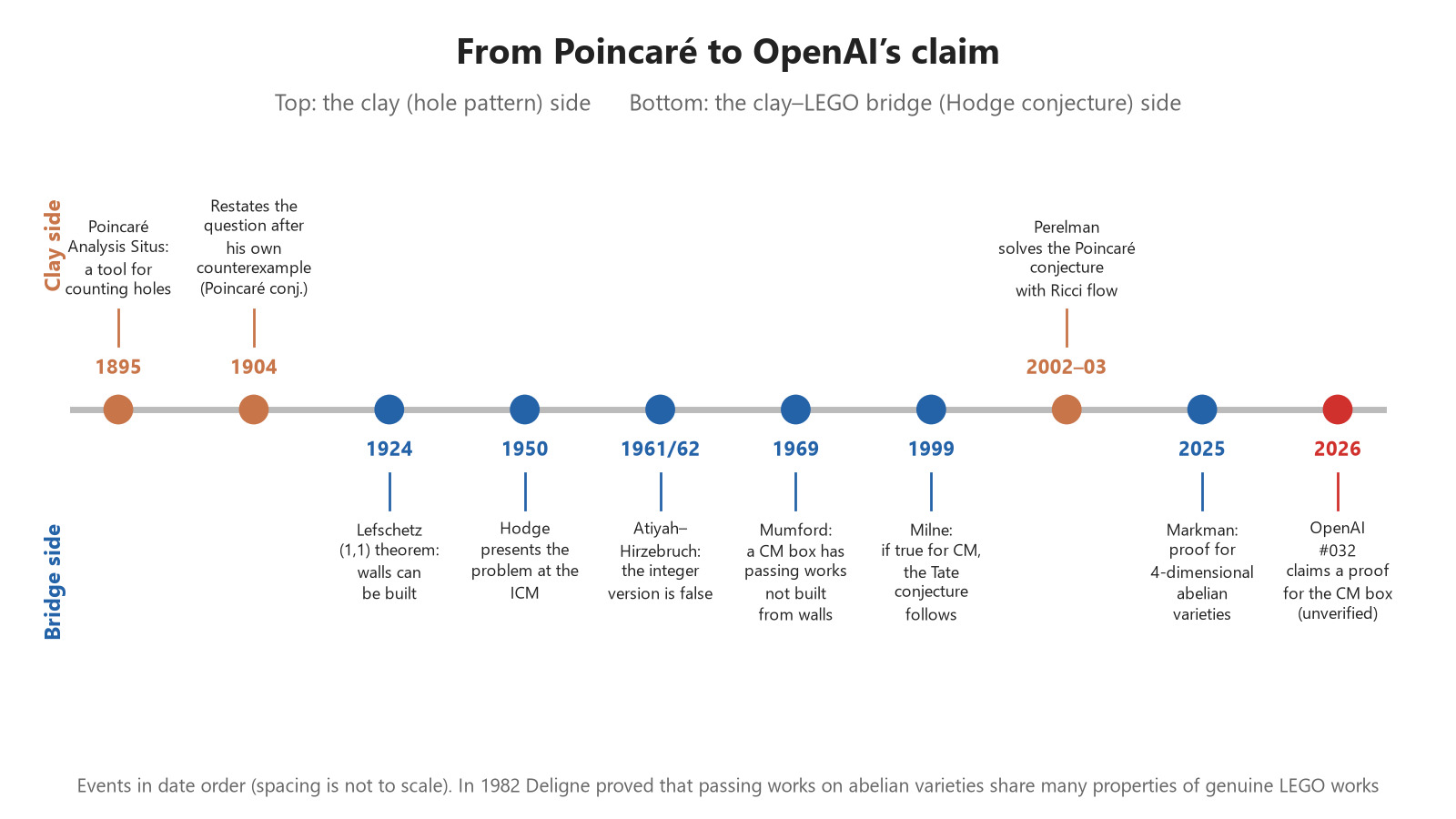
Let's turn the clock back about 130 years. The very idea of a "hole pattern" was created by the French mathematician Henri Poincaré.
In his 1895 paper Analysis Situs, Poincaré introduced homology, a tool for counting the holes in a shape algebraically. In the same paper he also introduced the "fundamental group," which tracks how loops can be moved. The paper and its supplements became the starting point of the entire field of algebraic topology.
At first, Poincaré believed that counting holes was enough to tell whether a shape is a sphere. In his second supplement, in 1900, he asserted that a shape whose hole count matches the sphere's is a sphere.
But in his fifth supplement, in 1904, he himself produced a counterexample to his own claim: a 3-dimensional shape whose hole count is exactly the same as the sphere's, yet which is not a sphere. This shape, now called the Poincaré homology sphere, has loops that cannot be shrunk to a point.
Counting holes is not enough. Poincaré accepted this and rebuilt his question: "If every loop can be shrunk to a point, is the shape a sphere?" This became what we now call the Poincaré conjecture.
The program that brought this feel for "shrinking loops" to a wide audience in Japan was a 2007 NHK Special, Why Was the 100-Year Problem Solved? In it, Dr. Valentin Poénaru, a Paris-based researcher on the Poincaré conjecture, gives a special class at the Lycée Henri Poincaré.
"Imagine that someone sets off on a trip around the universe, holding a long rope. Suppose they finish the journey and return safely to Earth. Can the rope they have looped all the way around the universe always be reeled back into their hands, like this?"
According to the program's director, Masato Kasuga, the rope analogy was crafted by Dr. Poénaru and the film crew over many discussions, aiming to be "as easy to understand as possible, and reasonably accurate mathematically too."
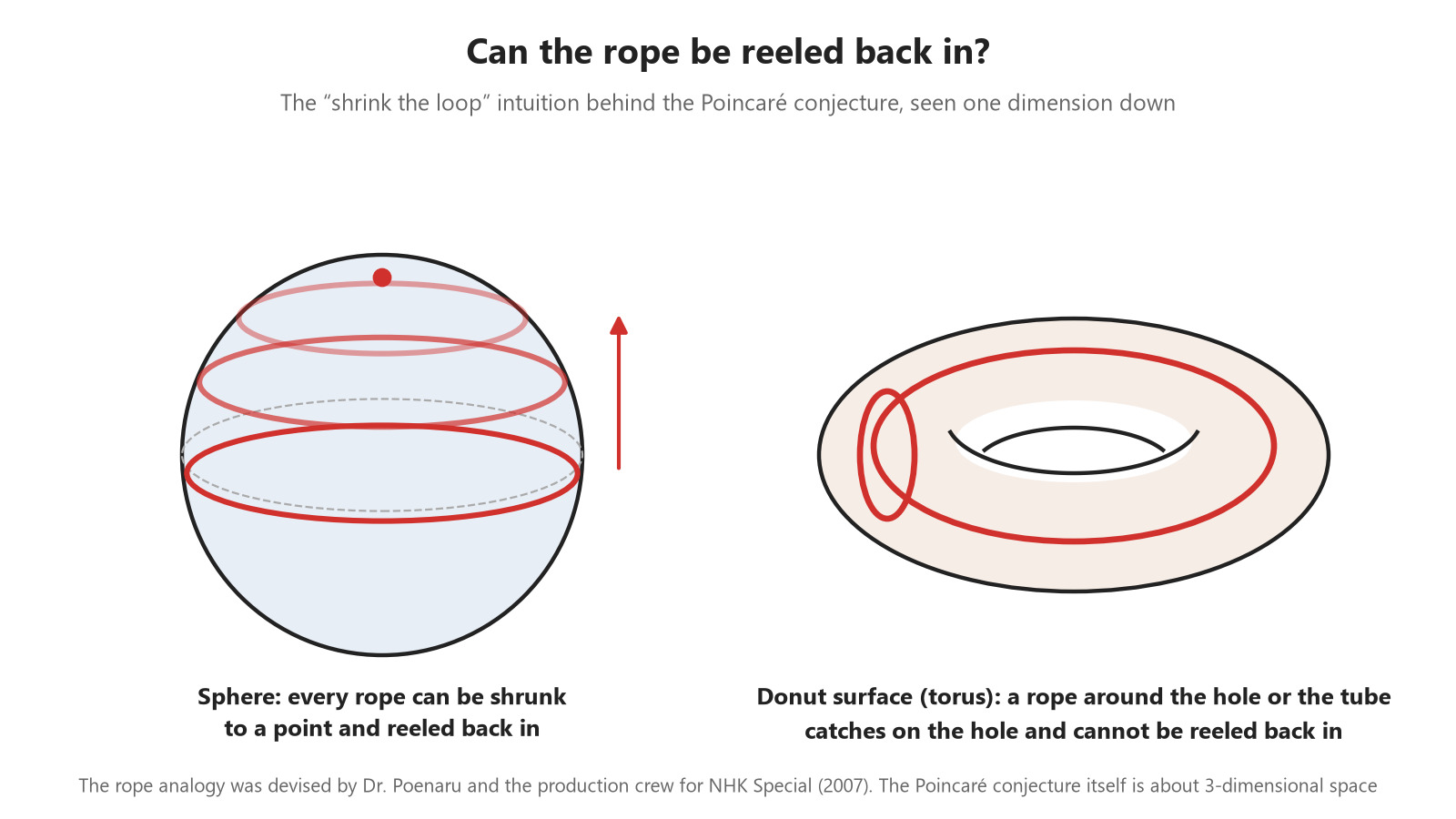
The Poincaré conjecture was solved in three papers Grigori Perelman posted to arXiv in 2002 and 2003. The proof uses Ricci flow, a technique begun by Richard Hamilton that deforms a shape smoothly. In 2010 the Clay Institute announced its first award for a Millennium Prize Problem, but Perelman declined the $1 million.
A bridge that inherited the name Analysis Situs
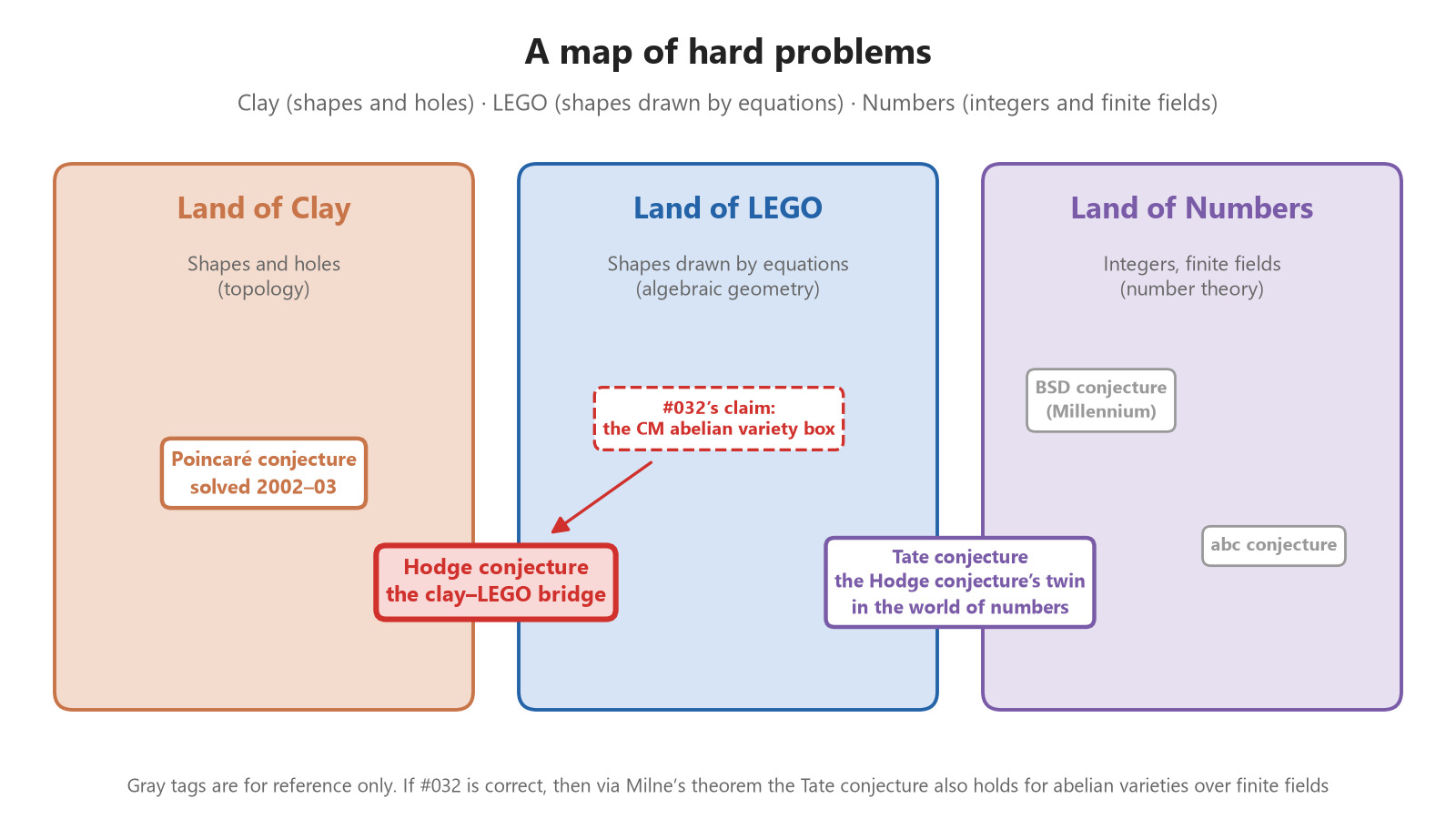
Poincaré's work belongs firmly on the clay side, the side of hole patterns. It was Hodge who asked about a bridge connecting the patterns in clay to constructions in LEGO.
Look at the foundations of that bridge and you find Poincaré's name carved into them. The book in which Lefschetz published the (1,1) theorem in 1924 was titled L'Analysis situs et la géométrie algébrique (Analysis Situs and Algebraic Geometry). The original proof used a tool Poincaré had introduced, "normal functions."
At the 1950 International Congress of Mathematicians in Cambridge, Massachusetts, William Hodge cited this book at the opening of his address, and called extending Lefschetz's condition to higher dimensions "clearly a matter of great importance." The address also contains the sentence "Beyond this, the problem is an unsolved one."
On a map, the Poincaré conjecture is a problem inside the land of clay, while the Hodge conjecture is a problem about the bridge joining the land of clay to the land of LEGO. The new paper carries the story further still, into the world of numbers beyond that bridge.
CM abelian varieties: the most suspicious box
Abelian varieties are spaces that are something like higher-dimensional relatives of the doughnut's surface. CM abelian varieties are the ones among them that have an exceptionally large number of special ways of mapping to themselves (endomorphisms).
The more such maps a space has, the more works pass the inspection machine. For most abelian varieties, the passing works can be explained by stacking up the thickest works, the "walls," and the Hodge conjecture is known to hold.
In 1969, however, David Mumford found, on an abelian variety of CM type, a passing work that cannot be built no matter how many walls you stack. In 1977 André Weil showed that such works appear whenever there is a symmetry involving complex multiplication.
It has the most passing works, and among them are works that simple stacking cannot explain. If fake clay is hiding anywhere, this is the first box to suspect.
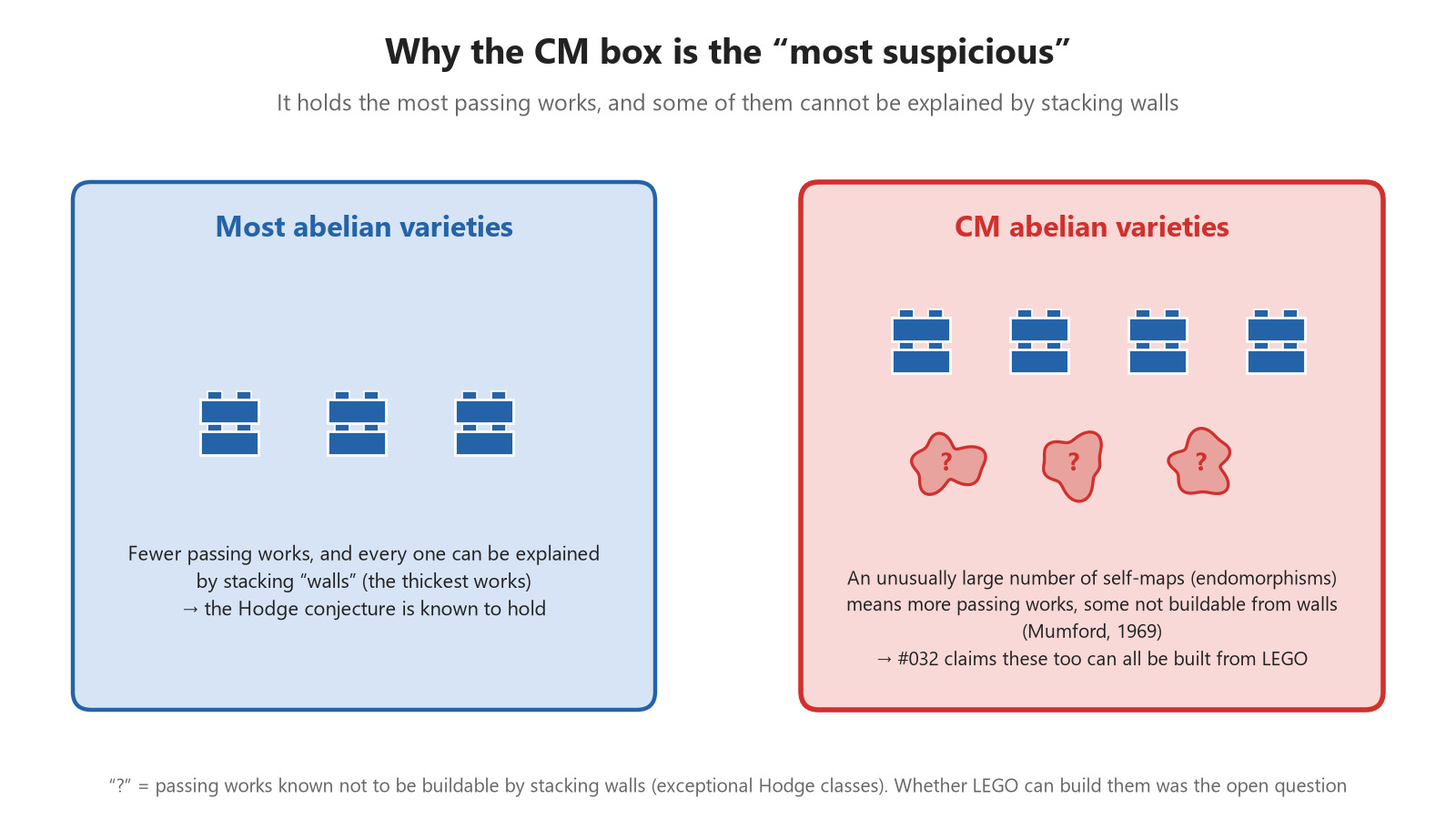
Mathematicians have long struggled to crack this box. In 1982, Deligne proved that the passing works on abelian varieties share many properties with genuine LEGO works.
But that is not an assembly diagram; it is circumstantial evidence. In the official problem description, Deligne himself writes:
"Progress is blocked by a lack of methods to construct interesting algebraic cycles."
At the same time, it was understood early on that this box is a strategic point. In 1999, J. S. Milne proved that "if the Hodge conjecture holds for CM abelian varieties, the Tate conjecture holds for abelian varieties over finite fields."
Fumio Hazama narrowed the problem of the CM box down to the codimension 2 case alone. Milne closed a 2007 talk this way:
"Optimists will now try to prove the Hodge conjecture in codimension 2 for CM abelian varieties ... Pessimists will try to prove the opposite."
Humans, too, had pushed right up to the edge of the box. In 2025, Eyal Markman proved that the Hodge conjecture holds for all 4-dimensional abelian varieties.
What OpenAI claims, and two conjectures beyond it
Theorem 1.1 of OpenAI's paper states that on CM abelian varieties, every work that passes the inspection, at any thickness, can be built in LEGO. It says the same holds for spaces formed by multiplying CM boxes together. If the claim is correct, two further conjectures follow by way of Milne's already proven theorems:
- The Tate conjecture for abelian varieties over finite fields: the same kind of question as the Hodge conjecture, posed in a world (a finite field) that, like a clock face, goes all the way round using only finitely many numbers. The paper derives it in Corollary 8.3 by applying Milne's 1999 theorem.
- The Hodge standard conjecture for abelian varieties: one of the "standard conjectures" Grothendieck put forward as foundations for the geometry of equations. Corollary 8.4 derives it from Milne's 2002 theorem.
The paper itself marks the limits of its claim clearly. Remark 8.5, on applications, ends with the words "not the Hodge conjecture for arbitrary complex abelian varieties."
What the Millennium Prize Problem asks for is a proof for every box, that is, for "all smooth, closed spaces drawn by equations." The CM box is only a tiny part of that.
No one has checked it yet
Verification of OpenAI's Theorem 1.1 is still to come. The repository has a catalog of manuscripts whose main results have been machine-checked in the Lean proof assistant, with 162 entries. Family 32 manuscripts on the Hodge conjecture or K3 surfaces account for zero of them.
The review status of the catalog as a whole is also "unchecked." The README is frank about the results that have not been formalized:
"Some of the unformalized results could have issues. We will endeavor to fix any such issues quickly."
The README also lists the proof of the Hodge conjecture among the "exceptions" to the fixed procedure used for the vast majority of results. It does not say how it was an exception, how much compute was used, or how far people were involved.
As of October 7, commentary in which an expert named this paper and assessed its content came to zero, as far as we could find. Outside Japan, there are secondhand reports that OpenAI CEO Sam Altman acknowledged the results have not yet been confirmed externally, but his original words remain untraced.
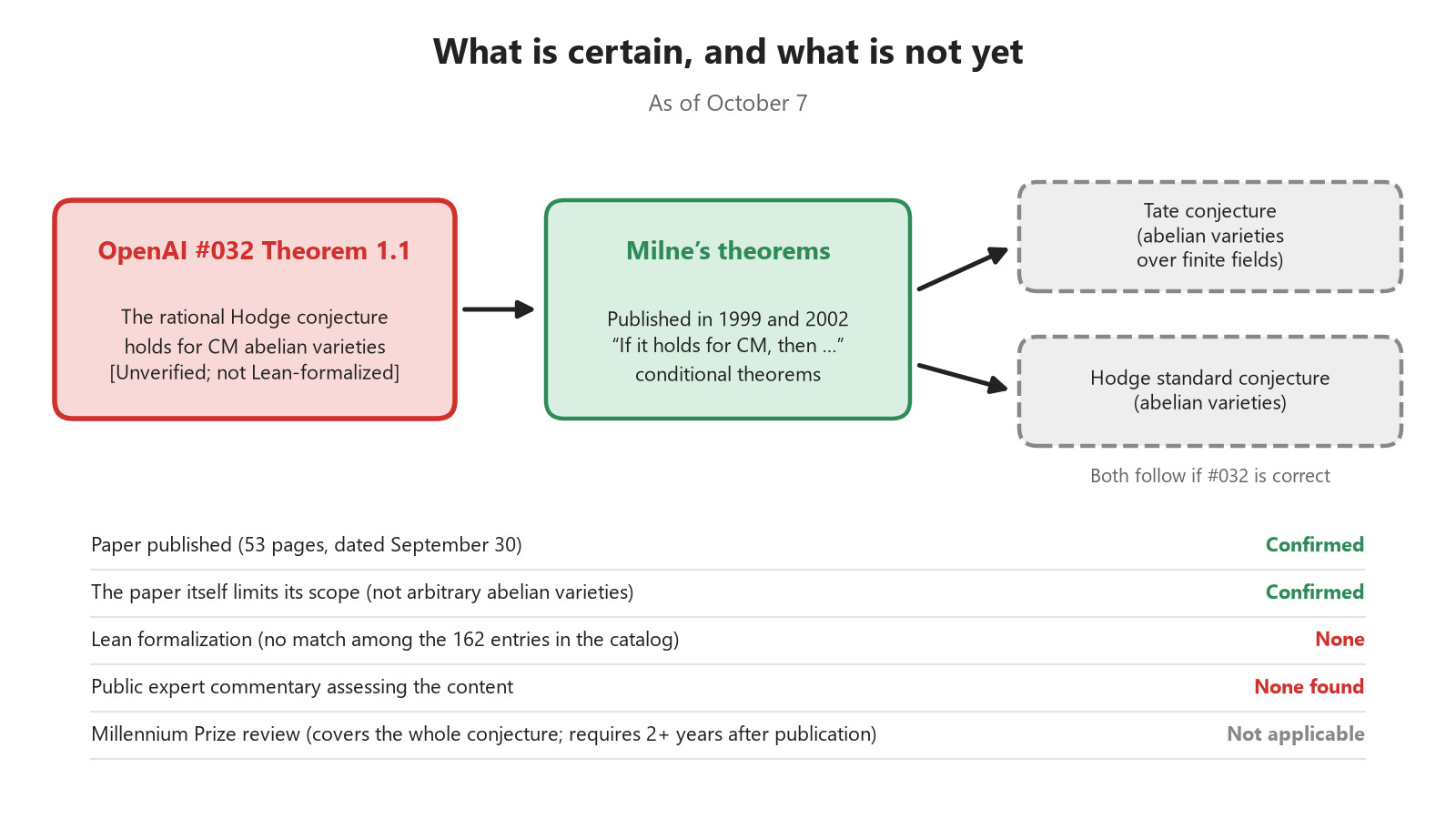
Under its rules, the Clay Institute does not consider a proposed solution until at least two years after publication. In September, while it was still a rumor, the algebraic geometer Richard Thomas commented: "Personally I simply cannot believe an AI could do that yet – it would require completely new ideas."
Human proofs, too, take time to verify. A serious flaw was found in Hodge's own 1936 proof about harmonic forms, and Hermann Weyl and Kunihiko Kodaira each repaired it independently. Even a great mathematician's proof needed years of other people's eyes before it was settled.
Passing the inspection is not the same as being buildable
The 130-year story of clay and LEGO holds lessons that apply beyond mathematics:
- Passing the inspection does not prove something can be built: the real thing always passes. But whether what passes is real is a separate question. In mathematics, the distance between a plan that ticks every box on the checklist and a business that has actually been built goes by the name of the Hodge conjecture.
- A rebuilt question can drive the next 100 years: Poincaré withdrew his own claim that "counting holes is enough" because of a counterexample he found himself. The question he rebuilt became a hard problem that lasted a century, all the way to Perelman.
- Name the strategic point and the attackers gather: in the quarter century since Milne laid out the route, "if only the CM box could be proved," humans and AI alike have aimed at that one spot. Before anyone solves a problem, there is great value too in the work of showing where a solution would pay off.
In September, in the comments under his guest post on Tao's blog, Totaro wrote that even if the Hodge conjecture turns out to be false, pursuing it "would not have been a dead end." Are OpenAI's 53 pages a genuine LEGO assembly diagram, or an elaborate piece of clay? That will be decided by the eyes of the mathematicians who now read the manuscript.
References
- The rational Hodge conjecture for CM abelian varieties (OpenAI, GitHub)
- openai/math README (GitHub)
- Lean formalization catalog, formalization.yaml (GitHub)
- Sharing AI progress in mathematics (OpenAI)
- The Hodge Conjecture, official problem description (Clay Mathematics Institute, P. Deligne)
- Poincaré Conjecture (Clay Mathematics Institute)
- Proceedings of the ICM 1950, Vol. 1 (International Mathematical Union)
- On the Hodge conjecture (Burt Totaro, What's new)
- The status of the Hodge conjecture (Claire Voisin, What's new)
- The Tate conjecture over finite fields (J. S. Milne, arXiv)
- Polarizations and Grothendieck's standard conjectures (J. S. Milne, arXiv)
- Cycles on abelian 2n-folds of Weil type from secant sheaves on abelian n-folds (E. Markman, arXiv)
- An introduction to the Hodge conjecture for abelian varieties (B. van Geemen)
- The Hodge Conjecture (Tom Rocks Maths)
- The "hard problem" of communicating mathematics: notes from covering the Poincaré conjecture (Masato Kasuga, Sugaku Tsushin, Mathematical Society of Japan, in Japanese)
- Warawanai Sugaku: Hodge Conjecture Special (NHK, in Japanese)
- Analysis Situs (paper) (Wikipedia)
- Poincaré conjecture (Wikipedia)
- Hodge conjecture (Wikipedia)
- Hodge theory (Wikipedia)
- Grigori Perelman (Wikipedia)
- Millennium Prize Problems (Wikipedia)
- "OpenAI claims it solved more than 100 open problems" (XenoSpectrum, in Japanese)
- OpenAI claims its in-house AI proved a hard problem related to the Riemann hypothesis (ITmedia NEWS, in Japanese)
- AI Daily Digest Issue 175 (GitHub)