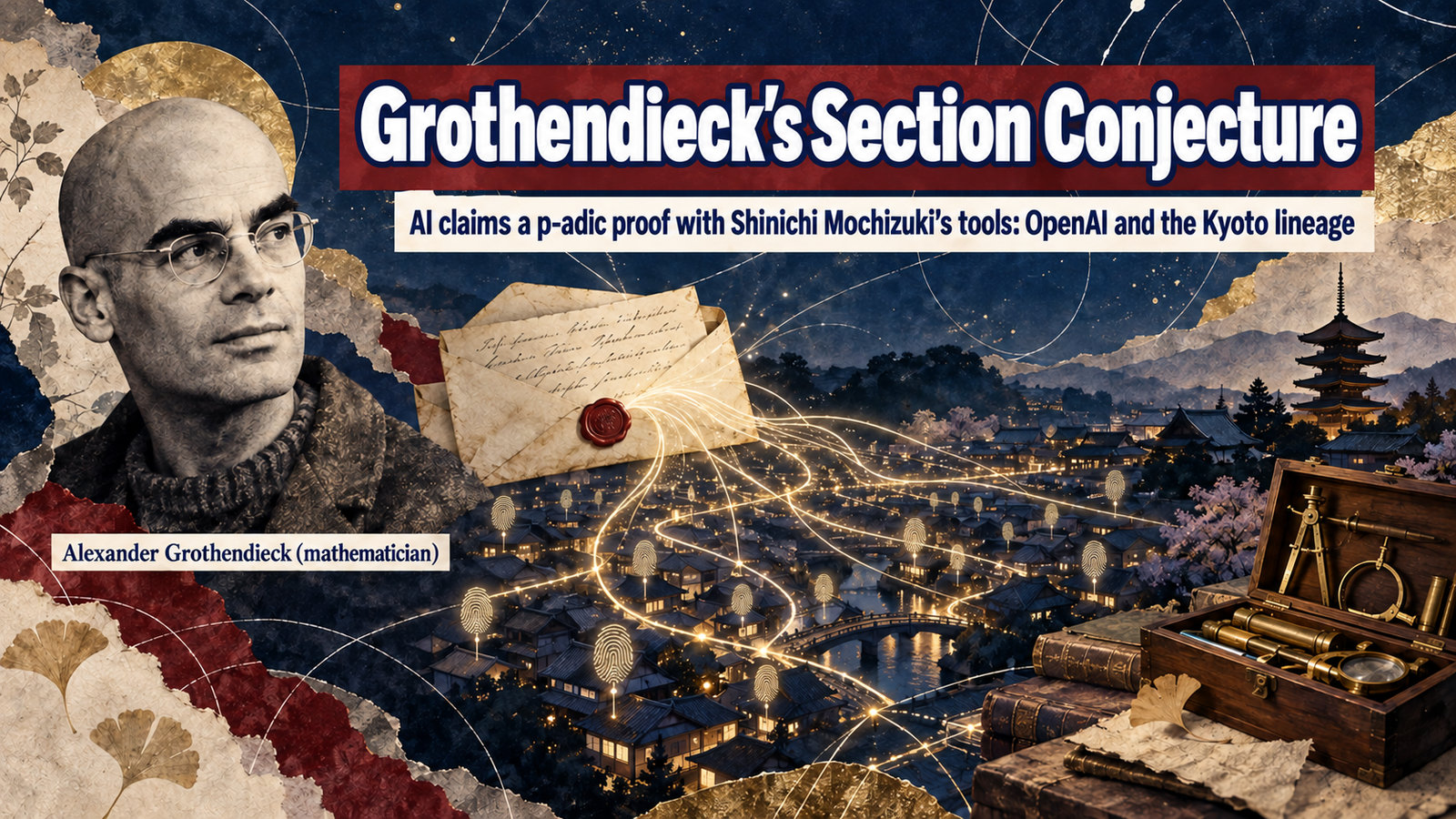
On the morning of October 7, the news that OpenAI had released 722 mathematical manuscripts came with headlines about things like "a hard problem related to the Riemann hypothesis." According to a third-party tally that counted every bibliography in those 722 manuscripts, just 2 of them mention Professor Shinichi Mochizuki of Kyoto University's Research Institute for Mathematical Sciences (RIMS).
For many readers, the name Shinichi Mochizuki probably brings to mind nothing but the long dispute over the ABC conjecture. These two manuscripts light up another side of him.
The family they belong to, the 19th (No. 019), claims to prove the local version of the "section conjecture" that Grothendieck, one of the greatest mathematicians of the 20th century, set down in a letter in 1983. What's more, the tool it places at the geometric core of its argument is a theorem published in 2023 by Mochizuki and his student Shota Tsujimura.
As of October 7, however, there had been no public word of any expert in anabelian geometry checking this proof; the claim is still awaiting verification.
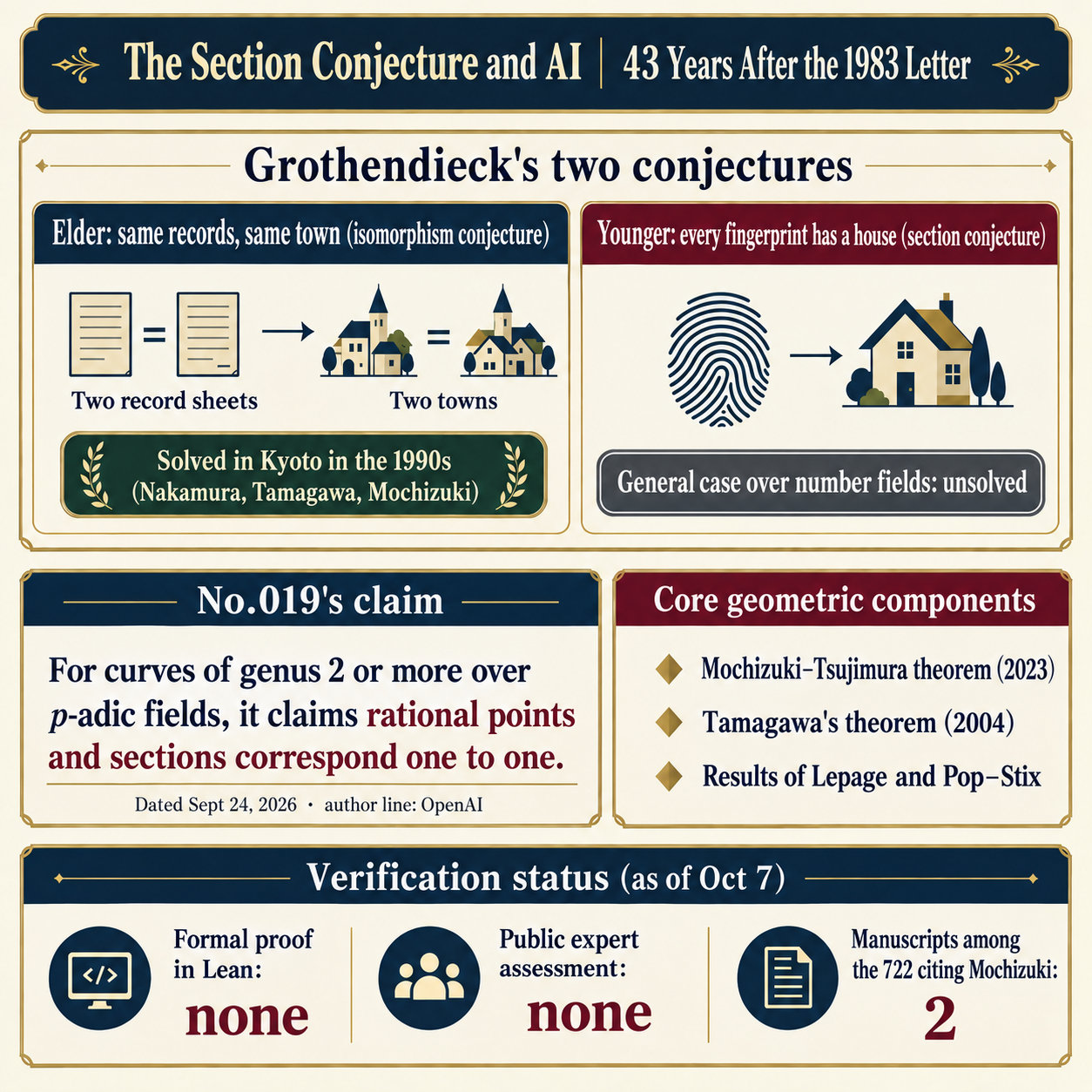
Of the 722, only two cite Shinichi Mochizuki
In the early hours of October 7, Japan time, OpenAI published a repository called openai/math on GitHub. According to the README, it contains "mathematical manuscripts … produced by an internal OpenAI model," 722 of them, divided into 372 families.
It also says that each result used an average of three hours of ChatGPT Pro thinking compute, and that about 4,000 problems were posed over the course of the evaluation. At the same time, the README cautions:
"Some of the unformalized results could have issues."
A third-party site unaffiliated with OpenAI, citedbyagi, has tallied the bibliographies of these 722 manuscripts. Of the 16,576 entries by human authors it covers, only 2 mention Shinichi Mochizuki.
Both are in the two manuscripts of No. 019, and both cite the same paper, co-authored by Mochizuki and Tsujimura. Neither the papers on inter-universal Teichmüller theory (IUT) nor the landmark papers Mochizuki produced in anabelian geometry in the 1990s are cited anywhere in the 722.
Incidentally, counted by number of bibliography entries, the most-cited human mathematician across all 722 is Professor Osamu Fujino of Kyoto University's Graduate School of Science (minimal model theory), with 120 entries. Most of them, though, are concentrated in a small number of interrelated groups of manuscripts.
Counted instead by the number of manuscript groups citing them, the top name is Erdős (41 groups), and among researchers in Japan it is Shigefumi Mori (14 groups). Grothendieck's name, counting its variant spellings, appeared in 42 entries.
The work of Kyoto's mathematicians is certainly part of the foundation under the 722 AI-written manuscripts. And among them, No. 019 is the only family in which Mochizuki's name appears.
1983: Grothendieck's letter to Faltings
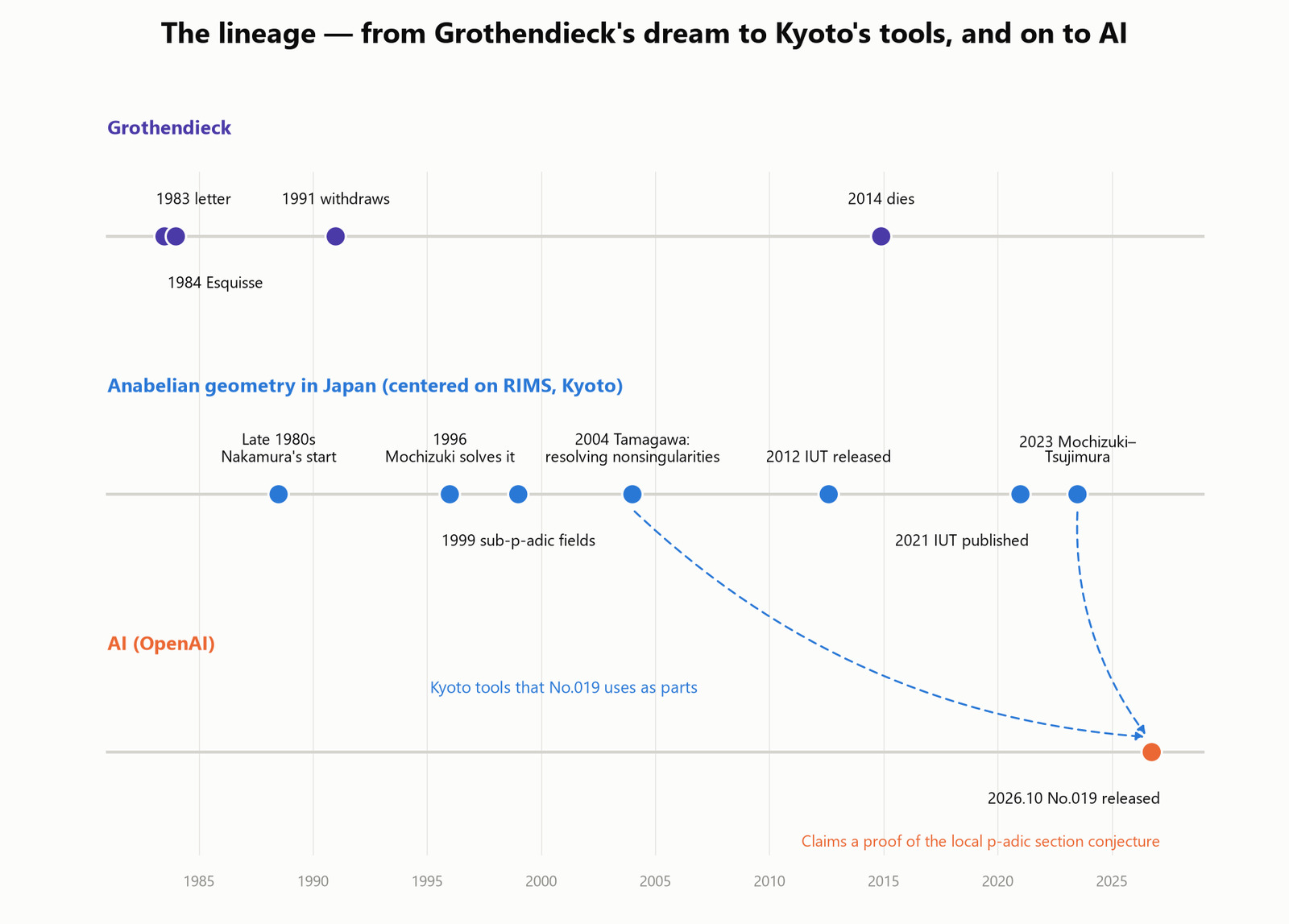
The story goes back 43 years. In 1983 the young German mathematician Gerd Faltings proved the Mordell conjecture, which had stood open for more than half a century. In response, Alexander Grothendieck, who by then had already withdrawn from the front line of mathematics, wrote Faltings a long letter.
It is dated June 27, 1983. Mochizuki later placed the letter in context in the first of his IUT papers:
"Anabelian geometry was apparently originally conceived by Grothendieck as a new approach to obtaining results in diophantine geometry such as the Mordell Conjecture."
The idea at the heart of the letter reads like this in the original German:
"Eine allgemeine Grundidee ist, dass für gewisse, sog. „anabelsche", Schemata X (von endlichem Typ) über K, die Geometrie von X vollständig durch die (profinite) Fundamentalgruppe π1(X, ξ) bestimmt ist" (A general basic idea is this: for certain so-called "anabelian" shapes X, the geometry of X is completely determined by the (profinite) fundamental group.)
The following January, in 1984, Grothendieck wrote Esquisse d'un programme (Sketch of a Program) as his application to join France's National Centre for Scientific Research (CNRS), expanding this vision further. But in his own hands it remained unfinished.
In 1991 Grothendieck vanished without telling anyone where he was going and withdrew into a hermit's life in Lasserre, a village in the foothills of the Pyrenees. He died on November 13, 2014, at the age of 86.
The conjectures he left behind would be raised across the sea, in Japan.
Can you rebuild a whole town from a record of its alleys?
Yuichiro Hoshi of RIMS has recorded that the Japanese rendering of the term, en-abēru ("far-abelian"), was coined by Hiroaki Nakamura. The English word anabelian refers to shapes whose fundamental group is "far from abelian (commutative) groups."
Suppose a town's map has been burned, and all you have left is a record of "which alleys, walked in which order, bring you back to where." Could you rebuild the whole town from that record alone?
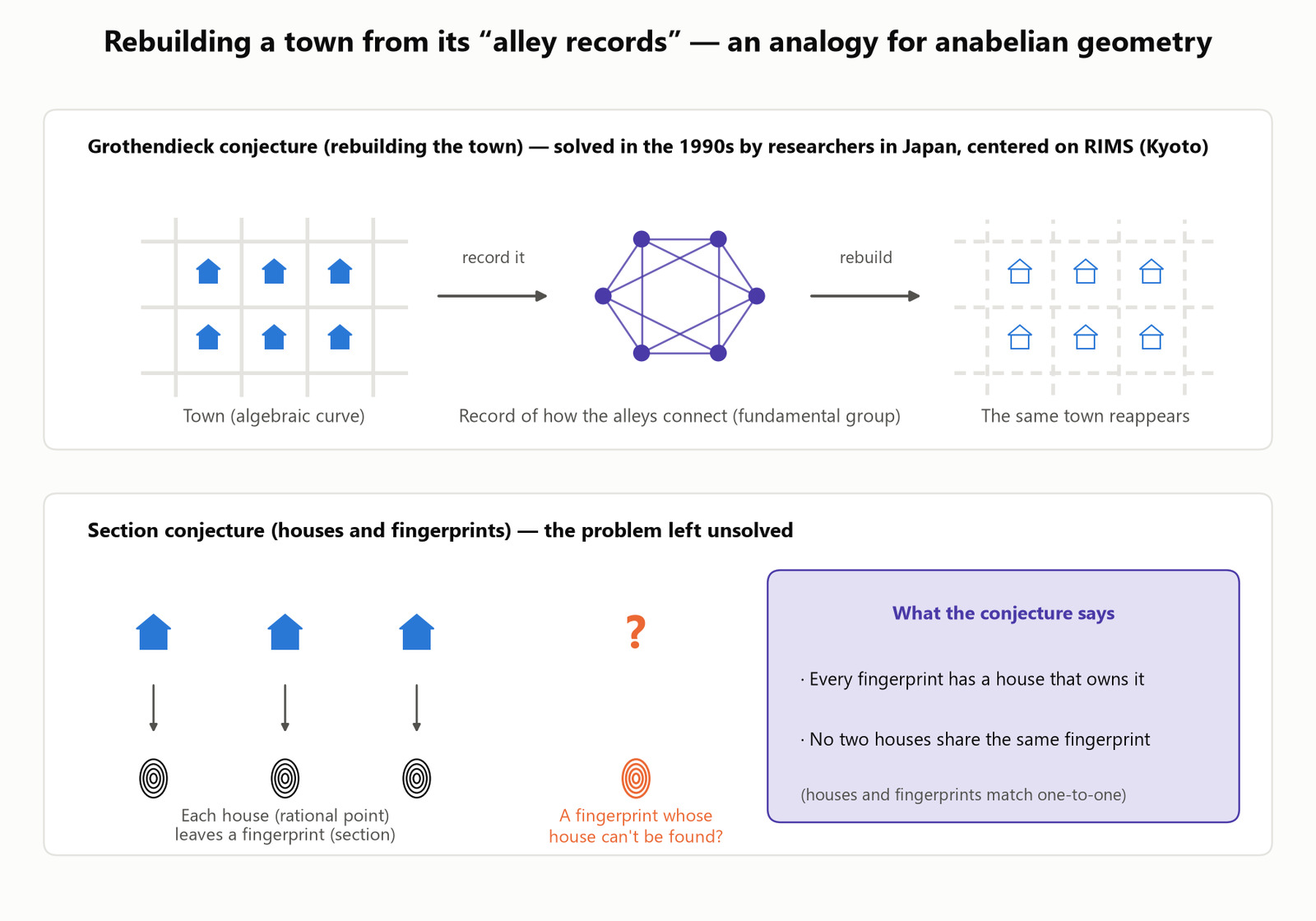
The town corresponds to what mathematicians call an algebraic curve, and the record of how the alleys connect corresponds to the "fundamental group." If this record is too simple, different towns can share the same record.
"Go in by the right-hand alley and out by the left" and "in by the left and out by the right" lead to different places. A complex record of this kind, where swapping the order changes the result (a noncommutative record), remembers the shape of the town in fine detail. Grothendieck's intuition was that for a town with a sufficiently complex record, the record alone determines the whole town.
In an introductory lecture note at RIMS, Shota Tsujimura describes anabelian geometry as "a discipline based on the idea of capturing a field structure, made up of two kinds of operations, through the group structure of the absolute Galois group, made up of one kind of operation."
To read a world built from two operations, addition and multiplication, out of a "record of symmetries" that has only one operation: that is the ambition of anabelian geometry.
The "elder brother," solved in Kyoto
Grothendieck's conjectures come in several forms. The first to be solved was the one of the form "same record, same town": the elder brother, so to speak.
The three people at the center of it described how it happened in 1998, in Sugaku, the journal of the Mathematical Society of Japan:
"Research on this problem was opened up at the end of the 1980s by one of the authors (Nakamura), given an essentially new development from the early 1990s (including the case of positive characteristic) by another (Tamagawa), and then brought to its final solution by the last (Mochizuki), starting from a new (p-adic) interpretation."
The ground had been prepared by the work of Yasutaka Ihara. In the English version of their survey, Nakamura, Tamagawa and Mochizuki write that in the 1980s Ihara began studying Galois actions on fundamental groups "independently of Grothendieck and Deligne," and that his success spurred researchers "mainly in Japan."
In 1996, building on Akio Tamagawa's result for affine curves, Mochizuki derived the Grothendieck conjecture for hyperbolic curves over number fields in general. In 1999 he proved a theorem over relatives of the p-adic fields (sub-p-adic fields), strengthened beyond isomorphisms to the form of homomorphisms (Hom).
The three shared the Mathematical Society of Japan's Fall Prize in 1997. Tamagawa later wrote, in a piece for the society's newsletter celebrating a prize awarded to Mochizuki:
"To this day, this result of Mochizuki's stands as the summit of anabelian geometry, and I believe it has influenced arithmetic geometers broadly, across the field."
"p-adic": closeness measured by how many times p divides
The word "p-adic" comes up again and again in Mochizuki's papers and talks. It is the same "p-adic" as in the three authors' "new (p-adic) interpretation," and in Tamagawa's remark that "p-adic Hodge theory played a central role."
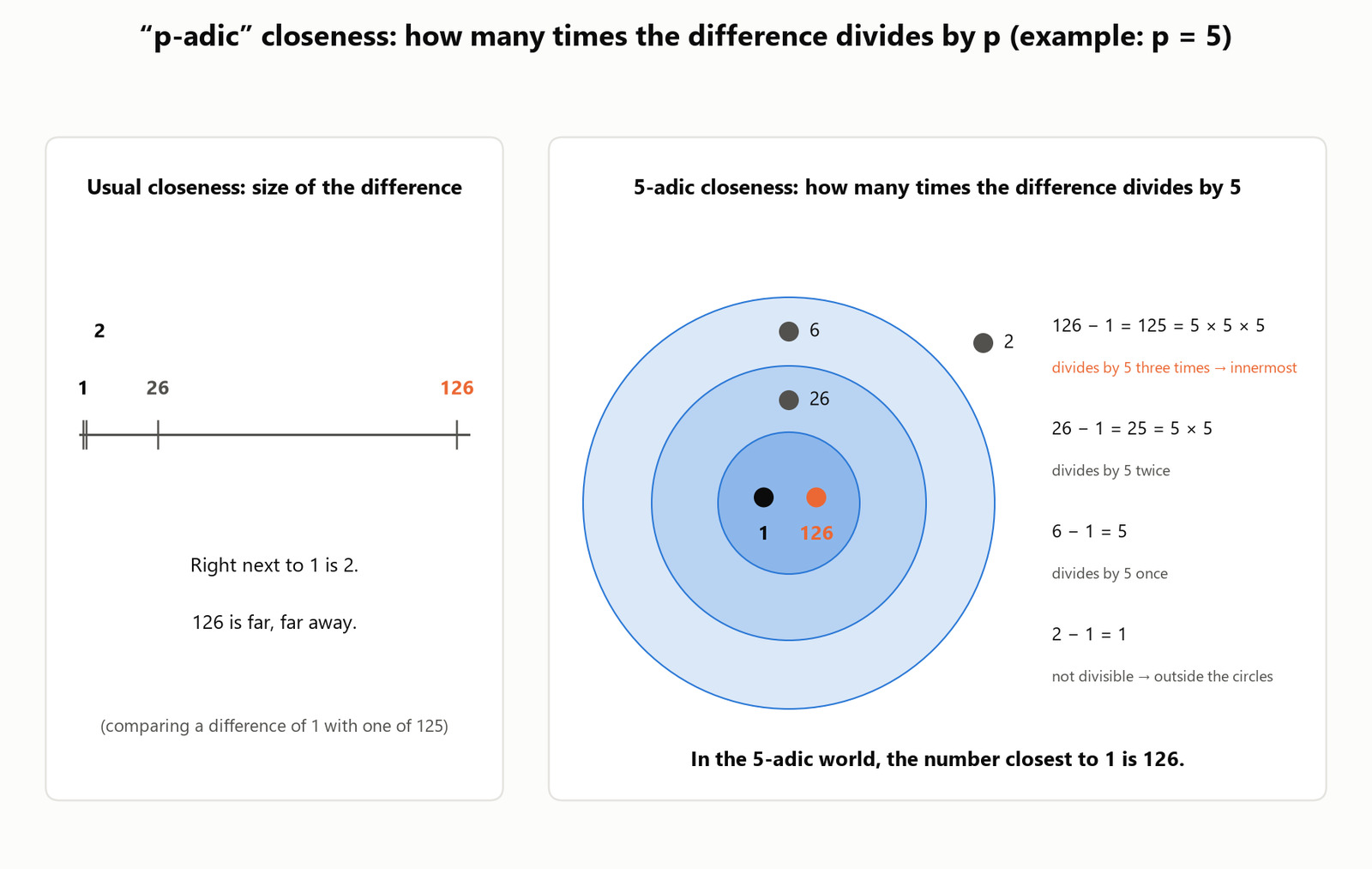
The p-adic world is one where the way we measure how "close" numbers are has been changed. Normally we think of 1 and 2 as close and 1 and 126 as far apart, because we measure distance by the size of the difference.
In the p-adic world, closeness is measured by how many times the difference is divisible by the prime p. With p = 5, 126 − 1 = 125 = 5 × 5 × 5, which is divisible by 5 three times, so 126 sits right next to 1. Meanwhile 2 − 1 = 1 is not divisible by 5 even once, so 2 is far away from 1.
It looks strange, but the world you get by filling in the gaps between the rational numbers with this yardstick (the field of p-adic numbers) is an indispensable stage in number theory: a "local" world in which numbers are viewed through the eyes of the prime p alone. Problems in the "global" world of the rational numbers themselves, or of number fields, are split into local worlds, one for each prime, and attacked there. It is a strategy number theory uses often.
Mochizuki's anabelian geometry was distinctive in shining light on global problems from this local, p-adic world. And No. 019, too, is a story set squarely in this local p-adic world.
The "younger brother" left unsolved: the section conjecture
In the same letter to Faltings, Grothendieck wrote down another conjecture. Each point on a curve (each rational point) determines one of what are called "sections" of the fundamental group. Equation (7) in the letter is a conjecture about this "point → section" correspondence.
"Es ist bekannt, dass (7) injektiv ist, und die Hauptvermutung sagt aus, dass sie bijektiv ist." (It is known that (7) is injective, and the main conjecture says that it is bijective.)
In terms of the town analogy, each house (rational point) leaves a fingerprint (section). It is known that different houses never leave the same fingerprint. The conjecture says the converse: "every fingerprint has a house it belongs to."
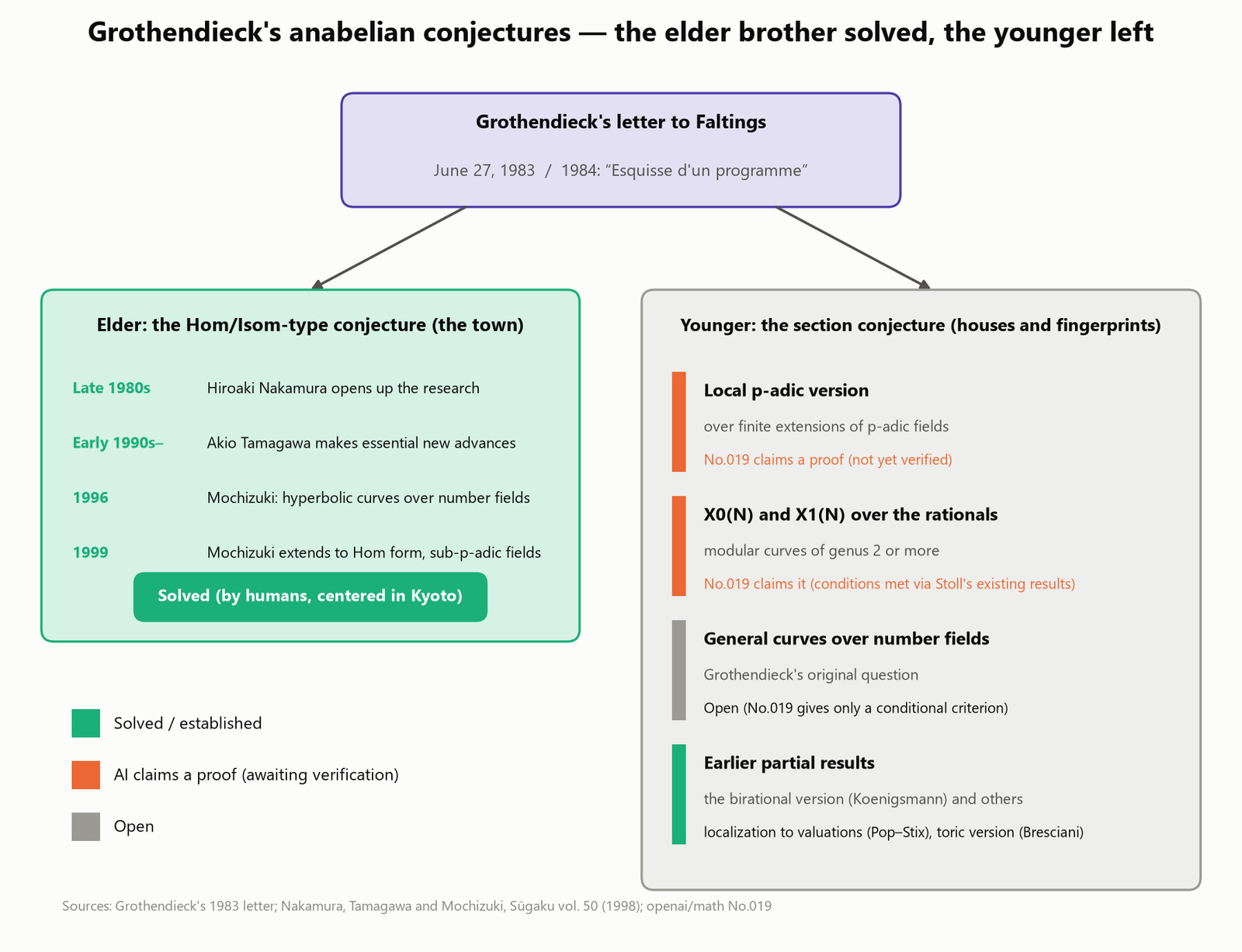
This "younger brother," the section conjecture, proved a tough problem. Hoshi wrote in the proceedings of the 2011 Algebra Symposium:
"Research to date has established the injectivity of ΦPrimes X/k, but I think it would be no exaggeration to say that almost nothing is known about the surjectivity of ΦPrimes X/k."
Are there really no fingerprints without an owner? That was the part that stayed out of reach for so long.
What No. 019 claims to prove
The main manuscript of No. 019, "The p-adic section conjecture," is dated September 24, 2026, and its author line reads only "OpenAI." Its main theorem states that for curves of genus 2 or more over a finite extension of a p-adic field, rational points correspond one-to-one with conjugacy classes of sections.
In other words, it claims that in the towns of the local p-adic world, every fingerprint has an owner's house, and no two houses share a fingerprint. The manuscript states plainly in its introduction that this is "a local analogue of the section conjecture" in the 1983 letter to Faltings.
The local version, too, has a body of earlier work behind it. Koenigsmann proved a weaker form known as the "birational version," and Pop–Stix tied every section to a p-adic valuation (a yardstick of closeness). Bresciani proved the conjecture for a special kind of section called "toric sections."
No. 019 describes the position of the gap it fills like this:
"The passage from a fixed valuation to a rational point remains the geometric issue addressed here."
The manuscript also uses the local version as a foothold to move on to the field of rational numbers. For the modular curves X0(N) and X1(N) of genus 2 or more, the catalog (CONTENTS) says it proves Grothendieck's section conjecture over ℚ itself.
This is not, however, a resolution of the section conjecture over number fields in general; it is a conditional criterion. What No. 019 shows is that the global version follows if you assume the condition that "the finite-cover descent set coincides with the rational points." The manuscript itself stresses the point:
"The general implication retains the finite-cover equality as a genuine arithmetic hypothesis; local point-theoreticity alone does not supply it."
The argument reaches its conclusion for X0(N) and X1(N) because a mathematician named Stoll had previously verified this condition for them. Grothendieck's original question, the section conjecture for general curves over number fields, remains open.
Made-in-Kyoto parts at the geometric core
The No. 019 manuscript says that "The geometric content lies in Theorem 1.2." In the first stage supporting that Theorem 1.2, Kyoto's tools appear by name:
"The resolution of nonsingularities theorem of Mochizuki–Tsujimura supplies a finite étale cover whose stable model maps to a prescribed semistable model [17, Theorem A and Proposition 2.4(iv)]. This extends Tamagawa's result for closed points on a stable model [28, Theorem 0.2(v)] and Lepage's corresponding resolution theorem for Mumford curves [14, Theorem 2.7]. The general theorem of Mochizuki–Tsujimura allows us to move these collars into the stable-node construction."
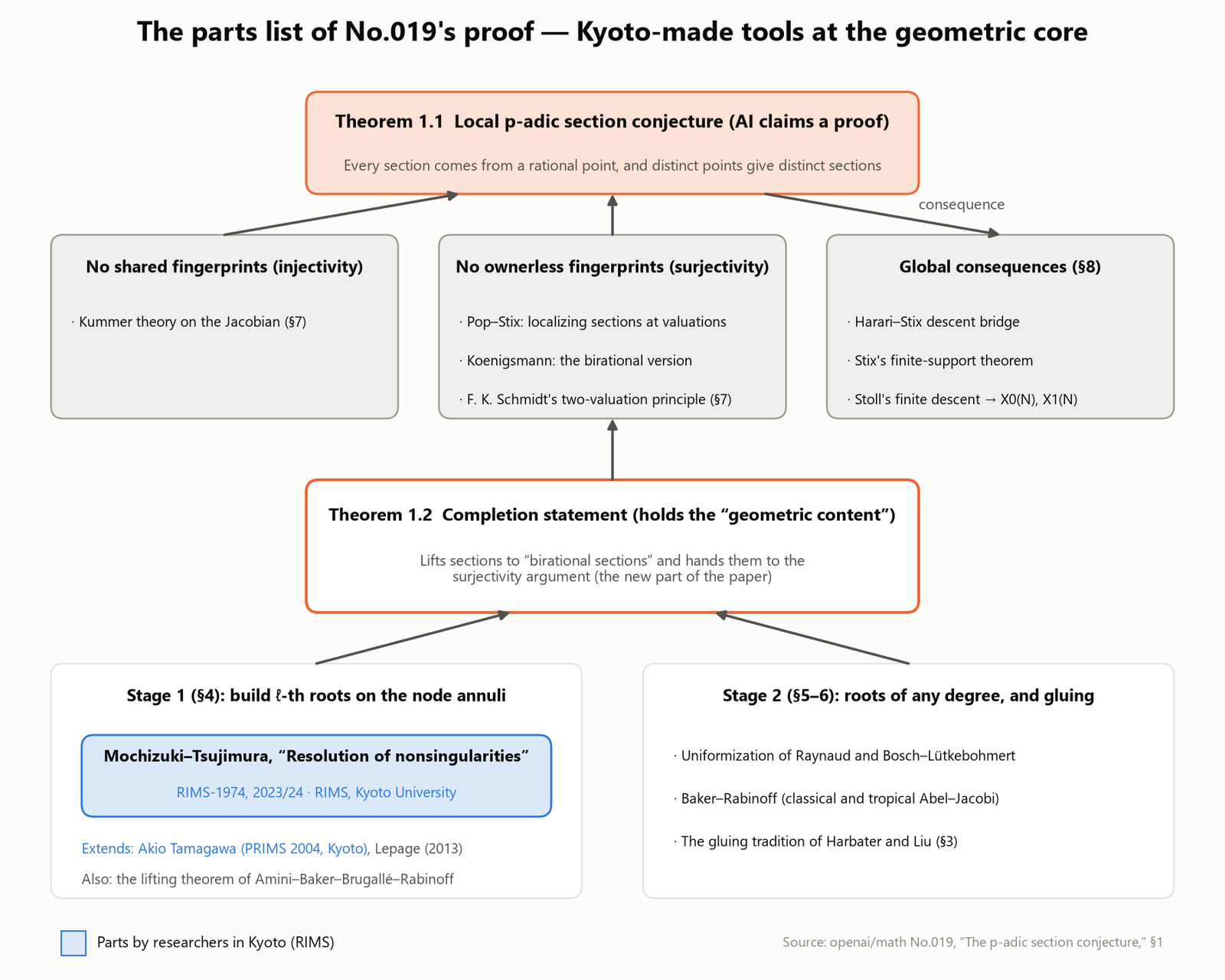
The Mochizuki–Tsujimura paper cited here was released in June 2023 as the RIMS preprint RIMS-1974, and No. 019 cites the revised version of March 2024. Its abstract placed the result this way:
"This settles one of the major open questions in anabelian geometry."
Tsujimura was born in Kyoto in 1992, completed his doctoral program at Kyoto University under Mochizuki's supervision in 2020, and has been an assistant professor at RIMS since that year. The other part, Tamagawa's paper, appeared in 2004 in PRIMS, the RIMS journal.
No. 019's companion manuscript, "Étale covers with a prescribed exterior sheet," is more direct still. After introducing the Mochizuki–Tsujimura theorem, it says: "This is our geometric input."
Kyoto's hand shows up beyond No. 019. No. 031, which claims a proof of Uchida's conjecture, uses Yuichiro Hoshi's criterion for its final move, stating explicitly: "Our proof uses the cyclotomic criterion at its endpoint."
The dream Grothendieck sketched was turned into tools over thirty years by researchers in Japan, and in Kyoto above all, and an AI opened that toolbox and used it. That is how the parts list of No. 019 reads.
What Shinichi Mochizuki has written about AI and formalization
Mochizuki's name became widely known with the four IUT papers he released in 2012. They were published in a special issue of PRIMS in 2021, but in 2018 Peter Scholze and Jakob Stix published a document stating that they "came to the conclusion that there is no proof," and Mochizuki has rebutted it. The dispute continues to this day.
Mochizuki has also written about AI. In a blog post on January 4, 2025, he wrote this about dividing roles with computers and AI:
"When the division of roles is clearly set out, with the human as the 'master' and the computer or artificial intelligence as the 'servant,' that is, the 'assistant,' or to put it another way, 'intellectual manual labor,' there is no particular problem. The problem is when the 'master–servant relationship' is reversed and the machine effectively produces the paper in a form in which the human hardly understands or is aware of its content."
In an English-language report on IUT in October 2025, he likens articles and preprints written without any apparatus of mathematical accountability to the "hallucinations" of LLMs such as ChatGPT. In the same section, Mochizuki also noted that research is underway to link LLMs to Lean, a language for verifying proofs, so that their text generation can be supported by Lean's rigorous verification.
"it appears that currently research is underway to link LLM's such as ChatGPT to Lean, so that interaction and text generation by the LLM can be supported by rigorous mathematical verification via Lean."
Then, in a blog post on January 1, 2026, he wrote that he would now "be getting down in earnest to work on" the Lean formalization of IUT. In another post the same day, he described Lean code as a technology able to preserve a record of an argument's logical structure "even several hundred years from now," when there may no longer be any mathematician who understands the content of the argument.
Wary of AI, yet hopeful about verification by machine: Mochizuki's writing holds both.
Between claim and verification
The two No. 019 manuscripts and No. 031 all lack a Lean formal proof: they are what the README calls "unformalized results." The related No. 009 (Bogomolov–Pop reconstruction) does have a formalization, but it is stated explicitly that it covers only the "injectivity" part, and that existence lies outside it.
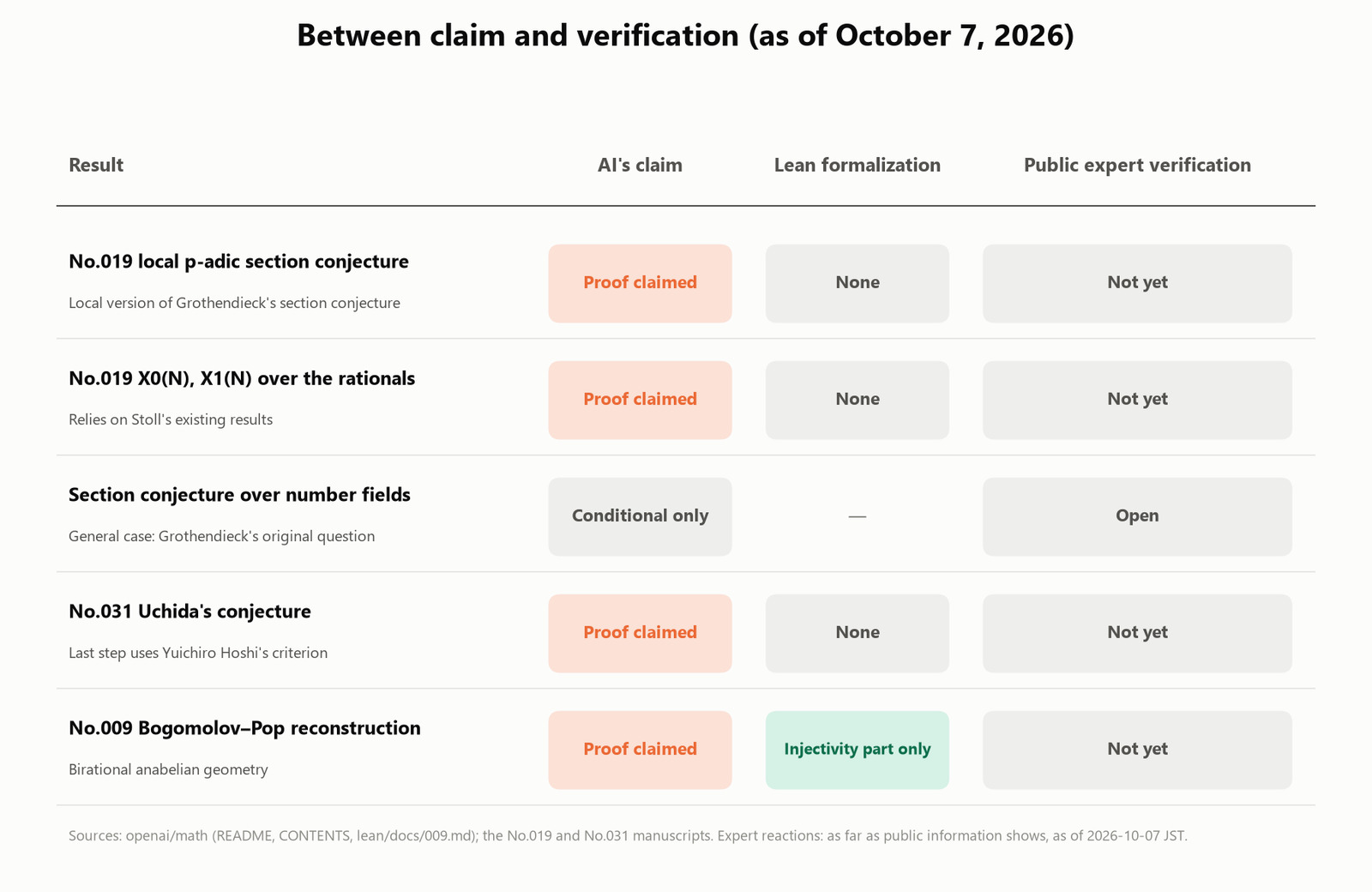
As of October 7, we had found zero public assessments of No. 019 or No. 031 by any expert in anabelian geometry. Coverage in Japan, too, has focused on other results, such as the quasi-Riemann hypothesis.
The Advisory Group on Mathematics and Artificial Intelligence (AGMAI) at the Institute for Advanced Study in Princeton, which OpenAI had consulted ahead of the release, wrote this in a statement on the day of the release:
"This release is the beginning, not the completion, of the process of human understanding and the incorporation of the work into mathematical knowledge."
Whether No. 019 is correct will be decided by the eyes of experts in anabelian geometry, including the very people who wrote the theorems the manuscript uses as parts: the researchers in Kyoto.
"Solving" is not the goal
On September 11, about four weeks before the release, Fields medalists published a declaration titled "A Severe Misalignment of AI in Mathematics." Among the 28 names signed to it are Shigefumi Mori, Deligne, Drinfeld, Scholze and Terence Tao.
The declaration first states that "Research mathematics deals with understanding basic structures of shapes, numbers, and natural phenomena." It then continues:
"But solving problems is only a tool and proxy for achieving the primary goal of conceptual understanding and insight."
The declaration does not reject AI outright; as its title says, its concern is a misalignment of goals. It acknowledges that "AI offers the potential of enhancing and accelerating genuine mathematical study and understanding," and then warns that without mathematicians to develop AI-conceived ideas and integrate them into the body of mathematical knowledge, "the crucial human transmission chain between mathematicians would be lost."
This way of thinking has a classic expression. In 1994, in his essay "On proof and progress in mathematics" for the Bulletin of the American Mathematical Society, the geometer William Thurston recast the work of mathematicians as the question "How do mathematicians advance human understanding of mathematics?"
"what they really want is usually not some collection of "answers"—what they want is understanding."
Seen from this angle, No. 019's parts list takes on a different meaning. Grothendieck's dream was turned into usable tools over several decades by researchers centered in Kyoto. The AI picked up those tools and claims to have filled a 40-year-old gap, the local section conjecture.
Whether that deepens understanding, however, is yet to be decided. Only when No. 019's argument has been read in Kyoto, checked, restated and made to give rise to the next question will this one paper become part of mathematics.
The same pattern exists outside mathematics:
- Name where the parts came from: No. 019 names the sources of the tools it uses: Mochizuki–Tsujimura, Tamagawa, Lepage, Pop–Stix. Stating whose tools went into a piece of work is the entry point for verification, and also a mark of respect for the people who made the tools.
- An answer and understanding are different things: even if an AI-written report is correct, if no one in the organization can explain what is in it, that is the reversal of the "master–servant relationship" Mochizuki describes.
- The last reader is a human: the verification machinery (Lean) and the eyes of experts are both irreplaceable.
How will the researchers in Kyoto read No. 019? It has been 43 years since Grothendieck's letter, and that answer is still to come.
References
- openai/math README (GitHub)
- openai/math CONTENTS (GitHub)
- The p-adic section conjecture (OpenAI, GitHub)
- Étale covers with a prescribed exterior sheet (OpenAI, GitHub)
- Open Homomorphisms of Global Solvably Closed Galois Groups (OpenAI, GitHub)
- Scope of the No. 009 Lean formalization (OpenAI, GitHub)
- Sharing AI progress in mathematics (OpenAI)
- Cited by AGI (citedbyagi.com)
- Brief an G. Faltings (A. Grothendieck, in Geometric Galois Actions 1)
- Esquisse d'un programme (A. Grothendieck)
- Inter-universal Teichmüller Theory I (Shinichi Mochizuki, RIMS, Kyoto University)
- The Grothendieck conjecture on the fundamental groups of algebraic curves (Hiroaki Nakamura, Akio Tamagawa, Shinichi Mochizuki, Sugaku vol. 50, in Japanese)
- The Grothendieck Conjecture on the Fundamental Groups of Algebraic Curves (Nakamura, Tamagawa, Mochizuki)
- The Profinite Grothendieck Conjecture for Closed Hyperbolic Curves over Number Fields (Shinichi Mochizuki)
- The Local Pro-p Anabelian Geometry of Curves (Shinichi Mochizuki)
- Shinichi Mochizuki, list of papers (RIMS, Kyoto University)
- Shinichi Mochizuki, Curriculum Vitae (RIMS, Kyoto University)
- The mathematics of Shinichi Mochizuki (Akio Tamagawa, Sugaku Tsushin, Mathematical Society of Japan, in Japanese)
- On Grothendieck's anabelian section conjecture (Yuichiro Hoshi, in Japanese)
- An introduction to anabelian geometry through the reconstruction of field structures (Shota Tsujimura, in Japanese)
- Shota Tsujimura, Curriculum Vitae (RIMS, Kyoto University)
- Resolution of Nonsingularities, Point-theoreticity, and Metric-admissibility for p-adic Hyperbolic Curves (Shinichi Mochizuki and Shota Tsujimura, RIMS-1974)
- Resolution of Nonsingularities of Families of Curves (Akio Tamagawa, PRIMS)
- Why abc is still a conjecture (P. Scholze and J. Stix)
- "Technology" that aims at sophisticated disguise, and "science and pure mathematics" that aim to uncover ultimate truth (Shinichi Mochizuki, blog Shinichi no "Kokoro no Ippyo", in Japanese)
- Report on the Current Situation Surrounding IUT, October 2025 (Shinichi Mochizuki)
- Can Lean formalization become a recording device that makes long-term verification and accountability possible? (Shinichi Mochizuki, blog Shinichi no "Kokoro no Ippyo", in Japanese)
- New Year's greetings 2026 (Shinichi Mochizuki, blog Shinichi no "Kokoro no Ippyo", in Japanese)
- On OpenAI's Release of Mathematical Results (AGMAI)
- A Severe Misalignment of AI in Mathematics (Math and AI)
- On proof and progress in mathematics (W. P. Thurston, arXiv)
- 'He was in mystic delirium': was this hermit mathematician a forgotten genius whose ideas could transform AI – or a lonely madman? (The Guardian)
- Obituary: Alexander Grothendieck (Sugaku Seminar, Nippon Hyoron Sha, in Japanese)
- Osamu Fujino, faculty profile (Kyoto University, in Japanese)