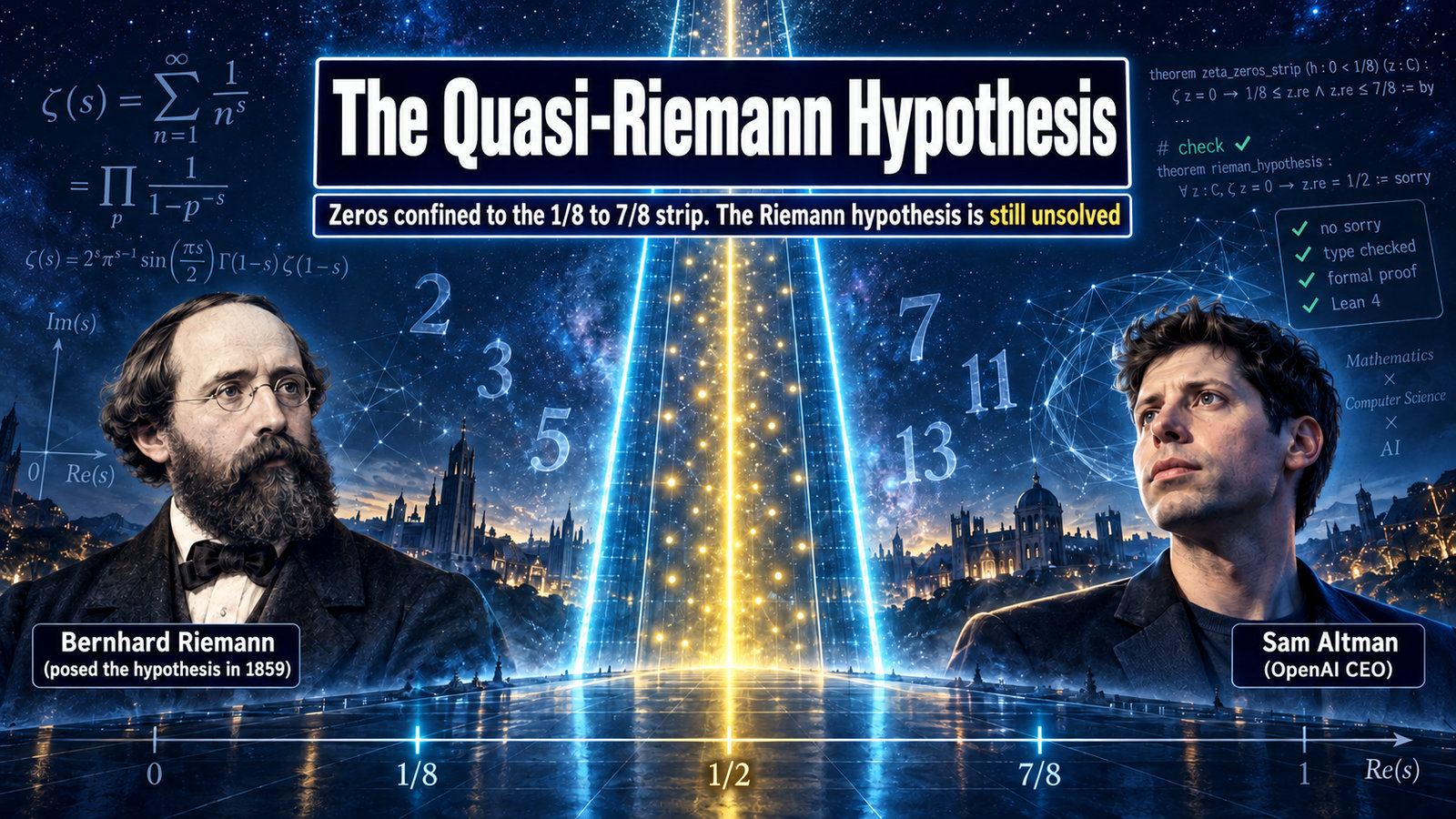
On the morning of October 7, 2026, news sites ran headlines like "OpenAI claims its in-house AI proved a hard problem related to the Riemann hypothesis." Many of you must have stopped scrolling at the name of mathematics' most famous unsolved problem.
Open the articles, though, and what you find is a wall of terms like "Dirichlet L-functions," "zero-free half-plane" and "7/8." One refreshingly honest post on X (formerly Twitter) put it this way: "I have absolutely no idea whether we're at the 3rd station up the mountain, the 5th, or have only just left the house."
The Riemann hypothesis itself remains unsolved.
Mathematicians are in an uproar all the same, because the claim is that a stake no one had managed to drive in for more than a century has now been driven into the mountainside, halfway up. And that stake is in a slightly strange state: it has passed a mechanical check by computer, while verification of the paper by human experts is still to come.
On the morning of October 7, 722 manuscripts appeared on GitHub
In the early hours of October 7, Japan time, OpenAI published a repository called openai/math on GitHub. Inside were 722 mathematical manuscripts that, according to the company, were produced by an unreleased internal model.
The related manuscripts are bundled into 372 result families, and the third of them is the quasi-Riemann hypothesis. The lead paper is "The Quasi-Riemann Hypothesis: A Zero-Free Half-Plane ℜs > 7/8." The author line reads "OpenAI," the date is September 30, and it runs to about 200 pages. The same family also holds a 49-page alternative proof and a 9-page related paper.
Surprisingly, OpenAI's official blog speaks only of "a broad range of new mathematical results" and never mentions Riemann by name. It was the press and social media that splashed the words "Riemann hypothesis" across their pages.
The numbers need careful handling. The figure 722 is the number of manuscripts; 372 is the number of result families (that is, of results); and about 4,000 is the number of problems posed to the model. Each counts something different.
The "377" that often appears in news reports is not the number of results but the number of the last family. The families are numbered from 001 to 377, but five numbers are skipped, so there are 372 families.
Divide 722 by 4,000 and what you get is something other than a "success rate."
The Riemann hypothesis is a conjecture about how the primes are scattered
Primes, 2, 3, 5, 7, 11 and so on, are the numbers divisible only by 1 and themselves. Their sequence looks capricious, but seen from a distance it follows a rule, and the prime number theorem, which says that "there are roughly x ÷ (the natural logarithm of x) primes up to x," was proved in 1896.
The Clay Mathematics Institute's explanation is concise: "The prime number theorem determines the average distribution of the primes. The Riemann hypothesis tells us about the deviation from the average." The Riemann hypothesis is also one of the seven Millennium Prize Problems, on each of which a $1 million prize was placed in 2000.
What governs this deviation is the "zeros" of the Riemann zeta function ζ(s), the places where the function's value is 0. The function ζ(s) is defined by the infinite sum 1 + 1/2ˢ + 1/3ˢ + 1/4ˢ + …, and thanks to a discovery by Euler it can also be rewritten as a product that uses only the primes.
All the information about the primes is folded into the positions of this function's zeros.
The function carries on where the sum cannot reach
Here is a common stumbling block. The sum 1 + 1/2ˢ + 1/3ˢ + … has a finite value only when the real part of s is greater than 1. And yet the Riemann hypothesis talks about places where the real part is 1/2.
A familiar example is the geometric series. The sum 1 + x + x² + x³ + … equals 1/(1−x) only when x lies between −1 and 1. Put x = 2 into the sum and it swells without limit, but the right-hand side, 1/(1−x), still has a perfectly respectable value at x = 2: −1.
The same goes for ζ(s): the function itself can be extended beyond the range where the sum works. This is called "analytic continuation."
What's more, there is only one way to extend it. A smooth function in the world of complex numbers is not clay you can knead into any shape you like; it is more like a crystal, where fixing the shape of one part fixes the whole. The part pinned down by the sum determines even the shape of the parts we cannot yet see.
The extended ζ(s) has a symmetry called the "functional equation." Its zeros come in left-right pairs on either side of the line where the real part is 1/2, like mirror images. If there is a zero at 0.9 on the right, there is a partner zero at 0.1 on the left, and so on.
The zeros live only inside the "strip from 0 to 1"
There are also zeros at the negative even numbers −2, −4, −6, …, but these are called "trivial zeros" and play only a supporting role in the mystery of the primes. The problem is the remaining "nontrivial zeros," every one of which is known to lie in a tall vertical strip where the real part is between 0 and 1.
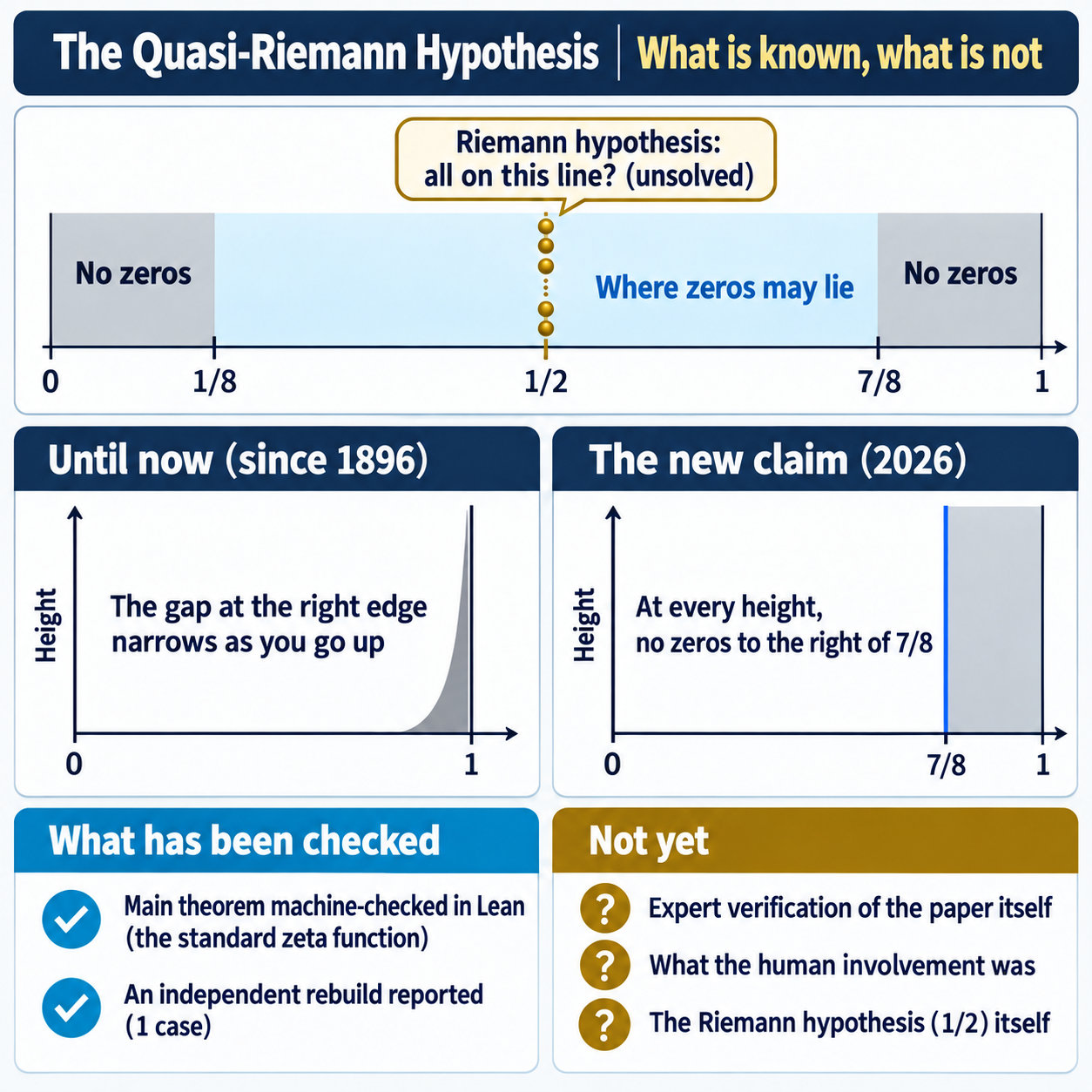
Think of it as a map: a long, narrow strip, its left edge at 0 and its right edge at 1, running endlessly up and down. The Riemann hypothesis asserts that "the zeros all stand in single file on the line running down the dead center of the strip (real part 1/2)."
Computers have confirmed that the first 10 trillion zeros do lie on the center line. But no one has held a proof for all of the infinitely many zeros since Riemann set the conjecture down in 1859.
For more than a century, all anyone could secure was "a thin gap at the edge"
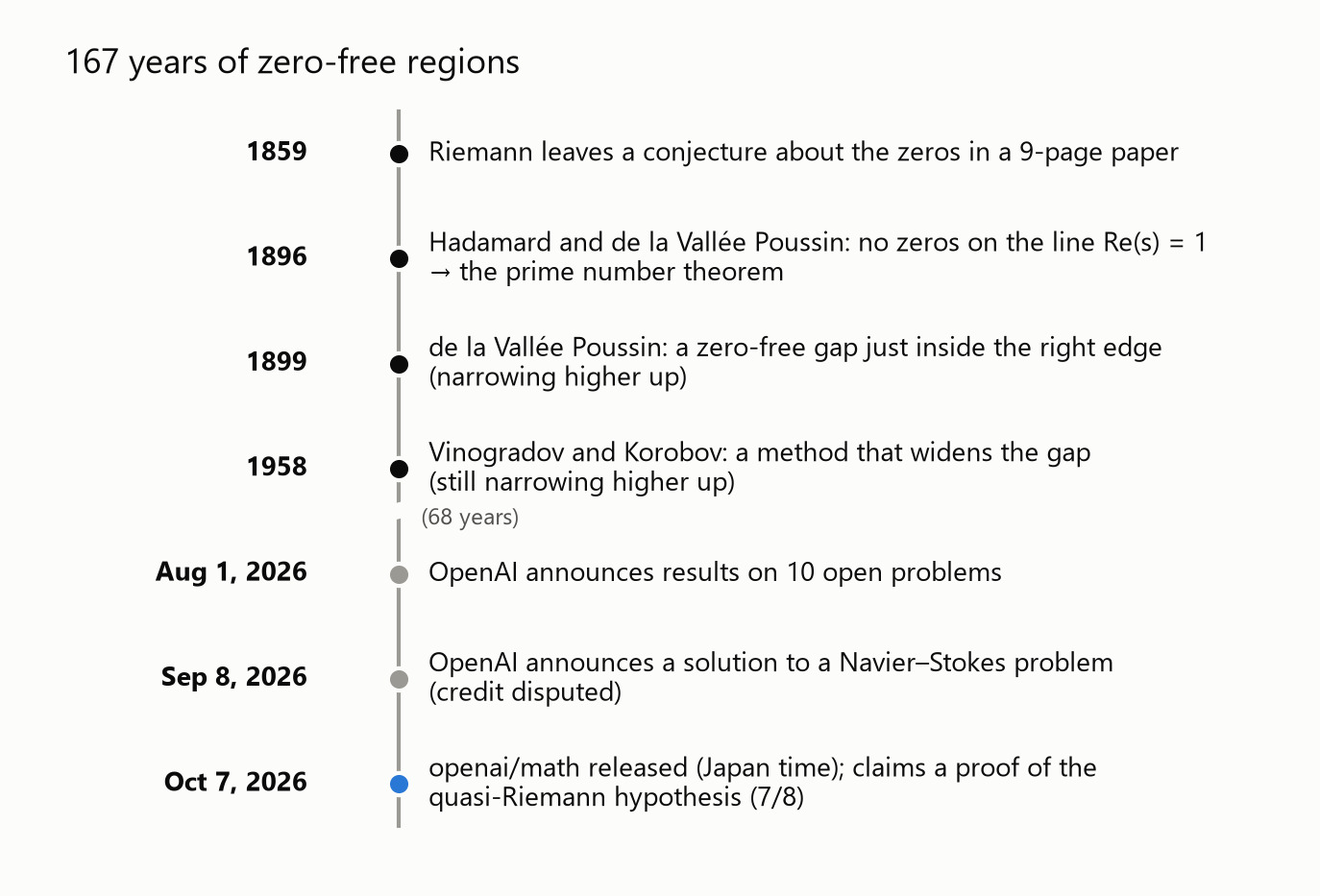
In 1896, Hadamard and de la Vallée Poussin independently proved that there are no zeros on the strip's right edge (real part 1). This is the heart of the proof of the prime number theorem.
Later it was shown that there is also a zero-free gap just inside the right edge. But this gap grows thinner the higher you climb the strip. Even with the 1958 methods of Vinogradov and Korobov, the width still shrank toward zero as the height increased.
No one had been able to rule out the possibility that, somewhere far overhead, zeros creep arbitrarily close to the right edge.
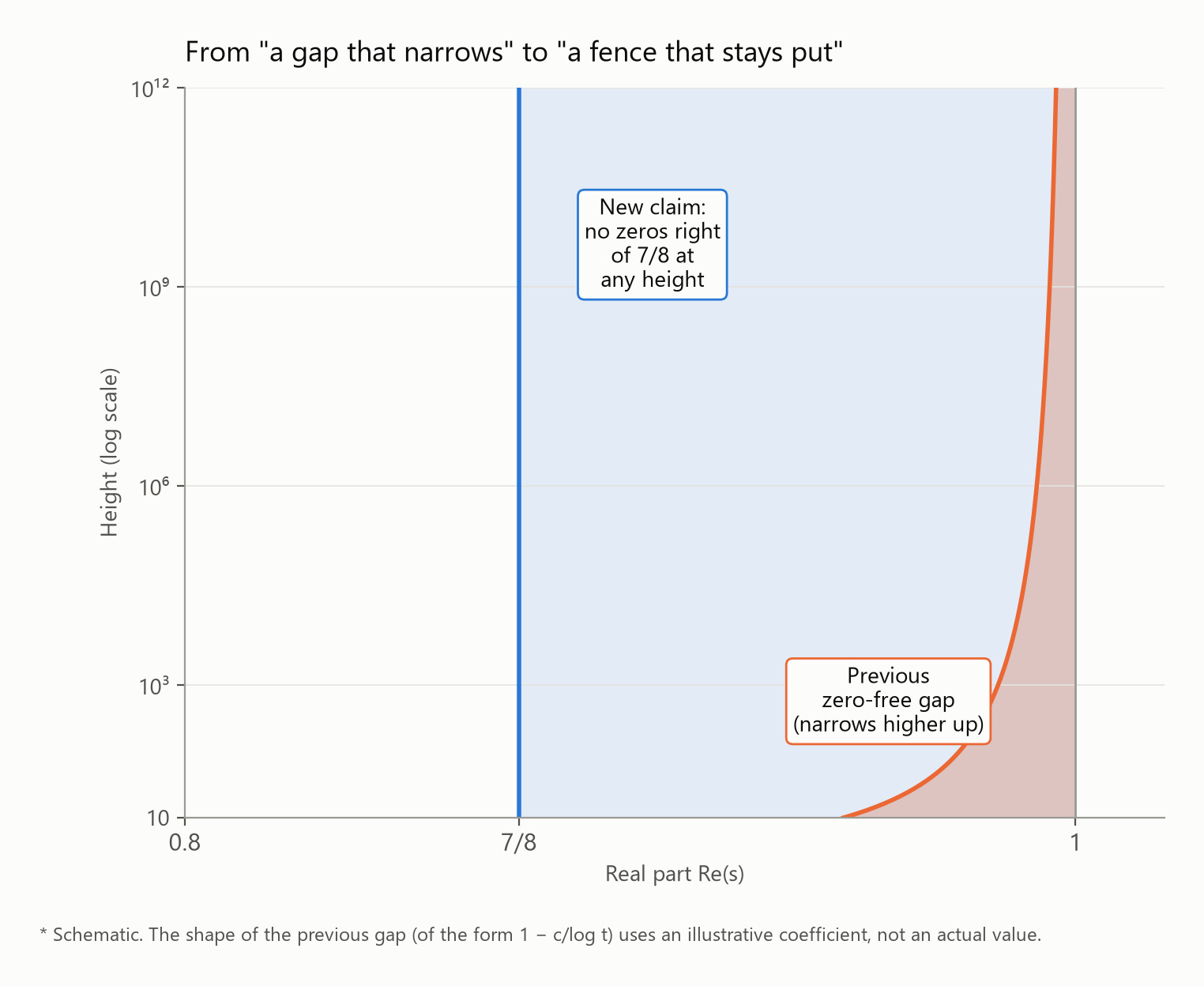
Alex Kontorovich, a number theorist at Rutgers University, singled out exactly this point in a post on X (the X post as quoted in an OfficeChai article). The best result until then, he wrote, was "a region that got thinner and thinner the higher up the imaginary axis you go," and he had thought that "maybe they'd fatten that up a bit." What came out instead was "a zero free strip."
In the same post he also wrote: "If a human did this, it would be an instant Fields Medal, no questions asked."
At 7/8, a fence that does not move with height
Theorem 1.1 of the new paper states that the Riemann zeta function ζ(s) has no zeros where the real part is greater than 7/8. At every height, the boundary stays at 7/8.
Whether such a "fixed gap valid at every height" exists is precisely what the quasi-Riemann hypothesis asks. The paper extends the same conclusion to all Dirichlet L-functions, the relatives of ζ(s), and to the Hecke L-functions of the number world ℚ(√−3).
Apply the symmetry of the functional equation and the same fence goes up on the left side too. Every nontrivial zero is then confined to the band where the real part runs from 1/8 to 7/8.
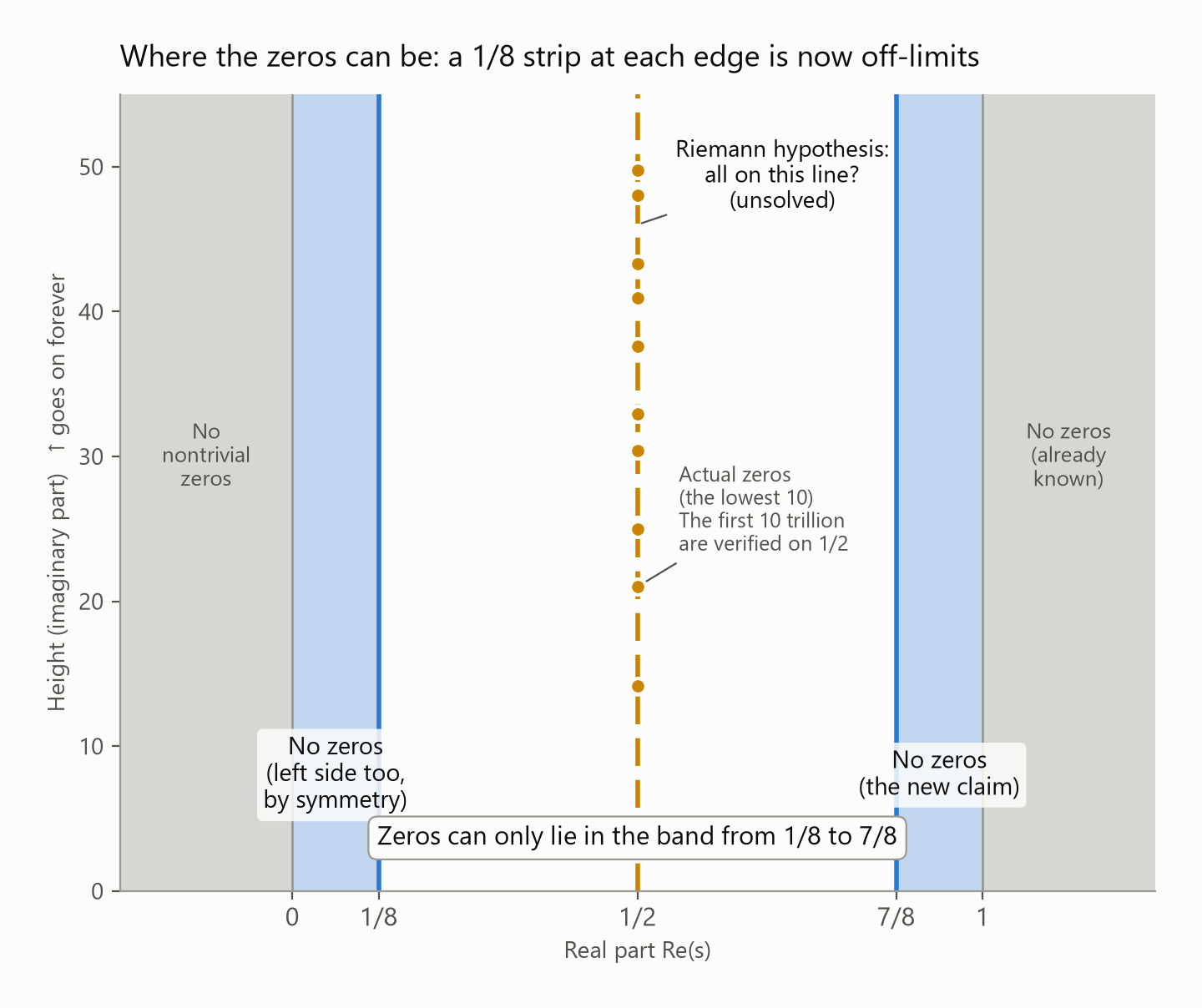
The paper itself draws a clear line here: "The theorem does not establish the Riemann hypothesis or its generalized versions … The Riemann hypothesis remains open."
Seen from the 1/2 at the center, the range where zeros might still be hiding stretches a full 3/8 to either side. To the question "Which station are we at?", it is hard to answer in terms of altitude. This result is less a step closer to the summit than a different kind of progress: a single fence that cuts off the danger of a cliff edge running on forever.
For a sense of how much excitement is warranted, an assessment posted on Hacker News by a self-described number theorist is a useful yardstick. The commenter says it "would likely be a Fields Medal for a human if a human had done it," but calls it "an exaggeration to say it is the biggest result in 200 years." In this reading, the new result strengthens the 1896 proof of the prime number theorem, and it is hard to argue that it is bigger than that proof.
How small can the "miscount" of primes get?
What the positions of the zeros change becomes clearer if you look at the "miscount" of primes: the size of the error, that is, how far an estimate of the number of primes up to x, made with the prime number theorem's approximation, is off from the true count.
The closer the zeros can get to the right edge, the larger this error can be. Conversely, the wider the zero-free range, the smaller the cap on the error.
Here are rough orders of magnitude at x = 10²⁴ (a 1 followed by 24 zeros). This is a very broad-brush comparison that ignores all constants and logarithmic factors.
- Number of primes up to x: about 1.8 × 10²²
- Rough error if the Riemann hypothesis is true: x to the power 1/2, or about 10¹²
- Rough error if the new 7/8 result is true: x to the power 7/8, or about 10²¹
- What could be said unconditionally until now: nothing that shaves the error down to a power of x; only about x divided by a quantity that grows very slowly
An error of 10²¹ still looks large next to a prime count of 10²². But as x grows, x to the 7/8 becomes steadily smaller relative to x, and the ratio approaches 0 without limit.
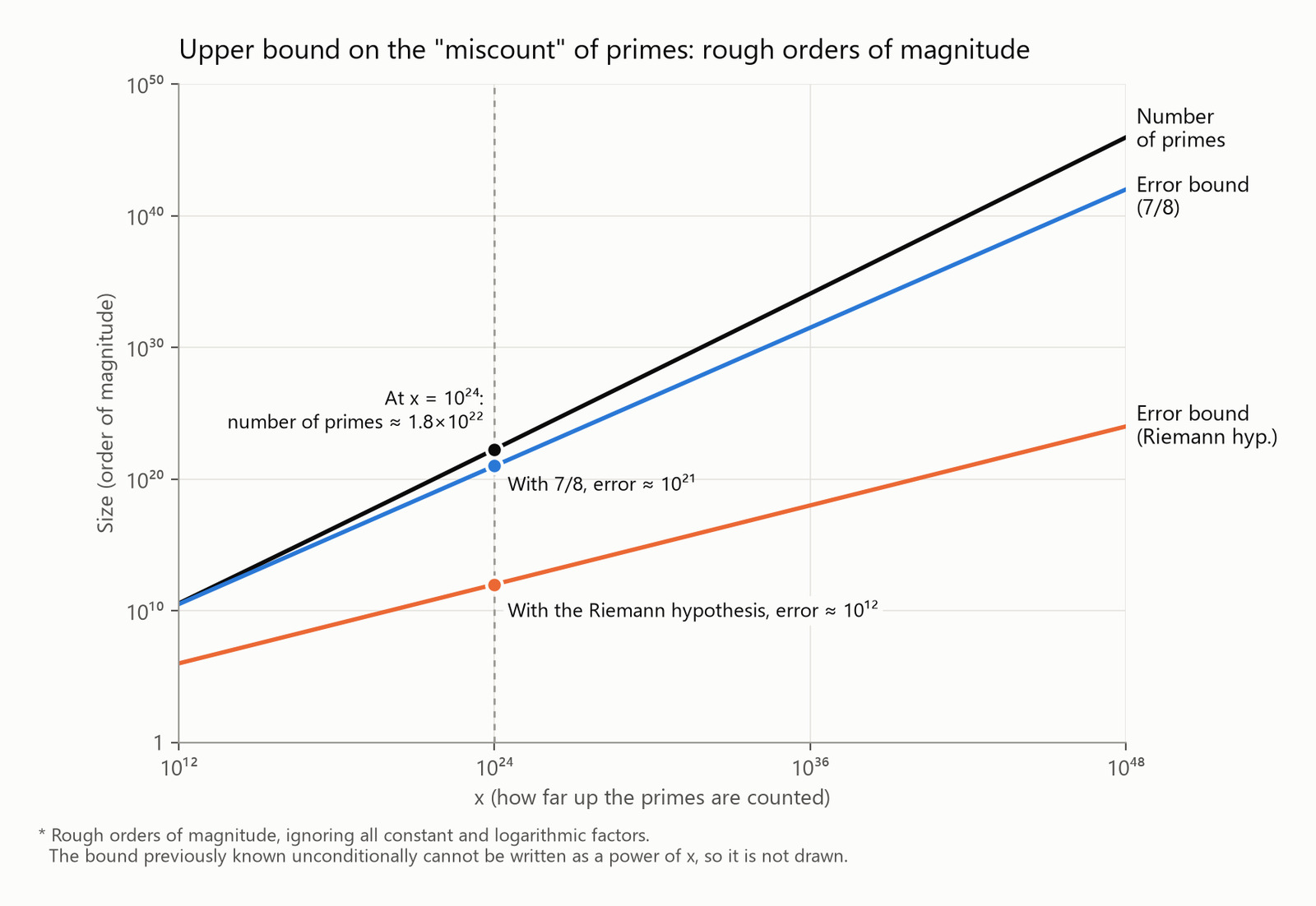
The unconditional guarantees available until now stopped short of shaving the error down to the form "x to some power." The number 7/8 means that this wall has been crossed for the first time.
There are limits, however, to which questions about primes this advance helps with. For short-interval problems such as "is there always a prime between x and a nearby x + h?", existing methods already give stronger results, and the new 7/8 adds nothing on top.
The exceptional zero called a "ghost" is gone
Number theory has a "ghost" that has haunted it for nearly 100 years: the Landau–Siegel zero, an exceptional zero that might be lurking on the real axis of a Dirichlet L-function, just short of 1.
Siegel's theorem of 1935 contained the ghost's influence, but in a form whose constant cannot be explicitly computed. Many theorems have been dogged by the resulting awkwardness: "it is bound to hold eventually, but we can't say from where."
The 7/8 fence removes the ghost's hiding place altogether. The consequences the paper lists include the following:
- Computing square roots: in the world of remainders after division by a prime p, a method is guaranteed for finding the square root of a number quickly and reliably, without relying on randomness
- Vinogradov's conjecture: a proof that the least "quadratic nonresidue" is very small
- Euler's 65 numbers: confirmation that the list of 65 "idoneal numbers" Euler collected in the 18th century was in fact complete
All of these are claims made by the paper, and these applications fall outside the Lean formalization described below.
Some readers may have come across explanations claiming that "if the Riemann hypothesis is solved, encryption will be broken." The security of the widely used RSA cryptosystem rests on the difficulty of factoring huge numbers into primes, and factoring is exactly as hard after this result as it was before. Square roots modulo a prime, too, could already be computed quickly in practice using randomness; what has changed is the guarantee that it can be done "reliably, without randomness."
The machine has checked it. Human verification is still to come
What sets this release apart from earlier AI-mathematics flaps is that the main theorem has been formalized in Lean, a proof assistant. Lean is a programming language in which a machine checks whether each line of a proof is logically correct.
In Lean, the main theorem is written in just 3 lines and says: "if the real part of s is greater than 7/8, the value of the zeta function is not 0." The zeta function used here is not one OpenAI defined for itself, but the standard definition that has long been part of the mathematics library Mathlib. The important point is that this is not a proof about some convenient "different zeta."
The body of the proof is enormous. According to a report by an outside individual user who rebuilt it from the public repository, the proof depends on 2,924 OpenAI modules running to about 486,000 lines, and compiling took about 63 minutes. It was accepted not only by Lean's standard kernel but also by a separate, independently implemented kernel (nanoda), and only the 3 standard axioms were used.
That said, this is a single report, from one run on one machine. The reporter himself added the caveat that "this checks the Lean proof, not the paper," and called for independent reproductions.
The machine has passed it, yet the tally of number theorists who have read the roughly 200-page paper all the way through and publicly declared it correct still stands at zero. In the repository's formalization catalog, too, the review status still reads "unchecked."
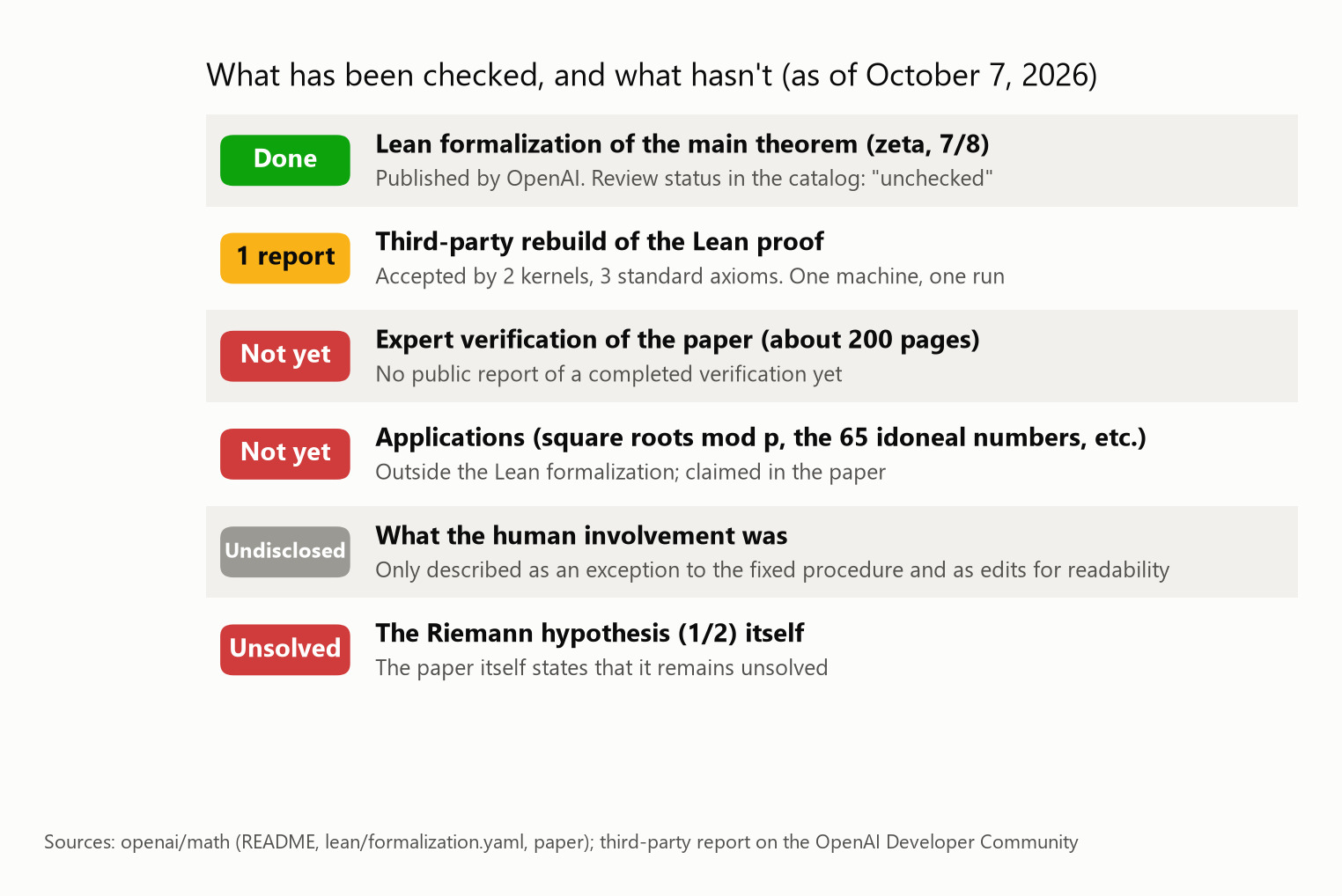
Questions also remain about human involvement. The README explicitly lists the work on a zero-free region for the zeta function among the "exceptions to this fixed procedure," and says the writeup of the 11/12 version "was human edited for readability." But it does not say what the exception consisted of, or who did what.
Andrew Sutherland, a mathematician at MIT, told Scientific American that claims about the procedure should be treated as unverified until they can be reproduced: "We should ask for receipts." On the same day, AGMAI, an independent group of mathematicians, issued a statement saying its advisory role should not be read as "a judgment of the impact of these results or an endorsement of the process by which OpenAI obtained them."
Delight and bewilderment, spreading at the same time
The reactions are mixed. Levent Alpöge, a mathematician at Anthropic, praised the work on X, "Big, big, big, big props for quasiriemann and no Siegel zeroes," while also touching on the sad stories of researchers "getting scooped" (the X post as quoted in a Latent Space article).
The Hacker News commenter mentioned earlier wrote that one of their own papers from 2018 would be 3 pages shorter with this result, adding that "there are likely hundreds of papers like this." If the proof is correct, the very scaffolding of existing research becomes sturdier.
Meanwhile, in a joint declaration in September, Fields medalists had argued that the push by AI companies to solve mathematical problems as a benchmark is "detrimental to the science of mathematics, and to the mathematical community." A few hours before the release, Terence Tao wrote that solutions to open problems "are now being harvested at large scale in an unsustainable fashion," and proposed a "Math 2.0" that would no longer put problem solving alone at the center.
The AGMAI statement framed the release as "the beginning, not the completion, of the process of human understanding."
The skill that counts when "answers" arrive first
This episode has a shape that carries over to our own work outside mathematics: the gap between the cost of producing something and the cost of checking it.
According to OpenAI, the compute used per result averaged roughly three hours of ChatGPT Pro thinking (the quasi-Riemann hypothesis is listed as an exception to this fixed procedure). Fully understanding a proof of about 200 pages, by contrast, will take human experts a considerable amount of time.
The same asymmetry is already playing out with AI-written proposals, draft contracts and analytical reports. What matters there are two questions that the Lean case brings into focus:
- What has been checked? A machine vouches only for "the claim as written"; whether that claim matches what you actually want is a separate question. Here, the very wording of the claim, "about the standard zeta function" and "about 7/8," was the crux of the verification.
- What has not been checked yet? The applications, the human involvement, and human verification of the paper itself. Whether you can state the boundary between checked and unchecked in a single sentence is the measure of anyone on the receiving end of AI output.
Keeping the units of numbers straight is part of the same skill. The moment 722, 372, 377 and 4,000 get mixed together, the discussion quietly drifts off course.
The summit is still ahead, but the map has been redrawn
In 1859, in a 9-page paper, Riemann set his conjecture about the zeros aside for the time being, since it "seemed unnecessary for the immediate purpose" of his investigation. Now, 167 years later, a machine-generated paper of about 200 pages claims that there are no zeros within 1/8 of either edge of the strip. The summit, the 1/2 at the center, is still unclimbed.
What is certain is that, against the long-standing worry that "the zeros might be clinging to the edge," one fence now stands that has, at the very least, passed a machine's inspection.
The human work of reading what that fence means has only just begun.
References
- openai/math repository (GitHub)
- The Quasi-Riemann Hypothesis: A Zero-Free Half-Plane ℜs > 7/8 (OpenAI, GitHub)
- The Quasi-Riemann Hypothesis, alternative 11/12 proof (OpenAI, GitHub)
- Scope of the quasi-Riemann hypothesis formalization, lean/docs/003.md (GitHub)
- Sharing AI progress in mathematics (OpenAI)
- First look at mathematics manuscripts from an internal frontier model (OpenAI Developer Community)
- openai-zeta-proof-check, third-party re-verification report (GitHub)
- Riemann Hypothesis (Clay Mathematics Institute)
- OpenAI unleashes hundreds more math results upon a field already in shock (Scientific American)
- Transformation live updates (Quanta Magazine)
- Mathematicians react with shock and wonder after OpenAI releases over 300 math proofs at once (OfficeChai)
- AINews: Quasi-Riemann Hypothesis (Latent Space)
- On OpenAI's Release of Mathematical Results (AGMAI)
- A Severe Misalignment of AI in Mathematics (mathandai.org)
- Math 1.0 / Math 2.0 thread (Terence Tao, Mathstodon)
- Comment by a self-described number theorist (Hacker News)
- OpenAI claims its in-house AI proved a hard problem related to the Riemann hypothesis (ITmedia NEWS, in Japanese)
- Riemann hypothesis (Wikipedia)
- Siegel zero (Wikipedia)