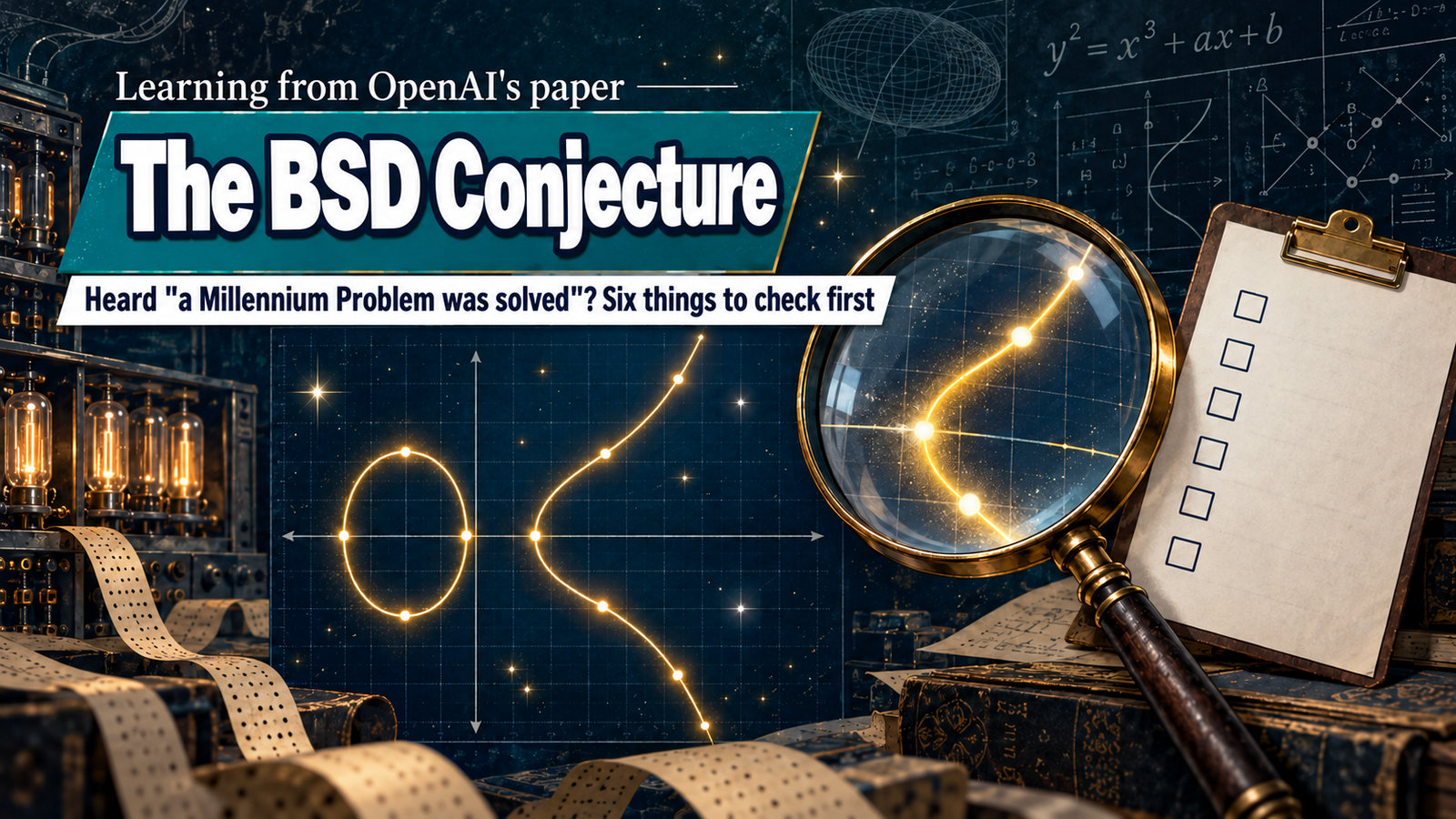
"A strange rumor is going around that OpenAI is about to solve (has solved?) another Millennium Problem (the Hodge conjecture)." On September 10, 2026, the Japanese AI researcher Shota Imai posted this on X (formerly Twitter).
The same day, a post on English-language X read: "The rumors for the last 48 hours have been OpenAI solved the Hodge Conjecture, and that Anthropic has solved the Birch and Swinnerton-Dyer Conjecture." The Hodge conjecture and the Birch and Swinnerton-Dyer (BSD) conjecture are both among the seven "Millennium Prize Problems," each carrying a $1 million prize.
When a bet on "Which Millennium Prize Problem will be solved next?" (before 2045) opened on the prediction market Kalshi on September 13, Japan time, the "BSD is next" contract, which settles at $1, briefly traded at 92 cents on the 14th. Overseas tech media ran the headline that the odds had "Jump[ed] 38 Points." Yet the total traded came to only a few hundred dollars, and by the 18th, Japan time, the price had fallen to 1 cent.
Then on October 6 (US time), OpenAI did in fact release a 94-page paper with the BSD conjecture's name in its title. Those who had braced themselves on hearing the rumor and those who read only the headline, "another hard problem solved?", now stand before the same question.
Has it really been solved?
October 6: a "BSD" paper among 722 manuscripts
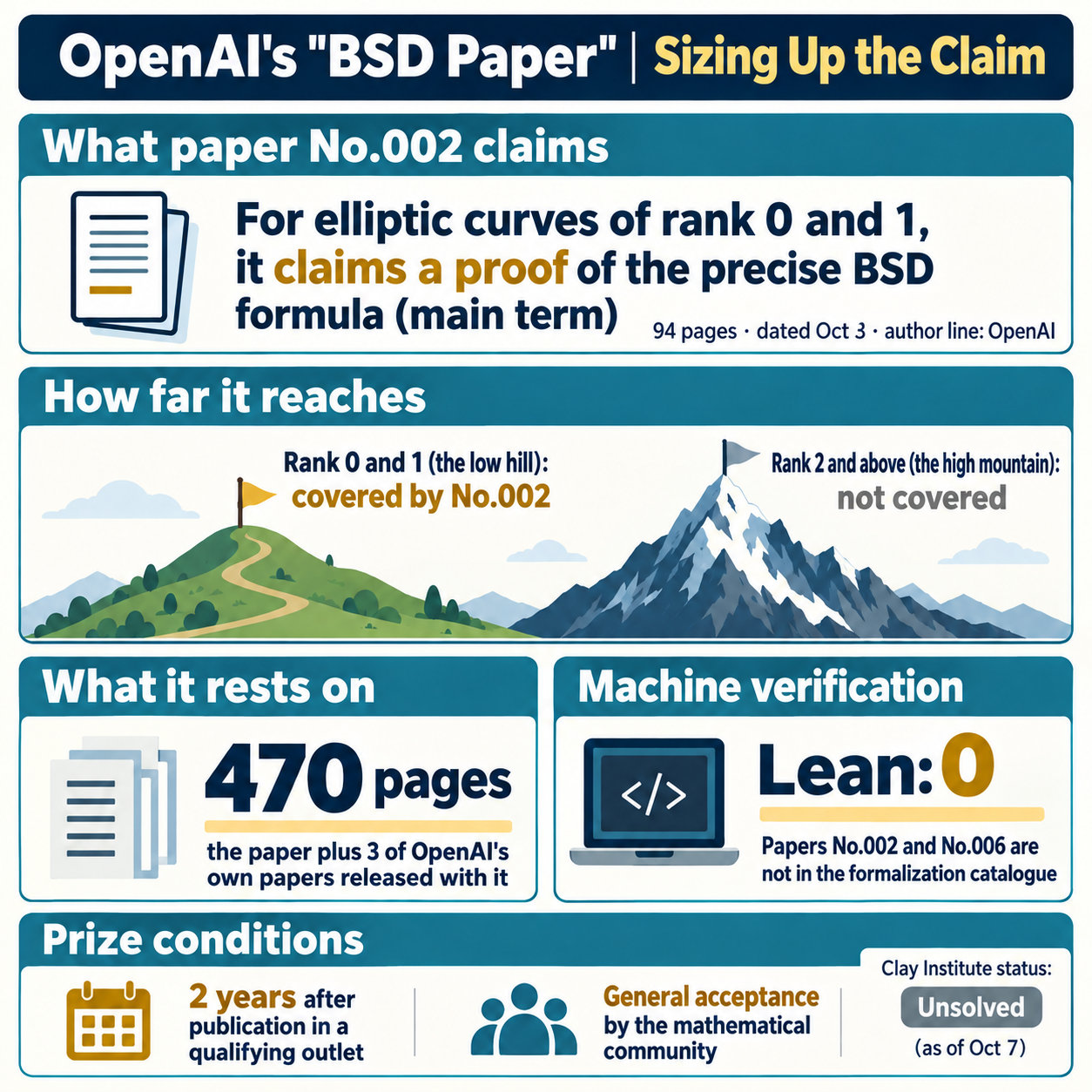
That day OpenAI released, in the GitHub repository "openai/math," 722 mathematical manuscripts it says were produced by an unreleased internal model. The related manuscripts are bundled into 372 "families," and placed second among them is the subject of this story: "The full BSD formula from low Selmer corank."
The main paper is dated October 3, and the author line reads "OpenAI." The abstract begins:
We prove the full Birch–Swinnerton-Dyer leading-term formula for every elliptic curve over Q whose full q-power Selmer group has corank zero or one at some prime q.
(In plain terms: for every elliptic curve over the rationals that meets a certain condition, "Selmer corank zero or one," at some prime q, the paper claims the complete Birch–Swinnerton-Dyer formula for the leading term.)
Surprisingly, all OpenAI's official blog says is that it is releasing "a broad range of new mathematical results"; BSD and the Millennium Prize go unmentioned. Some overseas outlets ran headlines such as "OpenAI Says Unreleased AI Model Has Solved 372 Maths Problems," but 372 is the number of "families," not the number of "problems." Both the numbers and who did what shift shape a little as the story travels.
The BSD conjecture is a conjecture about a treasure hunter's metal detector
The stage for the BSD conjecture is a curve of the form y² = x³ + ax + b, called an "elliptic curve."
On this curve we look for points where both x and y are fractions (rational numbers). If we call such points "treasure," the BSD conjecture is a conjecture about how much treasure there is.
Why "squared and cubed"?
How hard the treasure hunt is depends heavily on the degree of the curve. For curves of degree 2, such as circles and parabolas, both a way to decide whether there is any treasure and a way to list all of it have long been known. At the other extreme, for more complicated curves ("genus 2 or higher," in mathematical language), Faltings proved in 1983 that there are only finitely many treasures.
y² = x³ + ax + b sits right in between. On some of these curves the treasure runs out after finitely many finds; on others it springs up without end. A general method for telling which is which remains undiscovered.
Making the next treasure from one treasure
Elliptic curves come with a mechanism for making treasure from treasure. For example, draw the tangent line at the point (3, 5) on y² = x³ − 2, and the tangent strikes the curve once more, at a point whose coordinates are the fractions (129/100, 383/1000).
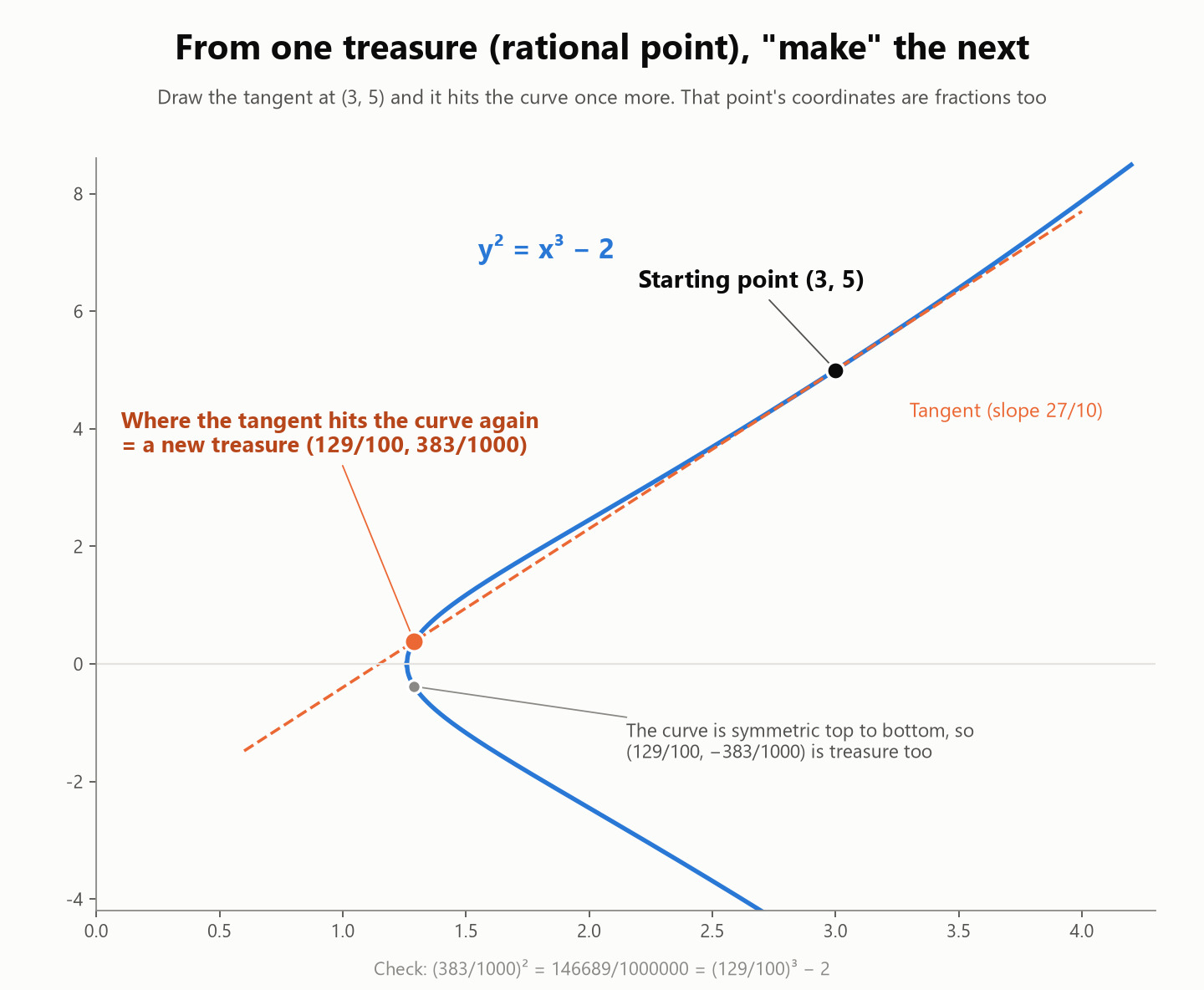
Multiplying them this way, on any elliptic curve all the treasure can be generated from a finite number of "seeds" (Mordell's theorem, 1922). The number of seeds needed is called the "rank." If the rank is 0, the treasure is finite; if the rank is 1 or more, it is infinite.
The metal detector is the L-function
In the early 1960s, Birch and Swinnerton-Dyer ran large computations on EDSAC, one of Cambridge University's early computers. For each curve they counted points in the world of remainders after division by primes, and from those counts assembled a function called the "L-function."
It then appeared that when the L-function drops to 0 at the point s = 1, there is infinite treasure. What's more, how deeply it collapses to 0 (the order of the zero) appeared to match the rank.
The rank, the "number of buried seeds," can be read off from the L-function, the "depth of the metal detector's response." That is what the BSD conjecture claims.
There is a catch: the L-function as assembled from point counts does not even have a defined value at s = 1. What guarantees the function can be extended that far is the "Taniyama–Shimura conjecture," familiar from Simon Singh's Fermat's Last Theorem, which is the theorem that "every elliptic curve is modular." Wiles, together with a joint paper with Taylor, proved in 1995 the cases needed to settle Fermat, and in 2001 Breuil, Conrad, Diamond and Taylor completed the whole.
OpenAI's paper, too, states on page 4 that these three modularity theorems "supply the analytic continuation and functional equation of the L-function of every elliptic curve." The theorem that solved Fermat is part of the foundation of this BSD paper as well.
A link to the triangle of area 5
The conjecture also connects to a question some 800 years old. Is there a right triangle whose three sides are all fractions and whose area is exactly 5? In the 13th century Fibonacci was set this problem at the court of the Holy Roman Emperor Frederick II, and he found an answer.
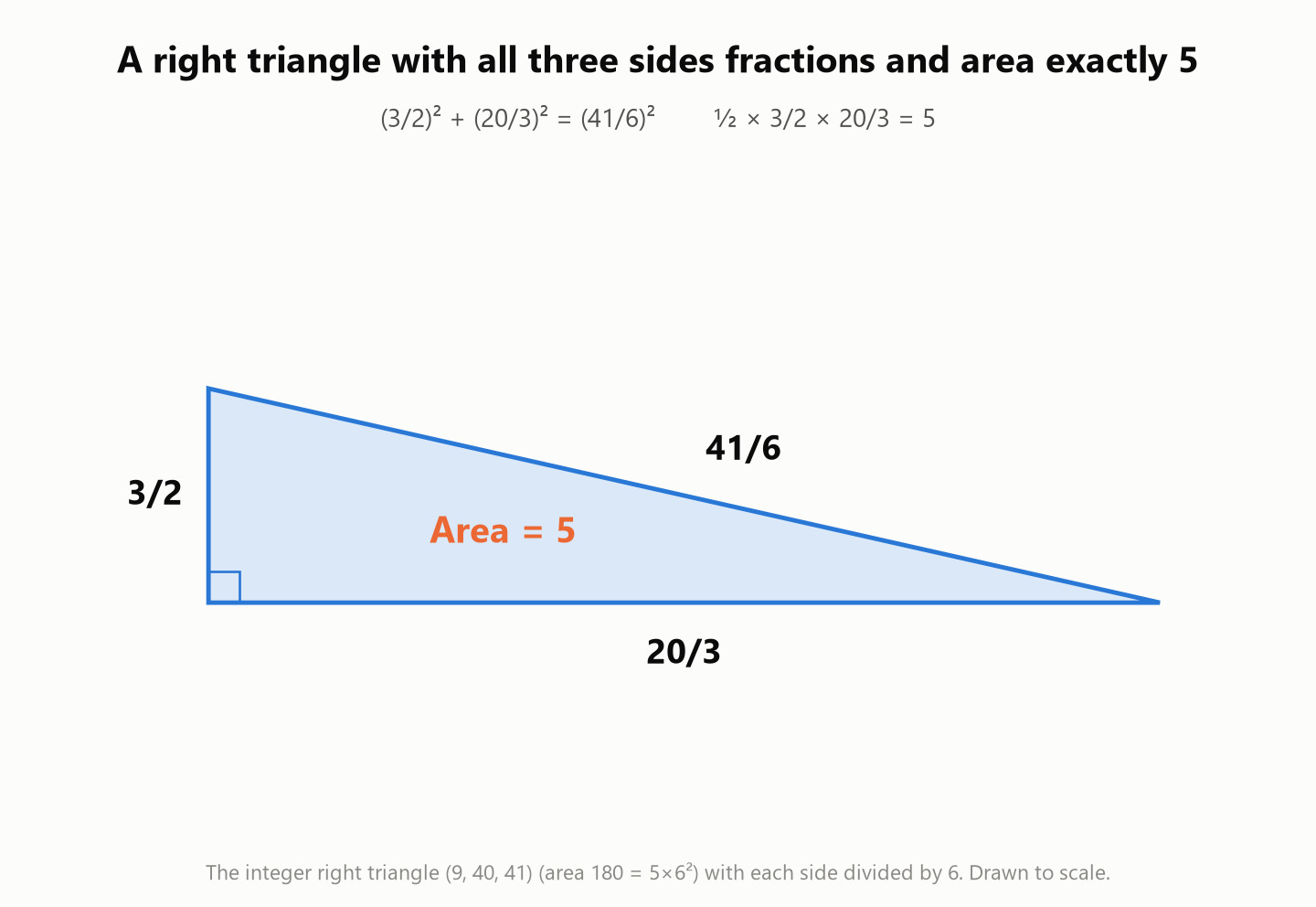
Fermat proved that no such triangle of area 1 exists. Whether a triangle of area n exists turns out to be the same question as whether the elliptic curve y² = x³ − n²x holds infinitely many treasures.
What you lose by believing only the headline
Many readers may feel that mathematics has nothing to do with them. But headlines saying "AI solved a hard problem" are already moving money and reputations.
The prediction-market swing at the start is one example. The article that reported it says itself that the BSD claim was "an unverified social-media rumor traced to a single prediction, not a lab statement." That one rumor sent the price of a thin, newly opened market swinging wildly.
Headlines get shortened, too. The same article's headline reads as if the odds on "Solved Before 2045?" had risen, but the bet the body describes asked whether BSD would be "the next" to be solved.
You lose more than money. Share a wrong headline in your company chat, and the credibility of your own words drops by just that much.
The bigger loss is missing the real substance. As we will see, OpenAI's No. 002, if it holds as claimed, is a considerable step forward. Reading it as a binary choice between "solved" and "not solved" actually hides the precise size of its value.
The Fields medalist Terence Tao wrote on the day of the release:
a problem that has been "solved" cannot be somehow reverted to become "unsolved"
(Once a problem carries the label "solved," there is no way back to "unsolved.")
Once applied, the label "solved" is hard to peel off. That is exactly why we need a procedure for checking before applying it.
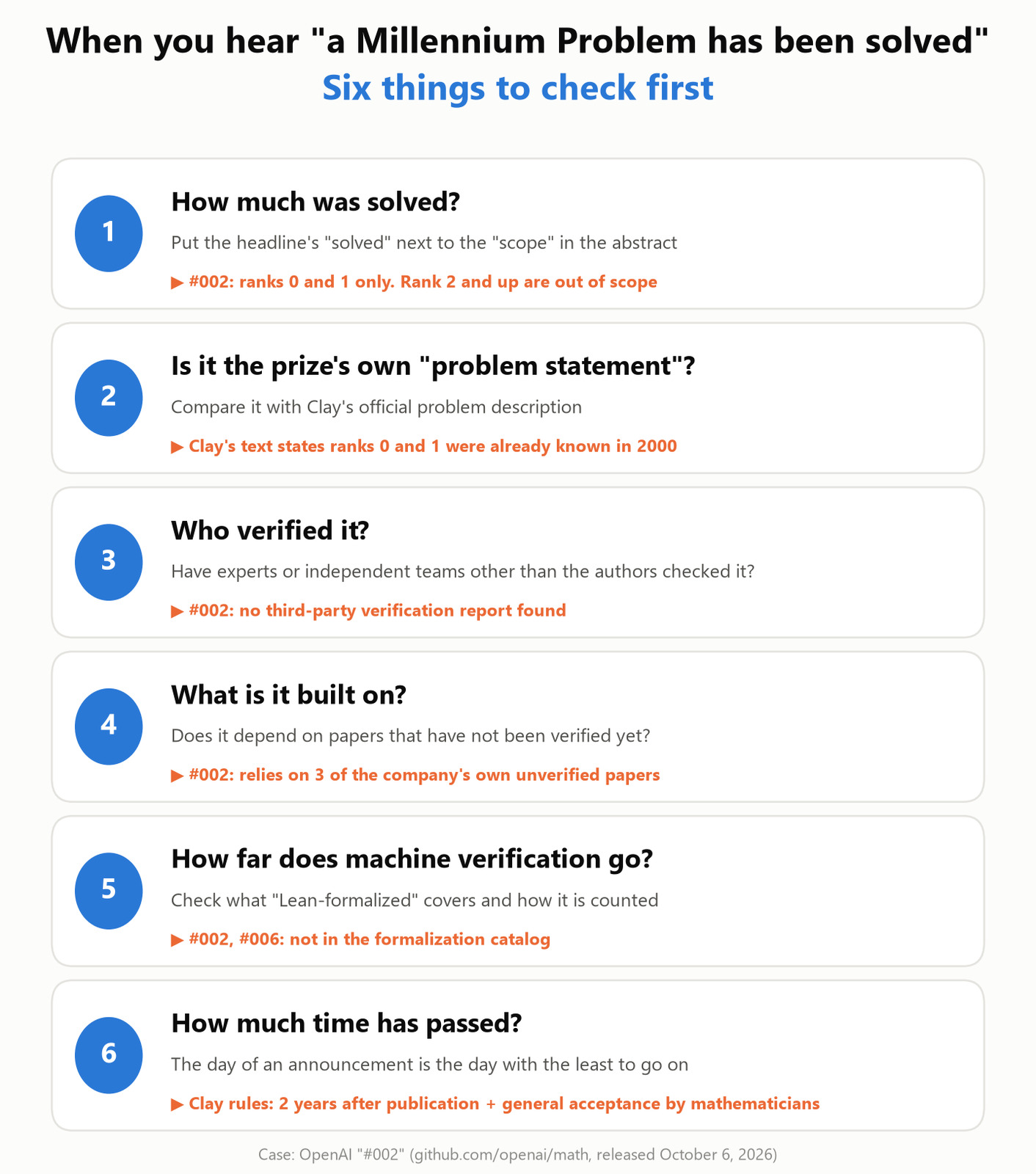
Check 1: How much was solved?
The first thing to look at is the gap between the headline's "solved" and the "scope" written in the paper's abstract. The condition in OpenAI's No. 002 is "Selmer corank 0 or 1 at some prime."
Stripped of jargon, curves meeting this condition turn out to have rank 0 or 1. In other words, it covers only curves with zero seeds or one.
Curves of rank 2 or higher fall outside the paper. The paper itself spells out its scope on page 3:
The low-Selmer-corank hypothesis is essential to the stated scope
(The assumption of low Selmer corank cannot be dropped from the scope as stated.)
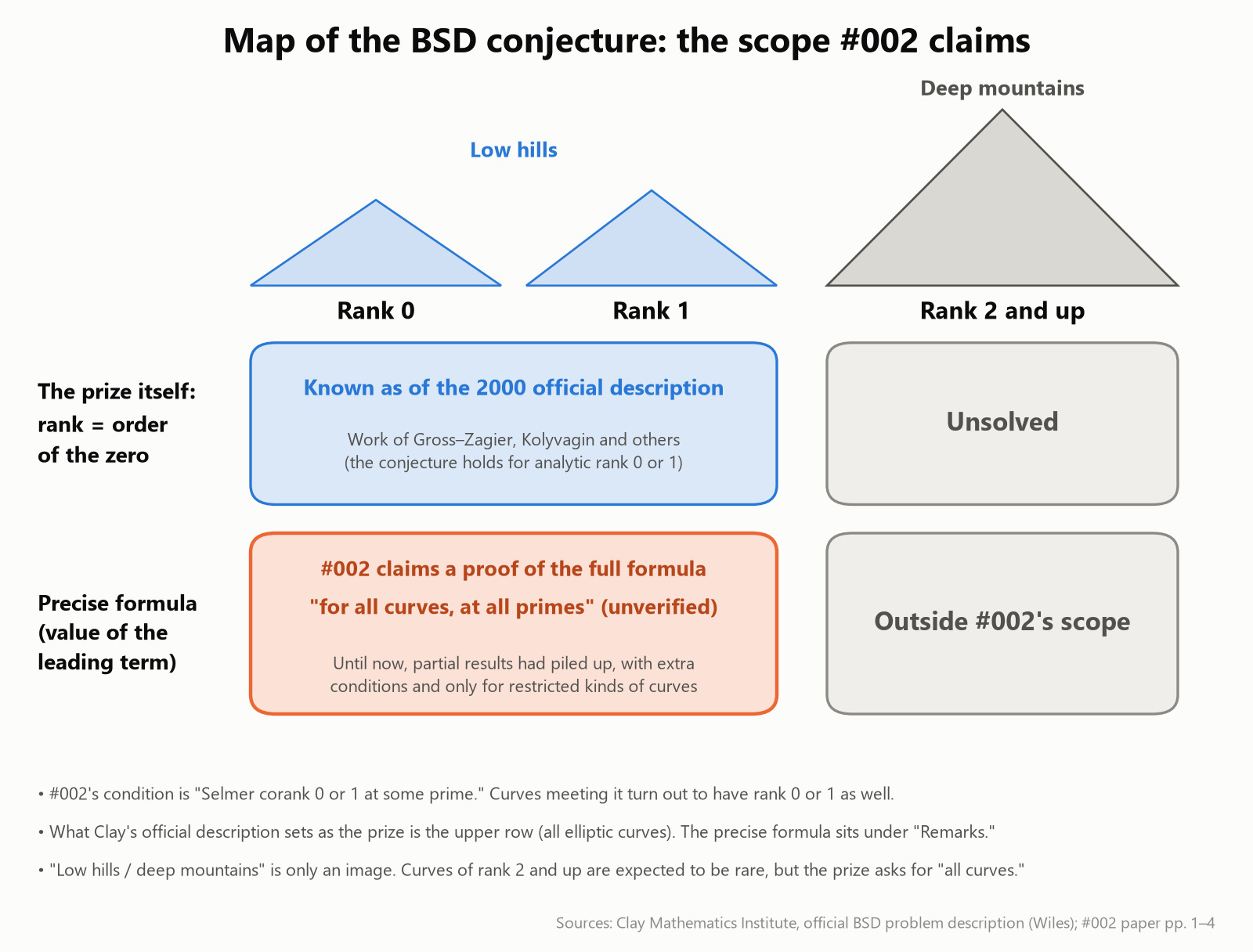
Put in terms of mountains, No. 002 is a paper claiming "a complete survey of the low hills (ranks 0 and 1)." The summit of the deep mountains (rank 2 and higher) remains unclimbed.
To be fair, even the survey of the low hills had until now been at the stage of conditional results piling up curve type by curve type and prime by prime. What makes No. 002's claim large is that it asserts the result "for all curves, at all primes, with no additional hypotheses."
Has the area-5 triangle problem moved forward?
For deciding whether a triangle of area n exists, methods are already known that settle the matter for curves on which the metal detector gives no response and for those on which it responds one level deep. The hard, unsettled cases remain on curves where the detector's response runs two or more levels deep. Paper No. 002's scope reaches only rank 1, so these remaining hard cases lie outside the paper's scope.
On the other hand, the curves in the area problem belong to one family, the relatives known as "twists" of y² = x³ − x. The claim that combines No. 002 with a separate paper, No. 006, "full BSD for a density-one set of quadratic twists of every elliptic curve over ℚ," formally reaches this family too. How new this is as a statement about proportions, including how it relates to earlier work in the field, is something on which the expert commentary we could find so far comes to zero.
Check 2: Is it the same question as the prize's "problem statement"?
The Millennium Prize comes with official problem descriptions published by the Clay Mathematics Institute. The description of the BSD conjecture was written by Andrew Wiles, who proved Fermat's Last Theorem.
What that description sets as the object of the prize is a proof of the claim "order of the zero of the L-function = rank" for every elliptic curve. The precise formula for the leading term (the part No. 002 claims) sits not in the main text but under "Remarks." What's more, the same description already states, as of 2000:
Theorem. If L(C, s) ∼ c(s − 1)^m with c ≠ 0 and m = 0 or 1, then the conjecture holds.
(Theorem: if the order of the zero, m, is 0 or 1, the conjecture holds.)
In other words, the "core of the prize" in the cases where the order of the zero is 0 or 1 (the low hills) was already known when the prize was announced. What No. 002 newly claims is the "exact value" on those hills.
Clay's rules state that a paper that does not answer the questions set out in the official problem description will not be considered a candidate solution, even if it deals with closely related questions. As of October 7, Clay's BSD page still reads "Unsolved."
Check 3: Who verified it?
Whether experts other than the person making the announcement have verified it is a basic yardstick of a claim's reliability, in mathematics and beyond. For paper No. 002, one day after release, our count of verification reports by third-party experts stood at zero.
The only expert remarks on BSD we could find date from the rumor stage before the release. The number theorist Pierre Colmez wrote in September:
Maybe they can prove that BSD is true for 100% of elliptic curves (asymptotically), but this would not bring us 1mm closer to a proof of BSD.
(Even a proof covering 100% of elliptic curves in the asymptotic sense, in his view, would leave a proof of BSD itself not 1 millimeter nearer.)
This assessment dates from the rumor stage, before No. 002 was released. But it conveys well an expert's sense that a great distance separates "almost every curve, as a proportion" from "every curve."
On the day of the release, the mathematician Frank Calegari set an "exam" for AI on his blog and graded it. His questions included "The BSD conjecture in its full form, in arbitrary rank," but in the grading he added that day, the points went to two items other than BSD. Since the question demanded "arbitrary rank," it is consistent, as a check on scope, that No. 002, which reaches only rank 1, earned no points.
AGMAI, an advisory group of mathematicians, also wrote in its statement on the day of the release:
This release is the beginning, not the completion, of the process of human understanding
(Publishing the work starts the process of human understanding; it does not finish it.)
Check 4: What is it built on?
Big proofs usually rest on existing results. Whether that foundation consists of verified results or results not yet verified makes a great difference to how stable the structure on top of it is.
For the rank and finiteness parts, the body of paper No. 002 hands the work over to the company's own papers, released at the same time. The paper itself says on page 3:
The rank and finiteness assertions are the unrestricted low-corank converse of [23]; the two-primary leading-term equality is supplied by [24].
(The rank and finiteness claims come from the converse theorem in [23], and the equality for the leading term at the prime 2 comes from [24].)
[22], [23] and [24] are all papers under OpenAI's name, and all were released only recently, at around the same time. What No. 002 itself says it newly proves is the part about "the exact value at every odd prime."
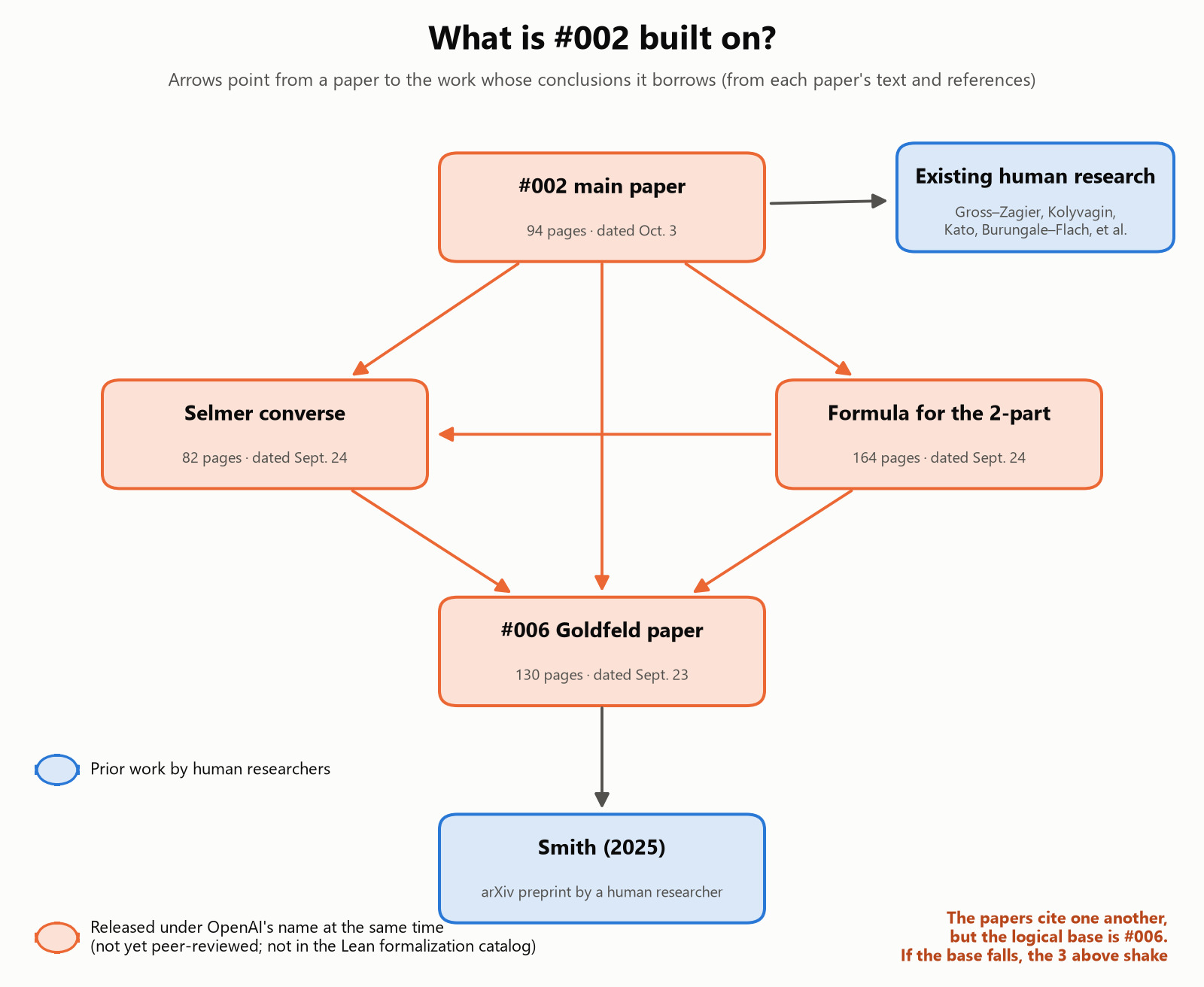
Trace the dependencies, and at the base lies No. 006's Goldfeld paper (130 pages), which in turn relies on a 2025 preprint by the mathematician Alexander Smith. The main paper, its two companion papers and No. 006's Goldfeld paper come to 470 pages in all.
The papers refer to one another, but the logic flows as a stack built on No. 006. If a hole is found in that one foundational paper, all three above it are shaken.
A small point: on page 4 of the main paper there is a citation that reads "[24, 23, ?]". The "?" is the mark a typesetting program prints when it cannot find the referenced source. It is not a mathematical error, but it can be read as a sign that the manuscript is still being finished.
Check 5: How far does machine verification go?
What drew attention in this release was "formalization" in a language called Lean: rewriting a proof as a program and having a computer check that its logic is sound. What deserves care here is how "with Lean" gets counted.
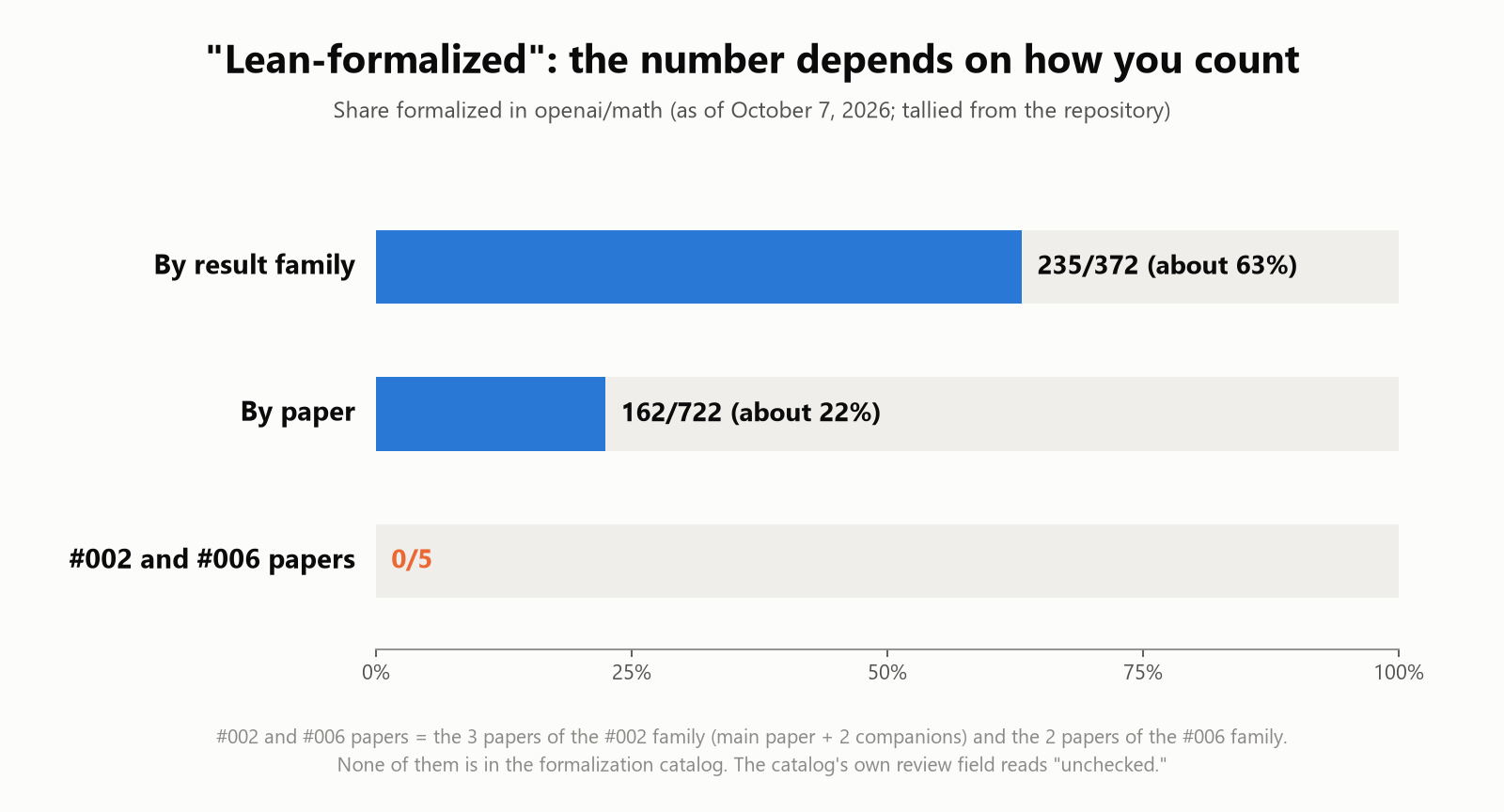
Counted by family, 235 of the 372 (about 63%) link to Lean documents. But counted by the catalog of papers whose main result has been formalized, it is 162 of the 722 (about 22%). News reports differ in which of these numbers they use.
And the count of No. 002 and No. 006 papers in this catalog is zero. The catalog's review field, too, reads "unchecked." OpenAI itself writes in the repository's description:
Some of the unformalized results could have issues. We will endeavor to fix any such issues quickly.
(Results that have not been formalized may turn out to have problems, and OpenAI commits to fixing any it finds promptly.)
Note too that what Lean checks is "the rewritten statement and proof"; the original paper itself lies outside its reach. A user who rebuilt on their own machine the Lean proof for a different result in the same release added the caution that "this checks the Lean proof, not the paper."
Check 6: How much time has passed?
The day of an announcement is the day with the least to go on. Line up past announcements that a "famous problem has been proved," and this becomes clear.
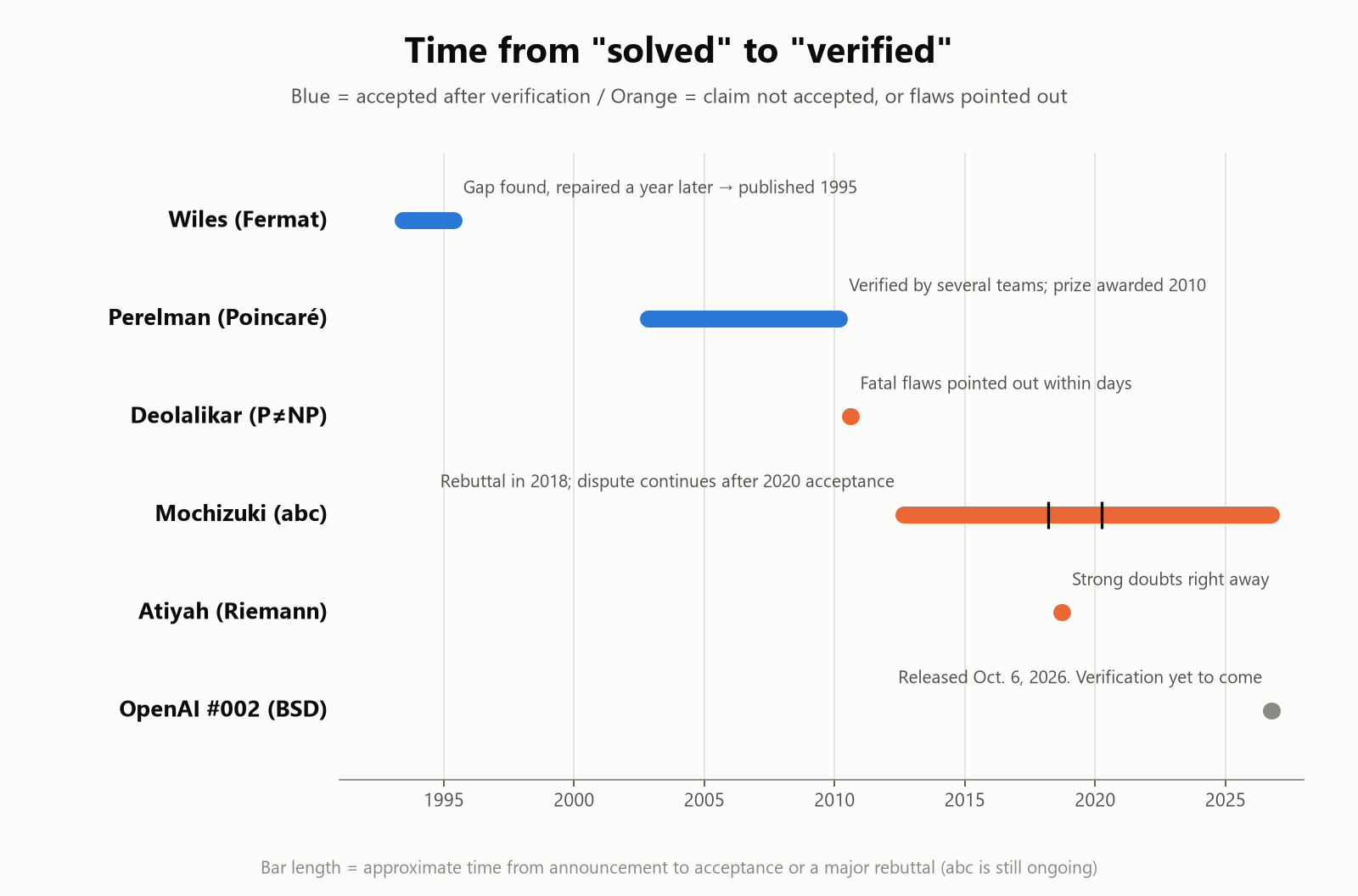
- Wiles (Fermat's Last Theorem, 1993): Peer review found a gap in the proof, and repairing it took about 1 year. The papers were published in 1995.
- Deolalikar (P≠NP, 2010): Within days of posting, experts pointed out what were considered fatal flaws. The computer scientist Scott Aaronson made his skepticism plain by writing that he would add $200,000 of his own if the prize were awarded.
- Atiyah (Riemann hypothesis, 2018): The lecture came from a winner of both the Fields Medal and the Abel Prize, yet the mathematician John Baez said, "I know of nobody who believes Atiyah has actually proved the Riemann Hypothesis."
- Shinichi Mochizuki (abc conjecture): In 2018 Scholze and Stix published a note concluding that "there is no proof." The papers were accepted for publication in 2020, but the dispute goes on.
- Perelman (Poincaré conjecture): Several teams spent years verifying his preprints of 2002–03, and in 2010 the decision was made to award him the Millennium Prize.
Of Perelman, the Clay Institute wrote in its prize announcement: "These expositions, those by other teams, and, importantly, the multi-year scrutiny of the mathematical community, provided the needed verification." As Mochizuki's case shows, being published and being accepted are different things. Clay's prize rules (revised in 2018) make them separate conditions, too.
b. at least two (2) years have elapsed since publication of the Proposed Solution in a Qualifying Outlet; c. the Proposed Solution has achieved general acceptance in the global mathematics community
(Put simply: at least 2 years must pass after publication in a qualifying venue, and the solution must win general acceptance among mathematicians worldwide.)
Settling "whose achievement it is" takes time as well. In September, when OpenAI announced it had solved a problem about the Navier–Stokes equations, a dispute broke out over its relationship to earlier work by human researchers. Charles Fefferman, author of Clay's official problem description, told the American magazine Quanta Magazine: "The heroes of the story...are Córdoba and Martínez-Zoroa."
Verification over time can also work in the direction of backing up AI results. For the 10 results OpenAI announced in August, outside researchers audited the review record and reported that no confirmed substantive errors remain in the principal results. The same paper, however, notes that the depth of review varies, and concludes that confidence should come from combining formal checking, human reconstruction, independent mathematical use and a public record.
The same six questions work for business news
These six questions are useful outside mathematics, too. They apply just as well to announcements that reach the workplace: "the industry's first full automation," "99% accuracy," "AI beat the experts."
- How far: "Complete" within what range of conditions?
- Problem statement: Is the problem your company actually wants solved the same as the one the announcement solved?
- Who: Has anyone besides the announcing company checked it?
- Built on what: Does the result rest on unpublished components or unverified assumptions?
- How much by machine: "Tested" is what share of the whole, counted how?
- Time: How long a period of real-world verification has it had since the announcement?
What strikes us most in this case is that the most honest account of the scope came from none other than OpenAI's paper itself. The sentence saying the hypothesis "is essential to the stated scope" and the caveat that results "could have issues" were both plainly written in the original.
The scope falls away on the way to becoming a headline.
A trustworthy announcement is one that writes down its own limits. And whether you get as far as that one sentence about limits is up to you, the reader.
Summary: before "solved," six questions
OpenAI's No. 002 is a candidate for a major advance, claiming that a precise formula holds on the "low hills" of the BSD conjecture for all curves and all primes. At the same time, it places the "deep mountains" of rank 2 and higher outside its scope, stands on the company's own unverified papers, and is still at the stage before either a Lean check or third-party verification.
Look at only one side, and you can call it either "finally solved" or "hype." Run it through the six questions, and its precise size, which is neither, comes into view.
Under the rules, the Millennium Prize's $1 million moves at the earliest 2 years after publication in a qualifying outlet. The decision whether to believe the headline can wait until the evidence is in.
References
- Post by Shota Imai (X, in Japanese)
- Post by Andrew Curran (X)
- Which Millennium Prize Problem will be solved next? Market data (Kalshi API)
- openai/math README and CONTENTS (GitHub)
- Exact Birch–Swinnerton-Dyer Formula from Low Selmer Corank (OpenAI, GitHub)
- Lean formalization catalog, formalization.yaml (OpenAI, GitHub)
- Sharing AI progress in mathematics (OpenAI)
- The Birch and Swinnerton-Dyer Conjecture, official problem description (Clay Mathematics Institute)
- Birch and Swinnerton-Dyer Conjecture (Clay Mathematics Institute)
- Millennium Prize Rules (Clay Mathematics Institute)
- Poincaré conjecture prize press release (Clay Mathematics Institute)
- The Birch and Swinnerton-Dyer conjecture implies Goldfeld's conjecture (Alexander Smith, arXiv)
- The Congruent Number Problem (Keith Conrad)
- The OpenAI problem dump (Persiflage)
- On OpenAI's release of mathematical results (AGMAI)
- Post by Terence Tao (Mathstodon)
- Post by Pierre Colmez (X)
- Birch and Swinnerton-Dyer 'Solved Before 2045?' Odds Jump 38 Points on Kalshi (Tech Insider)
- First look at mathematics manuscripts from an internal frontier model at OpenAI (OpenAI Developer Community)
- A Human Audit of OpenAI's AI-Generated Mathematical Proofs (arXiv)
- Why abc is still a conjecture (Scholze and Stix)
- Retired mathematician rocks math world with claim that he's solved $1 million problem (NBC News)
- Aaronson's bet on Deolalikar's P≠NP proof (Shtetl-Optimized)
- Fatal Flaws in Deolalikar's Proof? (Gödel's Lost Letter and P=NP)
- How Math's Most Famous Proof Nearly Broke (Nautilus)
- AI Has Solved One of Math's $1 Million Millennium Prize Problems (Quanta Magazine)
- OpenAI Says Unreleased AI Model Has Solved 372 Maths Problems (ETV Bharat)